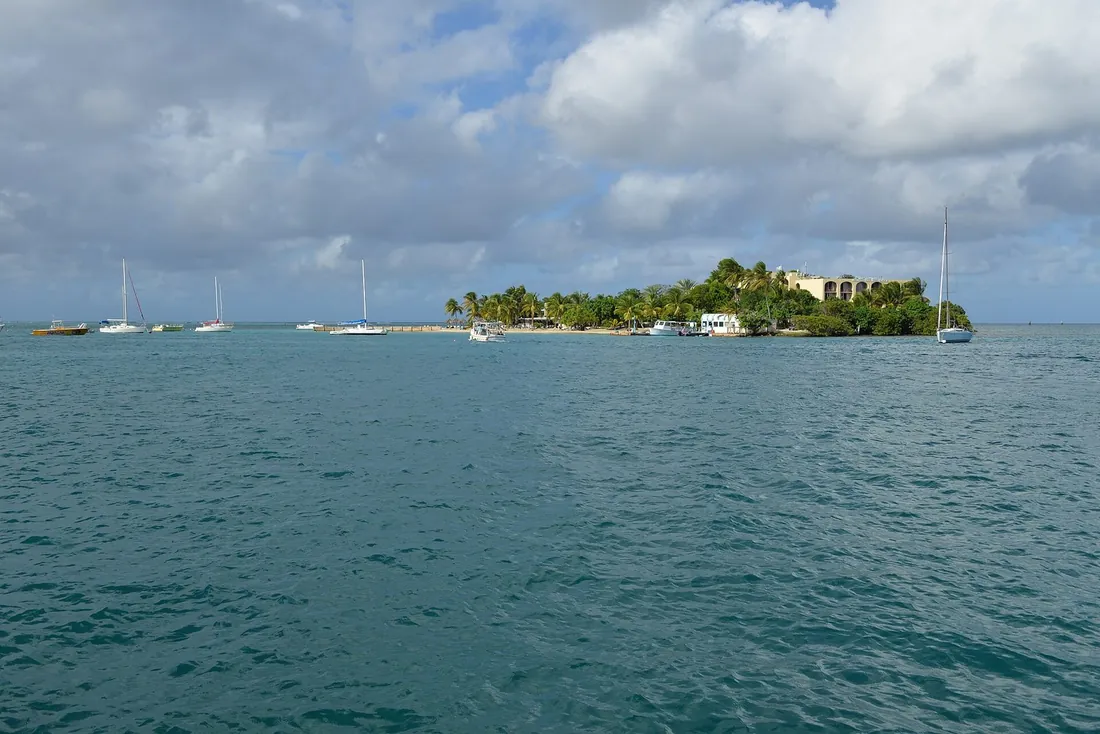
St. Croix vs Aruba
One Happy Island runs the Caribbean's most reliable weather machine — and its most crowded beach strip. The quiet American alternative asks what the reliability is for.
Aruba has built the Caribbean's most dependable product: a desert island south of the main hurricane belt, sunshine statistics no one disputes, a strip of superb sand lined with high-rises and timeshares, casinos for the evening and one of the region's most loyal repeat clienteles. It is tourism engineered to remove variables. St. Croix removes different variables — the passport, the crowds, the casino carpet — and keeps the ones that make an island feel like a place. Which set you delete is the whole choice.
The two, side by side
| St. Croix | Aruba | |
|---|---|---|
| Passport for U.S. citizens | Not needed | Required |
| U.S. State Department advisory | None — U.S. territory | Level 1: Exercise Normal Precautions |
| Hurricane exposure | Atlantic season, June–November | South of the main belt at 12.5°N; storms are rare |
| Landscape | Rainforest west, dry east, green hills | Desert island: cacti, divi-divi trees, constant trade wind |
| The beach scene | A dozen-plus beaches, usually near-empty | Palm and Eagle Beach: superb sand, high-rise and timeshare rows |
| Crowds | About 41,000 residents, light tourism | One of the Caribbean's highest tourist-to-resident ratios; heavy repeat timeshare trade |
| Casinos and nightlife | None; boardwalk dinners and beach bars | A dozen casinos, strip nightlife |
| Diving | Cane Bay Wall and Frederiksted Pier from shore | The Antilla wreck; modest reef |
| History and towns | Two Danish colonial towns; NPS historic site | Oranjestad's pastel shopping blocks |
| Coming home | Agriculture check; $1,600 duty-free | U.S. customs (with pre-clearance in Aruba); $800 duty-free |
Advisory levels and details are as published by the U.S. Department of State and checked August 2026. They change — read the current advisory at travel.state.gov before any international trip.
The short answer
Book Aruba if weather certainty outranks everything else and you like your beach with infrastructure: reliable sun, a casino after dinner, a Marriott's worth of services at your elbow and ten thousand fellow guests who agree with you. Book St. Croix if the point of an island is the island: space, quiet, reef off the sand, towns with three centuries in their stones, and a house of your own at a price the strip cannot match. We manage our homes on St. Croix; the facts below are sourced and survive the bias.
The hurricane-belt card, played fairly
Aruba's trump is real and this page states it: at about 12.5 degrees north, the island sits south of the main Atlantic hurricane track, and direct storm hits are rare. For September–October travelers who cannot move their dates and cannot stomach any storm risk, that is a legitimate, decisive argument, and honesty concedes it before the rebuttal begins.
The rebuttal is proportion. St. Croix shares the Atlantic season with the entire arc, June 1 to November 30, statistically busiest August–September — and the answer is management, not avoidance: travel insurance, flexible-cancellation bookings, and the fact that the same September and October weeks are the island's greenest, quietest, best-value stretch. Our hurricane-season guide states it without drama. Meanwhile Aruba's weather insurance carries its own premium the other eight months of the year: you pay strip prices in January for protection you only needed in September.
The strip, described accurately
Palm Beach and Eagle Beach are excellent sand — wide, white, groomed — and they are also the most intensively developed beachfront in the southern Caribbean: high-rise hotels shoulder to shoulder, timeshare towers with decades-deep owner rotations, palapa territory claimed at dawn, vendors working the rows, and a beach population on good weeks that resembles a stadium infield. The island's tourist-to-resident ratio ranks among the world's highest, and its repeat-visitor rate — the industry's envy — means the crowd is a feature loved by the people in it. If you are one of them, Aruba needs no defense and asks none.
St. Croix's beaches hold no towers at all. Sandy Point's two undeveloped miles — the largest leatherback nesting beach under U.S. jurisdiction — often carry a few dozen weekend visitors. Cane Bay has a beach bar and a dive wall; The Shoys sits behind a guard gate (our Shoy's Beach House fronts it); Jack's and Isaac's Bays ask a cactus-trail walk and pay it back with solitude; Rainbow faces the sunset. Palapas are not contested because there is no one to contest them. The roster: the best beaches.
Desert against two landscapes
Aruba is one ecosystem: cactus scrub under a relentless trade wind, divi-divi trees combed sideways, Arikok National Park's handsome badlands covering the island's wild half. Striking — and finished in a day trip. St. Croix packs two climates onto one island: a west end rainforest catching fifty-plus inches a year (Mahogany Road, the Creque Dam, the Domino Club), and a dry cactus East End that out-Arubas Aruba on the way to Point Udall, the easternmost point of the United States — with tide pools, a botanical garden in sugar-estate ruins and Robert Trent Jones Sr. golf at Carambola between them. See two landscapes, one island.
Underwater
Aruba's marquee dive is the Antilla, a 400-foot German freighter scuttled in 1940 and one of the Caribbean's larger accessible wrecks — a fine boat dive over sand. Beyond it the reef is modest; Aruba is candid that diving is a sideline to its beach product. St. Croix is the region's shore-diving capital: the Cane Bay Wall dropping toward abyssal depth a hundred yards off the sand, the Frederiksted Pier's celebrated macro and night dives — both walk-ins — plus Butler Bay's own wreck collection, Salt River Canyon's walls and Buck Island Reef National Monument's marked snorkel trail inside a no-take reserve dating to 1961. Snorkelers and divers do not linger over this choice. Start at diving St. Croix.
Evenings
Aruba's nights are the strip's: casinos, chain steakhouses, show bars — Las Vegas lite with a sea breeze, executed professionally for people who want exactly that. St. Croix's nights are the island's: dinner on the Christiansted boardwalk, a sunset at Rainbow with the west-end regulars, mocko jumbies at a Jump Up, a glowing kayak through Salt River on the dark of the moon, and stars the strip's lightbulbs never permit. Neither is wrong; they are different definitions of a good night, and you know yours.
What it costs
Aruba's reliability is priced in: the strip's rooms and timeshare maintenance schedules, resort casino economics, imported-everything menus (a desert island grows little), and January rates that reflect the reliable sun. Its devotees consider the premium fair; it is still a premium. St. Croix's costs run island-flat: direct-booked villas with pools, Plaza Extra provisioning, free beaches, charter-free shore diving, single-digit attractions, U.S. dollars with no exchange or foreign-transaction friction, and the $1,600 duty-free allowance home — double Aruba's return, pre-clearance notwithstanding. Compare matching dates; then see the homes.
Month by month on the two islands
Aruba's pitch is that the months barely differ — the desert climate delivers its sunshine statistics year-round, the trade wind never stops, and the hurricane-belt exemption flattens the fall risk. What does change is occupancy and price: winter high season books the strip solid at the year's top rates (the timeshare calendar hard-locks January–March decades ahead), Carnival season (January into February, one of the Caribbean's biggest) fills Oranjestad, and summer brings South American holiday waves. There is no cheap season so much as a less expensive one. St. Croix's calendar has real seasons to play: high winter at island rates, May–June clarity, and a green fall that discounts meaningfully under the standard insurance counsel. Aruba sells sameness at a premium; St. Croix sells a year with moods, and its best mood — the Christmas Winds — costs less than the strip's worst. Months in detail: when to visit.
The travel day, hour by hour
Aruba's arrival is honed by volume: wheels down at Reina Beatrix mid-afternoon among the East Coast banks, an immigration queue that moves but exists, the rental or hotel shuttle, and the strip by 4:30. The famous convenience is the departure: U.S. pre-clearance in Aruba, which means clearing American immigration and customs before boarding — a real convenience, paid for with a recommendation to arrive three hours early for the double screening, effectively an extra half-day donated to the airport. St. Croix's day needs no pre-clearance because nothing needs clearing: nonstop in, rental counter, villa inside forty minutes; boarding pass and agriculture check out, $1,600 allowance in hand. The strip perfected the queue; the island deleted it.
Seven days on each
The Aruba week is the strip's rhythm: Palm Beach palapa mornings (claimed early), Eagle Beach's divi-divi photo, a UTV run through Arikok's badlands to the Natural Pool, the California Lighthouse sunset, casino evenings, a catamaran snorkel to the Antilla, chain-and-steakhouse dinners booked ahead. Reliable, social, engineered — the same excellent week ten thousand other people are having in adjacent loungers.
The St. Croix week is the island's: Buck Island's snorkel trail Monday; Cane Bay's wall Tuesday; Christiansted's fort and arcades Wednesday; Point Udall's sunrise and the East End's cactus coast Thursday (out-Aruba-ing Aruba with nobody parked beside you); Frederiksted's pier and Rainbow's sunset Friday; the rainforest — a landscape Aruba cannot offer at any price — with Cruzan and the Domino Club Saturday; the bio bay glowing after dark. Plans: the 7-day itinerary.
Getting around once you land
Aruba moves its visitors competently, as it does everything: rental cars are easy and right-side familiar, the strip's hotels sit walkably close to each other (which is part of the density), taxis run fixed government tariffs, and the Arubus line connects Oranjestad to the resort corridor cheaply. The catch is where there is to go: the strip, the town's shopping blocks, and Arikok's gravel roads for the UTV day — a compact loop most visitors complete by Wednesday and then repeat. Parking at the famous beaches is its own season sport, with Eagle Beach's lots contested from breakfast.
St. Croix's forty-minute island rewards the same rental car with different days every day: the rainforest's Mahogany Road one morning, the cactus East End the next, two towns, a dozen beaches with empty lots, the distillery belt mid-island — left-side driving in ordinary cars, learned in a day (the guide), with the full island loop making one of the week's best half-days. Neither island has ride-share; only one needs the variety a car unlocks.
Before you book either island
For Aruba, book with the calendar's honesty in mind: the strip's high-season inventory locks up months out (the timeshare blocks decades out), so late planners pay the premium tier or settle off-strip; price the resort fees, the palapa rentals and the airport's three-hour pre-clearance arrival into the comparison; and if the hurricane-belt exemption is your reason, confirm your dates actually fall in the season that needs it — paying Aruba's January premium for September's insurance is the common mistake. Check your specific hotel's beach-chair policy; the towel wars are real enough to have policies.
For St. Croix: book the villa direct (the homes), reserve the car early for high season (how it works), put Buck Island and the bio bay on the calendar a few days ahead in peak weeks, and — if your dates are September or October — buy the travel insurance and enjoy the green season's prices with clear eyes (the season guide). That is the whole list.
The case for St. Croix, point by point
One: space — 84 square miles for 41,000 people against the hemisphere's densest resort strip. Two: no passport, no pre-clearance queue, no immigration hall at either end. Three: beaches without towers, timeshares or towel territories — Sandy Point's two miles are often shared with a few dozen people. Four: two landscapes on one island, rainforest to cactus coast, against one handsome desert. Five: diving that means something — a wall off the sand and a famous pier against one wreck by boat. Six: history you can walk into daily — Danish towns, an emancipation fort, Hamilton's streets — against shopping blocks. Seven: rum distilled on-island since 1760, with the $1,600 allowance flying five liters home. Eight: nights of stars and tree frogs instead of casino carpet. Nine: island prices — the January week that costs strip-premium money in Aruba books a villa with a pool here. Ten: a year with seasons to play, including a green fall that discounts properly. Aruba's certainty is real; count what it costs, and what it never includes.
Who should pick which island
Pick Aruba if: September–October dates are fixed and storm certainty is the absolute priority; the casino is a nightly event; the timeshare rhythm is your family's tradition; wind sports at Fisherman's Huts call; or you want the most engineered, least variable week the Caribbean sells. Pick St. Croix if: crowd density is the thing being escaped; the group wants a villa and a car over a tower and a palapa war; divers and snorkelers are aboard (the Antilla is one dive; the wall is a career); landscape variety matters (rainforest to cactus coast in forty minutes); or the same budget should buy space instead of certainty. Aruba removes the variables; St. Croix removes the crowd — and most weeks were only ever threatened by the crowd.
When Aruba is the right call
September and October, for storm-proof certainty — the belt card is real, play it when the calendar forces you. Casino travelers have no Crucian substitute. Timeshare families with decades of Palm Beach ritual are not customers this page can or should convert; the ritual is the vacation. Windsurfers and kitesurfers get steady, strong wind at Fisherman's Huts. For everyone else, the strip's premium buys reliability St. Croix mostly matches and company St. Croix blessedly lacks.
A rainy day on each island
Aruba's pitch is that this section is unnecessary — and fair enough, the desert statistics back it. When weather does interrupt, the island's indoor bench is the strip's: casinos, malls at Palm Beach and Renaissance, the small archaeology museum in Oranjestad, and the aloe factory tour. It fills an afternoon the way an airport fills a layover. St. Croix's wet-day contents run deeper: Fort Christiansvaern's vaulted rooms, the Whim estate museum, Frederiksted's arts center, and a distillery trail — Cruzan's tour, Captain Morgan's tasting room, Sion Farm's breadfruit vodka — that improves in the rain. The rainy-day plan exists and rarely gets used; when it does, it beats a mall.
If you choose Aruba anyway
Then optimize the machine. Book the strip's high season eight-to-twelve months out or accept the leftovers; pick low-rise Eagle Beach over the Palm Beach towers if crowd density decides your mood; claim the palapa at dawn or rent one and stop fighting. Do Arikok by UTV early before the heat, swim the Natural Pool on a calm-sea day only, and take the California Lighthouse at sunset once. Skip the chain steakhouses at least twice for Zeerovers' dockside fish and a local rum shop. Budget the resort fees, the palapa economy and the three-hour pre-clearance departure into the math, and if your dates are January–March, price the same week on St. Croix before you commit — the comparison is the point of this page, and it is starkest exactly then.
Where you would stay on St. Croix
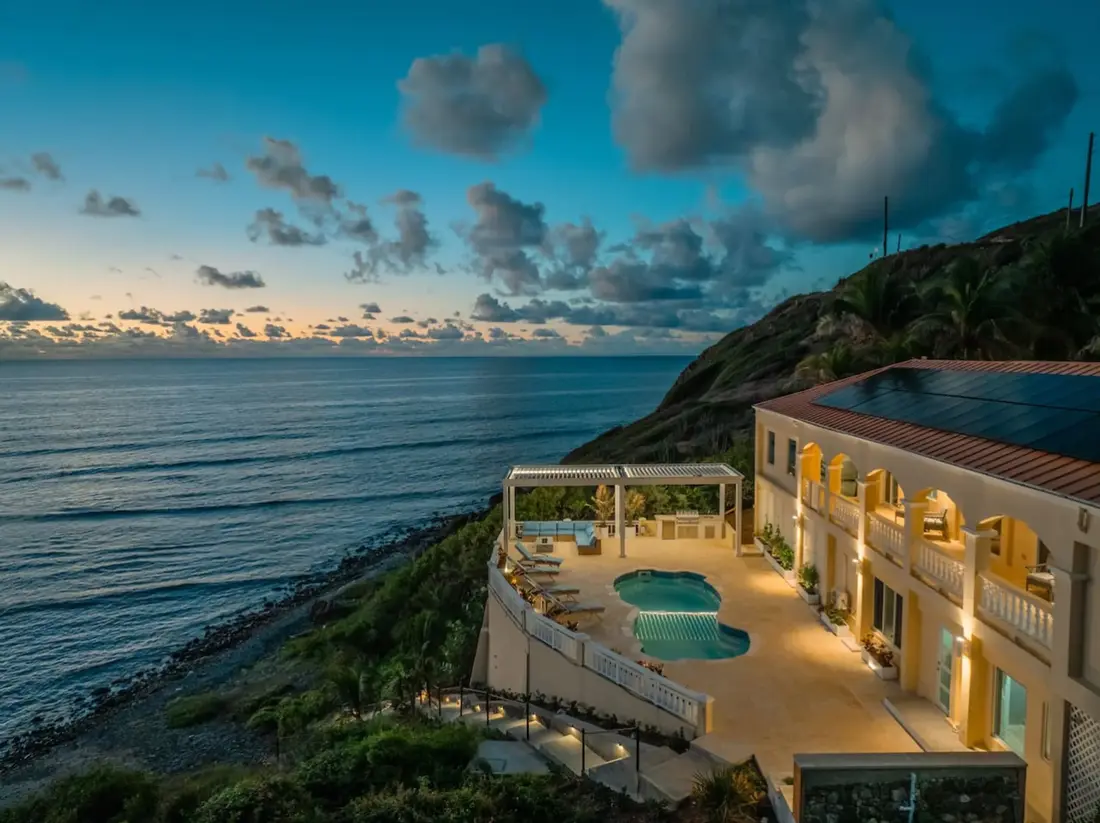
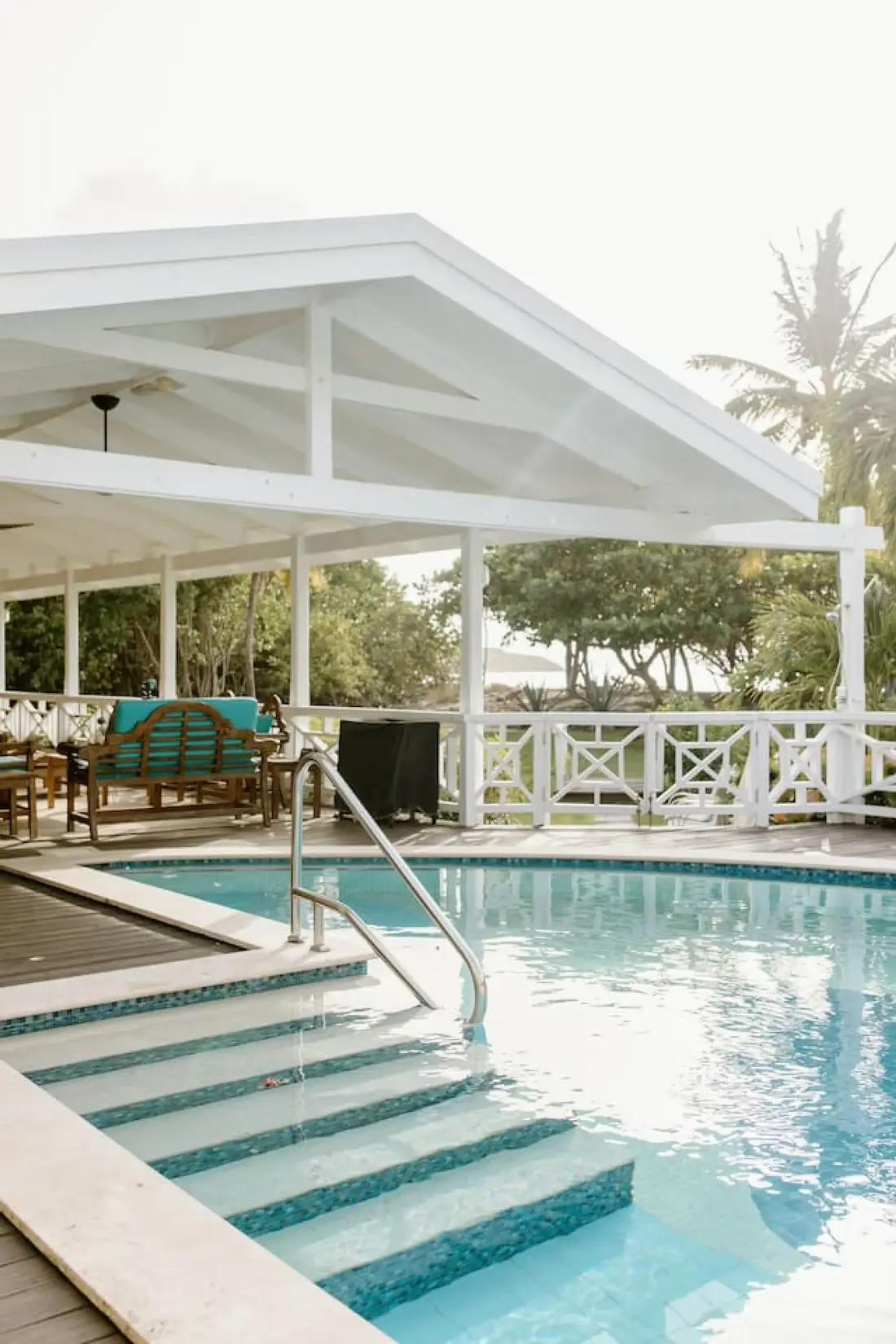
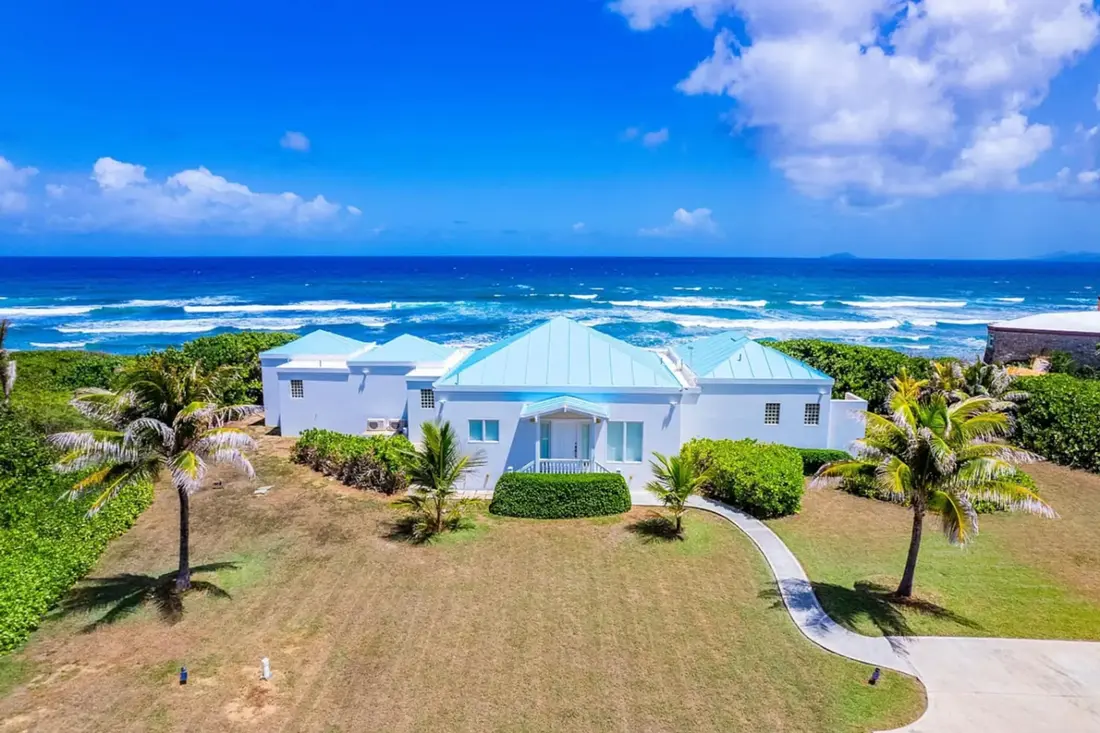
Instead of a tower floor, a house: Shoy's Beach House directly on The Shoys' guarded sand; the East End villas — The Cerulean among them — facing Buck Island from private pools; Christiansted condos a walk from the boardwalk; the west end for sunset seasons. Two to twelve guests, full kitchens, most with pools, all managed on-island by Sterling Point and booked direct with no platform fees or resort-fee surprises — the line-item Aruba's strip cannot write. Couples: the homes for two. Families: the family collection, with Chenay Bay's shallows ten minutes from most doors. The roster: the homes.
How this page was made
The rules of the series: safety and entry facts from the State Department (Aruba's Level 1 included) checked August 2026 — advisories change, read the current text at travel.state.gov; flights verified the same month; the hurricane-belt geography stated in Aruba's favor because it is true; crowd and price characterizations drawn from the island's own tourism statistics and the timeshare market's public record, stated as patterns rather than invented numbers. What Aruba does best — certainty, polish, wind — is conceded where it is due. Our bias is disclosed: the homes we manage on St. Croix. The facts survive it; verify any line.
The bottom line
Aruba perfected the Caribbean as a product: sun near-certain, towels reserved, dice rolling, crowds included. St. Croix kept the Caribbean as a place: two landscapes, two Danish towns, a wall off the beach, rum in the ground and room on the sand — no passport, no advisory, no timeshare presentation. Products are dependable; places are worth the trip. The homes are here.
Elsewhere in this series
This page is one of twenty-six. If you are still shopping the map, the verdicts nearest this comparison run as follows — each links to the full page with its own sources:
St. Croix vs the British Virgin Islands — The BVI are the Caribbean's sailing capital — reached by passport, puddle jumper and ferry. St. Croix flies you straight in, no passport at all.
St. Croix vs Turks & Caicos — Turks and Caicos sells one famous beach at luxury-resort prices. St. Croix sells a whole island for less — no passport, no Level 2 advisory.
St. Croix vs Anguilla — Anguilla perfected the quiet expensive beach. St. Croix does the quiet beach without the relay flight, the passport or the markup.
The complete set, grouped by region and passport rules, lives at St. Croix vs other destinations.
Which home fits your group
If St. Croix wins your comparison, the homes are the easy part. Groups of eight to twelve settle into the family collection; couples take a home for two; anyone who wants sand at the door starts with beachfront. Every one is managed from the island by Sterling Point and booked direct — tell us the dates and the headcount and we will point you at the one that fits.
Two practical notes that surprise first-time villa bookers. Direct booking means the rate is the rate: no platform service fees, no resort fees, and the people answering questions are the same Sterling Point team that manages the houses on the island. And every home runs a full kitchen — one run to Plaza Extra or Seaside Market on the drive from the airport covers the week, which is where a villa quietly beats a resort bill before the first beach day. How the booking works, and what it does not mean, is spelled out at book direct.
Who wrote this
SP Vacations is the vacation-rental division of Sterling Point Real Estate, a licensed real-estate operation based on St. Croix in the U.S. Virgin Islands. The team lives and works on the island it writes about: the homes in the villa collection are inspected, cleaned and managed locally, and the person who answers a booking question is on St. Croix, not in a call center three time zones away. That is the vantage point behind every page in this series — and the reason the series exists at all, since most of the destinations compared here are places our guests weighed before choosing this island.
Two standing practices shape what you read. First, the pricing wall: nightly rates and availability for the homes live only on the booking pages, never in articles, so nothing here goes stale or oversells. Second, the sourcing rule: safety statements cite the U.S. State Department, customs figures cite CBP, park facts cite the National Park Service, and anything that changes — advisories, schedules, hours — carries its checked date and a pointer to the primary source. Where a rival destination wins a category, the page says so, because a comparison that concedes nothing persuades nobody. Questions, dates or a villa to match a group — the island team is here, or call 340-205-3929.
Questions people ask
What is Baby Beach in Aruba?
The island's calm family lagoon at its southern tip — shallow, protected, a 30-to-40-minute drive from the strip, busy on weekends and cruise days. St. Croix's family shallows at Chenay Bay sit ten minutes from most East End villas, with kayaks and turtles instead of tour buses.
Does Aruba have good snorkeling?
Modest — the Antilla wreck and a few reef patches, mostly by catamaran excursion with open bar attached; the island sells beach and wind, not water life. St. Croix's snorkeling starts at the sand: Cane Bay's shelf, the pier's pilings, Buck Island's marked trail. See snorkeling.
Is Oranjestad worth a visit?
An afternoon — pastel Dutch facades, a small museum, the tram loop and shopping blocks aimed at cruise passengers. Christiansted's Danish arcades hold a full evening economy: the fort at five, dinner on the boardwalk, the town still a town after the shops close.
Why do so many people return to Aruba every year?
The timeshare calendar and the certainty — the same week, the same palapa, the same reliable sun built a repeat-visitor rate the industry envies; it is loyalty to reliability. St. Croix's repeat guests return for the opposite: an island that stayed a place, with room on the sand every year.
Which island is windier?
Aruba, by climate design — the constant trade blow that bends the divi-divi trees powers serious kitesurfing and never stops for dinner on the beach. St. Croix's Christmas Winds run December through March; its protected shores stay calm for swimmers year-round.
Is Aruba windy all the time?
Effectively yes — the trade wind that combs the divi-divi trees runs near-constant, a gift to kitesurfers at Fisherman's Huts and a fact of beach life everywhere else. St. Croix's Christmas Winds blow brisk December through March; the protected shores stay calm for swimmers year-round.
What is the Natural Pool in Aruba?
A rock-rimmed ocean pool on Arikok's wild coast, reached by UTV or serious 4WD and swimmable only on calm-sea days. St. Croix's counterpart adventure is the Annaly Bay tide-pool hike — a rainforest trail to blue pools, no vehicle rental required. See the tide pools.
Are Aruba's restaurants good?
Professional and plentiful — a resort strip's range from chain steakhouses to solid local spots like the dockside fish shacks at Zeerovers. St. Croix's smaller bench runs deeper on identity: Crucian kitchens, boardwalk dining rooms and three working distilleries. See the food guide.
Which island is better for a casino trip?
Aruba, without question — a dozen casinos anchor the strip's evenings, and St. Croix has none. If the tables are the vacation, this comparison was never close in your direction; if they were an afterthought, the quiet island's evenings have better stars.
Is Aruba really outside the hurricane belt?
Effectively yes — at about 12.5°N Aruba sits south of the main Atlantic track and direct hits are rare. That is its strongest card for September–October travel. St. Croix shares the region's June–November season and answers with insurance, flexible bookings and the best-value green months. See hurricane season.
Is Aruba crowded?
Yes — deliberately and successfully. Palm and Eagle Beach front the southern Caribbean's densest hotel-and-timeshare strip, and Aruba's tourist-to-resident ratio ranks among the world's highest, with a famously loyal repeat clientele. St. Croix runs light tourism across 84 square miles and its beaches sit near-empty on weekdays.
Do I need a passport for Aruba?
Yes. Aruba does offer U.S. pre-clearance on departure, which smooths the ride home, but the trip still requires passports for all travelers and the $800 duty-free standard. St. Croix: driver's license, agriculture check, $1,600 allowance.
Which has better beaches?
Aruba's Palm and Eagle are superb sand with towers behind them. St. Croix's are superb sand with nothing behind them — Sandy Point's two undeveloped miles, The Shoys, Cane Bay, Jack's and Isaac's. Groomed-with-crowds versus wild-and-empty is the real question.
Which has better diving and snorkeling?
St. Croix, decisively: the Cane Bay Wall and Frederiksted Pier are shore entries, with wrecks, canyon walls and Buck Island's protected snorkel trail beyond. Aruba's underwater case rests mostly on the Antilla wreck, a fine single boat dive.
Is Aruba expensive?
In season, yes — reliable weather, strip hotels and imported provisioning price the reliability in. St. Croix's direct-booked villas, supermarkets, free beaches and charter-free diving run the same week for meaningfully less on matching dates.
Do you need a car in Aruba?
Less than most islands — the strip walks, taxis run fixed tariffs and the Arubus covers the corridor; a car mainly serves the Arikok day. On St. Croix the car is the week: rainforest, East End, two towns and a dozen beaches, all on your own clock.
What are Aruba's beach-chair politics?
Notorious enough for hotel policies: palapas claimed at dawn, rented rows, and high-season towel disputes on the strip's shared sand. St. Croix's beaches have no concessions to contest — carry your own chair to Sandy Point and pick any hundred empty yards.
Is Aruba good for diving?
Modest: the Antilla wreck is the headline and the reef around the island is thin — Aruba itself markets beach and wind over water life. St. Croix's Cane Bay Wall, Frederiksted Pier and Buck Island monument make it the American Caribbean's diving island.
When is Aruba's Carnival?
January into February — one of the Caribbean's biggest, filling Oranjestad through the season's parades. It coincides with the strip's highest rates. St. Croix's carnival is the Crucian Christmas Festival, late December into early January, at island scale in Frederiksted.
Does Aruba have a low season?
A less-expensive one rather than a cheap one — the climate's sameness and the timeshare calendar keep occupancy high year-round. St. Croix's green fall discounts meaningfully, and its high season still leaves the beaches near-empty.
How does U.S. pre-clearance in Aruba work?
You clear American immigration and customs in Aruba before boarding — smooth on landing at home, and bought with a three-hour-early airport arrival for the double screening. St. Croix needs no pre-clearance: departures are domestic, with an agriculture bag check and the $1,600 allowance.
What does St. Croix have that Aruba doesn't?
Depth beyond the beach: two Danish colonial towns and an NPS historic site, three distilleries led by Cruzan's 1760 tradition, a rainforest and a cactus coast on one island, a year-round bioluminescent bay, shore-entry wall diving and golf by Robert Trent Jones Sr. Aruba's day-trip list is a fraction as long — by design.
In this comparison
St. Croix at a glance
- U.S. territory — no passport for U.S. citizens
- Nonstops from Miami, Fort Lauderdale, Charlotte, Atlanta, Newark and Chicago
- U.S. dollars, U.S. phone plans, no foreign customs
- $1,600 duty-free allowance home (double the standard $800)
- 84 square miles — the largest U.S. Virgin Island
More comparisons
- St. Croix vs St. Thomas
- St. Croix vs St. John
- St. Croix vs Puerto Rico
- St. Croix vs Vieques & Culebra
- St. Croix vs the Florida Keys
- St. Croix vs Hawaii
- St. Croix vs the British Virgin Islands
- St. Croix vs Turks & Caicos
- St. Croix vs Anguilla
- St. Croix vs St. Barts
- St. Croix vs St. Martin
- St. Croix vs Antigua
- St. Croix vs St. Kitts & Nevis
- St. Croix vs St. Lucia
Sources
Aruba's latitude and storm climatology per NOAA track data as widely published; tourist-to-resident ratio and repeat-visitor stature per Aruba's own tourism statistics; Antilla wreck per dive references; Level 1 advisory per the State Department (verify current). St. Croix facts from NPS, CBP and our sourced island reference. Flights verified August 2026.
St. Croix vs Aruba
Aruba is the dependable high-rise strip with casinos. St. Croix trades the crowds and the passport for space, history and walk-in reef.