Driving on the Left
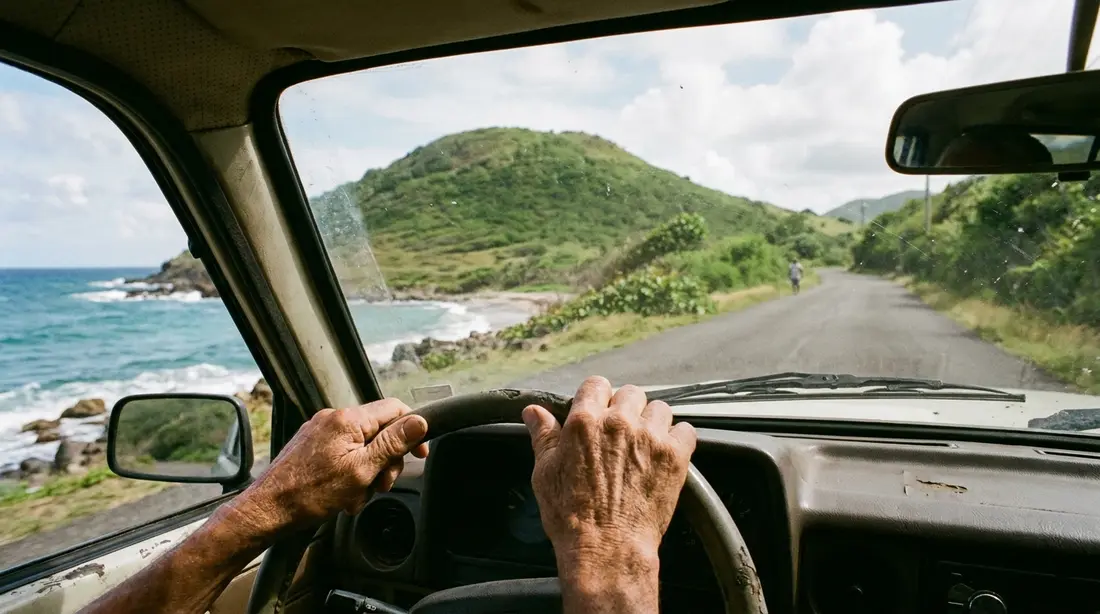
The one quirk everyone asks about: left-side driving in normal American cars. How it actually feels, and the habits that make it easy.
St. Croix puts traffic on the left side of the road and the steering wheel on the left side of the car, a pairing found in almost no other place on earth. No other state or territory of the United States runs traffic on the left. This page is the reference for actually doing it: where the rule came from, the mental habits that make it automatic within a day, the territory's real speed limits and traffic laws, the hazards worth planning around, and the procedure if something goes wrong. It reads in ten minutes and pays off the moment you leave the rental lot.
Why traffic keeps left
The rule is a Danish inheritance that outlived Denmark's own version of it. Denmark held these islands for centuries — St. Thomas settled in 1672, St. John claimed in 1718, St. Croix purchased from France in 1733 — and in the eighteenth century, keeping to the left was the ordinary custom across much of Europe. Danish colonial roads followed the practice of the era.
Then the mother country changed and the colony did not. Denmark moved its home traffic to the right side in 1793, during the same wave of reforms that shifted much of continental Europe rightward. The change never crossed the Atlantic. The Danish West Indies simply carried on as before, and two British occupations during the Napoleonic Wars — Britain being the great power most committed to the left — did nothing to loosen the habit.
When the United States bought the islands in 1917, paying Denmark $25 million in gold, it acquired a territory whose carts, mules, and early automobiles had been keeping left for the better part of two centuries. Washington changed the flag, the currency, and eventually the citizenship of the residents. It never changed the side of the road. More than a century of American administration later, the rule stands, and the territory remains the lone left-driving jurisdiction under the U.S. flag.
You will also hear a livelier version from island storytellers: that the draft animals of the plantation era — the donkeys and the ox teams hauling cane — were trained to keep left, and that no government afterward wanted to argue with a trained ox. Historians treat that one as folklore layered on top of the documented Danish custom, and we pass it along with that label. Both versions end at the same place: keep left.
The half of the equation that makes the USVI odd came later. Nearly every car on the island arrives from the U.S. mainland, built for American roads, with the wheel on the left. Left-driving countries normally put the driver on the right, next to the centerline. Here the two systems overlap, which is why your rental feels completely familiar inside and completely wrong outside for about the first twenty minutes.
The car and the lane
Start with the good news: nothing inside the car needs relearning. The pedals, the shifter, the signal stalk, the mirrors — all exactly where your hands and feet expect them. The entire adjustment happens outside the windshield, which makes St. Croix an easier place to learn left-side driving than Britain or Barbados, where visitors must reprogram the car and the road at the same time.
The one geometric consequence worth understanding: because you sit on the left of the car and the car travels in the left lane, you ride beside the edge of the road rather than beside the centerline. That gives you the island's most reliable lane check. Glance at where your own body sits. If the roadside — the grass, the ditch, the parked cars — is just outside your window, you are in your lane. If the centerline is at your elbow, or oncoming traffic is aimed at your door, you have drifted. Rental agencies reinforce the point with a keep-left sticker on the windshield or dash, and road signs in the visitor-heavy areas repeat it.
Lane position takes a short calibration too. Most new arrivals unconsciously crowd the outside edge for the first day, because a lifetime of right-side driving trained them to keep a car's width of space on their passenger side. Let the mirror and the line teach you; after a few miles the car centers itself in the lane without thought.
One more reassurance backed by the arithmetic of the place: the territory's speed limits top out at 55 mph on exactly one road, and most of your driving happens at 35 or less on two-lane roads with patient traffic. Errors here happen slowly, with time to fix them.
Turning at junctions
Turns are where left-side driving actually gets learned, because a turn forces you to choose a lane instead of following one.
- A left turn is the easy one. It is the near-side turn — short, tight, no traffic crossed. Swing into the closest lane and you are done. This is the mirror image of the mainland right turn.
- A right turn is the one that deserves your full attention. It crosses the oncoming lane, the way a left turn does at home. Wait for a real gap, cross deliberately, and finish in the left lane on the new road — the classic visitor error is completing a turn onto an empty road and settling into the right lane out of habit.
- At any junction, the nearest danger comes from your right. Traffic in the lane closest to you approaches from that side, so the scan is right first, then left, then right again before rolling.
- Narrate the first day. Saying the words out loud at each junction sounds ridiculous and works. By day two the voice goes quiet on its own.
Where new drivers go wrong
The mistakes visitors make here follow a pattern, and the pattern has almost nothing to do with busy roads. Traffic itself protects you: with cars ahead and oncoming, the correct lane is obvious and you follow it without thinking. Every predictable failure happens when that guidance disappears.
- Pulling out of a parking lot. The single most common error. You leave a beach lot, a gas station, a grocery store, or a restaurant onto a quiet road with no traffic to copy, and twenty years of muscle memory turns you into the right lane. The countermeasure is a fixed ritual: before rolling out of any lot, pause and say the rule.
- The empty-road drift. On a long quiet stretch mid-island or out east, attention wanders and the car migrates toward the side your instincts prefer. Passengers should feel free to say so; drivers should want them to.
- After any stop. Roadside fruit stands, photo pullouts, viewpoints — every re-entry to the road is a fresh chance to default to the wrong side. Same ritual as the parking lot.
- The first drive out of the airport, tired, at the end of a travel day, sometimes at dusk. The next section deals with it directly.
- Unmarked one-way streets in Christiansted. The old Danish grid includes one-ways that are not always signed, and a wrong-way block in a left-driving town scrambles everyone's instincts. Drive the downtown slowly and watch which way the parked cars face.
- Other visitors. Near the airport, the resorts, and the beach lots, assume the car ahead may be piloted by someone on their own first day. Defensive driving here includes defending against your fellow tourists.
Roundabouts, the junction type that most alarms mainlanders in left-driving countries, are essentially a non-issue on St. Croix: the island's major junctions are stop signs and a modest number of signal lights, and there is no roundabout of any consequence on the Crucian road network. The territory's well-known roundabout sits on St. John, near the Texaco junction outside Cruz Bay. If your trip includes that island, remember that circulating traffic runs clockwise, you enter by bearing left, and drivers already in the circle have the right of way.
The first half hour
Nearly everyone describes the same arc — total concentration on drive one, occasional self-reminders on day two, autopilot by day three. Here is how to spend the first thirty minutes so the arc starts smoothly.
- Decide whether the first drive should exist at all. Several island agencies deliver cars to your villa and collect them later, and a delivered car means your first left-side miles happen rested, in daylight, on quiet roads near the house instead of in airport traffic after a travel day. The agency list is in renting a car; if you would rather watch someone else drive first, a set-rate taxi covers arrival day, per taxis and getting around.
- Set the car up before it moves. Mirrors, seat, headlights, wipers. Put the phone in a mount or hand it to your navigator — the territory bans handheld calls at the wheel, and the first drive is no time to look down anyway.
- Say the rule out loud once, to mild family embarrassment. It helps.
- Use the airport road as your warm-up. Leaving Henry E. Rohlsen puts you onto the Melvin Evans Highway, the widest, best-marked road in the territory — a forgiving place for the first miles. Orientation and arrival logistics are in getting to St. Croix.
- Follow local traffic when you can. A car ahead of you is a rolling lane guide. Match its position, ignore its speed.
- Have the navigator call turns early — "right turn ahead, that is the crossing one" — so decisions get made before the junction, never in it.
- Keep drive one short and lit. Airport to villa, one grocery stop, done. If you land near dark, do the minimum and save real driving for morning; the broader arrival-day sequence is in first-time visitor tips.
Speed limits
The limits come from the Virgin Islands Code, Title 20, and they are lower than mainland instincts expect. As last checked, the statute sets these ceilings for cars, pickups, and motorcycles:
- 20 mph inside town limits — Christiansted and Frederiksted — unless posted otherwise.
- 35 mph on public roads outside the towns, which covers most of the island, including the north shore and East End roads.
- 40 mph on Centerline Road west of Kingshill, the mid-island straightaway's one posted exception.
- 55 mph on the Melvin H. Evans Highway, the south-shore artery past the airport — the fastest legal road in the entire territory.
Trucks and buses carry lower ceilings still. None of this is a trap; it is a description of the roads. Most routes are two lanes wide, curved, and shared with pedestrians and livestock, and traffic moves at these speeds. On the hairpins of the north shore and the rainforest — see the routes in Mahogany Road — locals take the tight bends at around 15 mph, holding well to the left, and you should copy them. Leave the mainland pace at the gate and the limits enforce themselves.
Seat belts, phones, and licenses
The territory's traffic law will feel familiar, with a few local particulars worth knowing cold. All of the following reflects the Virgin Islands Code as last checked; statutes move slowly, but verify anything that matters to you.
- Seat belts are mandatory for the driver and front-seat passengers, and children ride under their own rules: safety seats for passengers under five, rear-facing seats in a rear position for infants, and rear-seat placement for the youngest belt users. Buckling everyone in every seat is the sensible reading. Traveling families should reserve car seats with the rental agency or bring their own.
- Handheld phone calls at the wheel are illegal while the vehicle is in motion. Hands-free use is allowed for fully licensed drivers; learner-permit holders may not use devices at all, even hands-free, and school bus drivers are under the same total ban while carrying passengers. Navigation is fine in a mount or in the navigator's hands.
- Turning on red works in mirror image, at last check: the permitted move is a left turn on red — the near-side turn here — after a complete stop, unless a sign or a red arrow forbids it. Right on red does not exist in a left-driving territory. Treat the left-on-red as optional; no local behind you expects it from a rental car.
- Your U.S. driver's license is fully valid, and licenses from other countries are recognized for visitors. No international driving permit, no local paperwork.
- Impaired driving is policed as seriously as on the mainland. The math is the same everywhere: if the evening includes drinks, it should include a designated driver or a taxi.
- Helmets are required for every motorcycle rider and passenger, with no age exceptions — the territory keeps a universal helmet law.
Rules at a glance
| Rule | On St. Croix |
|---|---|
| Side of the road | Left, everywhere in the USVI |
| Steering wheel | Left side — standard U.S.-market cars |
| Speed, in town | 20 mph unless posted |
| Speed, open road | 35 mph on most roads outside town |
| Speed, Centerline Rd west of Kingshill | 40 mph |
| Speed, Melvin Evans Hwy | 55 mph — the territory's maximum |
| Turn on red | Left on red after a full stop, unless signed or a red arrow (at last check) |
| Seat belts | Required, driver and front seat; child seats under age five |
| Handheld phone | Illegal while driving; hands-free allowed for licensed drivers |
| Motorcycle helmets | Required, all riders and passengers |
| License | U.S. licenses valid; foreign licenses recognized; no permit needed |
| Rideshare | Uber and Lyft do not operate in the territory |
| Emergency | 911, island-wide |
Print-worthy version of the whole subject, in one sentence: keep left, keep slow, keep your shoulder by the roadside, and wave.
The horn
Crucian drivers use the horn constantly and almost never in anger, and decoding it correctly is half of fitting in on these roads.
- A quick beep is a greeting — to a friend on the sidewalk, to a familiar car, sometimes to nobody in particular. It can also mean thanks, or "come ahead."
- A stopped car flashing its lights or beeping while you wait to pull out is yielding to you. This is the island's signature courtesy. Take the gap without dawdling, then answer with a raised hand or a return tap.
- Give the courtesy back. The towns have few traffic lights, so drivers waiting to exit driveways and side streets depend on someone letting them through. Locals let people in as a matter of routine; a visitor who does the same reads as a guest worth having.
- The sustained mainland anger-honk barely exists here, and using it marks you instantly. If a car ambles below the limit ahead of you, that is the pace of the place. You came here for it.
Hazards
None of what follows should scare anyone off the road — thousands of visitors drive this island uneventfully every week. But the real hazard list for St. Croix differs from a mainland suburb's, and knowing it in advance is most of the protection.
- Potholes, stated. Some island roads carry craters big enough to bend a wheel, and a fresh shower turns them into innocent-looking puddles. Local drivers thread around the known ones — onto the shoulder, or briefly across the centerline after checking for oncoming — with the ease of long practice. Borrow their lines, with your own eyes doing the verifying, and slow down anywhere standing water hides the surface.
- Animals with zero road sense. Chickens and roosters own every roadside on the island. Add white-tailed deer (most active at dawn and dusk), goats, iguanas sunning on warm asphalt, mongooses darting across, and the occasional cow, horse, or donkey on rural stretches. Braking for animals is a Crucian reflex; build it into yours.
- Rain slicks. The first minutes of a shower float weeks of oil and dust on the pavement, hillside runoff carries mud and gravel across low points, and the rainforest roads add water crossing through dips and drainage cuts. Double following distance the moment rain starts, and take the descents in the rainforest gently.
- Narrow historic streets. The old town grids were surveyed for carts. Expect tight two-way streets that feel like one lane, unmarked one-ways, faded or absent lane striping, scarce street signs, and pedestrians walking in the roadway where sidewalks give out. Both downtowns reward crawling speed and forgiving nerves; orientation for each is in the Christiansted guide and the Frederiksted guide.
- Unpaved roads. The mountain routes — the Scenic Road above all — call for high clearance and a rental contract that permits dirt, and most contracts do not. Know what your agreement says before pointing the car uphill.
- Fellow visitors, covered above, concentrated wherever rental cars concentrate.
Night driving
Darkness is the island hazard that multiplies all the others. Street lighting effectively ends at the town edges; beyond them, rural St. Croix goes black — the same blackness that makes East End stargazing remarkable makes East End Road demanding at 10 p.m. In that dark sit the potholes, the deer, and the unfamiliar curves, all on the left side of the road.
The working policy costs nothing and solves the whole problem:
- Do every unfamiliar route once in daylight before doing it at night. A road you have seen is a different road.
- Cut your speed after dark below what the limit allows. Animal eyes catch headlights before bodies do; give yourself the braking room.
- Use high beams on empty stretches and dip them early for oncoming cars — remembering that oncoming traffic passes on your right here, so the courtesy angle reverses.
- Schedule accordingly. Sunset over the water, then dinner, then a known road home is a fine plan. A first-ever crossing of the island after dinner is a plan worth trading for a table closer to the villa.
The passenger's job
A front-seat passenger on left-driving roads holds a real position, and couples who treat it that way adjust faster than solo drivers. The job description: call turns two junctions early, in plain words that name the hard case — "right turn coming, that is the one across traffic." Watch every exit from every parking lot, the single likeliest failure point, and say "left side" before the wheels roll. Own the phone entirely, since the driver legally and practically cannot. At night, add a second pair of eyes for reflective ones on the verges. And deliver corrections in the tone of a co-pilot rather than a critic; the driver processing an inverted road has no spare capacity for defending their ego. Solo drivers can borrow most of this by narrating aloud — the ritual works without an audience.
Parking in the towns
Parking is untroubled almost everywhere on the island — beach lots and roadside pull-offs are free and informal — with the one thinking-required zone being downtown Christiansted, where Company and Queen Cross Streets carry an enforced two-hour limit and the paid lots handle anything longer. Full details for each downtown, including the lots and the cruise-day rhythm out west, live in the Christiansted and Frederiksted guides.
Motorcycles, scooters, and bicycles
Two-wheeled St. Croix exists, with caveats worth stating. The territory's helmet law covers every rider and passenger, no exceptions, and the conditions that are minor annoyances in a car — potholes, gravel wash, absent shoulders, drivers on their first left-side day — are serious business on two wheels. Scooter-hopping of the Bermuda variety has never been the culture here, and we do not suggest a vacation rental scooter as anyone's introduction to left-side traffic. Riders with real experience will find the island's roads rewarding and its traffic patient.
Cyclists are a steady presence, from town cruisers to the triathletes who train on the island's race-famous courses. Give any bike the full lane width when passing — the law of the friendly road applies double to the unarmored — and expect groups on the west-end and mid-island routes in the early morning.
If you have an accident
The odds favor you: low speeds and courteous traffic keep most visitor incidents at the scraped-bumper level. If one happens anyway, the procedure runs close to the mainland version.
- Call 911. It works island-wide, exactly as at home, routed through the territory's emergency call center. Police, fire, and ambulance all dispatch through it. For a collision with injuries, that call comes first and everything else waits.
- Stay at the scene, move cars out of the travel lane if they roll and no one is hurt, and put on the hazards. The Virgin Islands Police Department investigates collisions — its Traffic Investigation Bureau handles the serious ones — and a police report number is what the rental agency and every insurer downstream will ask for.
- Document like it matters: the other driver's license, plate, and insurance details, photos of positions and damage before anything moves, names of witnesses.
- Call the rental agency's number on your contract before accepting a tow or arranging repairs. The island's agencies, listed in renting a car, deal with this routinely and will tell you exactly what they need.
- On insurance, sort the categories before you fly. Because the USVI is U.S. territory, many mainland auto policies and some credit-card collision benefits extend here — but "many" and "some" are doing real work in that sentence, and exclusions for territories exist. One call to your insurer and card issuer before the trip tells you whether the counter's collision-damage waiver is redundant or essential for you. We cannot make that call for you, and neither can the counter agent.
Questions guests ask
Can you turn on red on St. Croix?
In mirror image, yes, at last check: because traffic runs on the left, the permitted move is a left turn on red — the near-side turn — after a complete stop, where no sign or red arrow forbids it. Right on red does not exist here. In practice, treat it as strictly optional. Local drivers will not honk you into it, junctions with lights are few, and a first-week driver has better uses for their attention than an optional maneuver. Stop, look right for the nearest traffic, and go when it is clearly clear.
Do I need an international driving permit in the USVI?
No. This is the United States: a valid U.S. driver's license is all a U.S. visitor needs, and visitors from other countries drive on their home licenses, which the territory recognizes. There is no local permit, no fee, and no paperwork beyond the rental agreement itself. The only license-related surprise is at the rental counter rather than the law: most island agencies set 25 as the minimum renter age, so younger drivers should confirm policies before booking.
Are there roundabouts on St. Croix?
Effectively no — the junctions you will meet on St. Croix are stop signs and a handful of traffic lights, and no roundabout of any consequence exists on the island's road network. The USVI's famous roundabout is on St. John, near the gas-station junction outside Cruz Bay, so island-hoppers may meet it. The left-driving rules there: traffic circulates clockwise, you enter by bearing left, and vehicles already in the circle hold the right of way. Slow, look right, merge.
Is it legal to use my phone for GPS while driving?
Holding the phone to talk while the car is moving is against territorial law; hands-free operation is allowed for fully licensed drivers. Navigation sits in the practical gap: a phone in a dash mount, set before you roll, keeps you inside both the law and good sense, and a phone in the navigator's hands is better still. Learner-permit drivers may not use devices at all, even hands-free. Cell coverage is solid along the main roads, though a downloaded offline map of the island is cheap insurance for the interior.
What happens if I catch myself on the wrong side?
You will probably catch yourself once, nearly always pulling out of a parking lot onto an empty road, and the fix is undramatic: check your mirror, signal, and move back across. At island speeds a drift is a correction, and local drivers — who watch rental plates with professional patience — give visibly confused cars room. Reduce the odds with the standard ritual: a spoken "keep left" at every lot exit, a navigator assigned to watch lane choice, and the body check — roadside outside your window, not the centerline.
How fast can you legally drive anywhere on St. Croix?
55 mph, on exactly one road: the Melvin H. Evans Highway along the south shore past the airport. Everywhere else the ceiling is 40 mph on Centerline Road west of Kingshill, 35 mph on other roads outside the towns, and 20 mph inside Christiansted and Frederiksted, all per the territorial code as last checked. Trucks and buses run under lower limits. If those numbers sound restrictive from a mainland desk, they stop feeling that way about ten minutes into the island's actual curves.
Who do I call after a fender-bender?
911, which works throughout the territory just as on the mainland, brings the Virgin Islands Police Department; ask for the report number, which your rental agency and insurer will both want. Your second call is the rental agency's contact line from your agreement, before you arrange a tow or accept roadside help. Photograph everything where it sits, exchange license, plate, and insurance details with the other driver, and collect witness names. For injuries, 911 dispatches ambulance service to the island's hospital.
The drive home to your villa
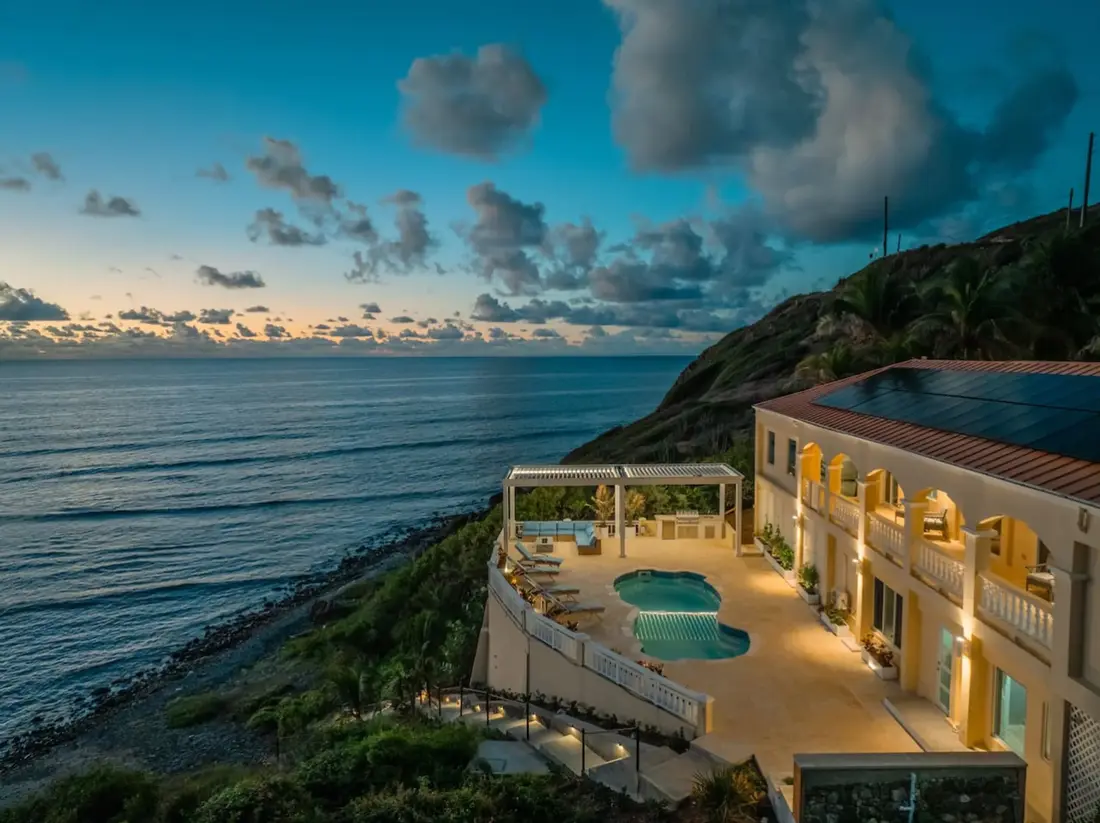
Every home in our portfolio assumes a car, and the driving profile varies by coast. Guests at our East End homes — The Cerulean among them — finish each evening on East End Road, a curving, unlit coastal drive that is routine after one daylight pass and memorable stargazing forever after; do that route once in the afternoon of day one and it is yours. North-shore and west-end stays add the hill roads toward Cane Bay and the rainforest to daily driving. The car-or-no-car decision itself is argued in full in our journal post, the classic full-island day is mapped in drive around the island, and every villa page notes what the drive home actually looks like.
Sources
Written from official and first-party sources, checked August 2026. Hours, prices and event dates change — confirm before you go.
In this guide
Stay nearby
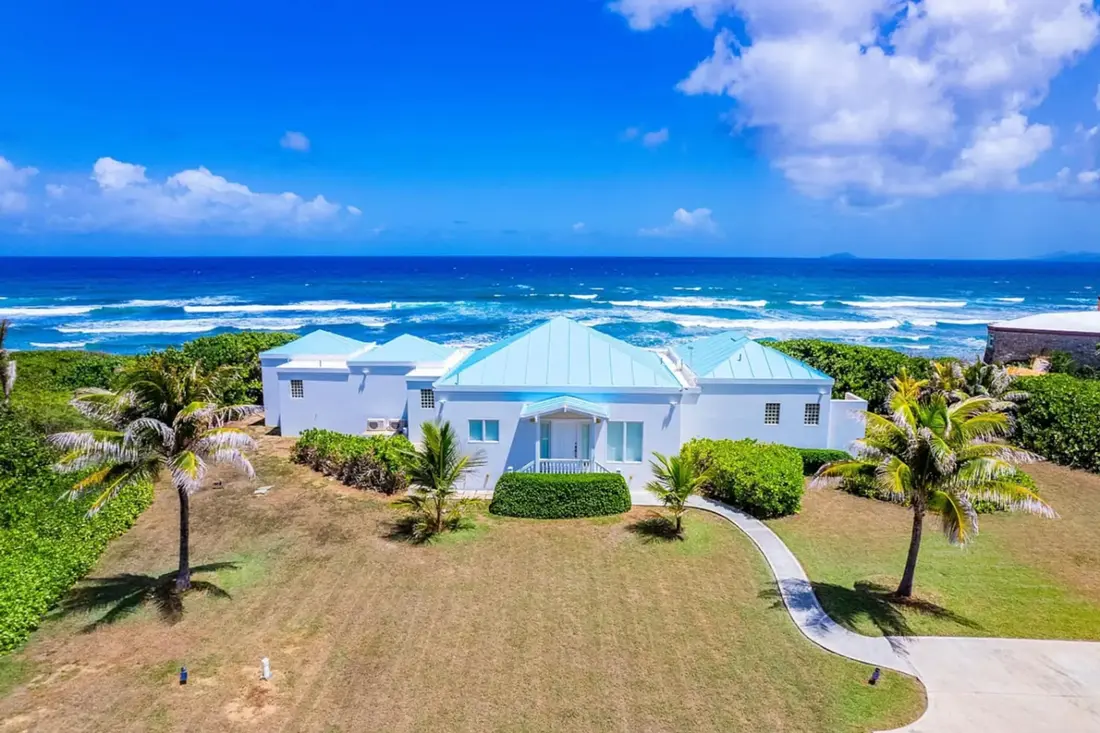
On The Shoys beach: six bedrooms, six baths, pool and hot tub, room for twelve, and the beach through the back garden.
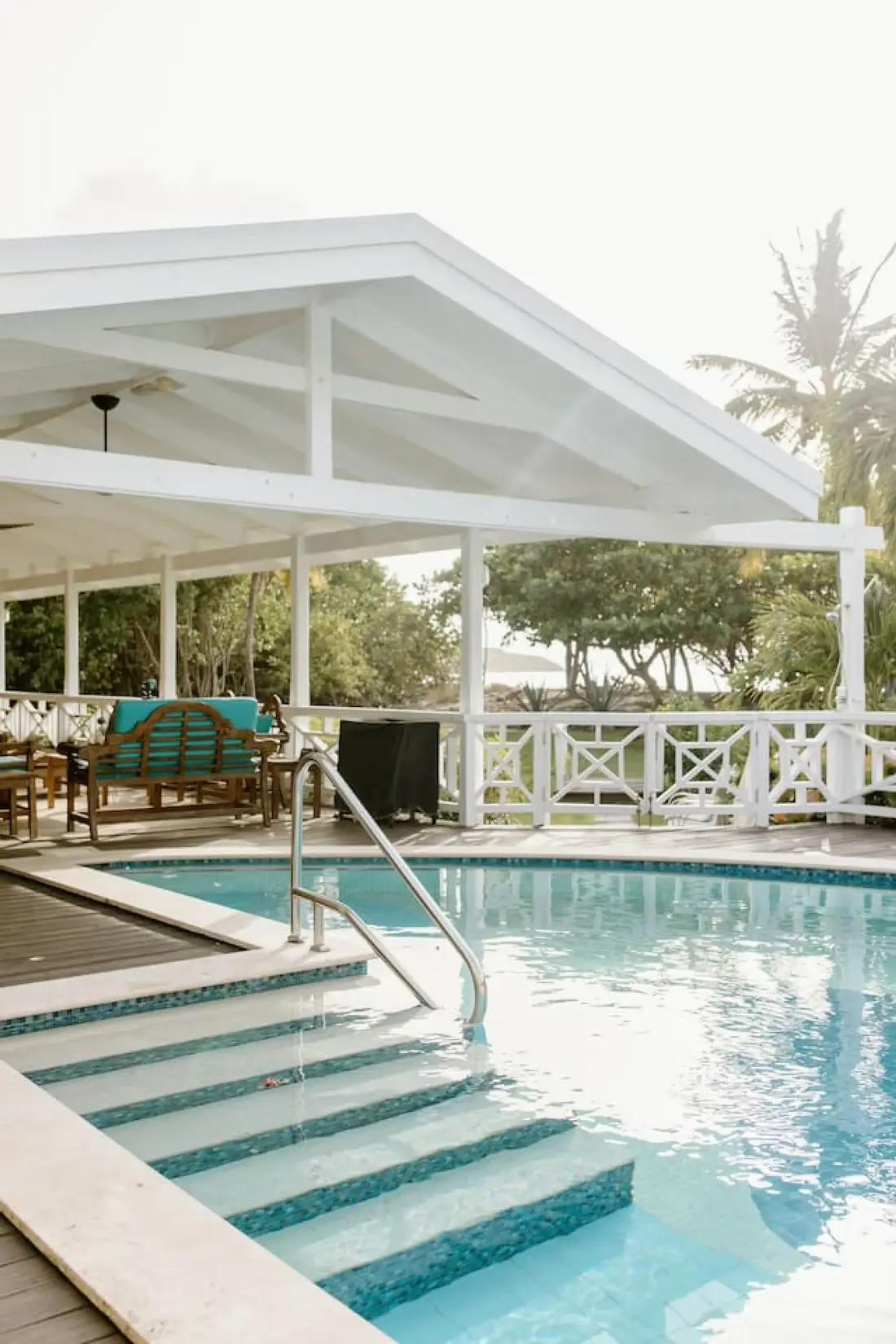 Shoy's Beach House6 bd · 6 ba · sleeps 12 · Christiansted
More in Plan Your Trip
Sources
10 references, listed in full at the end of this guide — official park, refuge, tourism-board and business sources, checked August 2026.