Kayaking the Bioluminescent Bay
Salt River Bay is one of the world's few year-round bioluminescent bays. Night kayak tours, clear-bottom boats, and how moon phase matters.
On the dark nights of each month, guided kayaks slip out of Salt River Marina after sundown and glide into water that flashes blue-green around every paddle blade. Salt River Bay glows all 365 nights of the year, something only a few bays on the planet can claim, and three tour outfits run trips into it. This page covers the science behind the light, the moon math that decides your date, the operators and their prices, and the island's second, lesser-known glowing lagoon.
The essentials
| Detail | What to know |
|---|---|
| Where | Salt River Marina, north shore, about 20 to 25 minutes by car from Christiansted |
| When | After sunset, on the dark half of each lunar month; every operator posts which nights they run |
| Cost | $50 to $70 per person at last check, depending on operator and kayak type |
| Duration | Roughly 1 hour 45 minutes to 2 hours dock to dock |
| Minimum age | 6 with Virgin Kayak Tours, 8 with Sea Thru Kayaks, at last check; confirm when booking |
| Swimming | Off the program; you stay in the boat to protect the organisms |
| Fitness | Low bar; the route is short, the lagoon is sheltered, and guides set an easy pace |
Everything in that table gets unpacked below. If you only remember one thing, make it this: pick your tour date off the lunar calendar first, then build the rest of the evening around it.
The organism behind the light
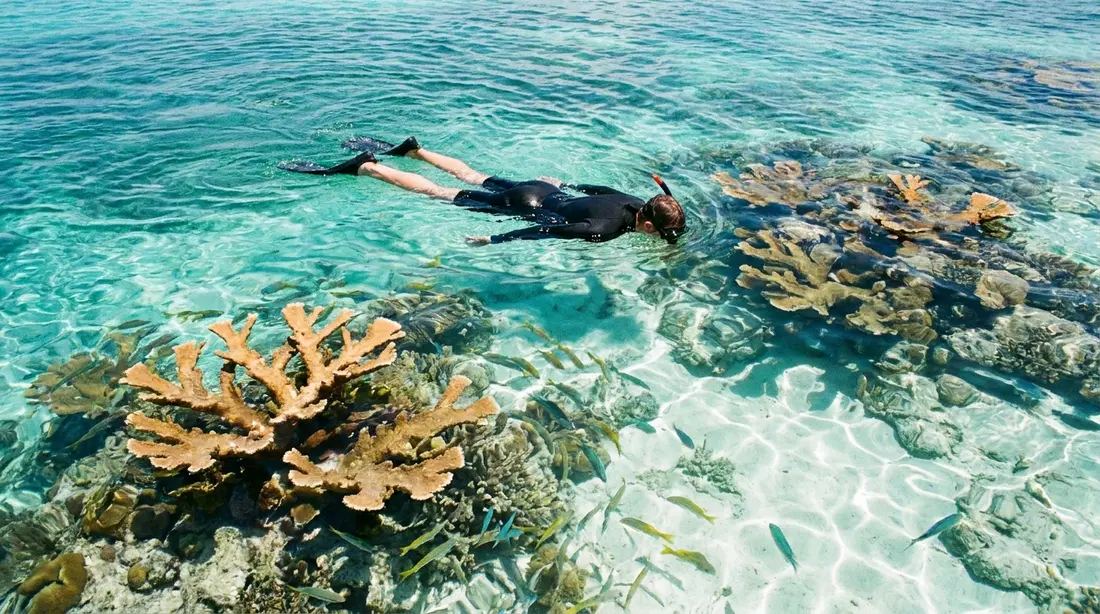
The glow belongs mostly to a single-celled plankton species, the dinoflagellate Pyrodinium bahamense. It is the resident light-maker of the Caribbean's famous glowing bays, including Mosquito Bay on Vieques, and it produces a brief blue-green flash whenever something jostles it: a paddle, a fish, a hand dragged through the water, rain hitting the surface. Each cell is invisible on its own. What you see from a kayak is thousands of cells firing at once along the pressure wave your boat pushes ahead of itself.
Salt River's population has been measured, and the results hold up. In 2013 the lab of Dr. Michael Latz at Scripps Institution of Oceanography, working with the St. Croix Environmental Association and a crew of citizen scientists, sampled the bay's light output from June through December. Brightness tracked the abundance of Pyrodinium bahamense closely, and on good nights the readings matched Mosquito Bay on Vieques, which is widely treated as the benchmark glowing bay. That study is the reason guides here can say the glow is present every night of the year with a straight face; what changes night to night is your ability to see it, which is a moon and weather question covered below.
The dinoflagellates get company. Guides point out comb jellies, harmless walnut-sized animals that ripple with green light when a net touches them, plus glowing worm spawn that appears on its own lunar timetable and the occasional firefly working the mangrove edge. Virgin Kayak's guides count five distinct light-producing organisms living in or around the lagoon. Our Why the Bay Glows page is the short-form companion to this section.
How the flash works
One plain paragraph of biochemistry, because guests ask every night. Inside each dinoflagellate sit microscopic pockets called scintillons, loaded with a light-emitting fuel molecule, luciferin, held safely by a binding protein, alongside an enzyme called luciferase. When the cell gets squeezed or sheared by moving water, an electrical signal races across its membrane and lets protons flood the scintillons. The sudden acidity makes the binding protein let go, luciferase oxidizes the freed luciferin, and the reaction throws off light. The chain from touch to flash takes on the order of 15 to 20 milliseconds, faster than your own eye can react, and each flash lasts about a tenth of a second. Dinoflagellate luciferin is a tetrapyrrole, a molecule chemically close to chlorophyll, which fits for an organism that spends its days photosynthesizing. The system also runs on a day-night clock: cells are primed to flash after dark and stay mostly quiet in daylight, which is one reason a daytime paddle through the same lagoon shows you nothing unusual.
Why flash at all? The leading explanation is defense. A burst of light startles the small grazers that eat plankton, and, better, it spotlights them for the larger fish that eat the grazers. Biologists call it the burglar-alarm effect: the cell cannot outrun its attacker, so it calls the neighborhood.
Why Salt River Bay sustains the glow
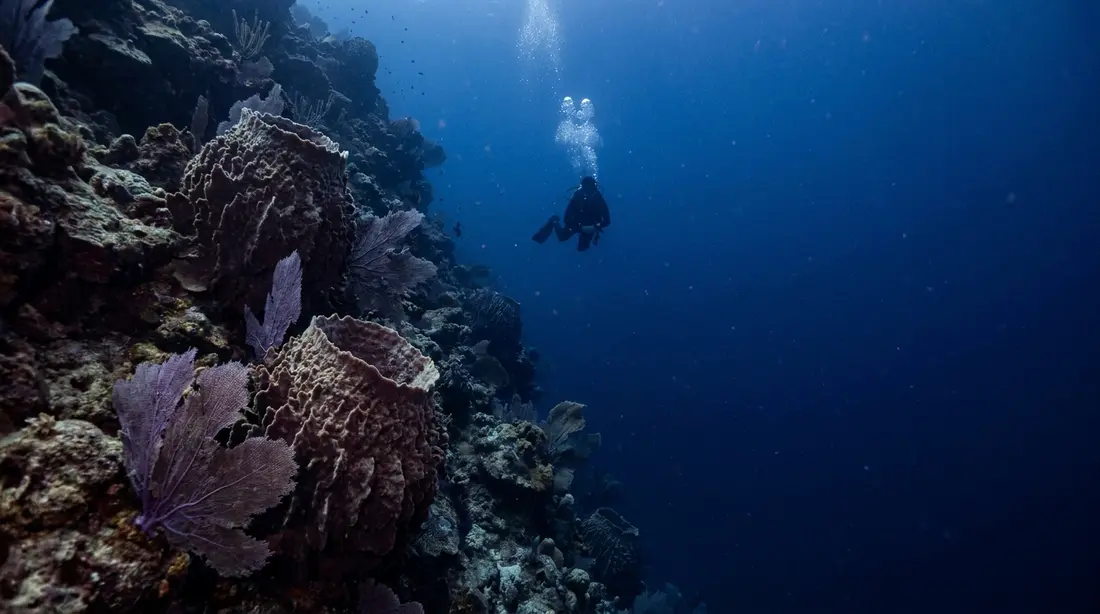
A permanent glowing bay needs a rare mix of conditions, and Salt River's mangrove lagoon happens to check every box. The lagoon itself is small and shallow, about 3.8 hectares and under four meters deep by the U.S. Geological Survey's Water Resources Research figures, and it connects to the open sea through a narrow mouth. That geometry traps water long enough for dinoflagellate populations to build up instead of washing out to sea on every tide, the same basin shape that makes Puerto Rico's glowing bays work.
The red mangroves ringing the shoreline do the feeding. Pyrodinium bahamense cannot manufacture vitamin B12, a nutrient it strictly requires; recent laboratory work on the species confirms it depends on outside sources, in practice the bacteria it lives among. Decomposing mangrove leaf litter fuels exactly those bacterial communities, and the tannins and nutrients steeping out of the root zone enrich the water further. Cut the mangroves and the kitchen closes; researchers studying Vieques documented how storm damage to the mangrove fringe there set the glow back for months after Hurricane Maria. Salt River's forest, among the largest mangrove stands left in the Virgin Islands, sits inside a national park and cannot be developed, which is the quiet reason this bay still performs while glowing lagoons elsewhere have dimmed. More on the trees themselves in The Mangroves of Salt River.
St. Croix's two glowing bays
Salt River gets the tours, but it has a sibling. Altona Lagoon, a public lagoon and shoreline park just east of Christiansted's Gallows Bay, also holds bioluminescent dinoflagellates, and on the right night its water sparkles too. The differences are practical. Salt River's population is dense, resident, and dependable, the reason operators there use the phrase super glow; Altona's organisms come and go, shifting around the lagoon so that any given evening is a coin flip. Salt River is reached by guided kayak from a marina; Altona can be walked to from its shoreline, no boat required, which makes it the free, do-it-yourself option for a couple willing to gamble on a dark night. No commercial night tours operate at Altona at last check. If seeing the glow matters to your trip, book Salt River and treat Altona as a bonus errand on a moonless evening near town. Both bays appear in the island roundup at Why the Bay Glows, and Altona's daytime park setting comes up in our Christiansted guide.
The moon decides your date
The organisms flash every night. The sky decides how much of it your eyes can pick out. Moonlight raises the background brightness of the water surface, and the faint blue-green of the plankton disappears into it the way stars disappear over a stadium. So the industry runs on the lunar calendar: tours go out roughly from the waning half through the new moon and into the first days of the waxing crescent, and they stand down around the full moon.
Operators handle this openly. Virgin Kayak Tours publishes date windows for the whole year, listing the exact spans each month when glow tours run, and offers a sunset-and-moonlight paddle on the bright nights, a pleasant trip, marketed as exactly what it is. Sea Thru Kayaks fills the bright half of the month with an LED-lit night paddle in its transparent boats. BushTribe schedules its bioluminescence departures on what it calls optimal moon-cycle dates. Practical translation for planners: before you lock flights, glance at a moon-phase table. A new moon inside your travel window is the jackpot; a full moon means either shifting dates or enjoying the alternative trips for what they are.
Reading a moon calendar for this purpose takes one minute. Find the new moon nearest your trip; the roughly ten nights centered on it are prime, the surrounding week is workable, and the five or six nights around the full moon are when the alternatives run. There is a finer wrinkle worth knowing: the moon is only a problem while it is actually in the sky. In the days after full, the moon rises well after sunset, which can leave a usable pocket of true darkness in the early evening before it clears the hills, and operators sometimes exploit exactly that gap when they set departure times. This is why two tours in the same week can leave at different hours; the schedule tracks moonrise, sunset, and cloud, and the people setting it watch all three.
Weather stacks on top of the moon. The Scripps fieldwork found the bay's brightness dipped after storm events and bounced back within days, with longer swings tied to wind speed and direction. Heavy rain also stirs sediment into the lagoon. None of this is predictable months out, so book the darkest night your schedule allows and let the operators call any weather scrubs.
What the tour is actually like
Every trip follows roughly the same arc. You meet at Salt River Marina, off Route 80 on the bay's edge, in the last hour of daylight; Sea Thru's shop address is 9001 Salt River Marina, and the other outfits stage nearby, with your confirmation email carrying the exact meeting spot. Arrive fifteen minutes early, park in the marina lot, and use the facilities before launch, since the next two hours happen in a kayak. Departure times shift week to week with sunset. Guides fit you for a tandem or single kayak, run the safety talk while there is still light to see hand signals, and lead the group out of the marina channel as dusk settles. The paddle to the glowing water is short, about three quarters of a mile on Sea Thru's route and about a kilometer on BushTribe's line along the bay's east side, all of it on flat, wind-sheltered water behind the mangrove fringe. Full dark arrives while you are en route, which is part of the design.
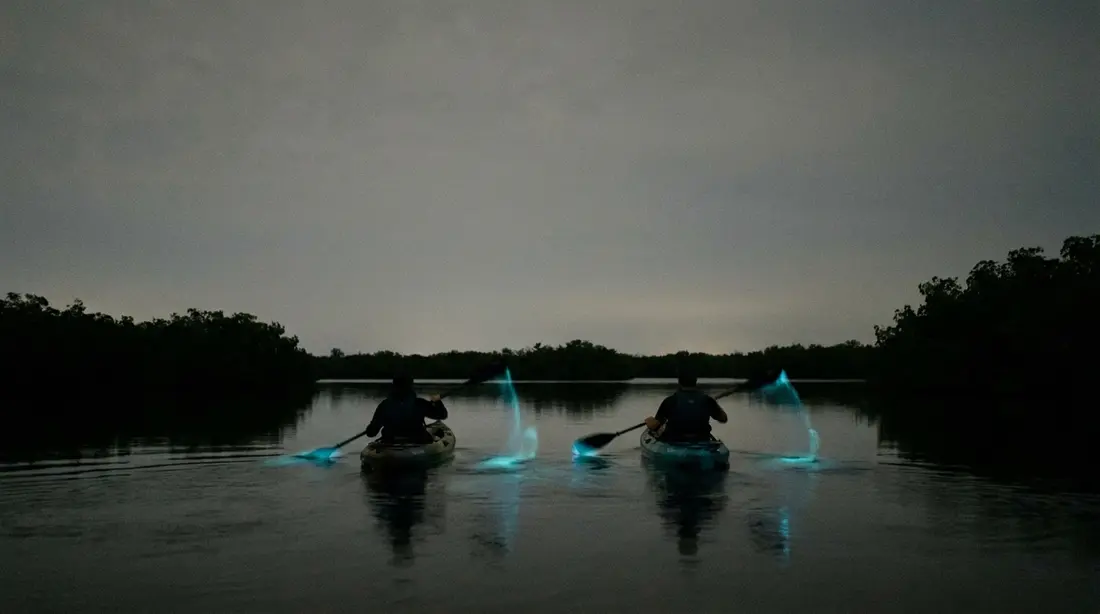
Inside the mangrove lagoon the group rafts up and drifts. This is the show: paddle strokes trail light, fish dart past as streaks, and guides pass around small mesh nets so you can stir the water beside your boat and watch the sparks pour off the rim. Plan on around 45 minutes in the glow zone before the group turns for home. Guides narrate throughout, and the talk is worth having: the 1493 story, the mangrove ecology, the plankton science, and with BushTribe a running history quiz with prizes and a dose of Arawak heritage. Total time on the water lands between an hour and three quarters and two hours.
Set expectations correctly and the night delivers. On a dark, calm evening the effect reads as glitter trailing off everything that moves, closer to a field of underwater fireflies than to the lit-swimming-pool photographs the internet loves. Children tend to lose their minds over the nets. Adults tend to go quiet.
The operators
Three companies ran Salt River glow tours at last check, all launching from the marina area. All three book out on the darkest nights of winter weeks, so reserve ahead.
Sea Thru Kayaks VI
The transparent-kayak specialists, running what they describe as the island's largest fleet of see-through boats, so the water lights up beneath your seat as well as beside it. The signature bioluminescence tour ran $55 per person at last check, two hours, ages 8 and up, with a 385-pound capacity per kayak. Around the bright half of the month they offer an LED moonlight tour at $70, and by day a glass-bottom kayak trip and a national park paddle, each $60. The shop office keeps Monday-through-Saturday daytime hours at the marina.
Virgin Kayak Tours
The pedal-drive option. Their Hobie Mirage kayaks move by foot power, leaving hands free for the net, a camera attempt, or holding onto a kid. Ages 6 and up, 260 pounds per person, with the bio tour priced seasonally at last check: $65 from mid-November to mid-August, $55 from mid-August to mid-November, with early-booking discounts. They post their glow-night date windows for the full year, run the sunset-and-moonlight alternative around the full moon, and also lead the daytime historical and ecological paddles covered in Daytime Kayaking at Salt River. Booking is by appointment.
BushTribe Eco Adventures
The eco-outfitter of the three, with a sunset-into-dark trip along the bay's east side that folds in local ecology, island history, and a trivia round. At last check the trip ran two hours and cost $50 per person in a standard ocean kayak or $60 in a clear one. BushTribe also guides the Annaly Bay tide-pool hike, morning paddles at Salt River, and kayak and paddleboard rentals around the island, useful if you want one operator for several days of activity.
| Operator | Boat type | Price at last check | Minimum age | Bright-night alternative |
|---|---|---|---|---|
| Sea Thru Kayaks VI | Fully transparent | $55 | 8 | LED night paddle, $70 |
| Virgin Kayak Tours | Hobie pedal-drive | $55–$65 by season | 6 | Sunset and moonlight paddle |
| BushTribe Eco Adventures | Ocean kayak or clear | $50–$60 | Ask when booking | Runs on moon-cycle dates |
Prices move; treat every figure above as a snapshot and confirm when you book.
Clear kayak, pedal kayak, or standard
The boat choice changes the experience more than most guests expect. A transparent hull puts the light show under your feet: fish streak beneath you as comet trails, and the wake off your own bow glows through the floor. The trade-off is that clear polycarbonate boats ride a little stiffer and cost a few dollars more. Pedal drive solves a different problem: hands. Stirring a net, steadying a child, or attempting a photograph is far easier when your legs do the propulsion, and the Mirage drives need no kayak experience at all. A standard sit-on-top is the budget pick and gives up nothing in glow visibility beside the boat, which is where most of the show happens anyway. Families split the difference all the time: kids in a clear tandem with one parent, the other parent pedaling alongside.
Rules on the water
Swimming is off the table. Operators keep guests in the boats, both as a night-water safety matter and because the lagoon's plankton population is the entire asset; Virgin Kayak states the no-swimming rule outright. The related rule surprises people more: nothing on your skin that rinses off. Insect repellent, sunscreen, perfume, and heavy deodorant all wash into the lagoon from wet hands and forearms, and the chemicals are hard on the very organisms you came to see. Cover up instead: lightweight long sleeves and long pants beat spray for the mosquitoes that live in any mangrove system, and guides will tell you the bugs on the water are milder than guests fear. Handle the comb jellies only as guides direct; they carry no sting, but they are absurdly fragile. Pack out everything you bring. The lagoon sits inside a national park and a functioning nursery for the island's reef fish, and the operators' livelihoods depend on leaving it exactly as found.
Season and conditions through the year
There is no glow season; the population is resident and the bay performs in January as in July. What varies is comfort and odds at the margin. The Scripps measurements showed brightness dipping briefly after storms and shifting with wind patterns, so the rainier late-summer and fall months carry slightly more scrub risk and slightly more sediment in the water column, balanced by warm nights and, at Virgin Kayak, the lower shoulder-season price. Winter brings the crispest, driest air, the busiest villa calendar, and the most competition for dark-night slots, so December-through-March guests should book the tour before the dinner reservations. Trade winds blow year-round, and the lagoon is sheltered enough that tours run in conditions that would cancel an open-ocean trip. Whatever the month, the moon outranks the season: a new-moon night in the wet season beats a full-moon night in the dry season, every time.
Photography, realistically
Phone cameras almost always lose this fight. The flashes are faint, brief, and moving, and a handheld sensor in the dark returns either black frames or smeared noise. The gorgeous long-exposure shots you have seen were made with tripod-mounted cameras on stable ground, multi-second exposures, and high-end sensors, none of which coexists with a drifting kayak. A newer phone's night mode braced against the boat can sometimes catch a faint wash of color in an energetic swirl, and that is the ceiling. Our advice after watching many guests try: make one attempt in the first ten minutes, then put the phone in the dry bag and spend the rest of the hour looking at the water. The memory outperforms the footage. If you want proof you were there, the operators' own galleries carry professional shots of their boats in the glow, which is what those images take to produce.
The place you are paddling through
The bay holding all this light is also the only documented spot where a Columbus expedition touched what is now United States soil: his second-voyage fleet anchored here on November 14, 1493, and met armed resistance from the people already home. Today the whole basin is Salt River Bay National Historical Park and Ecological Preserve, 1,015 acres run jointly by the National Park Service and the territory. The full story is in Salt River Bay, 1493, and the area's daytime menu, from the calm beach at Columbus Landing to the marina restaurants, is in our Salt River area guide. Divers should know a submarine canyon drops off just outside the bay's mouth, with two moored walls covered in Diving Salt River Canyon.
Building the evening around it
The tour occupies the middle of the night, sunset to roughly two hours after, which leaves room on either side. The standard play is an early dinner in Christiansted, 20 to 25 minutes away, then the drive up the north shore; our Christiansted dining guide flags kitchens that handle a we-need-to-leave-by deadline gracefully. Late eaters reverse it, and a marina-adjacent bite keeps the logistics trivial. Doubling up on the water works well here: kayak the same mangrove shoreline by daylight on the daytime paddle, spend a bright-moon evening on a sunset sail instead, or, if you dive, ask about pairing the canyon walls with a glow night, since boats and kayaks share the marina. In summer, the island offers a second after-dark wildlife program entirely: guided leatherback watches at Sandy Point, covered in Turtle Watch Season. Divers chasing a full nocturnal itinerary can add the Frederiksted Pier from our night diving guide on another evening.
What to wear and bring
- Clothes that can get wet — you will take drips off the paddle and the net. Quick-dry fabric over cotton.
- Long sleeves and pants — your mosquito defense, since repellent stays home.
- A dry change for the car — the ride back to the villa is nicer in dry clothes.
- Bare feet or water sandals — Sea Thru and Virgin both run shoeless-friendly launches.
- A small dry bag — phone, key fob, cash for the guides. Leave everything else at the villa.
- A light layer — trade-wind evenings on the water run cooler than the beach led you to expect.
- Nothing scented on your skin — no repellent, sunscreen, perfume, or cologne, per the rules above.
Kayak experience is unnecessary. The route is short and sheltered, tandems are standard, and guides shepherd the group the whole way. If a rental car is part of the plan, remember the drive home is on the left side of dark, winding roads; the driving guide covers the adjustment.
Questions guests ask
Will we see the glow?
No operator promises it, and you should distrust one who does. The organisms are present every night, verified by actual measurement, but visibility rides on darkness, weather, and water clarity. Booking inside the operators' published dark-night windows puts the odds strongly in your favor, and guides know the lagoon's brightest corners on any given evening. Think of it like whale watching with much better odds: a natural phenomenon, stacked in your favor, never contractual.
Can young children come?
Yes, within each company's floor: 6 years old with Virgin Kayak Tours and 8 with Sea Thru at last check, with BushTribe handling age questions at booking. Kids ride tandem with a parent, life jackets are provided and mandatory, and the net-swirling portion of the night is reliably the family highlight. The practical limits are bedtime and sitting still in a boat for the better part of two hours; parents of the very young sometimes split shifts across two nights.
Why can't we swim in it?
Two reasons. Safety first: a dark lagoon at night with a group of guests is no place for swimmers, and guides cannot watch the water and the boats at once. Conservation second: sunscreen, repellent, and body products shed off skin and accumulate in a small, poorly-flushed lagoon, degrading the plankton population that makes the whole enterprise exist. Puerto Rico's glowing bays banned swimming years ago for the same reason. The net gives you the tactile version without the impact.
Is paddling at night difficult or unnerving?
Less than most first-timers expect. The water is flat, the distance is short, the group stays tight, and guides carry lights for the transit stretches. Pedal kayaks remove even the paddling skill requirement. Full darkness is the point of the trip, and most guests report their eyes adjusting within minutes, with the mangrove channel reading as peaceful rather than spooky. Anyone anxious about balance should request a tandem and let the guide know; they handle nervous paddlers nightly.
Our only free nights fall near the full moon. What then?
Take one of the bright-night trips and re-aim expectations. Sea Thru's LED paddle and Virgin Kayak's sunset-and-moonlight tour are built exactly for these dates, and a moonlit mangrove lagoon is lovely on its own terms; you may still catch faint sparkle in shadowed corners. If the glow itself is the whole reason for the outing and your trip dates are still movable, shift them toward the new moon before you shift anything else.
How far ahead should we book?
In winter high season, as soon as your travel dates are fixed; the dark-window nights are a minority of the month and the boats are finite. A week or two ahead usually suffices in the summer and fall shoulder. Book directly with the operator, confirm the meeting time the day before since departure follows sunset, and give them a working cell number for weather calls.
What happens if weather cancels the tour?
Operators make the call, usually the afternoon of the trip, based on wind, lightning risk, and water condition rather than rain alone; a light shower does not stop a kayak tour, and rain on the water actually sets off the plankton. When a night does get scrubbed, the standard practice is rescheduling you onto another dark night or refunding, but policies differ by company and by how late you cancel on your end, so read the terms at booking. Guests near the end of a stay should book their glow night early in the trip precisely so a scrub leaves room to try again.
Is the clear kayak worth the extra money?
If the budget stretches, most guests say yes, especially with kids aboard, because the underfoot view adds a dimension a standard boat cannot. That said, the show beside the boat, where your net and paddle work, is identical from any hull. Couples on a tighter budget lose little in a standard kayak, and the pedal boats trade the transparent floor for free hands, which photographers and parents often value more.
Getting there from our villas
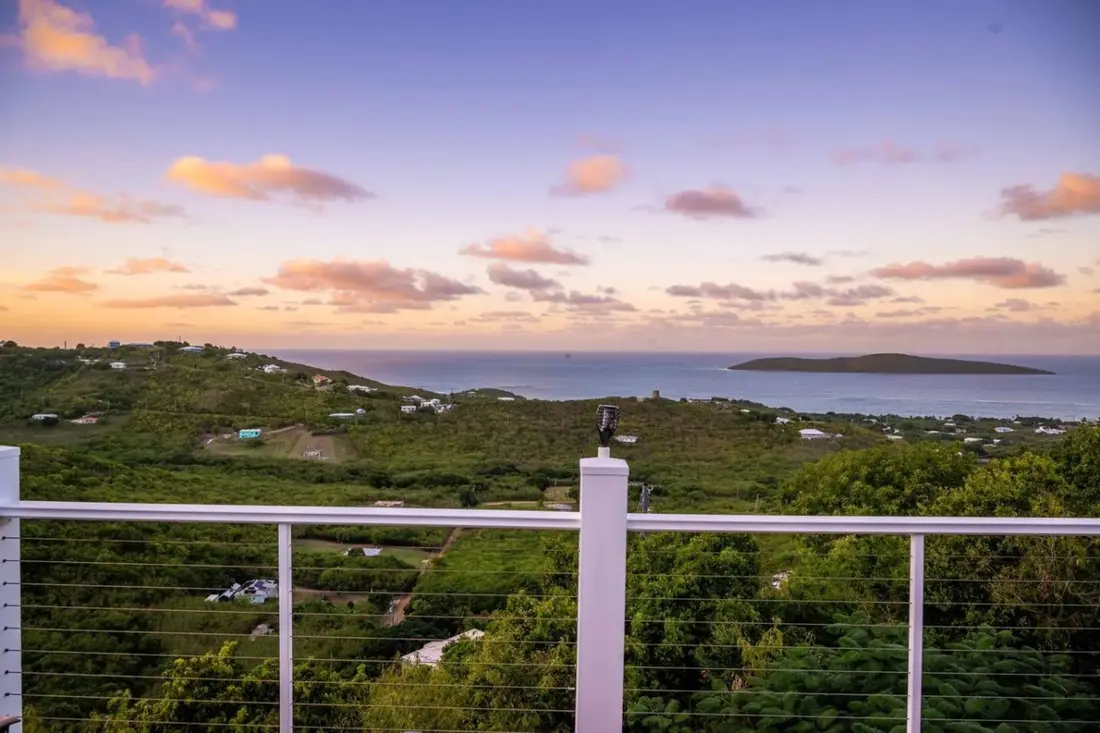
Salt River sits on the north shore roughly midway along the island, an easy night drive from anywhere we manage. From the East End villas and the beachfront collection, figure the 20-to-25-minute Christiansted run plus a bit more, most of it on Route 80 with the sea on your right going out; from the West End homes allow extra time for the cross-island drive on unlit roads. Guests at several of our hillside houses can see the bay's headlands by day, which makes a nice before-and-after. Tell us your travel dates when you book and we will flag the dark-moon windows for your stay, along with which operators have space; it is the single most calendar-sensitive activity on the island, and a two-minute check at booking time saves the trip.
Sources
Written from official and first-party sources, checked August 2026. Hours, prices and event dates change — confirm before you go.
In this guide
Stay nearby
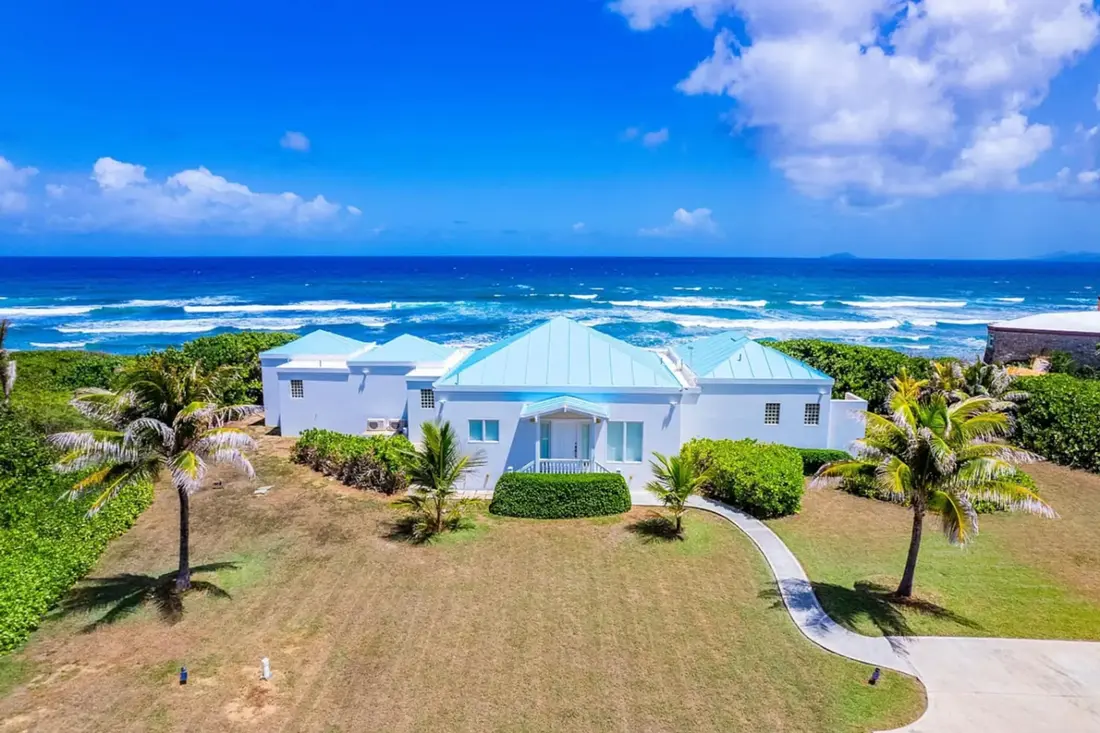
Private oceanfront on the East End with a sandy, swimmable beach, pool, outdoor kitchen and a separate guest cottage. Sleeps twelve.
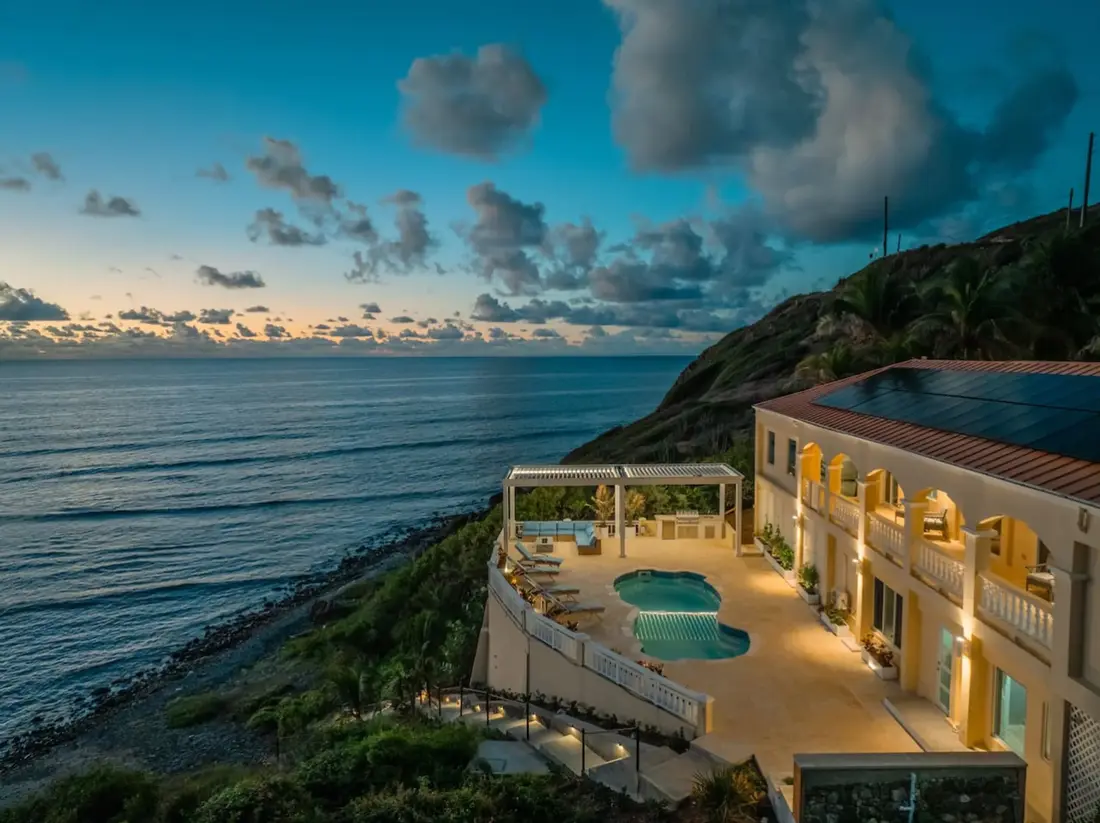 The Cerulean5 bd · 5 ba · sleeps 12 · Christiansted
More in On the Water
Sources
12 references, listed in full at the end of this guide — official park, refuge, tourism-board and business sources, checked August 2026.