Estate Whim Museum
A restored sugar plantation on 12 acres: the Great House, the windmill, and an unflinching look at the labor that built the island's wealth.
Estate Whim Museum sits on 12 acres of old sugar land beside Centerline Road, a short drive east of Frederiksted. The St. Croix Landmarks Society has kept the site since 1954 and calls it the oldest sugar plantation museum in the Virgin Islands: an oval-ended great house, three generations of cane mill, factory ruins and a string of outbuildings, all standing where they were built. One correction up front, because guidebooks keep printing the old version: the great house interior has been closed since the 2017 hurricanes. What you tour today is the outdoor complex, and it holds most of the story anyway.
This page is the reference for the whole property: the estate's Danish record, the people enslaved on it, the architecture of the house, what every surviving structure did, how cane became sugar and rum, and the practical details of a visit. For the wider west-end day around it, see the Frederiksted guide.
What the museum is today
Whim is a preserved plantation complex rather than a gallery with cases. The Landmarks Society leases the 12 acres that hold the remains of most of the original estate buildings, an arrangement in place since 1954, and interprets them as a single working unit: residence, mills, factory, service buildings and the foundations of the laborers' village. Exhibits and tours are built to explain three things at once — the economics of a plantation, the mechanics of sugar-making, and the daily lives of the people who did the work.
Open days have been limited since the storms. At last check the gate opened Wednesday and Saturday, 10 a.m. to 3 p.m., plus days when a cruise ship is in Frederiksted; a few listings show Wednesday through Saturday instead, which is exactly why a phone call beats any website here. The number is 340-772-0598, and the address is 52 Estate Whim, Frederiksted, with parking on the property. Admission at last check ran about $10 for adults and $5 for children aged 7 to 12.
The estate in the Danish records
Denmark bought St. Croix from France in 1733, and the Danish West India Company surveyed the island into a grid of plantation parcels in the 1730s. Whim is a textbook example of one. The earliest ownership records date to 1743 and show cotton in the fields; by 1754 sugar had taken over as the main crop and held the ground for roughly 170 years. The name wandered before it settled: a French-period map labels the parcel Le Vert, a 1799 entry calls it John's Rest, an 1856 record spells it Wym, and The Whim is the form that stuck.
The owner who left the largest mark was Christopher MacEvoy Jr., a merchant heir who held the estate until 1824 and put up the great house that still anchors the property. Sugar stayed in Whim's fields into the 1920s, long after the industry had stopped paying, and cattle took over the acreage when the cane finally went.
The people who were enslaved at Whim
For a little over a century, from the first records in 1743 until emancipation in 1848, Whim ran on the forced labor of enslaved Africans and their island-born descendants. A 1750 survey of the estate already shows their village in the plantation's northwest quadrant, set apart from the owner's house. The scale of the system island-wide is stark in the census figures: in 1803, St. Croix held about 30,000 people, and roughly 26,500 of them were enslaved.
The work covered every stage of the estate's operation — digging cane holes with hoes and picks, cutting and hauling cane, feeding the rollers, tending the boiling coppers through the night, coopering, carting, cooking and washing. It also included the skilled building trades: the National Trust for Historic Preservation credits Whim's 18th-century walls of limestone and cut coral to enslaved African masons and carpenters. The mills themselves were dangerous. A windmill had no brake — stopping it meant turning the sails out of the wind — and an axe or machete was kept inside the mill for the worst accidents at the rollers.
The Landmarks Society's own plantation-life research notes that the laborers' quarter functioned almost as a self-sufficient settlement, with its own food plots, crafts and internal economy, and the spot is still called the Village. Its house foundations remain on the grounds, and reading them alongside the great house is the point of the site: one estate, two entirely different experiences of it.
Emancipation, Contract Day and the Fireburn
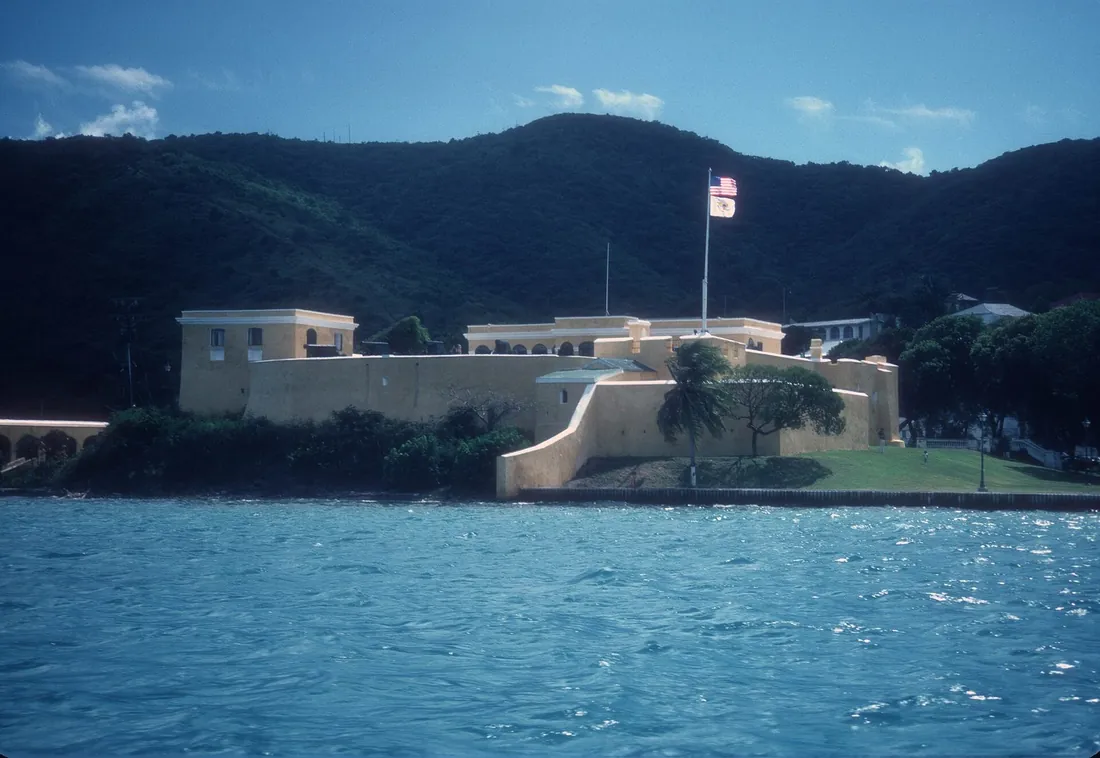
Freedom came on July 3, 1848, when Governor-General Peter von Scholten proclaimed emancipation at Fort Frederik, three miles down the road from Whim; that story has its own guide at Fort Frederik, and the holiday's modern observance is covered under Emancipation Day. What followed on the estates was not free labor in any practical sense. The Labor Act of 1849 tied workers to year-long contracts at fixed low wages that could change only on October 1 each year.
On that date in 1878, the arrangement exploded. In the uprising Crucians call the Fireburn, laborers burned most of Frederiksted and dozens of western plantations — contemporary lists count at least 51 estates damaged or destroyed, and Whim appears on them. Danish records put the property losses around $600,000. The full account, including the four queens who led it and what the revolt changed, is in the Fireburn guide; at Whim, the relevant fact is that the fields you are standing in burned. There is a daily reminder of the aftermath in the road out front: Centerline Road is officially Queen Mary Highway, named for Fireburn leader Mary Thomas.
The American years and the homesteads
The United States bought the Danish West Indies in 1917, taking on an island whose sugar economy was already failing. In 1932 the federal government purchased the full 1,450-acre Estate Whim and turned it into a Depression-era homestead project: the land was cut into 6-acre plots for small farmers, with new three-room concrete houses that had a gallery and a cistern — a real step up from the one-room village housing that had persisted since slavery. By 1934 more than 230 farming families held plots. The neighborhoods around the museum grew out of that subdivision, which is why a historic estate now sits in the middle of ordinary west-end homes.
In 1954 the 12 acres holding the surviving estate buildings were leased to the newly active St. Croix Landmarks Society for management, and the museum era began.
The great house
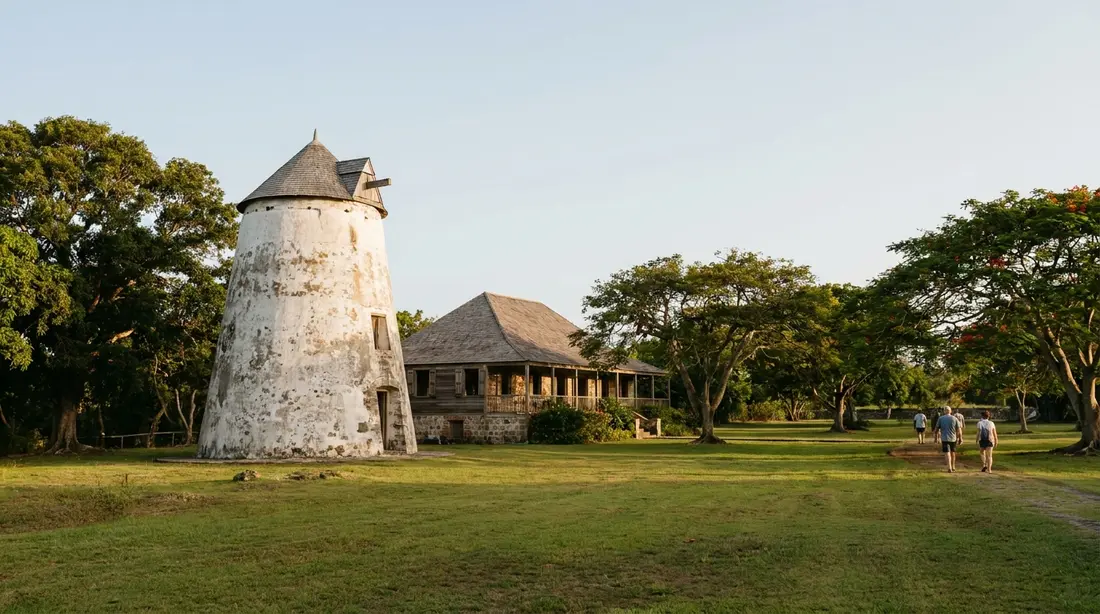
Whim's great house is the most unusual planter's residence on the island. It is a single story raised over a cellar, about 90 feet by 35, with ceilings around 16 feet — and its two ends are rounded, so the floor plan reads as an oval. Writers have long compared the effect to a small French chateau. Construction is credited to Christopher MacEvoy Jr. in the 1790s; the National Trust dates it to 1794, while the Landmarks Society's own history estimates about 1796 and concedes the paper trail is thin.
The building was engineered for heat. The masonry — cut brain coral, limestone and rubble, bonded with a lime mortar famously mixed with molasses — runs close to three feet thick in published descriptions. Tall doors and windows line up for cross-draft, and a dry moat rings the entire house, pulling light and moving air into the cellar, which is entered by a door set down in the moat itself. Inside are only a few rooms, and in museum years they were furnished with Crucian antiques: island mahogany furniture, decorative arts and archival pieces that the National Trust lists among the collections still held at the site.
Storm damage and the endangered-places listing
Hurricanes Irma and Maria hit the property hard in September 2017, and every structure on the 12 acres took damage. FEMA's 2018 assessment put full restoration of the buildings above $1.5 million, with over $1 million of that in the great house alone. Recovery money moved slowly; years later the house still stood under weathered blue tarps while rain worked on the interior, and the roof framing, limestone and cut-coral walls kept deteriorating.
On May 1, 2024, the National Trust for Historic Preservation named Estate Whim Museum one of America's 11 Most Endangered Historic Places. The Landmarks Society's executive director, Sonia Jacobs Dow, publicly welcomed the listing as a blessing, and board chair Valencio Jackson said the accompanying agreement put the museum on a path toward full restoration; architects and engineers began reassessing the buildings that same month, with disaster-recovery funds from the territory's Office of Disaster Recovery in the mix. Until that work finishes, the great house is viewed from the outside. Ask at the gate what is open on the day you come, because the answer has changed year to year.
The grounds, building by building
The outdoor complex is the museum now, and it rewards a slow lap. Take the structures in roughly the order the cane took them.
The windmill
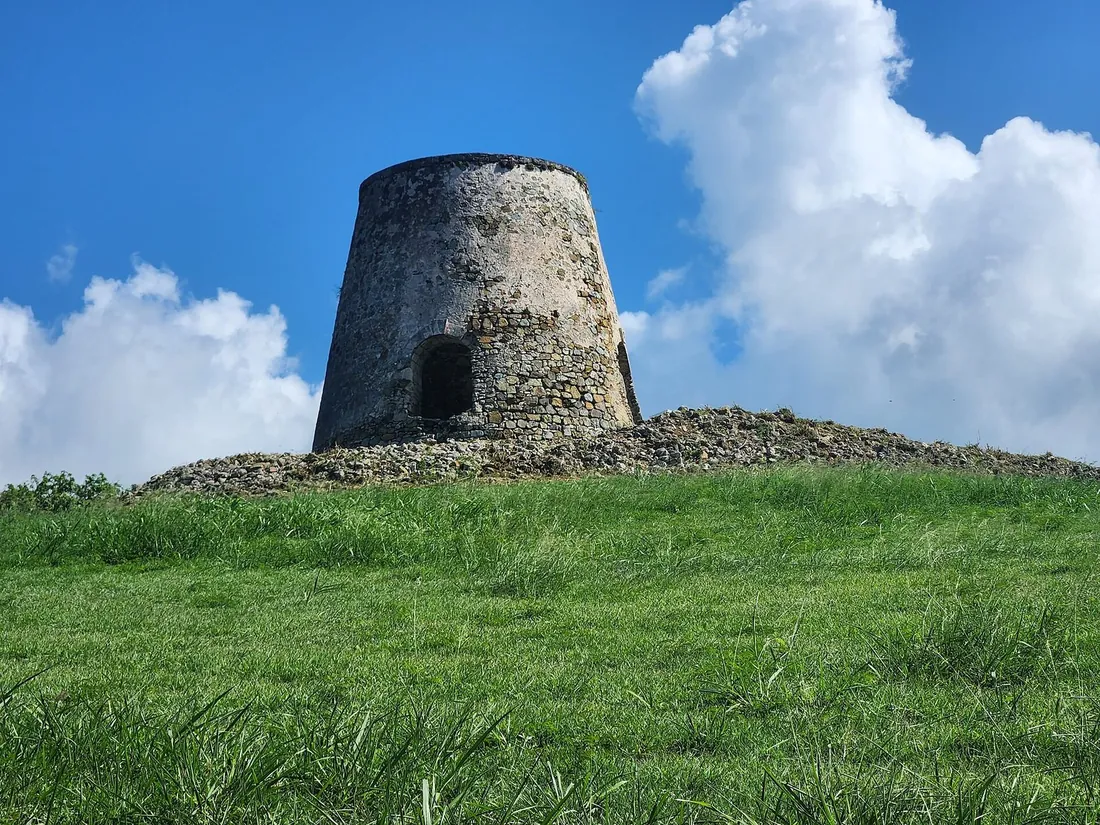
The stone tower most likely went up in the 1770s, and the island-wide survey of mill ruins records Whim's as the one windmill on St. Croix rebuilt to complete form, cap and all. Inside, three upright iron-shod rollers stand where enslaved workers fed the cane through; a ramp rather than stairs leads up to the crushing floor, and an opening in the wall let the crushed stalks, the bagasse, pass out to dry for fuel. Overhead, a wooden cap houses the shaft the sails once turned, and a machine slot with its own stairs gave workers access to the gearing. Remember the detail from the labor story: no brake, and an axe kept within reach.
The animal mill round
Older than the tower — an animal mill shows on estate maps from 1766 — this is the raised circular platform with ramps at its edges. Mules or oxen walked the circle hitched to long sweeps that turned another set of three vertical rollers, and a masonry basin below the platform caught the juice. The rollers have collapsed, but the round itself reads clearly.
The steam mill
When wind gave way to steam, Whim bought Scottish iron. Two horizontal three-roller steam crushing mills are displayed at the site: one built by P&W McOnie of Glasgow in 1847, works number 48, and one by McOnie & Mirrlees, also Glasgow, from 1855, number 184. The tall brick chimney nearby served the steam plant and the boiling house fires, and it is the landmark you can spot from Centerline Road.
The factory and boiling house
Downhill of the mills — always downhill, so juice could flow by gravity — stand the ruins of the sugar factory, where the survey records a train of four boiling pots. This is where juice was clarified and reduced to the point of crystallizing; the next section walks through the process itself.
The service buildings
Around the yard survive the smaller structures that kept an estate running: the cookhouse, a separate kitchen kept away from the residence so its constant fire could not take the house with it; the bathhouse, listed by the Society as the privy and bath house; the watch house, whose name records its job of keeping eyes on the yard and works; and the carriage house for vehicles and tack. Beyond them lie the foundations of the workers' houses — the Village.
The exhibits
My Granny House is the museum's permanent exhibit on how ordinary Crucian families lived in the generations after the estates, and the North and South Exhibit Halls carry rotating cultural shows. Both were among the storm-damaged spaces, so check what is open when you arrive.
Structures at a glance
| Structure | Date | What it did | State today |
|---|---|---|---|
| Great house | c. 1794-96 | Planter's residence; oval plan, dry moat, cellar | Exterior viewing only since 2017 |
| Windmill | Likely 1770s | Crushed cane between three rollers when the trades blew | Rebuilt complete; entered by ramp |
| Animal mill round | By 1766 | Mule- or ox-driven crushing on a raised platform | Platform and juice basin survive |
| Steam mill | Engines of 1847 and 1855 | Steam-powered crushing after wind power faded | Two Glasgow engines displayed; chimney stands |
| Boiling house / factory | 18th-19th c. | Juice boiled down a four-pot copper train to crystal | Ruins, walkable |
| Cookhouse | 18th-19th c. | Estate kitchen, detached for fire safety | Survives |
| Bathhouse | 18th-19th c. | Privy and bathing house | Survives; storm-damaged |
| Watch house | 18th-19th c. | Lookout over the yard and works | Survives; storm-damaged |
| Carriage house | 18th-19th c. | Vehicles, harness and tack | Survives |
| Workers' village | By 1750 | Homes of the enslaved, later of contract laborers | Foundations |
| My Granny House | Exhibit | 20th-century Crucian home life, interpreted | Confirm access at the gate |
Cane to muscovado to rum
Everything on the grounds existed to run one race against spoilage, and the process makes the ruins legible.
It began in the field with cane holes — square pits, dug with hand tools, that held water and soil around each plant — and cuttings laid flat so they would bud at both ends. Cane took about a year to mature, and harvest was timed to the steady winter trades, the Christmas winds, because the windmill needed them. At cutting, every part of the plant had a job: the leafy tops went for animal fodder, sound sections of stalk were set aside as planting stock for the next crop, the juicy lengths went to the mill, and the field trash was burned as fuel. Once cut, the clock started: cane goes off within about three days of harvest, and pressed juice within about two, so crushing and boiling had to happen on the estate, immediately, around the clock in crop time.
Cut stalks went between the rollers, and the juice ran down a trough to the boiling house. There it moved through the copper train, each vessel smaller and hotter than the last, each with its own fire beneath it, while impurities were skimmed off in the biggest copper. When the sugar-master judged the syrup ready, it was struck off to a cooler to crystallize, then packed into inverted cone molds with a hole at the tip. Over one to two months in the curing stage, molasses dripped out of the cones, leaving muscovado — raw brown sugar — which shipped out for final refining in Europe or North America. Nothing was wasted: the dried bagasse from the rollers fueled the copper fires, and the molasses, along with the sweet water used to rinse the coppers between boils, went to the stills as the makings of rum. The finished goods left the island in hogsheads weighing 800 to 1,500 pounds, floated out to ships by skiff.
To see the process still running at industrial scale, drive ten minutes to the Cruzan Rum Distillery at Estate Diamond, where molasses ferments and a five-column still works to this day. The two stops together are the whole arc of the sugar economy, old technology and living industry.
What a mill cost
The capital figures explain why estates looked the way they did, and why so few families owned them. Contemporary accounts priced an animal mill at roughly 1,000 pieces of eight — plus about 2,500 more for its twenty mules — while a windmill could run to 9,000 pieces of eight. A complete working estate represented 50,000 to 70,000 pieces of eight, a sum one modern silver-content estimate translates to something like $30-45 million today. Steam reached the island in 1814 at Estate Hogensborg, and by 1857 the census of machinery read 62 steam mills, 80 windmills and just 4 animal mills still turning.
| Mill type | Approximate cost | At Whim | Island-wide in 1857 |
|---|---|---|---|
| Animal mill | ~1,000 pieces of eight, plus ~2,500 for mules | On maps by 1766 | 4 in service |
| Windmill | Up to 9,000 pieces of eight | Tower likely 1770s | 80 in service |
| Steam mill | Machinery imported; first on island 1814 | Engines of 1847 and 1855 | 62 in service |
St. Croix counted over 150 mills at the height of the industry, and their towers still stand across the island; the sugar mill ruins guide maps where to see the best of them from the road.
The Research Library and Archives
On the museum grounds, the Landmarks Society keeps a Research Library and Archives that serves genealogists and Caribbean historians — a working collection of estate records, historical documents and a photograph archive from which prints can be purchased. For Crucian families tracing ancestry through the Danish period, and for visitors researching a particular estate, it is one of the most valuable rooms on the island. Access is by appointment, arranged through the Society, so email or call before your trip rather than after you arrive. At last check the archive remained active even while building repairs continued around it; confirm current arrangements when you book a slot.
Apothecary Hall, the Society's town museum
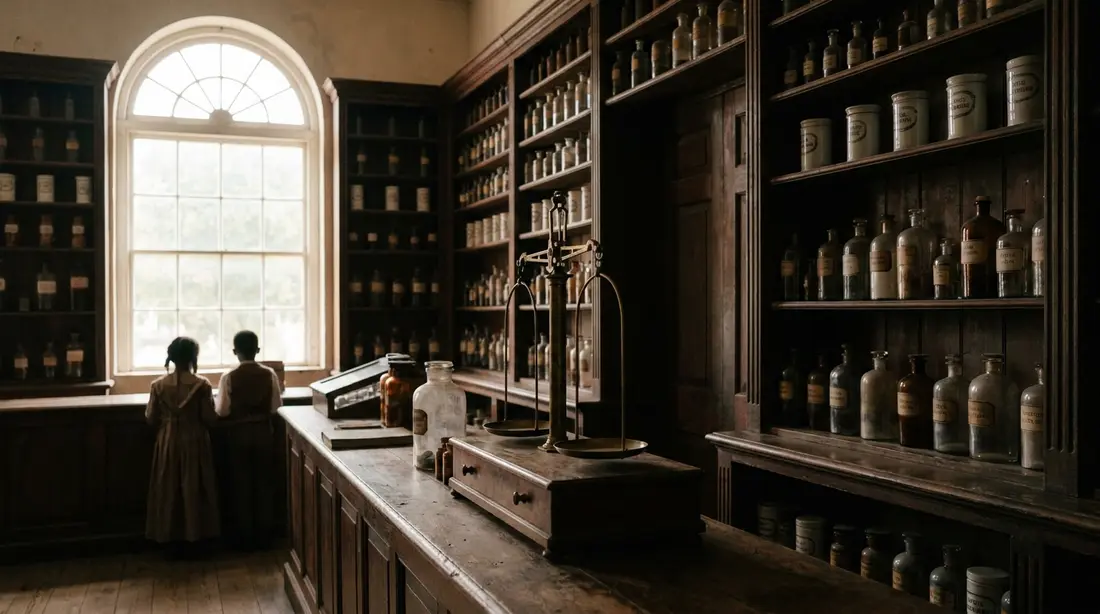
Whim is one of two museums the Landmarks Society operates. The other is Apothecary Hall in Christiansted: a Danish colonial pharmacy founded in 1820 by a pharmacist who came out to compound medicines for the garrison, housed in the same building from 1828 until it finally closed as a working drugstore in 1970. The Society restored it and opened it as a museum (published accounts date the opening to the late 1980s or 1996), original drug jars, powder drawers and equipment intact. At last check it kept Monday-to-Saturday, 10-to-4 hours with free admission — an easy add-on to a Christiansted historic district walk, and a neat pairing: the Society's country museum and its town museum, forty minutes apart.
Concerts and events at Whim
The great-house lawn has long been the Landmarks Society's stage. The Society's fundraising calendar has centered on a Candlelight Concert Series — classical and other musicians performing by candlelight, with Whim's great house among the listed venues — and on annual House Tours of notable Crucian homes, which have run in February and March. Longtime visitors may also remember antiques auctions on the lawn; do not plan around those without checking, since the event lineup has shifted through the recovery years. The Society's own events calendar is the source of record for what is scheduled during your dates, and evening events at Whim are worth building a night around: the grounds by candlelight are a different place.
Visiting Estate Whim
Whim sits on Centerline Road (Queen Mary Highway) at 52 Estate Whim, about ten minutes from the Frederiksted waterfront and a bit over half an hour from Christiansted; remember to keep left the whole way (see driving on the left). Plan 60 to 90 minutes for the grounds, longer if a docent is giving tours or you fall into conversation, which happens here. The site is mostly open lawn with little shade, so a hat, water and closed shoes for the ruins are the kit; mornings beat afternoons for heat.
With kids it works better than most museums: there are ramps to climb, mill machinery to puzzle out and room to move, and the sugar-process story is concrete enough for school-age children to follow. Combine it with a beach hour afterward and nobody complains. On rain-threatened days it also slots neatly into the covered-and-outdoor sequence in the rainy-day plan. Hours, again, at last check: Wednesday and Saturday 10 to 3, plus cruise days, roughly $10 and $5 admission — and a two-minute call to 340-772-0598 before you drive across the island is the single best piece of advice on this page.
Cruise-day openings cut both ways. When a ship is at the Frederiksted pier, Whim is likelier to be open outside its usual two days, so a ship in port can rescue an otherwise closed morning — and the same ship means shared grounds and a fuller parking area. If you want the site quiet, a regular Wednesday or Saturday right at the 10 a.m. opening has been the calmest window, and the light on the stone is better then too.
Building a west-end day around Whim
Whim anchors the island's history corridor, and the classic sequence runs sugar in the morning, rum after lunch, water at the end. Start at the museum when the gate opens. Add St. George Village Botanical Garden, a few minutes east, where a 16-acre garden grows through another estate's ruins. Book an early-afternoon slot at Cruzan, then drop into Frederiksted for the fort, the pier and dinner as the sun goes down over the water — the west coast's standing reward, covered in the sunset beaches guide. If the mood is more forest than town, the west-end rainforest roads begin just inland. A rum note for planners: the Captain Morgan Visitor Center mid-island covers the modern industrial end of the story and pairs well with Whim on a different day.
Questions guests ask
Is Whim worth the drive while the great house is shut?
Yes. The closure disappoints people who arrive expecting the furnished rooms described in old articles, so it helps to reset expectations before the drive. The house was always the smallest part of the acreage. The windmill you can walk into, the animal mill round, the Glasgow steam engines, the factory ruins, the service buildings and the village foundations are all outdoors and all open, and together they teach more about how the island actually worked than the parlor ever did. Price the visit as a walk through a complete 18th-century industrial site, and it earns its slot easily.
Which days is the gate open?
The pattern at last check was Wednesday and Saturday, 10 a.m. to 3 p.m., with extra openings when a cruise ship calls at Frederiksted — and some directories list Wednesday through Saturday, which tells you how much the schedule has moved during the recovery years. Treat every published listing, this one included, as a starting point and call 340-772-0598 once your dates are set. If your itinerary is tight, aim for a Saturday, which has appeared in every version of the schedule we have seen.
How long does a visit take?
Sixty to ninety minutes covers the grounds at a comfortable pace, including time inside the windmill and along the factory ruins. Add time if rotating exhibits are open, if a staff member offers a walkthrough, or if you are pairing the visit with a library appointment. It is deliberately easy to combine with the botanical garden and Cruzan in a single unhurried day, since all three sit on the same few miles of road.
Why is the great house oval?
The rounded ends were a stylistic flourish — writers have compared the house to a small French chateau — but the shape belongs to a whole system of tropical engineering: thick coral-and-limestone walls that damp the heat, tall aligned openings that pull the trade wind straight through, and the dry moat around the base that lights and ventilates the cellar. The result was a house that stayed livable through Caribbean summers two centuries before air conditioning, which is why the design still gets studied.
What happened to Whim in the Fireburn?
Whim appears on the contemporary lists of estates damaged or destroyed when laborers rose on October 1, 1878, burning most of Frederiksted and at least 51 plantations across the west and center of the island. The revolt began three miles away in town, on the annual Contract Day, and swept east through exactly the fields the museum now interprets. The causes, the four women who led it and the reforms that followed are in the Fireburn guide.
Can we research our family history there?
Yes — this is one of the museum's quietest strengths. The Research Library and Archives on the grounds holds genealogical resources, estate records and a photograph collection covering the Danish colonial period and after, and researchers use it to trace Crucian family lines through and beyond the plantation era. Visits are by appointment, so contact the Landmarks Society ahead of your trip, and confirm the archive's current setup when you book, since building repairs have moved collections around.
What should we bring, and where is lunch?
Sun kit: a hat, water and shoes you can walk ruins in, because shade on the lawn is scarce and the stonework is uneven in places. There is no restaurant at the museum, so plan food around Frederiksted, ten minutes west, where the waterfront has solid casual options, or fold the visit into a Cruzan tour with lunch between the two. Cash for admission is a safe hedge at small island museums, though confirm current payment options when you call about hours.
Staying near the history corridor
Guests at Sunset Sea-Clusion, our Frederiksted home, can be at Whim's gate within about ten minutes of leaving the driveway, which turns the museum, the botanical garden and Cruzan into an easy morning rather than a cross-island project. From our East End and Christiansted properties, the drive west along Queen Mary Highway takes a bit over half an hour and passes a parade of mill towers that will mean something after this page. Every one of our twelve villas and condos puts you within a day-trip of the whole sugar story, from the 1770s windmill to tonight's rum pour on your own gallery.
Sources
Written from official and first-party sources, checked August 2026. Hours, prices and event dates change — confirm before you go.
In this guide
Stay nearby
On The Shoys beach: six bedrooms, six baths, pool and hot tub, room for twelve, and the beach through the back garden.
 Shoy's Beach House6 bd · 6 ba · sleeps 12 · Christiansted
More in History & Culture
Sources
12 references, listed in full at the end of this guide — official park, refuge, tourism-board and business sources, checked August 2026.