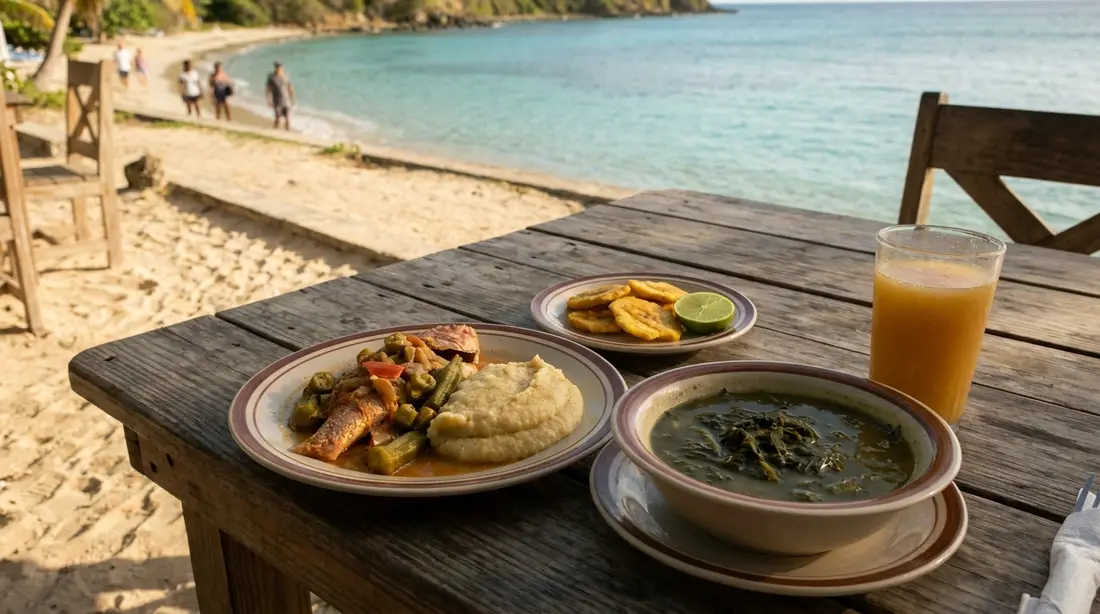
What to Eat on St. Croix
Pate, johnny cakes, kallaloo, fungi, saltfish, stew conch: the Crucian plates worth ordering, and where the flavors come from.
Crucian food is the cooking of St. Croix: a creole kitchen with West African foundations and Danish, Puerto Rican, eastern-Caribbean and American layers added across three centuries. Most of it is inexpensive, generous and cooked from recipes that live in families rather than cookbooks. This page is the cuisine itself — where it comes from, the full canon of dishes and drinks, the fruit calendar behind them, and how a villa guest gets to eat all of it. The fried-dough branch has its own detailed page, linked below; the tables and counters that serve everything are in the restaurant guides linked throughout.
Five layers, one kitchen
Crucian cooking follows the island's census. The base layer is West African, carried by the enslaved people who worked St. Croix's sugar estates through nearly two centuries of Danish rule. Okra, stewed greens, one-pot cooking over coals, cornmeal turned into a soft staple — the techniques and the palate underneath almost every traditional plate arrived this way, kept alive in provision grounds and Sunday markets where enslaved cooks grew and traded their own food. Kallaloo and fungi are the most direct descendants, and both are still on the table.
The Danish layer, 1733 to 1917, contributed less flavor and more circumstance: the plantation ration system that paired cornmeal with salted fish, the estate economy that put pork and ham into holiday cooking, and a handful of direct imports. The clearest survivor is red grout, the guava-and-tapioca dessert adapted from Denmark's rodgrod med flode; a case can also be made for the island's love of dense celebration cakes.
The Puerto Rican layer arrived mostly by boat from Vieques. Hard times in the 1920s and the closure of Vieques sugar mills in the 1930s sent thousands of Puerto Rican families to St. Croix to cut cane, and between the 1920s and the 1960s they became a permanent part of the island — historians write about a blended "Puerto-Crucian" identity, and the food followed the families. Coquito at Christmas, rice-and-beans traditions, lechon at holiday tables and Spanish surnames over restaurant doors all trace to this migration.
The eastern-Caribbean layer came next. From the early 1950s through the 1970s, workers from St. Kitts, Nevis, Antigua, Montserrat, Dominica and the rest of the chain — "down island," in local speech — came to build and staff the hotels, the airport and the Hess refinery. They brought curry, roti and doubles with them, and those are now ordinary Crucian lunches. The American layer sits on top: supermarkets, diners, brunch. The island absorbed it the way it absorbed everything else, without giving up the older table.
Two things make this history unusually visible on St. Croix. The first is that the layers never fully merged — a single week here can hold a Danish-descended pudding on a holiday table, a Puerto Rican coquito, a Kittitian-style curry from a van and an okra stew whose technique predates all three flags. The second is that the territory now protects the canon on paper: in 2024 the Legislature and the governor put the founding plate into law, a formal answer to the worry that the old dishes might fade as the cooks who guard them age. The food fairs, the school cultural days and the church-hall pots do the same work informally, which is why this cuisine is easiest to meet at events rather than restaurants.
Fish and fungi, the official plate
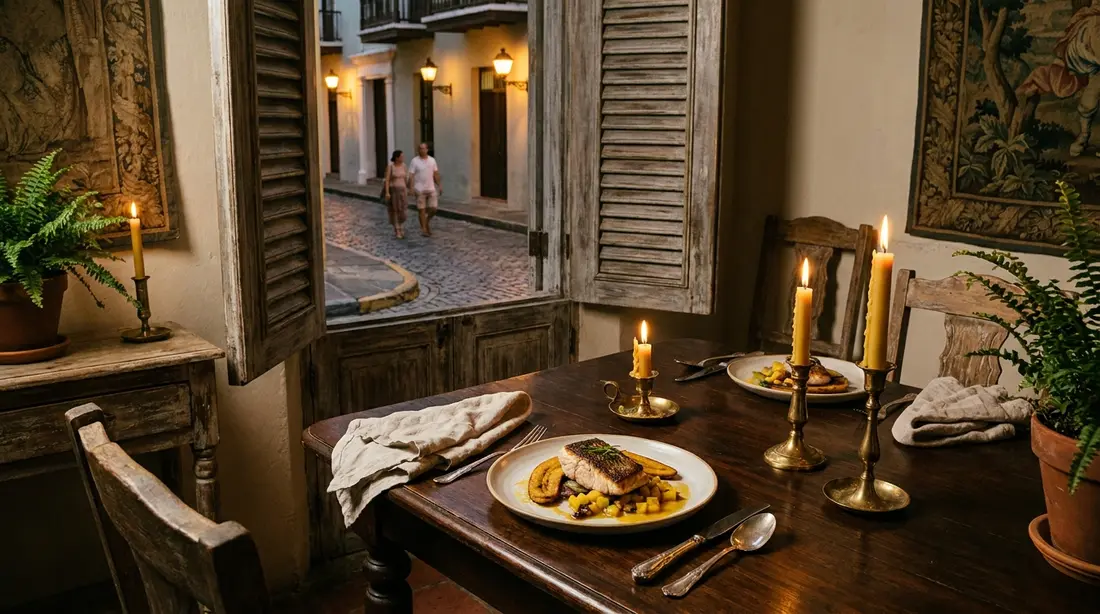
Fish and fungi carries legal status now. Governor Albert Bryan Jr. signed Bill No. 35-0078 on July 11, 2024, making it the official dish of the U.S. Virgin Islands (the same act named the tart the official dessert). The neighboring British Virgin Islands claim fungi and fish as their territorial dish too, which tells you how deep the pairing runs across the whole archipelago.
Fungi — say FOON-jee — is cornmeal whisked into boiling water with sliced okra and finished with butter, worked smooth over the heat until it forms a soft, spoonable mound. Island cooks talk about "turning" fungi, and the wrist work matters: lumps are the mark of an unpracticed hand. It lands somewhere near polenta and grits on the mainland map, with the okra giving it a silkiness neither of those has. The fish half is local catch — often boiled in a lime-and-herb broth with hot pepper, or pan-fried — finished with a creole-style sauce of onion, sweet pepper, tomato and thyme.
The plate's ancestry is the reason for the honor. It began as survival cooking assembled from plantation rations of cornmeal and salted fish, refined over generations into the territory's signature. Our kallaloo and fungi page is the dedicated reference for both of that page's dishes.
Kallaloo
Kallaloo is a deep-green pot that sits between soup and stew: leafy greens and okra simmered down with thyme and hot pepper over stocks built from fish, crab, conch, salted meats or ham bone, every household to its own formula. On St. Croix the greens are commonly spinach and whatever the garden gives, with onion, celery and parsley in support; elsewhere in the Caribbean the same word (usually spelled callaloo) names a different dish built on dasheen leaves and coconut milk. The ancestry is West African on every island, and on St. Croix the pot carries ceremony — it is the dish Crucian families cook as the old year turns to the new, a tradition covered in our Crucian Christmas Festival guide. The rest of the year it appears at food fairs, at family gatherings and wherever a cook wants to show a full range.
Saltfish, morning and always
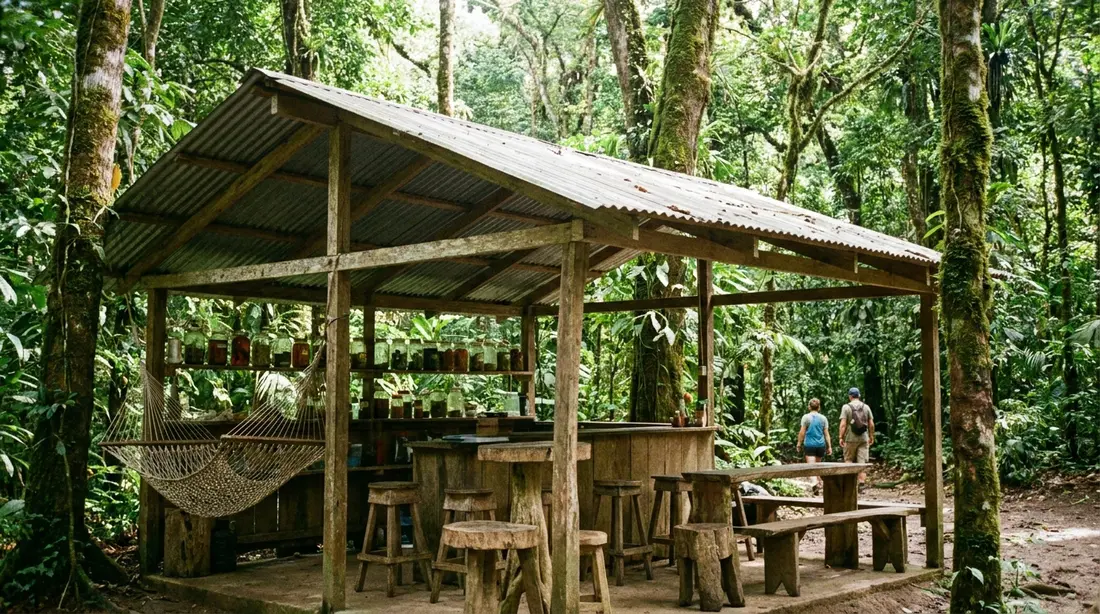
Salt-cured, dried fish — rehydrated overnight, flaked, then sauteed with onion, sweet pepper and thyme — threads through the whole cuisine. It fills the classic pate. It anchors the traditional Crucian breakfast, where it shares the plate with boiled eggs, cooked greens and johnny cakes or dumb bread; the breakfast and brunch guide explains where to find that plate, because it is rarely posted on a menu. And it stands behind fish and fungi's origin story, since salted fish was the ration protein the dish was born from. If one ingredient explains Crucian food's logic — preservation first, seasoning second, nothing wasted — it is this one.
Souse and the celebration pork
Souse is the dish visitors least expect and locals most defend: pork from the head, feet and tail, cooked down and served in a sharp lime-based broth with hot pepper, onion and herbs, traditionally alongside potato salad. It descends from the same waste-nothing economy as saltfish — the estate pig's prime cuts went elsewhere, and the cooks made the rest delicious. Across the English-speaking Caribbean souse is a weekend dish, and on St. Croix it shows up at fairs, fundraisers and family Saturdays rather than on restaurant menus; when a church hall or a roadside tent advertises it, that is the real thing.
The other side of the celebration table is potato stuffing, a Crucian holiday fixture with a misleading name: no bird involved. It is white potato mashed and baked with raisins, minced onion, diced celery and tomato into something between a side dish and a souffle, sweet-edged and dense. It belongs to Thanksgiving, Christmas and Sunday dinners, usually next to ham, turkey or roast pork — the Danish-era estate ham tradition and the Puerto Rican lechon both feed into the same holiday plate.
The stew pots
Crucian cooking stews what tougher cuts it is given, slowly and darkly. Stewed goat — locals often say mutton — turns up over rice or fungi at local kitchens and fairs, seasoned deep with thyme, pepper and browning. Stewed oxtail gets the same treatment and has the same following; both reward whoever ordered them over the safer choice. Cow heel soup, thick with okra, potato, carrot and flour dumplings, belongs to the same family of long-simmered comfort. None of these are tourist dishes, which is exactly the recommendation: find them at local counters, at festival booths, and wherever a chalkboard lists the day's pot. Recipes vary house to house and nobody writes them down; the constant is time on the stove.
Senepol, the island's own beef
St. Croix did something almost no small island has done: it bred its own cattle. In 1860, about sixty N'Dama heifers and two bulls arrived from Senegal, and by 1889 Henry C. Nelthropp — the same family name that runs through the island's rum history — kept 250 purebred N'Dama at the Granard estates. In 1918 his son Bromley crossed in a Red Poll bull bought from Trinidad to improve milk and lose the long horns, and decades of selection for solid red color, natural polling and heat tolerance produced a new breed. It took the name Senepol in 1954 and gained a formal registry in the late 1960s; genetic work has since shown Criollo ancestry in the mix as well. Senepol cattle now graze pastures on several continents, and they still graze St. Croix — when a menu or a fair plate advertises local beef, this is the animal behind it. The cattle a visitor sees grazing island pastures are working livestock, heirs to a breeding project more than 160 years old.
From the reef and the rocks
The sea supplies the cuisine's luxuries. Conch — the big pink-shelled sea snail — is the headliner, and conch in butter sauce is its definitive Crucian preparation: the meat sliced thin, pressure-cooked until tender, then bathed in melted butter loaded with sliced onion and seasoning. Stew conch in a tomato-based sauce is the older cousin, and conch also fills pates and fritters. Supply moves with season and regulation, so kitchens serve it when they have it; asking what came in today is standard practice, not pushiness.
Whelks — wilks in island speech — are the West Indian top shell, a black-and-white sea snail gathered off wave-washed rocks around the shoreline. Archaeologists find piles of the shells in pre-Columbian sites across the territory, which makes this the oldest continuously eaten food on the island. They are boiled in the shell, picked, cleaned and finished in butter or stewed; whelks and rice is a beloved old-time plate that surfaces at fairs and family tables more than on menus.
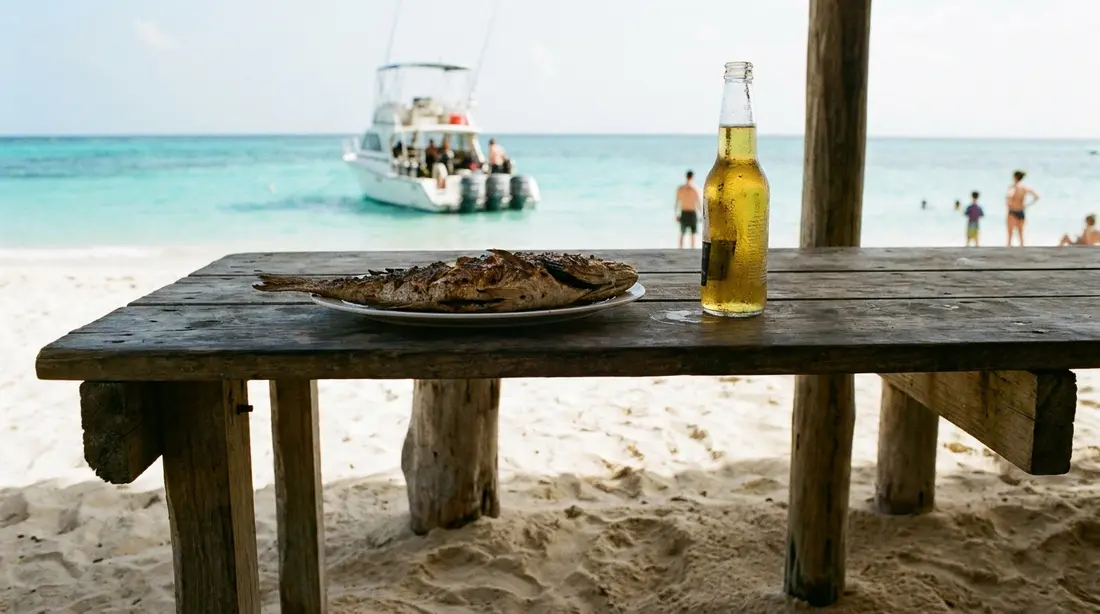
Then the finfish: wahoo, mahi mahi and kingfish from offshore, snapper and the mixed small reef catch Crucians call pot fish, plus spiny lobster. Boiled fish — a whole fish simmered in that lime-herb-pepper broth, often with an "ole wife" (a local whitefish name) in the pot — is the traditional preparation mainland visitors order least and remember most. The Christiansted, Frederiksted and East End restaurant guides map who is cooking the catch this year.
Rice, peas and provisions
The bottom half of a Crucian plate has its own vocabulary. Peas and rice — pigeon peas or beans cooked into seasoned rice — is the default starch beside stews and fried fish. Seasoned rice, the party version, is a one-pot rice colored and flavored with tomato, herbs and bits of meat or saltfish; each household runs its own recipe and gatherings judge them. "Provisions" is the collective word for boiled starches — breadfruit, cassava, yams, sweet potato and green plantain — served plain beside rich mains, a direct inheritance from the provision grounds where enslaved families grew their own food. Breadfruit deserves its own mention: roasted, boiled or fried, it is a staple with history, and the island now also distills it into Mutiny Island Vodka.
The fried-dough department
The pate, the johnny cake and dumb bread make up the cuisine's bread branch, and they have their own full reference: pates and johnny cakes covers the dough, the fillings, the journey-cake etymology argument, the verified vendors and the pate-versus-patty question. For this page's purposes, know that the pate (pa-TAY) — a fried turnover filled with saltfish, beef, chicken, conch or vegetables — is the island's true fast food, the johnny cake is its everyday bread, and dumb bread, the dense coconut-scented round baked in a covered pot, is the third member of the breakfast trinity.
Vienna cake, red grout and the sweets
The dessert canon peaks at the Vienna cake, a Crucian specialty found nowhere else in the world. It is a celebration cake of five to seven thin butter-cake layers, each spread with a different fruit preserve — guava, gooseberry, guavaberry, pineapple and greengage are traditional — stacked, sealed under white boiled icing, and rested a full day so the preserves perfume the crumb before anyone cuts it. The name nods to the layer cakes of Vienna; the execution is entirely St. Croix. It appears at weddings, birthdays and holidays, made by home bakers whose reputations ride on it. Who baked the first one, and who fixed the layer count, nobody can say — the recipe's history is oral, like most of this cuisine's.
Red grout is the Danish keepsake: guava and tapioca cooked into a rose-colored pudding, served cold with cream — a Crucian adaptation of rodgrod med flode. It is tied to Transfer Day, March 31, and reappears through the Christmas season. Black cake, the dark fruitcake whose dried fruit soaks in rum and brandy for months before baking, rules the holidays. And the humble tart now holds the territory's official-dessert title under the same 2024 act that crowned fish and fungi. A Virgin Islands tart is a pastry shell filled with fruit cooked down at home — stewed guava, grated coconut simmered with spice, pineapple, gooseberry — and it earns its status by being everywhere: bakery cases, fair tables, holiday tins, family gatherings. It is the dessert Crucians eat week in and week out, which makes it a fitting choice over grander candidates. The street-candy table (tamarind balls, sugar cakes, gooseberry stew over ice cream) is covered in the pate guide, and the bakery-and-ice-cream circuit in coffee and sweets.
What Crucians drink
Maubi is the island's heritage beverage and its best argument-starter. It begins as bark — from the maubi tree, Colubrina elliptica or its relative Colubrina arborescens — boiled with spices that usually include cinnamon, clove, anise and orange peel, sweetened, then fermented a few days with a splash of a previous batch as the starter. The ferment softens the bark's bitterness and puts a gentle fizz and a big foam on the pour. The taste opens like root beer and closes bitter, and islanders grew up on it centuries before soda reached the Caribbean; versions of the same drink run from Puerto Rico (mavi) to Trinidad (mauby). Buy it in longneck bottles from fair vendors, markets and roadside coolers, and open it over a sink the first time.
Seamoss is the other bottled tradition: a red seaweed boiled to a gel and blended with milk, sugar, nutmeg and vanilla into something closer to a milkshake than a juice. The fresh-juice bench is deep — soursop, passionfruit, tamarind, ginger beer, coconut water — and bush tea, brewed from local leaves and herbs, is the standing morning and remedy drink. December brings the seasonal pair: sorrel, the crimson spiced hibiscus drink, and coquito, the Puerto Rican rum-and-cream holiday bottle that the Vieques migration made Crucian too. Guavaberry liqueur, the caroling drink steeped from wild December fruit, has its own story in the festival guide linked above. The distilled side of the island — Cruzan's 1760-founded rum operation above all — lives in the Cruzan distillery guide.
The fruit calendar
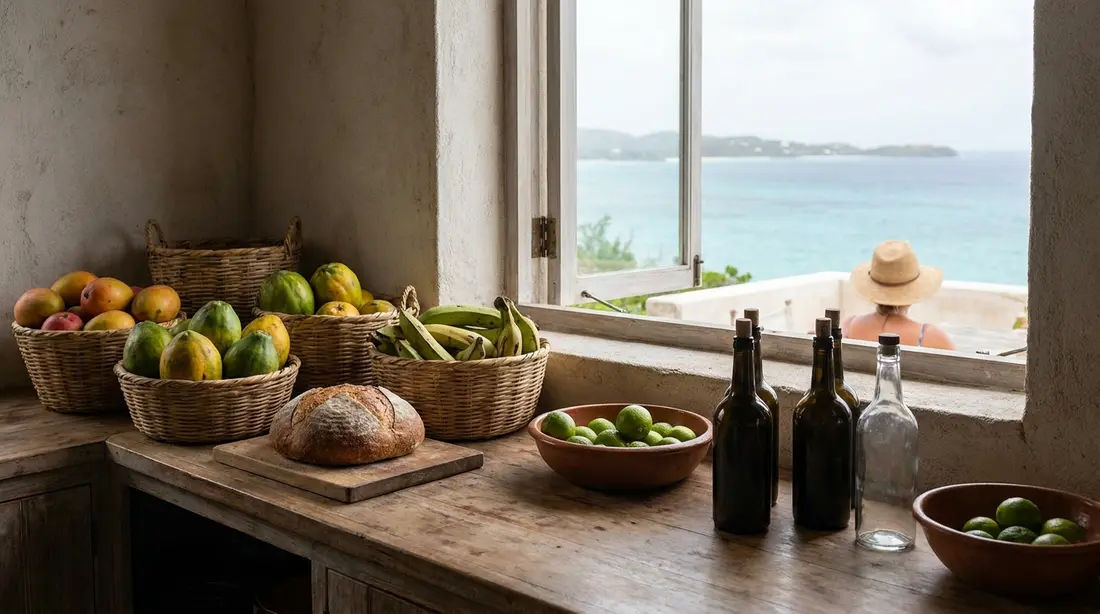
The cuisine runs on a fruit clock that mainland shelves never taught. Summer is the crest: mango trees across the island outproduce their owners, roadside fruit stands multiply, and the season gets a festival of its own — Mango Melee at the St. George Village Botanical Garden, held each July (the 30th edition ran July 12, 2026) with a mango-eating contest, moko jumbies and more than a hundred food and craft vendors on the garden's grounds. Genip clusters hang in bags at roadside stands through the hottest months, eaten by the branchful. Soursop turns into juice and ice cream; sugar apple and mesple reward anyone willing to ask what they are. Guavaberry ripens wild in December and goes straight into the liqueur. Breadfruit, papaya, banana and avocado cycle through much of the year. The groceries and provisioning guide covers the Saturday market and farm stands where this calendar becomes a shopping list, and St. Croix in July describes the island at peak mango.
Where a guest meets the cuisine
The short version: counters, fairs and festival booths first, restaurants second. The named year-round addresses — La Reine Chicken Shack's spit-roasted chicken with johnny cakes, Turtle's Deli's sandwiches in Frederiksted — are profiled in local food institutions, and the pate guide lists the verified street-food vendors. February's AgriFest at Estate Lower Love is the single densest concentration of traditional cooking on the calendar, with the festival food fair in late December its rival. Taste of St. Croix in June is the chef-driven event. One correction that outlives every old guidebook: Harvey's, long Christiansted's standard-bearer for home-style Crucian plates, is permanently closed. The tradition moved to counters, vans and fairs; go where the line of locals is, and lead with good morning.
Two etiquette notes serve better than any listing. First, traditional kitchens cook in batches and sell until the pot is done — earlier is better, and a sellout is a recommendation for next time. Second, your villa manager eats this food every week; asking who has kallaloo or souse on right now gets fresher intelligence than anything printed, this page included.
The canon at a glance
| Dish | What it is | When and where it appears |
|---|---|---|
| Fish and fungi | Local fish in creole sauce with okra-cornmeal fungi; the official territorial dish | Local kitchens, fairs; year-round |
| Kallaloo | Green stew of leafy greens, okra, seafood and salted meats | Food fairs, gatherings; the New Year pot |
| Saltfish | Rehydrated salt-dried fish sauteed with onion, pepper, thyme | Breakfast plates and pate fillings; mornings |
| Souse | Pork head, feet and tail in lime broth with potato salad | Fairs, fundraisers, family weekends |
| Stewed goat, oxtail | Dark, slow stews over rice or fungi | Local counters, chalkboard specials |
| Conch in butter sauce | Thin-sliced conch, pressure-cooked, in onion butter | Restaurants and local kitchens, supply permitting |
| Whelks | West Indian top shell, boiled, in butter or stewed | Fairs and family tables; occasional menus |
| Potato stuffing, seasoned rice, provisions | The celebration and everyday starches | Holiday tables, local plates daily |
| Vienna cake, red grout, black cake, tarts | The dessert canon, from layered cake to guava-tapioca pudding | Celebrations; Transfer Day; Christmas; bakeries |
| Senepol beef | Beef from the cattle breed developed on St. Croix | Local menus and fair plates as supply allows |
| Maubi, seamoss, sorrel, coquito | The bottled drink canon, brewed and seasonal | Vendors and markets; December for the holiday pair |
Cooking Crucian in a villa kitchen
Some of this canon is realistic for a visitor with a week and a good kitchen, and some should be left to the aunties. Three dishes travel well into amateur hands. Fresh fish creole-style: buy wahoo or mahi from the market or the Saturday fish coolers, and simmer a sauce of onion, sweet pepper, tomato and thyme — the technique is ordinary, the ingredients do the work. Fungi: cornmeal, okra, butter and patience, with lump-free turning the only skill to practice. Peas and rice with boiled provisions: forgiving, cheap and exactly what the stews want underneath them. Kallaloo, souse and Vienna cake are the opposite case — recipes that reward decades, best eaten from the hands that have them. Every ingredient above is on island; the provisioning guide linked in the fruit section maps the supermarkets, the Saturday market and the gourmet counter. If the group wants the real repertoire cooked in the villa with no burned first attempts, the island's private chefs cook Crucian menus as their signature work.
Questions guests ask
What food is St. Croix known for?
Fish and fungi (the official territorial dish), kallaloo, pates and johnny cakes, saltfish, souse, stewed goat and oxtail, conch in butter sauce, whelks, and a dessert canon led by the Vienna cake and the officially designated tart. The drink list runs maubi, seamoss, fresh local juices and Cruzan rum. The cooking is creole in the true sense — West African foundations with Danish, Puerto Rican, eastern-Caribbean and American layers — and the best of it is sold from counters, fairs and festival booths rather than formal dining rooms.
Is Crucian food spicy?
Seasoned deeply, yes; hot by default, no. Most traditional dishes are built on thyme, onion, sweet pepper and slow cooking rather than raw heat. Scotch bonnet pepper is respected and present, but it usually arrives as pepper sauce on the side or as a whole pepper simmered in the pot and removed. If heat matters to you in either direction, ask — vendors field that question constantly and answer it straight.
What is the difference between fungi and callaloo elsewhere in the Caribbean?
Two separate traps. Virgin Islands fungi is okra-and-cornmeal, no mushrooms involved, cousin to polenta. And Virgin Islands kallaloo is a mixed-greens-and-okra stew over seafood and meat stocks, while the callaloo of Trinidad and much of the eastern Caribbean is a different dish made from dasheen (taro) leaves and coconut milk. Same word families, different plates. On a St. Croix menu, assume the Crucian versions.
What should I try first?
A saltfish pate from a roadside vendor, because it costs a few dollars and compresses the whole cuisine into one hand. Then fish and fungi as your first sit-down local plate, then whatever stew the chalkboard names. Drink a maubi with any of them, with the caution that it splits opinion roughly in half. If your dates line up with AgriFest in February or the festival food fair around New Year, the whole canon appears in one field of booths.
What is a Vienna cake?
St. Croix's celebration cake and one of the few dishes unique to the island: five to seven thin butter-cake layers, each carrying a different fruit preserve (guava, gooseberry, guavaberry, pineapple, greengage), iced white and rested a day before serving. It is baked for weddings, birthdays and holidays, almost always by home bakers rather than shops. If you are offered a slice at an island event, accept; ordering one takes a connection and notice.
When is mango season on St. Croix?
Summer, peaking through June, July and August, when trees across the island produce faster than households can eat and roadside stands fill with fruit. The season's festival, Mango Melee, runs each July at the St. George Village Botanical Garden — the 2026 edition, the 30th, drew its usual crowds for the mango-eating contest and vendor rows. Outside mango months the fruit clock keeps moving: genips in high summer, guavaberry in December, soursop, papaya and breadfruit cycling most of the year.
Which local flavors travel home well?
Bottled spirits first: Cruzan rum from the source and Mutiny's breadfruit vodka both pack safely and cost less on island than anywhere else. Dried sorrel keeps for months and steeps into the Christmas drink wherever you live. Local preserves and pepper sauces from fairs and markets travel fine in checked luggage. Maubi is the one to drink here instead — a live ferment in a capped bottle keeps building fizz, and a suitcase is the wrong place for that experiment. Fresh fruit is best treated the same way: eat the mangoes on island and carry the memory.
Can I find these dishes in restaurants?
Some, not all. Fresh catch in creole sauce, conch preparations and stews appear on restaurant menus around the island. Kallaloo, souse, whelks, potato stuffing and the celebration desserts live mostly at fairs, fundraisers, counters and family tables, and the closure of Harvey's in Christiansted removed the best-known restaurant address for home-style plates. The working method is to treat restaurants as one channel and the counters, food vans and event booths as the main one.
Eating Crucian from a villa
A villa week suits this cuisine better than a resort stay does. You get a real kitchen for the market fruit and the fish-market wahoo, a fridge for the maubi and the leftover stew, and a manager on island who knows whose pot is on this week. Our guests tend to settle into a rhythm fast: pates between beaches, one local counter lunch a day, a creole fish dinner cooked at home. The Cerulean and the rest of the collection all carry full kitchens, and we will happily point you toward whoever is cooking the real thing the week you arrive. Ask us early; the good pots sell out by noon.
Sources
Written from official and first-party sources, checked August 2026. Hours, prices and event dates change — confirm before you go.
In this guide
Stay nearby
On The Shoys beach: six bedrooms, six baths, pool and hot tub, room for twelve, and the beach through the back garden.
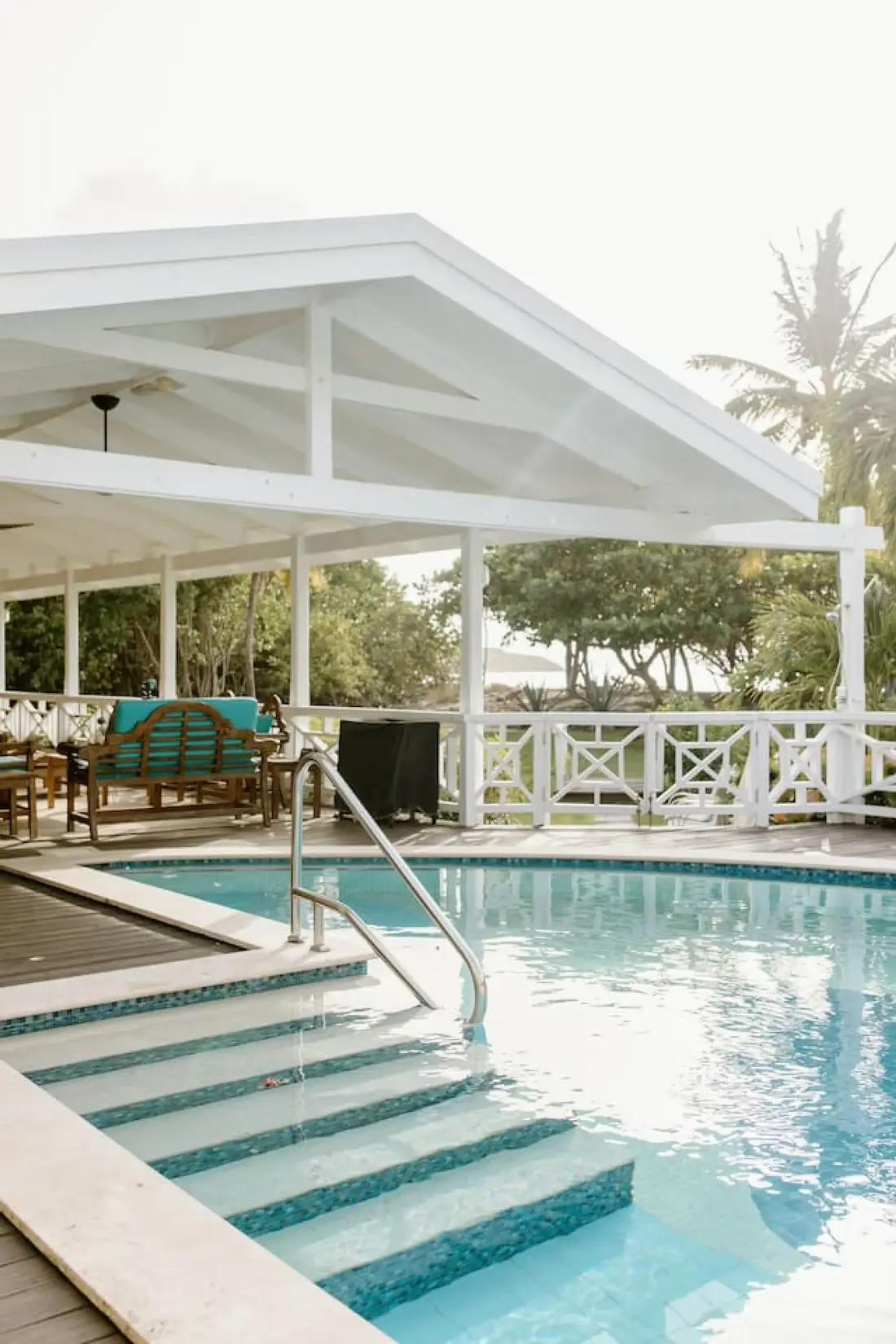 Shoy's Beach House6 bd · 6 ba · sleeps 12 · Christiansted
More in Food & Drink
Sources
14 references, listed in full at the end of this guide — official park, refuge, tourism-board and business sources, checked August 2026.