St. George Village Botanical Garden
Gardens grown through the ruins of an 18th-century sugar plantation village — orchids and cactus among cut-stone walls.
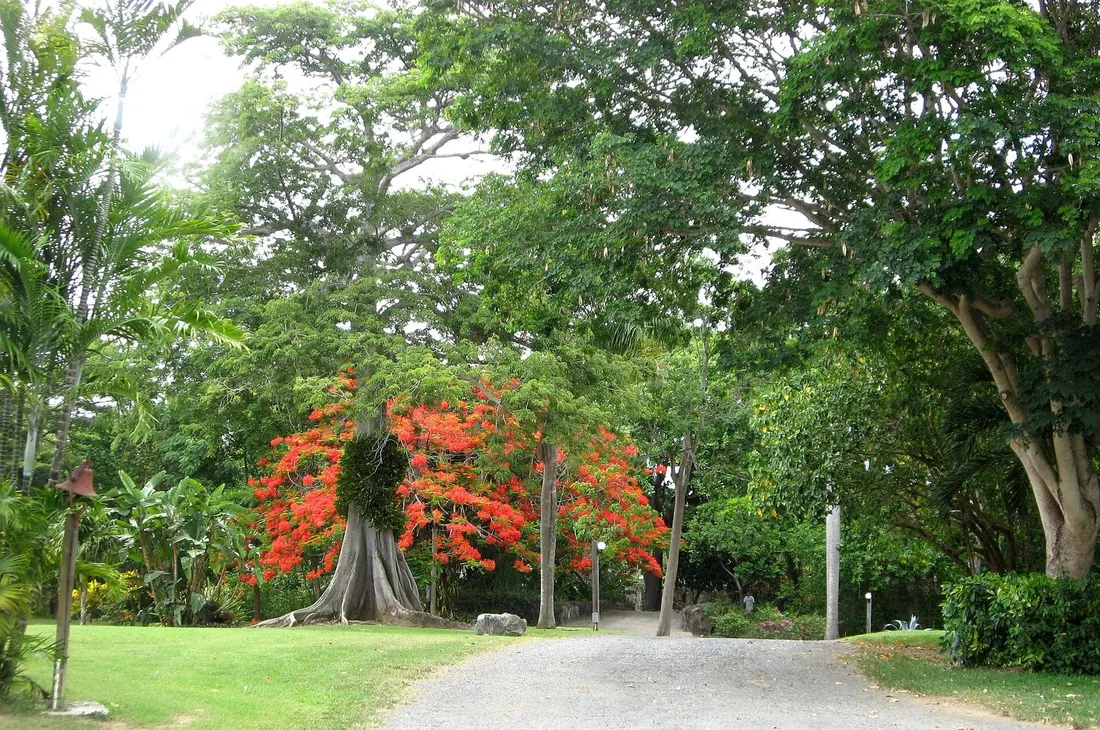
St. George Village Botanical Garden spreads across sixteen acres of Estate St. George, a Danish sugar plantation west of the center of St. Croix, growing more than a thousand kinds of Caribbean and tropical plant among the estate's cut-stone ruins. Locally it is just called the Garden.
This page is the site's reference for the Garden itself: the layers of history under it, the ruins you walk past, the plant collections you walk through, and the practical facts of a visit. The island's wild plant life, wet side and dry, has its own page in the two landscapes guide; the sugar economy that raised these walls is covered at Estate Whim and the sugar mill ruins guide. Here we stay inside the garden gate.
What the Garden is
The Garden is a sixteen-acre nonprofit botanical garden and open-air history site at 127 Estate St. George, off Centerline Road, a few minutes inland from Frederiksted on the western half of the island. It grows on the footprint of a sugar plantation, and its plantings run in and around the estate's surviving stone buildings. The result reads as two attractions in one: a plant collection and a preserved plantation, laid over each other on the same ground.
Its stated mission is to interpret the part plants have played across the Caribbean — as food, medicine, fiber, dye and building material — and to preserve the island's native flora. So the collections are arranged to teach as much as to please: a dry-country cactus bed, a shaded rainforest walk, a house full of orchids, beds of medicinal and heritage plants, all labeled. A registered arboretum, the Garden also keeps a herbarium and a small research library on the grounds, which puts a working scientific collection behind the display. It is a Level II accredited arboretum, open to the public all but one day of the year, and it draws on the order of ten thousand visitors annually. It runs as a nonprofit, so admissions, memberships and its own events pay to keep the gates open.
Estate St. George before the garden
The ground here has been settled for a very long time, and the Garden protects more than one past.
The Amerindian village
The property overlaps an Amerindian settlement that dates back to around 100 A.D. Sources place a pre-Columbian community on this spot for centuries — roughly between 100 and 900 A.D. — part of a human presence on St. Croix that reaches back thousands of years before that. The Taino who lived on the island knew it as Ay Ay, a word tied to water. Little of that world is visible to a casual visitor, but the Garden sits on one of its recorded village sites, which is where the "Village" in the name comes from.
The Danish sugar estate
In 1733 Denmark purchased St. Croix from France and carved the island into plantation parcels. Estate St. George was among the earliest sugar plantations to start up, working its fields from the 1750s. It ran, like every estate of its day, on enslaved labor: the first documented enslaved Africans arrived in 1749, twenty-three people, and by 1824 the estate held one hundred and eighty-seven. Emancipation came in 1848. Thirty years later, in the 1878 labor revolt Crucians call the Fireburn, Estate St. George was among the plantations set alight. The people and the events behind those two dates have their own pages — the Fireburn and Emancipation Day — and the sugar-making itself, the mills and the boiling house, is the subject of Estate Whim a few minutes down the same road. Here the estate's story is told through what survived the fire and the decades after it.
From abandoned estate to garden
After sugar stopped paying, the estate fell quiet for generations. The garden took shape in the early 1970s, pushed by local residents who wanted to save the estate's history and the island's plant life on the same ground. The Moon and deChabert families began handing the land to the St. Croix Garden Club in 1972, and the garden was formally established by mid-decade, in 1975. It has run as a nonprofit ever since, with a paid staff of around a dozen split between the grounds and the office, a working board, and a corps of volunteers and interns.
| Period | What happened on this ground |
|---|---|
| c. 100-900 A.D. | Amerindian village on the site; part of a much older human presence on St. Croix |
| 1749 | First documented enslaved Africans on the estate — twenty-three people |
| 1750s | Estate St. George working as one of the island's early sugar plantations |
| 1824 | Estate holds one hundred and eighty-seven enslaved people |
| 1848 | Emancipation across the Danish West Indies |
| 1878 | Estate St. George burned in the Fireburn revolt |
| 1972 | Botanical garden founded; land given to the St. Croix Garden Club |
The ruins among the gardens
The thing that sets this place apart from a botanical garden on open ground is that you walk it through a plantation. The stone is not decoration; the plantings were laid around buildings that were already standing when the garden club arrived.
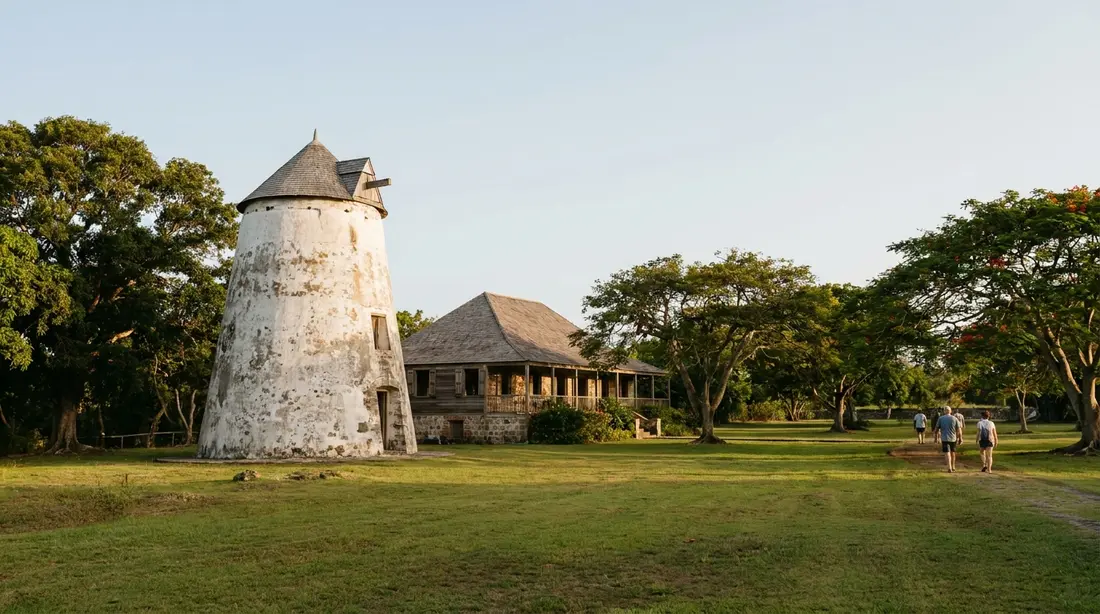
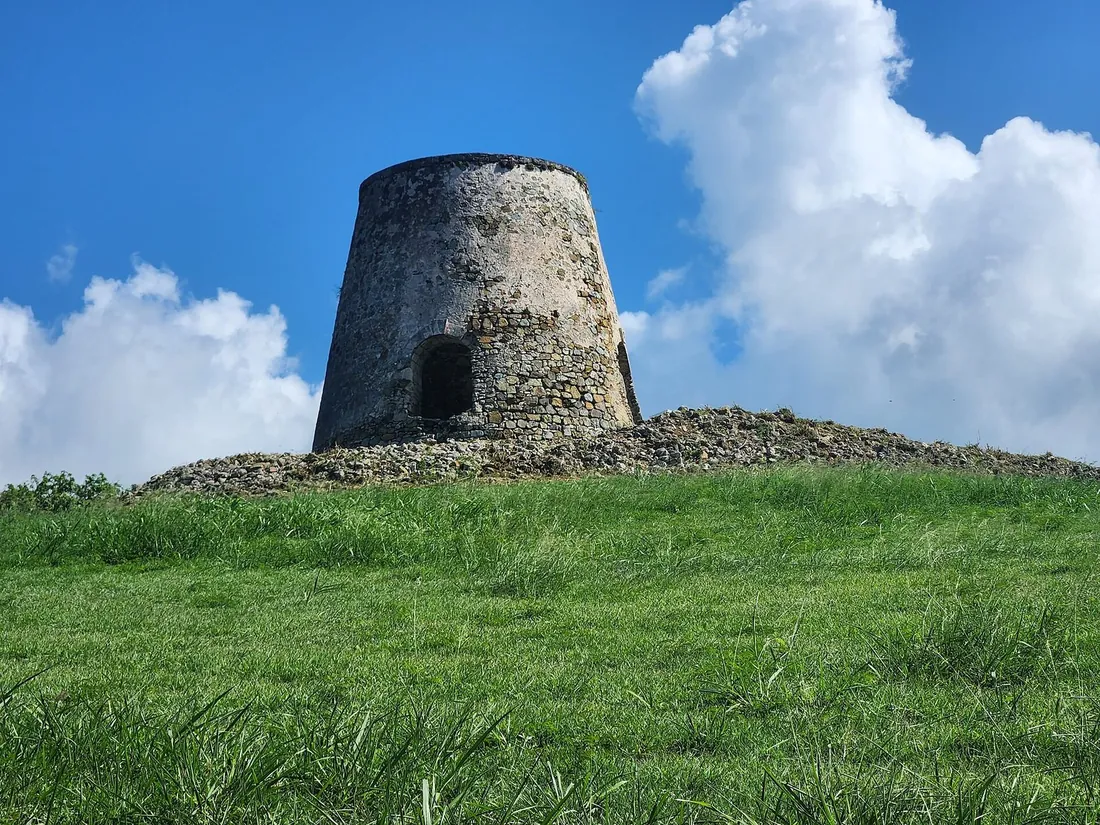
The centerpiece is the restored Great Hall, the estate's largest surviving structure and now the Garden's roofed event space. The old sugar factory stands as a ruin that has been put back to work sheltering plant collections. Around the grounds are the shell of a blacksmith's shop, the manager's quarters, and the foundations and walls of the village where enslaved workers lived. A post-emancipation workers' cottage has been restored to hold the library and herbarium. In the rainforest section, a Danish flume — a stone water channel from the plantation's working days — runs through the plantings. Off to one side lies the Old Danish Cemetery.
The reuse is the interesting part. Rather than clear the ruins to make room for beds, the garden grew into them: a factory that once boiled cane juice now shades a plant collection, a laborer's cottage now holds the herbarium, and the walls that framed the estate now frame the plantings. Some structures are restored and roofed, like the Great Hall; others stand as open ruin, half-taken by vine and root. Walking it, you read the estate's floor plan through the greenery — where the work happened, where the manager lived, where the enslaved were housed — without a single reconstruction pretending the past away.
Two features tie the plants back to the people. The 1000 Orchid Memorial Garden is planted in memory of the Africans enslaved on the estate. And the heritage beds, growing the food, medicine and dye plants of the plantation era, put the Garden's mission on the ground: this is what these acres were for, and what the people who worked them used. Reading the ruins and the plantings together is the whole idea of a visit, and recording that combination — the archaeology and the horticulture on one loop — is what this page is for.
The plant collections
The Garden's own count runs past a thousand Caribbean and pan-tropical plants and trees; the figure most often published for the full collection, counting named varieties, tops fifteen hundred. They are grouped into themed gardens, most of them self-explanatory once you have the map at the entrance.
Cactus and succulents
The cactus and succulent beds gather the island's dry-country plants in one place, rare and endangered species among them. St. Croix has a arid end — the East End runs to cactus and thorn scrub — and this collection is the labeled, shaded-bench version of that landscape, a short walk in place of a hot drive. The wild version, and the reason one island carries both a desert and a rainforest, is laid out in the two landscapes guide.
The orchid house
The orchid house holds around sixty orchid species plus hundreds of hybrids, kept under shade and mist. It is the collection people ask after by name, and it pairs with the separate 1000 Orchid Memorial Garden nearby, which carries the estate's human history into the plantings.
The rainforest walk and the Danish flume
The tropical rainforest section is the wet, shaded counterpart to the cactus beds: ferns, broad-leaved understory plants and tall canopy trees, cooler than the open lawn even at midday. The old Danish flume runs through it, so the walk doubles as a look at how the estate once moved its water. For the real rainforest up the mountain roads west of here, see the west-end rainforest guide.
Palms, bromeliads and the naturalized forest
The palmetum gathers more than twenty-five species of palm from the Caribbean and the nearby mainland. A bromeliad collection covers both the kinds that perch on trees and the kinds that root in the ground. The native arboretum sets out St. Croix's own trees and shrubs — the plants that belong here, as against the ornamentals brought in over the centuries — and it leans on species that were cut toward extinction for their timber or other value, which is much of the reason for growing them safely in one place. Beside it, a naturalized-forest section is planted to recreate the island's wild bush, the tangle of shrubs, trees and vines that covered this land before the cane.
The big trees and signature plants
A few individual plants are worth seeking out. The kapok, or silk-cotton tree (Ceiba pentandra), is the giant of Caribbean lowland forest, with a buttressed trunk and seed pods full of floss. The sandbox tree (Hura crepitans) carries a spined trunk and pods that crack open with a snap. The grounds also hold specimen oddities that stop people mid-path: the cannonball tree (Couroupita guianensis), whose heavy round fruit grows straight off the trunk; the sausage tree (Kigelia africana), hung with long dangling pods; and a baobab, the swollen-trunked African tree that turns up on only a handful of Caribbean islands. Ginger Thomas (Tecoma stans), the yellow-flowered shrub the U.S. Virgin Islands claims as its territorial flower, grows here as it does along island roadsides. And the Garden keeps Agave eggersiana, an agave found in the wild nowhere but St. Croix and rated endangered — one of the native-plant rescues the Garden is known for.
The heritage and economic plants
The Garden's mission comes to ground in the beds of useful plants. These are the species that fed, healed, clothed and housed the Caribbean: medicinal herbs, dye and fiber plants, spices, and the food crops and fruit trees of the plantation era and the villages that followed it. The Garden's plant records single out medicinal plants and, in its own wording, wild plants of economic importance — the trees and shrubs people harvested for timber, food or trade until some were nearly gone. Read against the ruins a few steps away, the beds make a plain point: an estate like this one was a machine for turning plants into money, and many of the same plants carried the daily life of the people forced to run it. You can walk the beds as scenery or read them as a record of what the island grew and why; the labels are written to let you do either.
Conservation, the herbarium and education
Behind the display is a working conservation program. The Garden's herbarium holds more than six thousand dried and pressed specimens — a collection reported to account for roughly eighty percent of the plant species known in the U.S. Virgin Islands — alongside a reference library. That collection is what lets the Garden do more than grow plants for show: it documents the territory's flora and gives researchers a baseline to measure change against.
The living work follows from it. The Garden propagates and protects native and threatened species, the endemic Agave eggersiana among them, and it runs the two halves of practical plant conservation: ex situ work, growing threatened plants off their home ground as a hedge against losing them in the wild, and reintroduction, putting propagated natives back out where they belong. It takes part in wider networks as an affiliate of the Center for Plant Conservation, and its Level II arboretum accreditation reflects the range and record-keeping of its tree collection. Education runs alongside: school groups, tours, talks, and a volunteer and internship program that keeps island hands in the beds.
For a visitor, the takeaway is that the tidy collections are the public face of a real botanical institution — a staff of around a dozen, some ten thousand visitors a year, and a gate open all but one day of it. The admission you pay and the plant you buy at the shop go back into that work, which is worth knowing as you walk in.
The Garden as an events venue
The restored Great Hall is the Garden's event space, and it earns a good part of the Garden's keep. Weddings are the mainstay — published accounts have put the number held here at around fifty a year — along with banquets, receptions and private functions, with the ruins and the plantings as the setting. Couples looking at the island for a small destination wedding tend to find their way here.
The Garden's own signature event is Mango Melee, the mango festival it has hosted on these grounds every July for three decades. It is the Garden's biggest fundraiser of the year, filling the lawns among the ruins with food, plant sales and a crowd. Because it belongs to the summer calendar rather than to this reference page, the full write-up — dates, contests, what to expect — lives in the July guide. The Garden also runs seasonal and members' events through the year; the events calendar shows what is on during your dates.
The setting is the draw for a wedding. A ceremony on the lawn puts the Great Hall and the old estate walls behind the couple, with the plantings for color and the big trees for shade; a reception can move under the roof when the afternoon rain comes through. For planners weighing venues, that mix — a covered hall, open grounds and a ready-made backdrop — is what keeps the Garden on the short list, along with the run of accommodation and catering within a short drive on the west end.
Supporting the Garden
Because the Garden is a nonprofit, the money side is not hidden behind the plantings; it is the reason they are there. Admissions and memberships carry the day-to-day, Mango Melee is the year's big fundraiser, and rentals of the Great Hall bring in the rest. Members get free or reduced entry and back the conservation and education work directly. The Garden also runs on people as much as money: a volunteer corps and an internship program put island hands into the beds, the herbarium and the events, and the plant sales send garden-grown natives home with visitors. None of this needs to shape a visit, but it explains how a small garden on a former plantation manages to keep a herbarium, a conservation program and a full events calendar going at once. If you want to give back past the ticket, membership and volunteering are the two doors, arranged through the Garden.
Planning your visit
Hours have moved over the years, and sources disagree, so treat any printed time as provisional. At last check the Garden's own site listed daily hours of 9 a.m. to 3 p.m., closed Christmas Day; older listings show a 9-to-5 day. Check the website or call before you drive out, especially if you are aiming for the late afternoon.
Admission at last check ran fifteen dollars for adults, ten for seniors and military, and two dollars for children under ten, with reduced rates for U.S. Virgin Islands residents — ten dollars for resident adults, eight for resident seniors, and free for resident children under ten. Prices at small island attractions change; confirm on arrival.
The Garden is self-guided. Maps at the entrance lay out a general route around the sixteen acres and the history, plus a botanical-highlights route that points you at the notable trees and shrubs. Most visitors spend an hour to ninety minutes; plant people and photographers stay longer. The welcome building at the entrance has served as a small shop for books, gifts and garden-grown plants at last check, and the Garden's plant sales are a fixture of Mango Melee.
On footing and access: the central lawn and main paths are largely level, but some of the ruins and outer beds have gravel, grass and uneven steps, so anyone using a wheelchair or pushing a stroller should call ahead about the current route. Bring a hat, water and sun cover — much of the walk is in the open — plus bug spray in the wet season and shoes you can walk stone in. Mornings are cooler than afternoons, and benches sit along the main paths for a rest in the shade; the light on the ruins and the orchids is kindest early or late in the day if you are carrying a camera. As everywhere on the island, you will be driving on the left to get here; see driving on the left if that is new to you.
| Detail | At last check |
|---|---|
| Address | 127 Estate St. George, off Centerline Road, near Frederiksted |
| Size | 16 acres |
| Hours | 9 a.m. to 3 p.m. daily on the Garden's own site (older listings say 9 to 5); closed Christmas — confirm before going |
| Admission | Adults $15; seniors and military $10; children under 10 $2 |
| Resident rates | Adult residents $10; senior residents $8; resident children under 10 free |
| Tour | Self-guided; general route plus a botanical-highlights route |
| Time needed | About one hour to ninety minutes |
| Signature event | Mango Melee, each July |
A west-end day around the Garden
The Garden sits on the island's history corridor, and it slots into a west-end day without much planning. The classic run puts sugar first thing, rum after lunch, and the water at day's end. Start at Estate Whim, the sugar-plantation museum a few minutes away, then add the Garden for the plant-and-ruins half of the same story. Book an afternoon tour at the Cruzan Rum Distillery, which still turns molasses into rum on the same island the estates once supplied; the modern industrial end of that story is at the Captain Morgan Visitor Center on another day. Drop into Frederiksted for the fort and the pier, then swing back toward the water for the evening; the sunset beaches all sit on this western coast. If the weather turns, the Garden's shaded paths make it one of the better wet-afternoon stops, and the full bad-weather plan is in the rainy-day guide.
Who the Garden suits
History travelers come for the layered site — an Amerindian village, a Danish estate and a Fireburn ruin on one plot — and leave with the sugar story in three dimensions. Gardeners and plant people come for the collections and the native rescues. Families find it easy: room to move, big trees to look up at, and a manageable loop. Birders add it to their list, since the grounds are good for the island's land birds, covered in the wildlife guide. And anyone after a couple of shaded, low-effort hours out of the sun — or the rain — finds them here. It is the island's culture-and-nature stop, and it works as a change of pace from the beach rather than a replacement for it. For a taste of the crops still grown on the island, the Crucian food guide picks the story back up at the table.
Questions guests ask
How long should we set aside?
An hour to ninety minutes covers the main loop at a relaxed pace, taking in the ruins, the orchid house, the cactus beds and the rainforest walk. Give it two hours or more if you photograph plants, read every label, or arrive when a tour or event is on. It is small enough to see well in a morning and easy to pair with Estate Whim and Cruzan on the same trip out west.
What are the hours and admission?
At last check the Garden's own site listed 9 a.m. to 3 p.m. daily, closed on Christmas, though older listings show a later close, so confirm before you go. Admission ran about fifteen dollars for adults, ten for seniors and military, and two for children under ten, with lower rates for U.S. Virgin Islands residents. Hours and prices at small island attractions change, so the website or a phone call is the last word.
Is it worth it if we are not plant people?
Yes, because half of what you are seeing is a plantation. The ruins — the Great Hall, the sugar factory, the blacksmith shop, the workers' village, the Danish cemetery — make this as much a history stop as a garden, and the site layers an Amerindian village under a Danish estate under a modern garden. Visitors who come for the trees often stay for the story, and the reverse happens just as often.
How is it different from Estate Whim?
They are two halves of the sugar story on the same road. Estate Whim is the plantation as a museum, built to explain how cane became sugar and rum, with the mills and the boiling house interpreted step by step. The Garden is a different estate, St. George, where the ruins have been kept as the setting for a botanical collection. See both if you can: Whim for the machinery, the Garden for the plants and the layered site.
Can we hold a wedding or event there?
Yes. The restored Great Hall is the Garden's event space, used for weddings, receptions and private functions, with the grounds as the backdrop; published accounts put the number of weddings held here at roughly fifty a year. Arrangements go through the Garden directly, and dates fill up in the drier winter and spring months, so ask early if you are planning around a specific weekend.
When is Mango Melee?
Mango Melee is the Garden's July fundraiser, held on a summer Sunday on these grounds, and it has run for more than thirty years. The date moves from year to year, so confirm it well before you plan around it. The full account — what happens, what it costs, how to plan for the heat — is in the July guide, and the year's other festivals sit in the events calendar.
Is it good for kids?
It works well for children who like room to roam. The loop is short, the big trees and ruins hold attention, and there is grass to burn off energy. Bring water and sun cover, since much of the walk is open, and plan around the heat by going in the morning. Pair it with a beach hour afterward and it makes an easy half-day.
When is the best time to go?
Mornings beat afternoons for heat and light, since much of the loop is open lawn. The drier, cooler months from winter into spring are the most comfortable overall, though the grounds stay green and worth walking year-round, and the shade houses do not care about the weather. Come for Mango Melee in July if you want the Garden at its liveliest, or almost any regular morning near opening if you want it quiet. It is open nearly every day of the year, so it drops into a rainy afternoon or a spare hour with little planning.
Staying near the Garden
Book Sunset Sea-Clusion, our place in Frederiksted, and the Garden is minutes from the door, which folds it, Estate Whim and Cruzan into one easy morning near base. Guests on the Christiansted side, or out on the East End, reach it in a little over half an hour across Centerline Road, passing the mill towers that mean more once you have walked these ruins. All twelve of our villas and condos sit within a comfortable day trip of the Garden, and a shaded morning among the plantings pairs neatly with an afternoon back at your own pool. On a day the weather turns, keep it on the list with the other covered and shaded stops in the rainy-day plan.
Sources
Written from official and first-party sources, checked August 2026. Hours, prices and event dates change — confirm before you go.
In this guide
Stay nearby
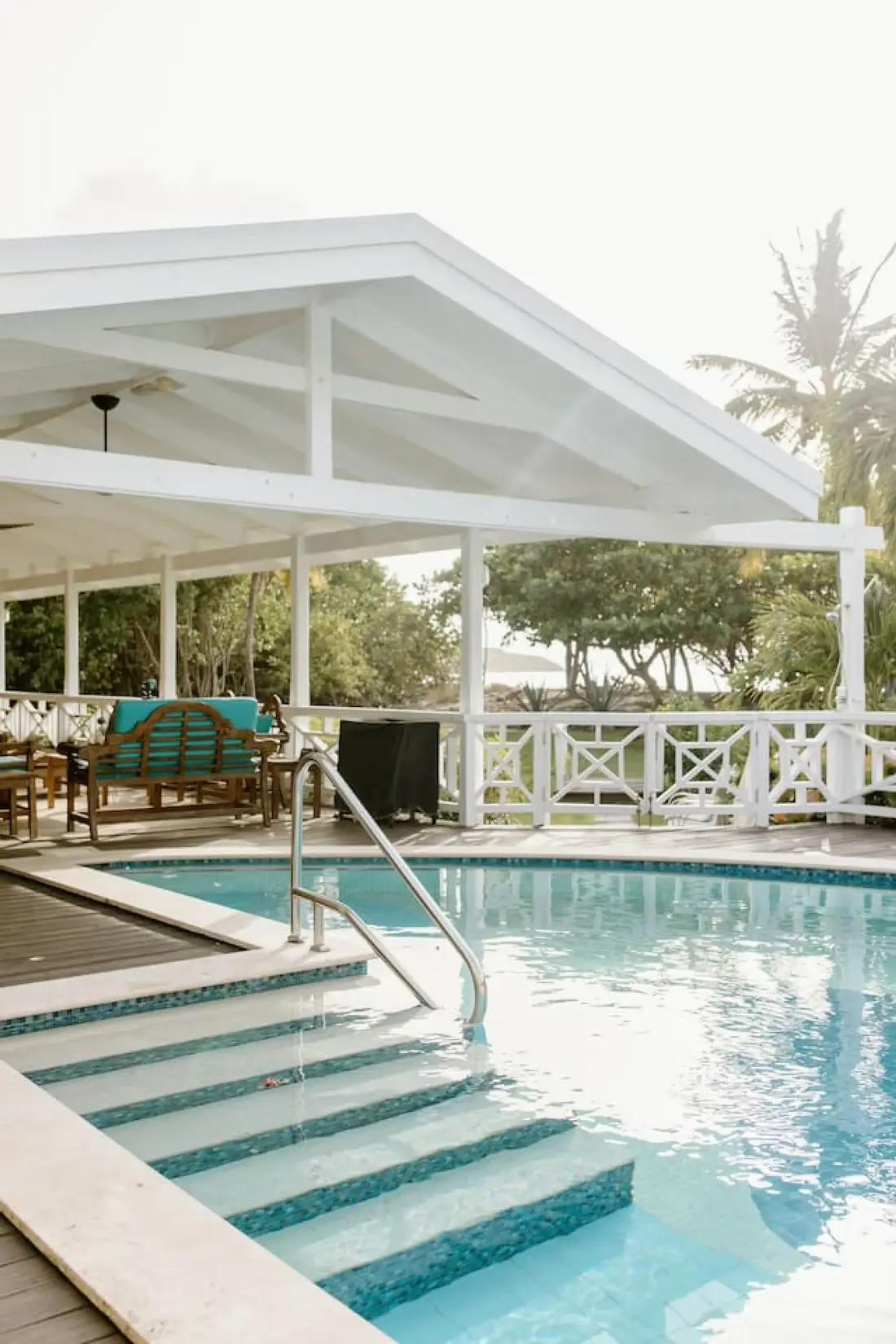
On The Shoys beach: six bedrooms, six baths, pool and hot tub, room for twelve, and the beach through the back garden.
 Shoy's Beach House6 bd · 6 ba · sleeps 12 · Christiansted
More in History & Culture
Sources
9 references, listed in full at the end of this guide — official park, refuge, tourism-board and business sources, checked August 2026.