The Shoys
A calm, secluded crescent east of Christiansted, reached through the Estate Shoys gate. Our Shoy's Beach House sits right on this sand.
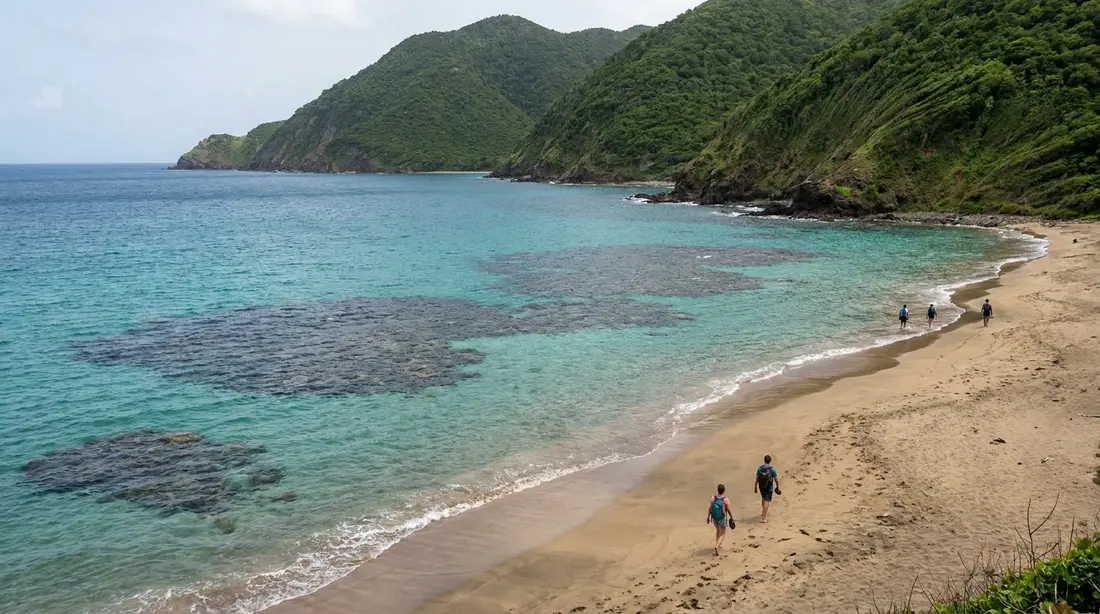
The Shoys is a sheltered crescent of pale sand ten minutes east of Christiansted, inside the Estate Shoys residential neighborhood beside The Buccaneer resort. It has no bar, no rental stand and no crowd, and the water off it is some of the calmest on the island. Our Shoy's Beach House stands on this sand, so this page is written from more mornings here than any other beach on St. Croix. It covers the beach itself, the gate, the law behind the gate, the reef, the history of the ground, and how to spend a day here without wasting any of it.
The beach
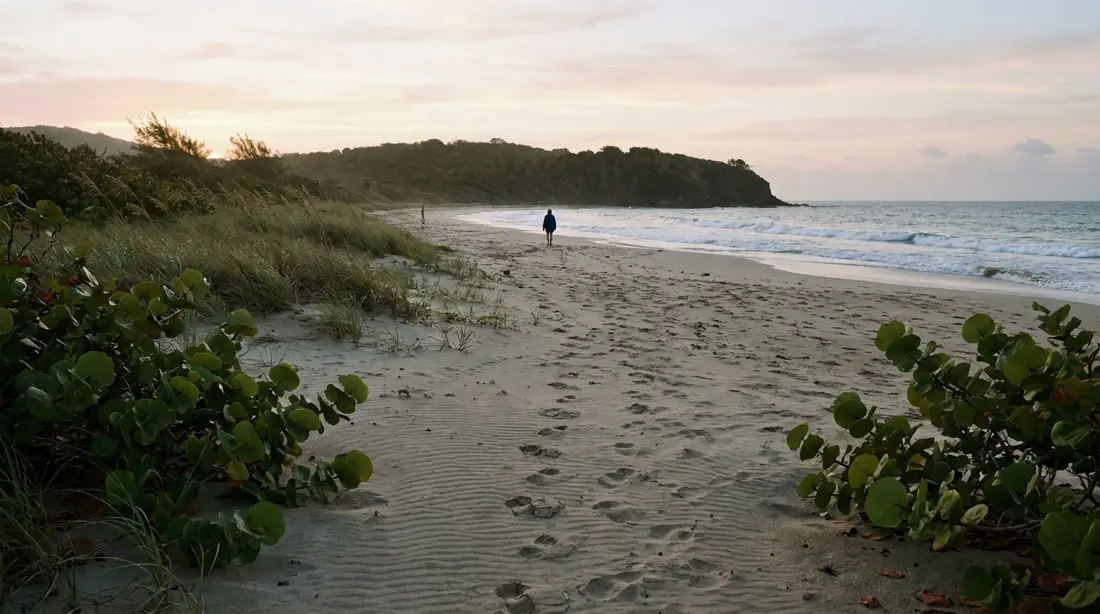
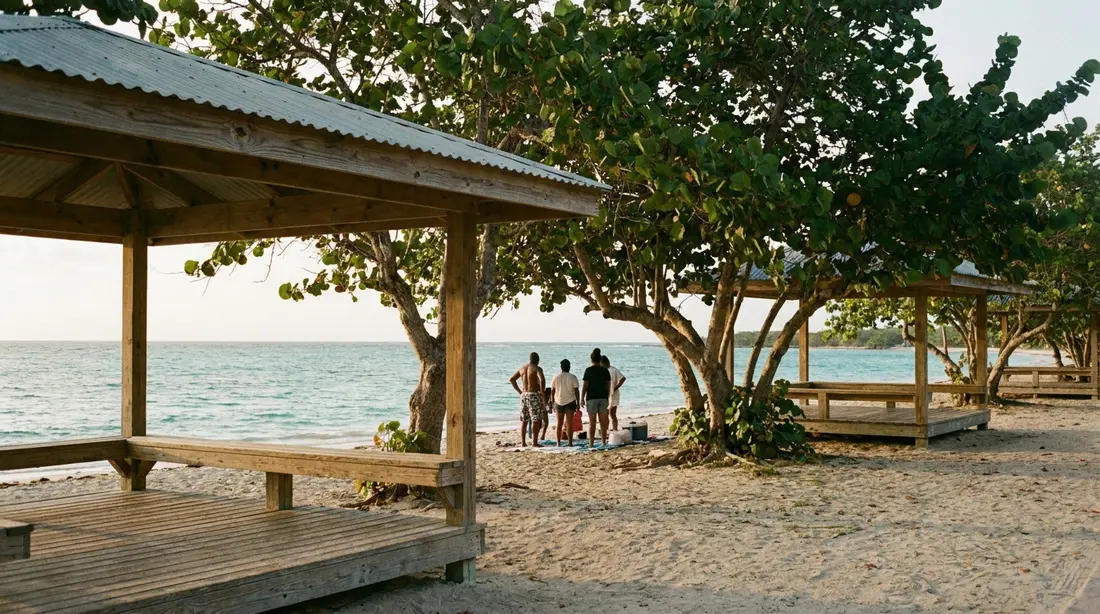
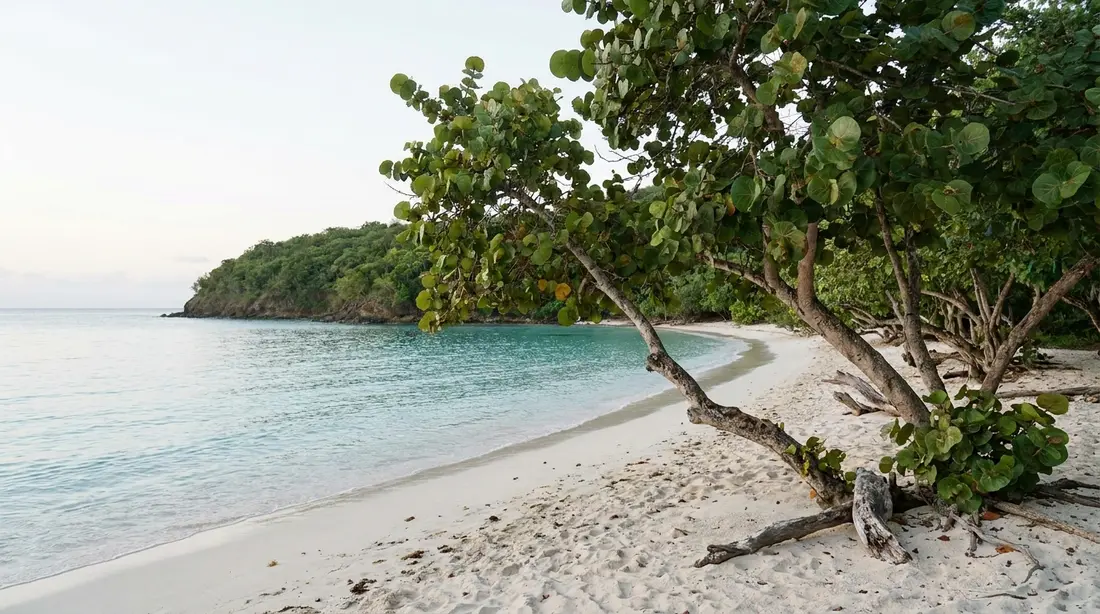
The Shoys curves along the island's northeast shore in a single arc of soft, light sand, long enough that walking it end to end is a genuine walk rather than a stroll, and level enough that runners use it. Behind the sand grows a thick line of sea grape and other coastal trees, which does two jobs at once: it throws real shade onto the upper beach through most of the day, and it screens the houses of the neighborhood so completely that from the waterline you mostly see green. The effect is a beach that reads as far more remote than its address. Christiansted's boardwalk, its shops and its harbor sit about ten minutes away by car, and you would never guess it standing here.
The shore faces northeast into water sheltered by the island's own geography, with a small fringing reef toward the eastern tip of the arc. That shelter is the beach's defining physical fact. Swell that roughs up the open north shore in winter arrives here filtered and reduced, and on an ordinary morning the surface lies flat from the sand out past swimming depth. There is no development on the beach itself. No restrooms, no bar, no chairs, no vendor of any kind, and no admission fee either. Everything you want for the day comes in with you and leaves with you.
Count on company in the single digits. A weekday morning here often means two or three other people across the whole crescent, most of them residents walking dogs or swimming laps; a weekend afternoon might bring a few more households. In June 2026 Caribbean Journal ran a piece on this beach under a headline calling it the St. Croix beach nobody tells you about, and that is roughly its standing among people who know the island: well loved, lightly used, and passed along by word of mouth.
Why it stays quiet
The Shoys stays empty for a plain, mechanical reason: reaching it requires knowing about a gate, and most visitors never learn about the gate. The beach sits inside Estate Shoys, a private residential community whose single road enters through a guard post shared with The Buccaneer's entrance drive off Route 82. Nothing about the arrangement forbids the public. The shoreline is public everywhere in the territory, the guards pass beach visitors through as a matter of routine, and this guide gives you the whole procedure below. What the gate does is filter out everyone who has not read a page like this one, and that filter is worth more than any rope or fee. Rental-car traffic flows to the beaches with signs, bars and parking lots; The Shoys has none of the three.
It is fair to say this beach benefits from geography twice over. The northeast shore's natural shelter gives it calm water, and the neighborhood around it gives it calm sand. We see no reason to be coy about either fact: the community is private, the beach is not, and the two coexist under a law written for exactly this situation.
The gate, the law and the parking
Here is the entire access procedure, start to finish. Take Route 82 east out of Christiansted and watch for The Buccaneer's entrance on your left a few minutes past Gallows Bay. Turn in. Ahead of you the drive splits at two guard posts: the hotel's own gate continues straight, and the Estate Shoys gate sits to the right. Pull up to the right-hand post, tell the guard you are visiting the beach, and expect to be asked for your name before the arm goes up. That is the whole exchange. There is nothing to pay, nothing to sign and no list you need to be on. Stay on the main estate road until it stops at a dead end, where a gravel parking area waits on the right-hand side. From the gravel, a footpath leads to the sand through a low canopy of mangrove and sea grape, tight enough overhead in places that tall visitors bend and everyone else grins; regulars call it a tunnel, and photographs of it circulate almost as widely as photographs of the beach.
The legal footing under all of this is the Virgin Islands Open Shorelines Act, passed in 1971 and codified at title 12, section 402 of the Virgin Islands Code. The statute declares the public's right to use and enjoy every shoreline in the territory and makes obstructing that use unlawful. It defines the shoreline precisely: the strip running inland from the low-tide line for fifty feet, or to where continuously spreading vegetation begins, or to a natural barrier, taking the shortest of the three. What the Act deliberately does not create is a right of way across private land to get to that strip, which is why access to this beach runs through a staffed gate on a neighborhood road rather than across somebody's yard. The named-at-the-gate routine is the working compromise, it has held for decades, and it depends on visitors holding up their side: give the name, park only in the gravel, keep to the path, carry out what you carried in.
Two practical notes complete the picture. First, residents and villa guests inside the estate skip all of this; a stay at Shoy's Beach House means the guard knows your name before you arrive and the sand begins at the back of the yard. Second, the gravel area is modest, and on the rare busy day it fills. There is no lawful overflow parking inside the neighborhood, so if you find it full, the resort beaches one gate over or Chenay Bay up the road absorb the swim instead.
The water
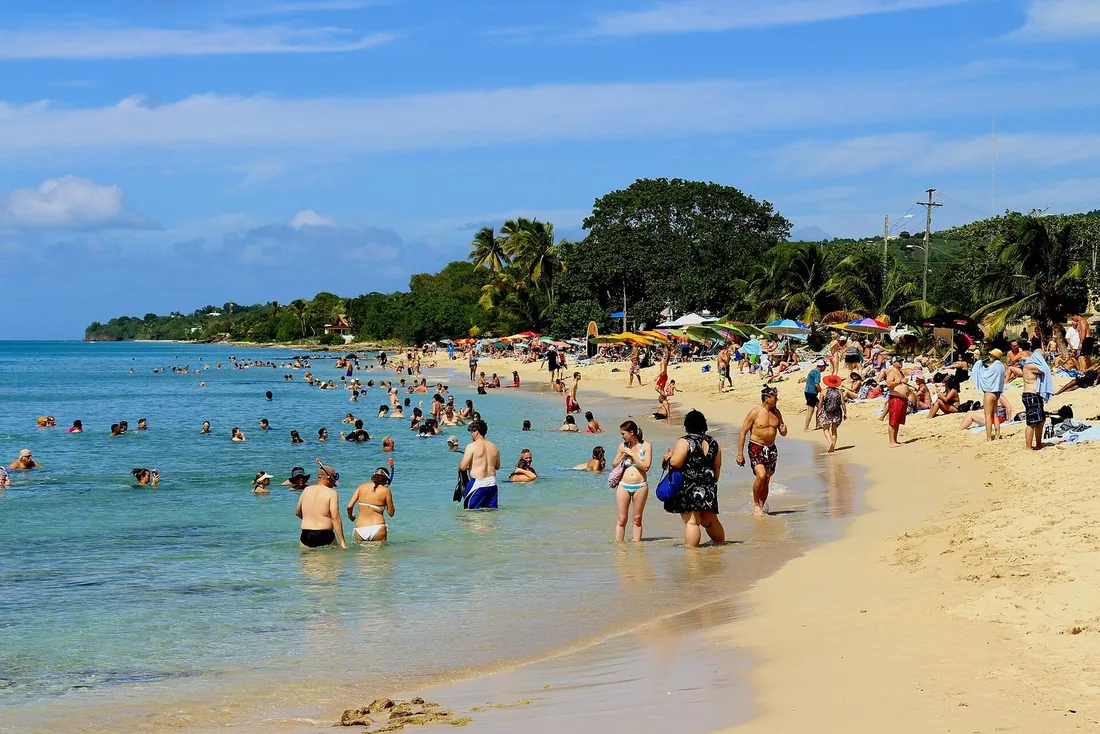
Swimming is what The Shoys does best, and it does it almost every day of the year. The bottom off the sand is a mix of clean sand and seagrass, it deepens gradually rather than dropping, and the sheltered northeast exposure keeps surface chop small even when the trades are working. Early morning is the premium window: the wind has usually slept through the night, the surface goes still, and the light comes in low across the water because this shore looks toward the rising sun. By mid-afternoon a light wind chop typically builds, still comfortable for adults, just no longer glassy. The pattern repeats so reliably that our guests at the beach house organize their days around it without being told to.
Depth suits mixed groups. Children can stand a long way out over the sandy patches, confident swimmers can put in real distance parallel to shore, and the water stays comfortable in every month; St. Croix's sea temperature is swimmable year round. No lifeguard watches this sand, and hardly any St. Croix beach has one, so the usual self-reliance applies: judge the day from the sand, keep children inside their depth, and swim with company rather than alone at the empty hours. On the handful of winter days when a north swell wraps in and the bay carries actual waves, the west coast at Rainbow or Dorsch offers flat water instead; the island beach rundown maps those alternatives.
One caution belongs here rather than in fine print. Manchineel trees grow along parts of this shoreline, as they do on many Caribbean beaches, and every part of the tree is toxic: do not eat the small green fruit, do not handle the leaves, and do not shelter under one in rain. On the villa property the specimens are marked; on the open beach, learn the tree once and give it room. Our guests get a pointer on arrival, and one of the January 2026 reviews of the beach house passes the same warning along, which tells you guests take it seriously.
Snorkeling the reef
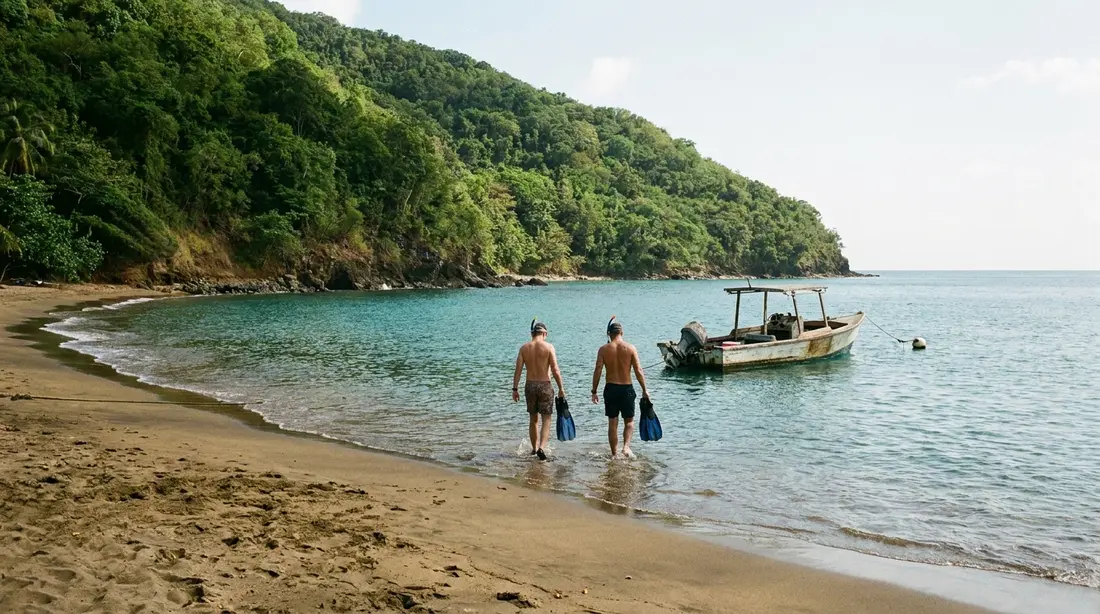
The snorkel here is small, easy and worth doing right, and it lives at the eastern end of the crescent where a fringing reef meets the sand. Set expectations correctly first: this is a beginner-friendly patch of habitat, ideal for a slow forty-five minutes, and nobody should drive across the island for it who has Buck Island or Cane Bay on the itinerary. What it offers is variety in shallow, protected water a short swim from a quiet beach, which for many guests beats a bigger reef with a parking lot behind it.
The habitat splits in two, and the animals split with it. Over the rocks and coral heads, look into holes and under ledges: small eels, the occasional lobster showing antennae, and the standard cast of tropical reef fish working the structure. Over the seagrass and open sand between the rocks, the residents change: southern stingrays settled into the bottom, conch plowing slow furrows, now and then a trumpetfish hanging vertical among the grass blades, and green turtles grazing where the meadow is thick. None of it is deep, most of it sits in six to fifteen feet of water, and the best conditions are the same as the best swimming conditions: a clear, windless morning before the chop stirs the shallows.
Bring every piece of gear with you, because nothing is rented within the gate. A mask that fits, fins, and reef-safe mineral sunscreen cover it; the territory restricts oxybenzone sunscreens, and this reef is alive, so the rule has teeth here. Stand only on sand, never on rock or coral, and let the rays and turtles set the distance between you. For a ranking of this reef against the island's other easy entries, the snorkeling beaches guide places it among the calmest options on the whole island.
Estate Shoys from 1653 to now
The ground behind this beach carries three and a half centuries of recorded history, and the records are unusually specific because St. Croix was mapped obsessively by its colonial administrations. A plantation house stood here as early as 1653, during the island's ownership by the Knights of Malta, and French survey work from 1671 places settlers named la Taille, Martel and Boucher on this stretch of coast, with Charles Martel, a knight of the order, associated with the ground closest to the later mill site. By 1750, under Danish rule, maps record a cotton plantation here in the hands of Bertram Samuel Schuster.
The name arrived in the following decade. A planter named Michael Shoy, whose surname Danish mapmakers rendered Schay with various spellings, bought the estate from Governor von Prock and raised cotton on it, and the Beck maps of 1766 through 1770 carry his name on this parcel. The place has been called Shoys ever since, which makes the name itself older than the United States. Ownership passed to John Heyliger by the 1790s, a geographic dictionary of 1851 lists an F. DuBois running the estate in sugar, and an 1856 map shows a windmill standing with structures on either side. The stone tower of that mill survives, minus its works, on the grounds of The Buccaneer next door.
The modern chapter began in 1922, when the Heyliger family sold the seaside estate, then a working cattle ranch, to Douglas Armstrong. The Armstrongs opened an eleven-room inn on the property in 1947, the first St. Croix hotel that a local family built and ran itself, and that inn grew into The Buccaneer, which the same family still operates and which describes itself as the Caribbean's longest-running family-owned resort. The residential neighborhood of Estate Shoys took shape on the estate land around the beach, and today it is a quiet enclave of homes under the trees, with one road, one gate and no commerce inside. That is the community a beach visitor drives through, and the reason this page keeps saying the sand feels private without being private.
| Year | Record |
|---|---|
| 1653 | First plantation house on the estate, under the Knights of Malta |
| 1671 | French survey places settlers la Taille, Martel and Boucher on this coast |
| 1750 | Cotton plantation of Bertram Samuel Schuster appears on Danish maps |
| 1760s | Michael Shoy buys the estate from Governor von Prock; the name Shoys enters the maps |
| 1790s | Ownership passes to John Heyliger |
| 1851 | Estate listed in sugar under F. DuBois |
| 1856 | Windmill mapped on the estate; its stone tower still stands on resort grounds |
| 1922 | Heyliger family sells the estate, then a cattle ranch, to Douglas Armstrong |
| 1947 | Armstrong family opens the eleven-room inn that became The Buccaneer |
A day at The Shoys, hour by hour
The beach rewards a particular shape of day, and after enough guest stays the shape is easy to describe. Arrive early, ideally before nine. The gate is quicker, the gravel lot is empty, the water is at its flattest and the whole crescent is yours for the walk. Do the full walk first, one end to the other and back on firm sand near the waterline; it doubles as a survey of the day's conditions and of anything interesting the night tide left. Swim or snorkel while the surface holds, because the calm is a morning asset that spends itself by afternoon.
Midday belongs to the tree line. The sea grape edge throws deep shade, and a towel moved twenty feet up the beach turns the hottest hours into reading hours. This is also the stretch of day to eat whatever you packed, since the nearest food requires either the resort next door or a drive to town. By mid-afternoon the trade wind has usually put a light texture on the water; swimmers who want laps take them anyway, and everyone else lets the wind earn its keep as air conditioning.
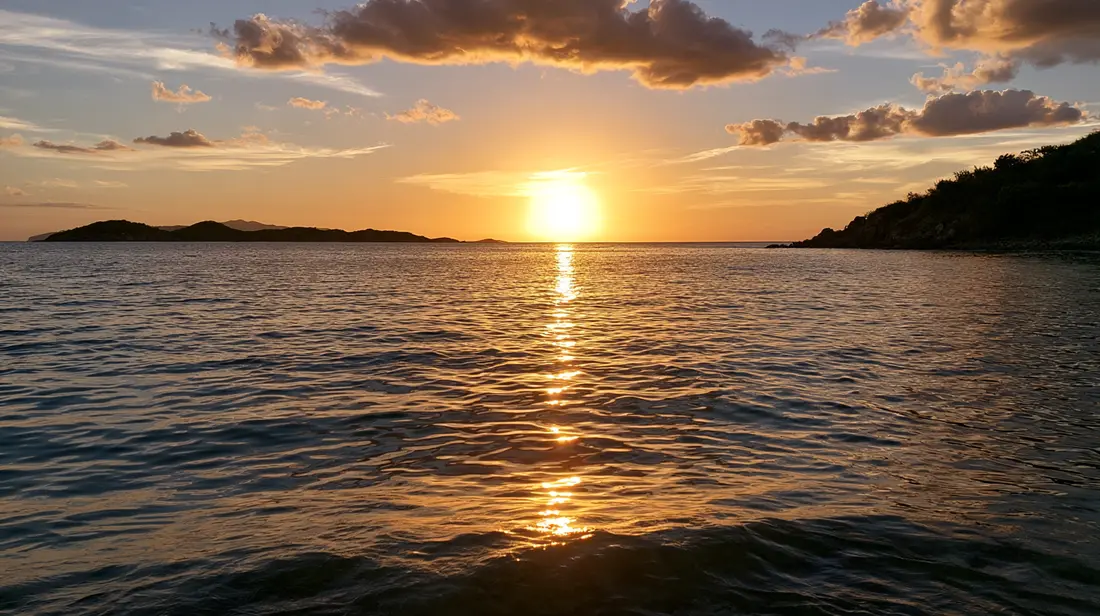
One orientation fact keeps expectations straight: this shore faces the sunrise, and the sun rises over the water here and sets behind the island. Photographers get their show at the start of the day, when first light comes up the coast, and anyone chasing a sun-into-the-sea evening should be on the west coast near Frederiksted instead, forty-plus minutes away. The classic pairing from this beach is different and arguably better: an early swim here, then the short drive east to Point Udall on another morning to watch the first sunrise in the United States, with Cramer's Park and the two walk-in bays beyond it rounding out that loop. Evenings here still have their own reward, quiet sand and lit water without another soul, just no orange horizon.
Wildlife on and off the sand
The animal life here is modest and steady rather than spectacular, which suits the beach's character. In the water, the seagrass supports the grazers and foragers described in the snorkeling section: green turtles, southern stingrays, conch. Turtles surface to breathe on calm mornings often enough that swimmers see heads without looking for them. On land, the neighborhood's trees hold iguanas and small birds, mongoose cross the road in front of cars the way they do everywhere on St. Croix, and guests at the beach house have logged white-tailed deer on the property along with the enormous caterpillars of the frangipani moth on the frangipani trees, an island signature that startles first-timers and delights children.
On nesting: St. Croix is a serious sea turtle island, with three species using its shores, and the documented strongholds are elsewhere, leatherbacks at Sandy Point in the island's southwest and the territory's densest green and hawksbill nesting at the protected bays of the far East End. Whether turtles also nest on The Shoys itself in a given season is not something we can document, and we will not pretend to. What we can say is that East End sand generally is nesting habitat, that summer and early fall are the season, and that the rules cost nothing to follow: if you find tracks like tractor marks running up the beach, or a marked or disturbed patch of sand, keep well away, keep lights off the beach at night in season, and report obvious nests rather than inspecting them. The sea turtle guide and the turtle watch page carry the island-wide picture.
Manners for a beach inside a neighborhood
Every beach has etiquette; this one has a specific version because homes sit a hundred feet behind the sand and the access agreement runs on goodwill. None of it is complicated. Keep music in headphones or off; sound carries across flat water and into yards, and a portable speaker is the single fastest way to be the visitor the neighborhood remembers for the wrong reason. Leave nothing behind, including the organic stuff people talk themselves into leaving; there is no trash pickup on the sand, so the standard is pack-in, pack-out, every time. Keep the path and the gravel lot as you found them, do not cut through vegetation to reach the road, and treat the private yards at the back of the beach as exactly that. The fifty-foot public strip is yours under the law; the lawns are not.
Fires, camping and overnight parking are not part of the arrangement here, and drones over the houses will make you unpopular fast. Dogs appear regularly with resident owners; if you bring one, leash manners and a bag are the price of admission. None of this is unique to The Shoys, and stated it amounts to one sentence: behave like a guest in a quiet place, because that is what every visitor here is. The reward for the collective good behavior of thirty years of visitors is that the gate still opens with nothing more than a name.
Seasons and conditions
The Shoys is a twelve-month beach, and the calendar changes it less than it changes almost any other shore on the island. Winter, the mid-December-to-mid-March high season, arrives with the Christmas Winds and the north swell that can turn Cane Bay's water milky for days; this bay's shelter absorbs most of that, leaving brisker afternoons and the occasional lively day, with mornings still swimmable in nearly every stretch of weather. Summer runs warmer, stiller and quieter, with the year's flattest water and the clearest conditions over the little reef. Hurricane season spans June through November on paper; in practice the island lives normally through it and pays attention to forecasts in the August and September peak, and villa guests get our current read on any system worth watching.
The one seasonal variable specific to east-facing sand is sargassum, the drifting weed that pulses through the Caribbean irregularly. This bay's shelter and orientation treat it kindlier than the open East End takes it, and many weeks there is none at all, but no northeast shore is exempt in a heavy year. It shifts week to week, so ask us what the sand looks like before you build a plan around it. For the wider weather picture month by month, see when to visit.
Who the beach suits
The Shoys is for people whose beach day is built around water and quiet rather than services and scene. That covers more travelers than it might sound like: families with swimming-age children, couples who want a morning routine, readers, walkers, lap swimmers, beginner snorkelers, and anyone recovering from a resort vacation somewhere louder. It is the wrong beach for anyone who wants a lounger delivered, a bar within shouting distance or a jet ski; the west end and the resort next door exist for those days, and the island is small enough to have both in one week.
| Visit type | How The Shoys handles it |
|---|---|
| Morning swim | The signature use. Flattest water before mid-morning; sand entry, gradual depth |
| Snorkeling | Small fringing reef at the east end; bring all gear; best on calm, clear mornings |
| Families | Calm and shallow near shore; no facilities, no lifeguard, so pack fully and watch depth |
| Walking and running | Long, firm crescent; shaded return along the tree line |
| Reading and shade | Sea grape line shades the upper beach much of the day |
| Sunset | Wrong coast; this shore takes the sunrise. Drive west for over-water sunsets |
| Serviced beach day | Next door at the resort's strands, or the west end; nothing is sold at The Shoys |
Staying on the beach itself
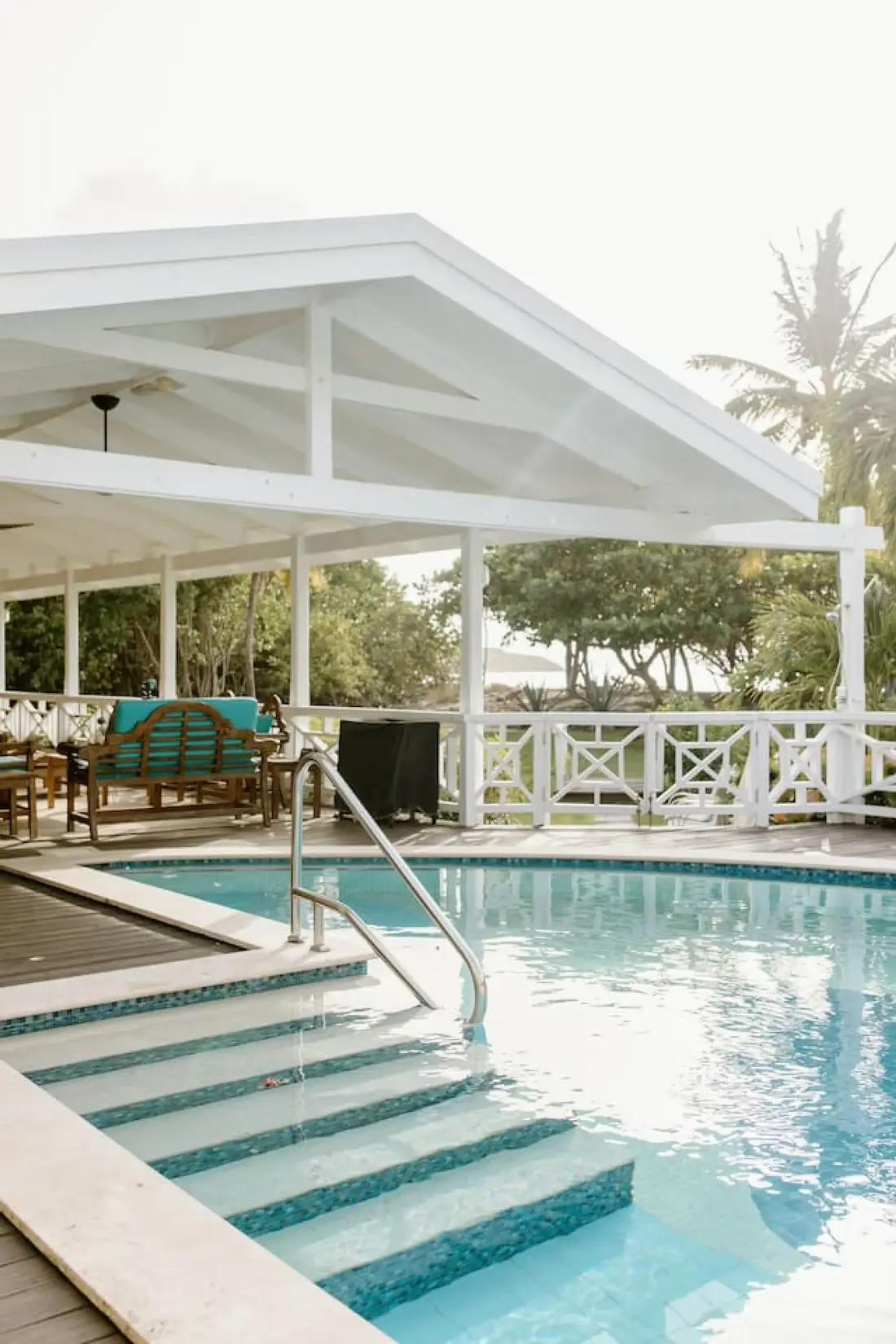
One house in our portfolio makes this page personal. Shoy's Beach House sits inside the estate with the crescent beginning at its backyard, and it is built the way a big-group beach house should be: five bedroom suites, every one with its own bathroom, arranged around a covered open-air courtyard, with the kitchen, dining and living areas in a separate pavilion so sleepers and early risers never share a wall. Outside are a pool, a hot tub and a broad deck, and an optional cottage adds a sixth bedroom that takes the sleeping count to twelve. The house keeps beach chairs and kayaks for guests, and a caretaker's cottage on the grounds means someone is minding the property without being in your week.
The reviews read like field notes for this guide. A family of ten who stayed ten days in January 2026 called the courtyard-of-suites layout ideal for couples traveling together, counted five full bathrooms plus two half baths, and reported the kids splitting time among the pool, the kayaks and a cornhole set while the adults held the porch and its ocean view. The same review inventoried the grounds the way a naturalist would: fruit trees and flowering plants labeled around the property, iguanas and deer and mongoose passing through, frangipani caterpillars on their host trees, and a sensible reminder to keep clear of the marked manchineel trees along the beach line. December 2025 guests reported a spotless house where everything worked and evenings that ended on the sand. For the villa pitch in one line: the beach this whole page describes is that house's backyard.
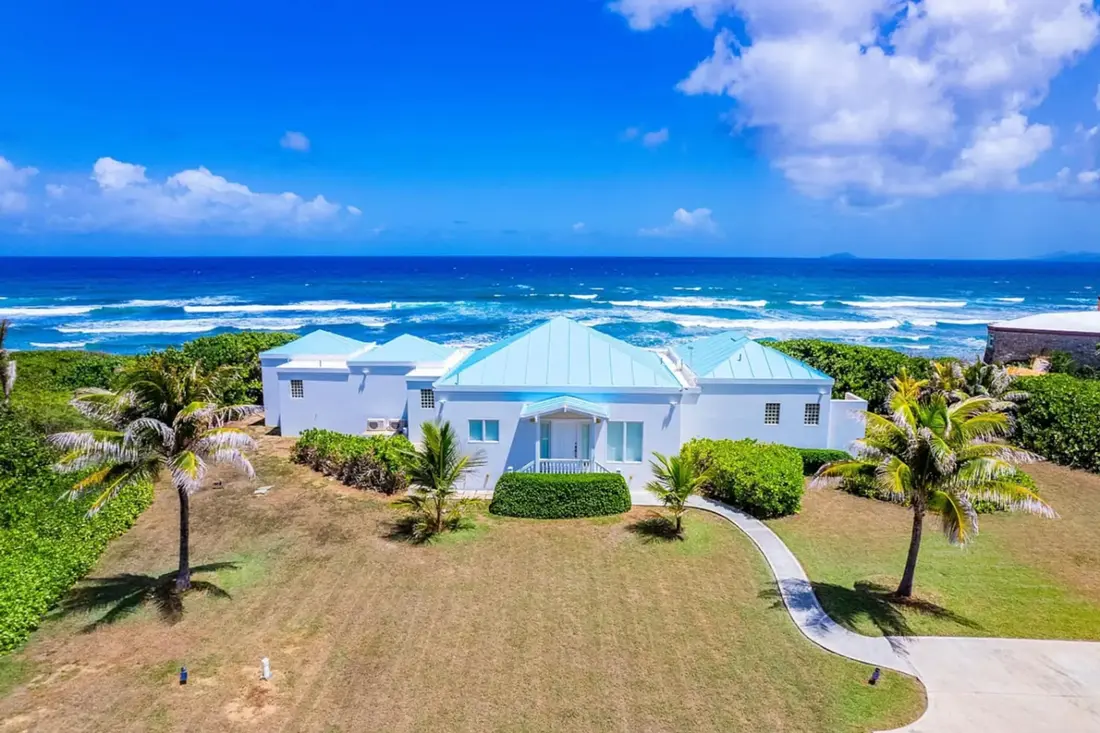
If the house is booked, the nearest sibling in spirit is The Cerulean on the East End, which fronts its own restored swimmable beach about twenty minutes farther out. Both belong to our beachfront collection, and the East End collection holds the hillside alternatives within a short drive of this coast.
Nearby and next
The Shoys makes a natural first stop on any eastbound day. One gate over, The Buccaneer's grounds hold the public-access resort strands plus an eighteen-hole golf course, and the beach grill the resort ran for years as the Grotto Grill, listed lately on its site as Beauregard's on the Beach, puts lunch five minutes from your towel; the full comparison of every swim within ten minutes of town lives in beaches near Christiansted. Continue east on Route 82 and the coast delivers Chenay Bay's shallow family water, Cramer's Park's pavilions, and finally the parking area below Point Udall where the trail drops toward Isaac's and Jack's Bays; the East End guide strings the whole quarter together. Westbound, Christiansted supplies lunch, the boardwalk and the Buck Island boats, with the town's food sorted in the restaurant guide and everything else, parking and the fort included, in the town guide. A car is effectively required for all of it, since the island has no rideshare; the getting around page covers the left-side driving and the rest.
Questions guests ask
Can anyone visit The Shoys, or is it residents only?
Anyone can visit. The beach is public under the territory's Open Shorelines Act, which has protected public use of every Virgin Islands shoreline since 1971. The neighborhood behind the beach is private, so you enter by its gate: stop at the right-hand guard post at The Buccaneer's entrance and say you are visiting the beach; the guard takes a name and raises the arm. Visitors are passed through routinely, without fees or paperwork. The one thing the law does not grant is shortcuts across private property, so use the estate road, the gravel lot and the footpath, and nothing else.
Where exactly do day visitors park?
At the dead end of the main estate road, where a gravel parking area sits on the right side. It is unpaved, unmarked and free, and the footpath to the sand leaves directly from it through a low canopy of mangrove and sea grape. Do not park along the neighborhood road or on any verge; the gravel is the whole allocation. It rarely fills, but if you do find it full, the resort beaches next door and Chenay Bay a few minutes east are the practical fallbacks. Leave nothing visible in the car, which is standard advice at every St. Croix beach.
How good is the snorkeling, really?
Pleasant and small. The fringing reef at the crescent's eastern end holds reef fish, small eels and sometimes a lobster in the rocky structure, with rays, conch, the odd trumpetfish and grazing green turtles over the surrounding seagrass and sand. Depths are modest and the water is protected, which makes it one of the island's gentlest snorkels for beginners and children. It is a forty-five-minute swim, well spent on a calm clear morning with your own gear. Set against Buck Island or Cane Bay it is a warm-up act, and it never pretends otherwise.
Can you watch the sunset there?
Not over the water. The beach faces northeast, so the sun comes up over the sea here and goes down behind the island; evenings bring soft light and empty sand rather than an orange horizon. If a sun-into-the-ocean evening is on your list, drive to the Frederiksted coast on the island's west side, where the beaches face the sunset properly. The compensation at The Shoys is the other end of the day: on a clear morning, first light over this water is worth setting an alarm for at least once in a stay.
Are there restrooms, food or chairs?
None. The Shoys has no facilities of any kind: no restrooms, no bar, no food, no rentals, no shade structures beyond the natural tree line. Carry in water, snacks, snorkel gear and anything else the day needs, and carry all of it back out. The nearest services are at The Buccaneer next door, where the resort's beach grill serves lunch at resort prices, and in Christiansted ten minutes west. Guests at Shoy's Beach House solve the problem by having the house, its kitchen and its bathrooms thirty seconds from the towel.
Is it safe for young children?
The water is about as forgiving as St. Croix offers: a sand entry, gradual depth, and shelter that keeps waves small on all but the roughest winter days. The caveats are the absence of a lifeguard and of every facility, so parents run the show and pack accordingly. Keep children away from manchineel trees along the shore, which are toxic and not always marked outside the villa property. For toddlers, Chenay Bay a few minutes east is even shallower and stays the island's standard answer for the smallest swimmers.
How is The Shoys different from the Buccaneer beaches next door?
Same coastline, opposite products. The resort's strands come groomed and serviced, with lunch, restrooms and chairs available at resort prices, and correspondingly more people on the sand. The Shoys comes with nothing and almost nobody. Ten minutes and one guard post separate them, so plenty of guests use both in a single week, picking by mood: service days next door, silent days here. If the group splits on the question, the resort side feeds the lunch faction while the swimmers walk the quiet crescent.
The villa on this sand
Shoy's Beach House is the reason we can write about this beach at dawn, at noon and in February. Five en-suite bedrooms around an open courtyard, a separate living pavilion, a pool, a hot tub and an optional sixth-bedroom cottage put up to twelve people a backyard away from everything this page describes, with kayaks and beach chairs waiting and a caretaker's cottage keeping the property right. Groups who want this coast without this exact house can compare The Cerulean and the rest of the beachfront collection, or browse all villas and tell us the week you have in mind; matching a group to the right stretch of St. Croix shoreline is the part of this job we are best at.
Sources
Written from official and first-party sources, checked August 2026. Hours, prices and event dates change — confirm before you go.
In this guide
Stay nearby
Private oceanfront on the East End with a sandy, swimmable beach, pool, outdoor kitchen and a separate guest cottage. Sleeps twelve.
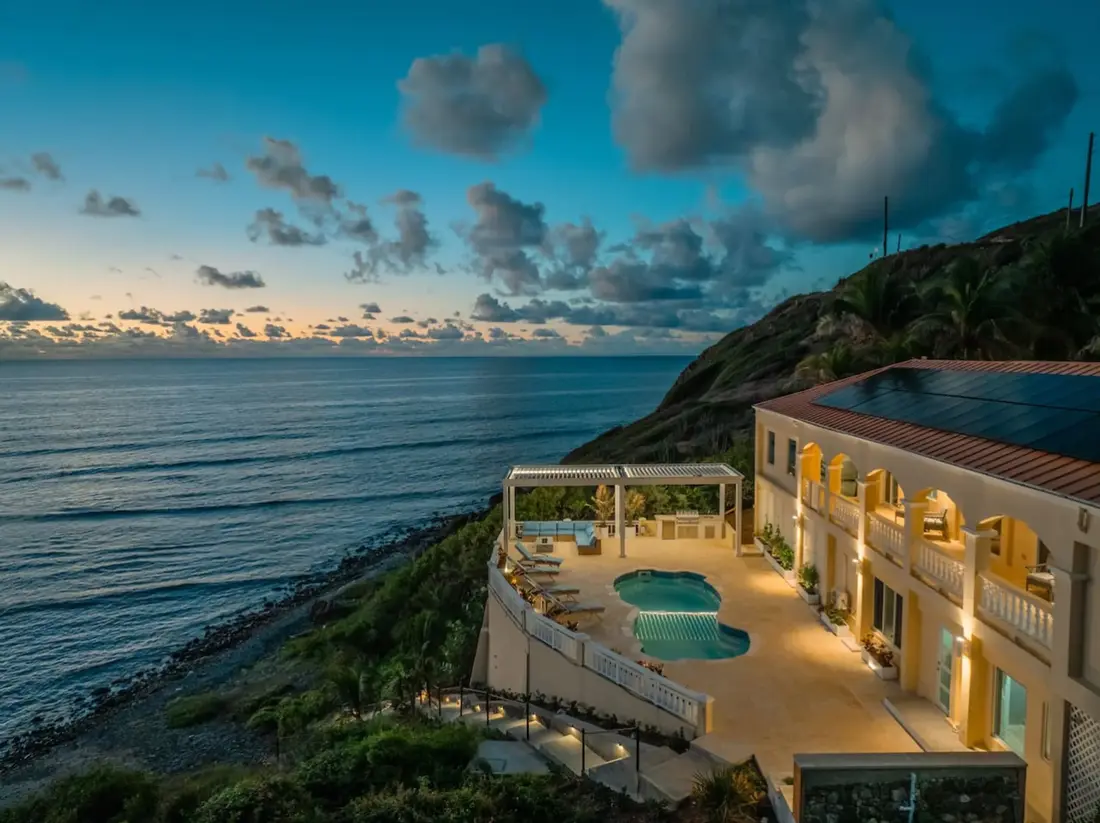 The Cerulean5 bd · 5 ba · sleeps 12 · Christiansted
More in Beaches
Sources
9 references, listed in full at the end of this guide — official park, refuge, tourism-board and business sources, checked August 2026.