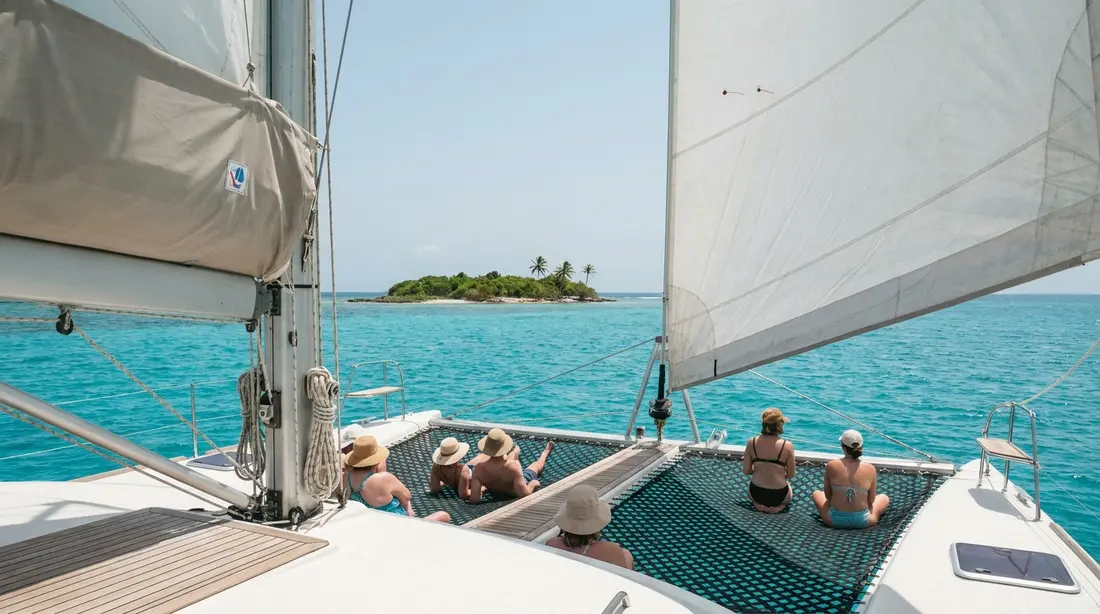
St. Croix vs the British Virgin Islands
The other Virgin Islands: a sailor's dream a passport, a small plane and a ferry line away. The American one has the jets and the villas.
The British Virgin Islands sit a few miles from their American siblings and run a very different trip: sixty islands and cays arranged for sailors, with the region's most famous charter grounds, The Baths' granite boulders, and beach bars you anchor off. It is a wonderful, specific product. It also requires a passport, a small plane or a ferry line, customs in both directions, and boat-economy prices. St. Croix — the largest Virgin Island of them all — runs the villa version of the same sea, with nonstop mainland jets and none of the formalities.
The two, side by side
| St. Croix | the British Virgin Islands | |
|---|---|---|
| Passport for U.S. citizens | Not needed | Required, plus BVI entry and departure formalities |
| Getting there | Nonstop jets from five mainland cities | No U.S. mainland nonstops: small plane via San Juan, or ferry from St. Thomas |
| Coming home | Agriculture bag check; no customs | U.S. immigration and customs on re-entry |
| Currency | U.S. dollar | U.S. dollar (the BVI's official currency too) |
| U.S. State Department advisory | None — it is the United States | Level 1: Exercise Normal Precautions |
| Signature experience | Buck Island's snorkel trail; walk-in wall diving | Chartering a sailboat through the island chain |
| Famous sight | Two Danish colonial towns; Point Udall | The Baths at Virgin Gorda |
| Where you stay | Managed villas and condos, most with pools | Charter boats, scattered villas, small resorts |
| Costs | Villa value, supermarket provisioning, $1,600 duty-free home | Charter fees, cruising taxes, barge-priced provisioning, $800 duty-free |
| Nightlife | Christiansted boardwalk; beach bars | Legendary beach bars reached by dinghy |
Advisory levels and details are as published by the U.S. Department of State and checked August 2026. They change — read the current advisory at travel.state.gov before any international trip.
The short answer
If your dream week has a mainsail in it, stop reading and book the BVI — they are the finest beginner-to-intermediate charter waters in the hemisphere, and nothing on St. Croix or anywhere else in the American Caribbean replaces a week on the hook at Norman Island. If your dream week has a villa in it — a pool, a kitchen, a rental car, a different beach every day — the BVI charge you sailing-economy prices and passport-line hours for a product St. Croix does better, closer and cheaper. We manage our St. Croix homes; that is our interest, and the logistics below are checkable facts.
Getting there: the ferry line is part of the price
There are no nonstop flights from the U.S. mainland to the BVI. Every American itinerary picks one of two relays. Option one: fly to San Juan, then a small regional aircraft into Tortola's Beef Island strip — capacity-limited seats that sell out around holidays and price like scarcity. Option two: fly to St. Thomas, taxi to the ferry dock, and ride to Road Town or West End — with a passport check and BVI entry formalities on arrival, an environmental levy at the door, and the same in reverse plus U.S. immigration and customs on the way home. Seasoned BVI hands build half a travel day around each direction and call it the toll for the sailing.
St. Croix's toll: none. Henry E. Rohlsen Airport lands mainland jets nonstop — Miami daily on American (about 3 hours), Charlotte daily from December 17, 2026, Atlanta near-daily from December 19, Newark Saturdays from October 31, 2026, Chicago winter Saturdays — plus the 50-minute San Juan hop all day. U.S. citizens carry a driver's license, not a passport. Coming home there is no customs hall at all, just an agriculture bag check, and your duty-free allowance is $1,600 per person — double what returns from the BVI. Verified August 2026:
| Airline | From | Schedule (as published Aug 2026) | Flight time |
|---|---|---|---|
| American Airlines | Miami (MIA) | Year-round, one to three flights daily by season | about 3 hours |
| American Airlines | Charlotte (CLT) | Paused until Saturdays return November 7; daily beginning December 17, 2026 | about 3¾ hours |
| American Airlines | Chicago O'Hare (ORD) | Winter Saturdays beginning December 5, 2026 | about 4¾ hours |
| Delta Air Lines | Atlanta (ATL) | Saturdays through September 5; Saturdays again from November 14; daily except Mondays beginning December 19, 2026 | about 4 hours |
| United Airlines | Newark (EWR) | Saturday nonstops beginning October 31, 2026 | about 4½ hours |
| Airline | From | Service | Flight time |
|---|---|---|---|
| Cape Air / JetBlue | San Juan, Puerto Rico (SJU) | Multiple daily, year-round | about 50 minutes |
| Fly The Whale | San Juan — Isla Grande (SIG) | Several round trips daily | about 40 minutes |
| Cape Air / Fly The Whale | St. Thomas, USVI (STT) | Multiple daily, year-round | about 25 minutes |
| Seaborne (seaplane) | St. Thomas — Christiansted Harbor to Charlotte Amalie | Schedules vary; one aircraft on the route | about 25 minutes |
| Cape Air | Nevis (NEV) | Fridays and Sundays | about 1 hour |
What the BVI do best, credited fully
Sailing, and everything arranged around it. The chain — Tortola, Virgin Gorda, Jost Van Dyke, Anegada and their satellites — sits in protected water with line-of-sight hops, steady trades and moorings everywhere: the whole territory is a nautical playground, and the charter fleets at Road Town are the world's largest. The Baths at Virgin Gorda — house-sized granite boulders stacked into sea grottoes — deserve every photograph. The beach bars are legend: the Soggy Dollar's Painkiller on White Bay, Foxy's on Jost Van Dyke, Anegada's lobster grills. If that is the trip, it is a great trip.
Note what it is not: a beach-villa trip. The BVI's land-based inventory is thin and priced for scarcity; provisioning arrives by barge and costs accordingly; getting between islands without your own boat means ferries with schedules. The territory is built for people who brought their hotel with them, under sail.
What St. Croix answers with
The largest Virgin Island of all — 84 square miles, more land than the entire BVI chain combined — with the American Caribbean's best shore diving, a protected snorkel-trail monument, and an island economy that makes a villa week easy. Buck Island Reef National Monument, a no-take reserve since President Kennedy's 1961 proclamation, holds a marked underwater snorkel trail behind an elkhorn barrier reef, reached by licensed boats from the Christiansted boardwalk — a taste of exactly the anchored-off-an-islet magic the BVI sell, in a morning, no passport. The Cane Bay Wall starts a hundred yards off the sand and drops toward abyssal depth; the Frederiksted Pier is the territory's famous macro and night dive; both are walk-ins. And St. Croix sails too: day charters and sunset sails run from the boardwalk year-round — see day sails and sailing St. Croix — so a villa week can hold one perfect day under canvas without becoming a boat trip.
Ashore, no contest at all: two Danish colonial towns (Christiansted's five-building National Historic Site, Frederiksted's emancipation fort), Alexander Hamilton's boyhood streets, the Cruzan distillery since 1760, a year-round bioluminescent bay at Salt River, a west-end rainforest, tide pools, golf by Robert Trent Jones Sr., and Point Udall, the easternmost point of the United States. Road Town is a charter base with shops; St. Croix is a place.
Beaches
The BVI's beaches are lovely and mostly arrival-limited: White Bay and the Baths reward those who anchor or ferry in, and Anegada's endless sand asks a separate hop. St. Croix's roster is drive-up and near-empty: Cane Bay under its wall, Rainbow facing the sunset, The Shoys behind its guard gate (our Shoy's Beach House fronts it), hike-in Jack's and Isaac's Bays, two undeveloped miles at Sandy Point on winter weekends. Nobody checks a passport at any of them, and nobody dinghies ashore either — you park.
Costs, side by side
A BVI week is boat economics even ashore: charter or villa scarcity pricing, cruising permits and environmental levies, barge-priced groceries, ferry fares, and the $800 standard duty-free allowance home. A St. Croix week is island economics with a U.S. supply chain: direct-booked villas that undercut BVI land inventory on matching dates, Plaza Extra provisioning, free beaches, walk-in dives that need no boat, and the $1,600 USVI allowance flying the rum home — five liters of it under CBP's insular-possession rule, if at least one is island-produced. We do not print rates; run your own dates and watch the direction of the gap. Then see the homes.
Safety and formalities
The BVI carry the U.S. State Department's Level 1 — Exercise Normal Precautions, the lowest tier — and this page will not pretend otherwise; the islands are calm. The difference is not danger but friction: passport, entry formalities, departure taxes, customs lines and re-entry paperwork bracket every BVI trip. St. Croix is a domestic flight. As of August 2026 the advisory point is simply that one trip involves the State Department and one does not; advisories change, so check current guidance for any foreign travel at travel.state.gov.
Month by month on the two territories
Same latitude, same trades, same hurricane season — the weather ties. The BVI's calendar runs on the charter industry's clock instead: winter high season books the fleets solid and prices moorings-to-Painkillers accordingly; spring regattas (the BVI Spring Regatta is the storied one) fill Tortola with racing crews; summer softens; and September into October much of the territory simply closes — charter companies haul fleets, famous bars shutter for the season, and the islands go dormant in a way a residential island never does. St. Croix's September stays open at low volume: villas discount, the wall still gets dived, the boardwalk still serves dinner, and the green months are a value play rather than a shutdown — with the standard season advice (insurance, flexibility) on both sides of the channel. Detail: when to visit.
The travel day, hour by hour
The classic BVI arrival, run in full: East Coast departure at 9, San Juan by 1, then the wait for the 16-seat island-hopper to Beef Island — 3:30 if the schedule holds — then BVI immigration, the environmental levy, a taxi over the hill to Road Town, and a 5 p.m. charter-base check-in or ferry onward to Virgin Gorda. Alternative: fly to St. Thomas by 2, taxi to the ferry dock by 3, the 3:30 or 4:30 boat to West End with passports out, and dockside by 5. Either way the day ends in a second country with a stamped passport and a levy receipt. Home is the same in reverse, plus U.S. immigration and customs at the $800 allowance.
The St. Croix arrival from the same 9 a.m. departure: Henry E. Rohlsen by early afternoon, rental counter, Plaza Extra, and a villa pool by 4 — driver's license never left the wallet's front slot. The point is not that the BVI relay is hard; sailors do it happily every winter. The point is what it buys: access to a charter base. If no charter is booked, the relay bought a slower version of the week St. Croix hands you at the jet bridge.
Seven days on each
The BVI week that earns its fame is a float plan: provision at Road Town, beat to Norman Island for the caves, Cooper for the night, the Baths at dawn before the day boats, Anegada's lobster if the wind allows, White Bay's Painkiller by dinghy, Jost's Great Harbour for the last night. It is one of sailing's great itineraries, and there is no land-based version of it worth chartering a car for — Tortola ashore is a base, not a destination.
The St. Croix week is a land plan with the sea folded in: Buck Island under sail Monday — the one day that echoes the charter magic, snorkel trail and Turtle Beach included; the wall and Cane Bay Tuesday; Christiansted Wednesday; Point Udall, the Jack's and Isaac's trail and The Shoys Thursday; Frederiksted's pier and Rainbow's sunset Friday; rainforest and Cruzan Saturday; a sunset sail any evening the mood strikes. Sailors rate weeks by anchorages; everyone else rates them by days — and the villa week holds more kinds of day. Plans: the 7-day itinerary.
Getting around once you land
The BVI's transport is the fleet: without a boat you are a ferry passenger, and the territory's inter-island schedules — Road Town to Virgin Gorda, West End to Jost — run to island time with printed timetables treated as aspirations. Ashore, Tortola drives on the left up switchbacks that make Ridge Road a rite of passage, rentals carry a visitor's permit, and taxis are open-air safaris priced per person. It all works if the boat is the point; it is friction if the boat was never the point.
St. Croix's transport is a parking lot: rent the car, learn the left side by lunch (the guide), and reach everything — including the day-sail dock for your one perfect day under canvas — on your own schedule. The only timetable that matters is the Buck Island departure you chose.
Before you book either territory
For the BVI: if chartering, book the boat before the flights — fleets and provisioning slots set the calendar, especially for winter and regatta weeks; if not chartering, ask hard what the land-based week actually contains beyond ferry rides to other people's anchorages; check the fall shutdown against your dates (September–October dims the territory); budget the levies, permits and moorings; and bring passports for every traveler with the $800 allowance home.
For St. Croix: book the villa direct (the homes), reserve the car, and calendar the Buck Island sail plus a sunset sail for the canvas fix. The pre-trip file fits on an index card.
The case for St. Croix, point by point
One: nonstop mainland jets against the San Juan prop or the St. Thomas ferry-with-passports. Two: no passport, no levies, no customs — and $1,600 of allowance against $800. Three: a villa week that stands on its own against a land week that exists to watch charterers sail past. Four: more land than the whole BVI chain combined, with towns, rum and rainforest on it. Five: walk-in wall diving and a famous pier against boat-dependent sites. Six: Buck Island's snorkel trail delivering the anchored-off-an-islet magic in one licensed morning. Seven: supermarkets and provisioning against barge economics. Eight: a year-round operating calendar against a fall shutdown. Nine: history — two NPS-anchored towns, Hamilton, emancipation — against beach bars with t-shirt walls. Ten: the same trade winds, turquoise and 80-degree sea, minus the relay. Sailors should sail the BVI; everyone else was always looking for St. Croix.
Who should pick which territory
Pick the BVI if: a charter — crewed or bare — is booked or dreamed; the Baths and the beach bars are bucket-listed; you sail, race, or want to learn aboard; or island-hopping itself is the vacation. Pick St. Croix if: the group wants a house, not a hull; anyone gets seasick (no shame, half the population does); the budget prefers an island economy to a charter economy; children need routines a boat complicates; or the week is a beach-villa-diving week that never needed a passport in the first place. And the split verdict works both ways: many of our guests are past or future BVI charterers, using St. Croix for the years the boat does not fit — same water, same trades, none of the formalities.
When the BVI are the right call
Chartering, full crew or bareboat: go, and go with our blessing — it is the best water in the hemisphere for it. Sailors celebrating something big can even split the difference: a St. Croix villa week bracketed by a two-day crewed charter out of St. Thomas touches both worlds. Bucket-listers who want The Baths specifically should see The Baths. And travelers who measure a trip by beach bars reached by dinghy already know who they are. For everyone else — families, couples, divers, groups who want a house — the passport line buys nothing St. Croix does not already hand you at the jet bridge.
A rainy day on each territory
Rain on a charter is a cabin day with cards and a weather app; rain ashore in the BVI is Road Town's small museum and folk-history stops, the rum shacks, and waiting. The territory is built for sun and sail, and says so. St. Croix's wet-day bench runs a full indoor circuit: Fort Christiansvaern's vaults and the Steeple Building, the Whim estate museum, Frederiksted's arts center, and the distillery trail from Cruzan to Sion Farm's breadfruit vodka. The rainy-day plan exists in writing; the charter fleet's version is a second Painkiller.
If you choose the BVI anyway
Then charter properly, because that is the product. Book the boat before the flights — fleets set the calendar; take the skipper if anyone doubts the bareboat math (a crewed week teaches more than it costs in pride); provision through the base's service and supplement at Road Town's markets. Sail the classics without shame: the caves at Norman, the Indians' snorkel, the Baths at dawn before the day boats, Anegada only with settled weather and a lobster reservation, White Bay by dinghy with dry bags. Respect the moorings, the park fees and the ferry timetables' looseness. Shoulder-season charters (May, early December) buy the same islands at softer rates — and skip September–October, when the territory largely naps. Passports current for every soul aboard; the $800 allowance and U.S. immigration wait at the far end.
Where you would stay on St. Croix
For the years the boat does not fit, the base is a house: our direct-booked homes with Sterling Point managing on-island. Shoy's Beach House on The Shoys' guarded sand; the East End villas — The Cerulean among them — facing Buck Island's water (the closest thing ashore to an anchorage view); Christiansted's condos near the boardwalk and the day-sail dock; west-end sunset stays. Full kitchens, real provisioning, no barge premium, sleeps two to twelve across the homes for two and the family collection. The one perfect day under canvas books from the boardwalk; the other six belong to the island. The roster: the homes.
How this page was made
Series rules: BVI access, entry formalities, levies and the Level 1 advisory per the State Department and BVI government publications, checked August 2026 — current text at travel.state.gov; flights and ferry patterns verified the same month; charter-industry stature per the fleets' own scale, clearly visible at Road Town. The BVI's crown — the hemisphere's best charter waters — is conceded in the first paragraph and never walked back. Our bias: the homes we manage on St. Croix, disclosed throughout this series. The logistics table needs no spin; count the legs yourself.
The bottom line
The Virgin Islands come in two flavors: the British chain, arranged for boats and reached by relay, and the American islands, reached nonstop. Within the American ones, St. Croix is the big, quiet, villa-shaped island. Same trade winds, same turquoise, same 80-degree sea as the BVI — minus the passport, the ferry line, the customs hall and the boat-economy price list. Unless there is a mainsail in the plan, the answer lives on the American side. The homes are here.
Elsewhere in this series
This page is one of twenty-six. If you are still shopping the map, the verdicts nearest this comparison run as follows — each links to the full page with its own sources:
St. Croix vs Turks & Caicos — Turks and Caicos sells one famous beach at luxury-resort prices. St. Croix sells a whole island for less — no passport, no Level 2 advisory.
St. Croix vs Anguilla — Anguilla perfected the quiet expensive beach. St. Croix does the quiet beach without the relay flight, the passport or the markup.
St. Croix vs St. Barts — St. Barts is a scene with a beach attached, priced accordingly. St. Croix is an island priced like one — no passport, no puddle jumper.
The complete set, grouped by region and passport rules, lives at St. Croix vs other destinations.
Which home fits your group
If St. Croix wins your comparison, the homes are the easy part. Groups of eight to twelve settle into the family collection; couples take a home for two; anyone who wants sand at the door starts with beachfront. Every one is managed from the island by Sterling Point and booked direct — tell us the dates and the headcount and we will point you at the one that fits.
Two practical notes that surprise first-time villa bookers. Direct booking means the rate is the rate: no platform service fees, no resort fees, and the people answering questions are the same Sterling Point team that manages the houses on the island. And every home runs a full kitchen — one run to Plaza Extra or Seaside Market on the drive from the airport covers the week, which is where a villa quietly beats a resort bill before the first beach day. How the booking works, and what it does not mean, is spelled out at book direct.
Who wrote this
SP Vacations is the vacation-rental division of Sterling Point Real Estate, a licensed real-estate operation based on St. Croix in the U.S. Virgin Islands. The team lives and works on the island it writes about: the homes in the villa collection are inspected, cleaned and managed locally, and the person who answers a booking question is on St. Croix, not in a call center three time zones away. That is the vantage point behind every page in this series — and the reason the series exists at all, since most of the destinations compared here are places our guests weighed before choosing this island.
Two standing practices shape what you read. First, the pricing wall: nightly rates and availability for the homes live only on the booking pages, never in articles, so nothing here goes stale or oversells. Second, the sourcing rule: safety statements cite the U.S. State Department, customs figures cite CBP, park facts cite the National Park Service, and anything that changes — advisories, schedules, hours — carries its checked date and a pointer to the primary source. Where a rival destination wins a category, the page says so, because a comparison that concedes nothing persuades nobody. Questions, dates or a villa to match a group — the island team is here, or call 340-205-3929.
Questions people ask
What does a BVI charter cost?
Bareboats run four figures to five per week by season and size before provisioning, moorings, levies, fuel and the skipper if taken — the fleet's pricing is public and worth studying before dreaming. A St. Croix villa week plus one day-sail prices under most bareboat weeks, beds included.
Is Jost Van Dyke worth it without a boat?
Ferries reach it, with schedules that make it a committed day — the Soggy Dollar's Painkiller tastes best off a dinghy anyway. St. Croix's barefoot-bar afternoons pour at Rainbow Beach and Cane Bay, a car ride from the villa.
Do the BVI have beaches worth flying for?
A few classics — White Bay, the Baths' boulder coves, Anegada's endless sand — all arrival-limited by boat or ferry. St. Croix's roster is drive-up: Sandy Point's miles, The Shoys, Cane Bay, Jack's and Isaac's, none needing an anchorage.
Should first-timers take a skipper in the BVI?
Usually yes — a crewed or skippered charter converts the learning curve into a vacation, and the line-of-sight waters make it the finest classroom anywhere. Non-sailors weighing the whole question should price a St. Croix villa week with one day-sail against a week afloat; the answer sorts itself.
What is Anegada like?
The BVI's outlier — a flat coral island of endless sand, flamingos and lobster grills, reached only in settled weather and worth the sail. St. Croix's flat coral counterpart is Buck Island's Turtle Beach, a licensed half-day from the boardwalk, no weather window negotiated.
Do the BVI use U.S. dollars?
Yes — the territory's official currency is the U.S. dollar, which softens one friction. The passports, levies, moorings and $800 allowance remain. St. Croix keeps the dollar and deletes the rest.
When do BVI charters cost least?
Shoulder months — May and early December — buy the same islands at softer rates, while September–October is the territory's near-shutdown. St. Croix's value calendar matches (May–June, the green fall) with the island fully open throughout.
Can you fly nonstop from the U.S. to the British Virgin Islands?
No. BVI trips route via San Juan on small regional aircraft into Beef Island, or via St. Thomas and a ferry with passport and entry formalities. St. Croix has nonstop mainland jets from six cities as of August 2026 and needs no passport for U.S. citizens.
Do U.S. citizens need a passport for the BVI?
Yes — plus BVI entry formalities, an environmental levy, and U.S. immigration and customs on the way home, with the standard $800 duty-free allowance. The USVI need no passport and allow $1,600 per person home.
Are the BVI safe?
Yes — the U.S. State Department lists the BVI at Level 1, Exercise Normal Precautions, as of August 2026 (advisories change; check travel.state.gov). The BVI's cost is friction and logistics rather than safety.
Is St. Croix good for sailing like the BVI?
The BVI are the hemisphere's charter capital and win any sailing-first comparison. St. Croix offers day sails and sunset catamarans from the Christiansted boardwalk and the Buck Island run — one perfect day under sail inside a villa week, rather than a week afloat.
What is St. Croix's answer to The Baths?
Buck Island Reef National Monument: a no-take marine reserve since 1961 with a marked underwater snorkel trail and Turtle Beach, reached by licensed boats from Christiansted. Different spectacle — reef rather than granite — and no passport or ferry relay to see it.
Which is cheaper, a BVI villa week or St. Croix?
St. Croix, consistently, on matching dates: the BVI's thin land inventory, barge provisioning and levies price the territory for charter customers. St. Croix runs U.S. supply chains, supermarket provisioning and direct-booked villas. Verify on your own dates — the direction of the gap is stable.
When do the BVI shut down for the season?
Late summer into fall — September and October see charter fleets hauled and famous bars closed for the season, a real shutdown rather than a lull. St. Croix's same months run quiet but open: discounted villas, working restaurants, divable water, with standard hurricane-season flexibility advised on both.
How much are BVI fees and taxes?
Plan for the stack: an environmental levy on arrival, cruising permits and national-park moorings for boats, departure taxes, and barge-priced provisioning — plus the $800 U.S. customs allowance home. St. Croix charges none of those; the USVI allowance is $1,600 with CBP's five-liter rum rule.
Is there anything like The Baths on St. Croix?
Nothing granite — that spectacle is Virgin Gorda's alone. St. Croix's counterpart wonders are underwater and historical: Buck Island's snorkel trail, the Cane Bay Wall's drop-off, Salt River's bio bay and two Danish colonial towns. Different marvels, no ferry relay to reach them.
Can I visit the BVI from St. Croix?
Yes, as a passport day: seaplane or ferry to St. Thomas, then the Road Town or Jost Van Dyke ferries. Most guests here spend that day at Buck Island instead and save the BVI for a dedicated charter trip.
In this comparison
St. Croix at a glance
- U.S. territory — no passport for U.S. citizens
- Nonstops from Miami, Fort Lauderdale, Charlotte, Atlanta, Newark and Chicago
- U.S. dollars, U.S. phone plans, no foreign customs
- $1,600 duty-free allowance home (double the standard $800)
- 84 square miles — the largest U.S. Virgin Island
More comparisons
- St. Croix vs St. Thomas
- St. Croix vs St. John
- St. Croix vs Puerto Rico
- St. Croix vs Vieques & Culebra
- St. Croix vs the Florida Keys
- St. Croix vs Hawaii
- St. Croix vs Turks & Caicos
- St. Croix vs Anguilla
- St. Croix vs St. Barts
- St. Croix vs St. Martin
- St. Croix vs Antigua
- St. Croix vs St. Kitts & Nevis
- St. Croix vs St. Lucia
- St. Croix vs Barbados
Sources
BVI access, entry formalities and Level 1 advisory per the U.S. State Department and BVI government publications, checked August 2026. CBP duty-free rules per Know Before You Go. St. Croix facts from NPS and our sourced island reference. Flights verified August 2026.
St. Croix vs the British Virgin Islands
The BVI are the Caribbean's sailing capital — reached by passport, puddle jumper and ferry. St. Croix flies you straight in, no passport at all.