St. Croix vs Grand Cayman
The Caribbean's banking capital runs a famously polished, famously expensive beach product — priced in a dollar worth more than yours. The American island charges island prices.
Grand Cayman is the Caribbean run like a wealth-management firm: orderly, safe, beautifully maintained and billed accordingly — in a currency engineered to be worth more than the U.S. dollar. Seven Mile Beach is a legitimate great beach wearing a condo wall; Stingray City is a famous moment shared with a flotilla; the wall diving is excellent and metered by boat. St. Croix offers the unbanked version: comparable water, more island, walk-in reef and a bill in ordinary dollars.
The two, side by side
| St. Croix | Grand Cayman | |
|---|---|---|
| Passport for U.S. citizens | Not needed | Required |
| U.S. State Department advisory | None — U.S. territory | Level 1: Exercise Normal Precautions |
| Currency | U.S. dollar | Cayman dollar — worth about 1.20 USD; prices bite twice |
| Cost reputation | Island economy | Among the world's most expensive islands to eat and sleep on |
| Famous beach | Sandy Point, Cane Bay, The Shoys, a dozen more | Seven Mile Beach, condo-and-resort lined |
| Signature excursion | Buck Island snorkel trail; bio bay at night | Stingray City sandbar, boat after boat |
| Cruise traffic | A handful of calls weekly | George Town tenders thousands most season mornings |
| Diving | Cane Bay Wall and Frederiksted Pier from shore | Superb walls — by boat, at Cayman prices |
| Terrain | Rainforest hills to cactus coast | Flat limestone; the sea is the scenery |
| Coming home | Agriculture check; $1,600 duty-free | U.S. customs; $800 duty-free |
Advisory levels and details are as published by the U.S. Department of State and checked August 2026. They change — read the current advisory at travel.state.gov before any international trip.
The short answer
Grand Cayman suits travelers who want the Caribbean with the unpredictability managed out: impeccable services, familiar brands, low crime, smooth roads — and invoices that reflect a jurisdiction where bankers set the cost of living. St. Croix suits travelers who want an island rather than a portfolio: twice the landscape variety, reef you walk into, towns with centuries in them, and prices set by an island economy rather than a financial one. The homes here are ours to manage to manage; every fact below survives that disclosure.
The Cayman dollar problem
Start with the detail first-time visitors discover at their first lunch: the Cayman Islands dollar is pegged above the U.S. dollar — one KYD buys about US$1.20 — so a menu priced like Miami bills like Miami plus twenty percent before the tip. Layer on an island where nearly everything is imported and a resident cost of living ranked among the world's highest, and Grand Cayman's reputation as one of the priciest islands in the hemisphere is not a stereotype; it is arithmetic printed on every receipt. Nobody minds who came for the private-banking polish. Everybody else minds by Wednesday.
St. Croix bills in the currency in your wallet, at island-economy rates: direct-booked villas with pools and kitchens, Plaza Extra provisioning, beach days that cost parking at most, shore dives with no boat fee, forts and gardens in single digits, no foreign transaction fees — and a $1,600 per-person duty-free allowance home, double the Cayman return, with CBP's five-liter rum rule for the Cruzan aisle.
Seven Mile Beach against the roster
Seven Mile Beach (closer to six, as Caymanians cheerfully admit) is superb urban sand: wide, white, calm, public along its length — and walled its length by condos, resorts and beach clubs whose towels define its territories. On cruise mornings George Town's tenders add thousands more. It is a great beach the way Central Park is a great park: magnificent, and never once yours.
St. Croix's beaches skip the wall. Two undeveloped miles at Sandy Point, the largest leatherback nesting beach under U.S. jurisdiction, shared on winter weekends with a few dozen people. Cane Bay beneath its dive wall, The Shoys behind its guard gate (our Shoy's Beach House fronts it), hike-in Jack's and Isaac's Bays, Rainbow's sunset sand, Chenay's shallows. The condo view is nobody's; the empty crescent is anybody's who drives to it: the roster.
Underwater: walls against walls
Cayman's diving reputation is earned: the North Wall and Bloody Bay (a sister-island hop away on Little Cayman) drop sheer into indigo, the Kittiwake wreck is a modern classic, and visibility runs generous. All of it is boat diving, booked through operations priced like everything Caymanian, and Stingray City — the sandbar where southern stingrays mob the tour boats — is a marvel that shares itself with every boat in George Town on any given morning.
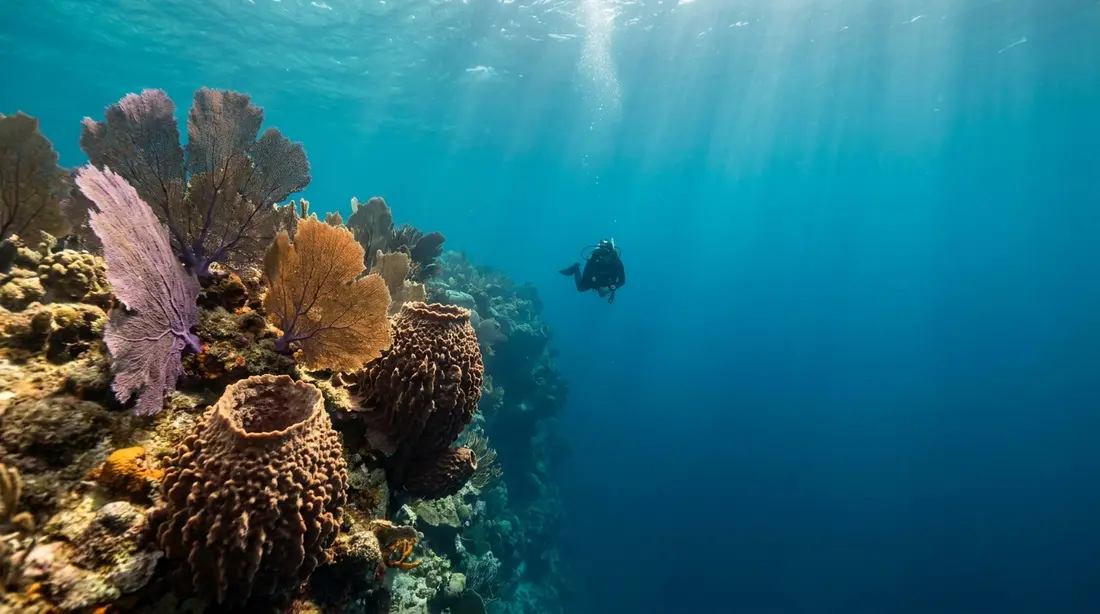
St. Croix's wall does not require a boat. The Cane Bay Wall begins about a hundred yards off the beach and falls toward depths measured in thousands of feet — a sheer profile Cayman divers would recognize, entered past snorkelers from the sand. The Frederiksted Pier gives macro photographers seahorses and octopus on a night dive of regional fame; Butler Bay's wrecks and Salt River Canyon's walls fill the week; and Buck Island Reef National Monument — no-take since 1961 — runs its marked snorkel trail for the surface crowd, by licensed boat from the boardwalk rather than a flotilla. Cayman wins visibility bragging rights some days; St. Croix wins every logistics column and every receipt. See diving St. Croix.
The island around the water
Grand Cayman is flat limestone wearing a garden: pleasant drives, the Botanic Park and its blue iguanas, Rum Point's beach bar, Hell's photogenic ironshore, Camana Bay's open-air mall — an afternoon list, polished and finite, with the sea carrying the rest of the itinerary. St. Croix's land itinerary runs the week: Christiansted's five-building National Historic Site and Danish arcades, Frederiksted's emancipation fort, Alexander Hamilton's boyhood streets, the west-end rainforest and Annaly tide pools, three distilleries, Robert Trent Jones Sr. golf at Carambola, Point Udall's first American sunrise and the bioluminescent bay after dark. One island entertains between dives; the other entertains, period.
Getting there
Cayman's airlift is solid — Miami barely more than an hour, several East Coast nonstops — and this page credits it as the best flight math of any foreign island in these comparisons. The bookends stay foreign: passports for every traveler, immigration queues scaled to cruise season, and U.S. customs home at the $800 allowance. St. Croix's flights land a driver's-license arrival: Miami about three hours daily on American, Charlotte daily from December 17, 2026, Atlanta near-daily from December 19, Newark Saturdays from October 31, 2026, Chicago winter Saturdays, San Juan hourly-ish. Verified August 2026:
| Airline | From | Schedule (as published Aug 2026) | Flight time |
|---|---|---|---|
| American Airlines | Miami (MIA) | Year-round, one to three flights daily by season | about 3 hours |
| American Airlines | Charlotte (CLT) | Paused until Saturdays return November 7; daily beginning December 17, 2026 | about 3¾ hours |
| American Airlines | Chicago O'Hare (ORD) | Winter Saturdays beginning December 5, 2026 | about 4¾ hours |
| Delta Air Lines | Atlanta (ATL) | Saturdays through September 5; Saturdays again from November 14; daily except Mondays beginning December 19, 2026 | about 4 hours |
| United Airlines | Newark (EWR) | Saturday nonstops beginning October 31, 2026 | about 4½ hours |
Safety
Grand Cayman is among the region's safest islands — Level 1, low crime, heavily policed — and no case will be manufactured against it here. St. Croix's answer is category, not degree: as U.S. territory it carries no State Department advisory at all, and the ordinary common sense any island deserves is written at safety and common sense. On this column the islands agree; the wallet and the passport decide elsewhere.
Month by month on the two islands
Cayman's calendar is corporate-smooth: winter high season books Seven Mile's condos at their formidable peaks (holiday weeks price like bonuses, because the clientele has them), Batabano carnival colors May, restaurant month and Pirates Week pepper the fall, and the island's one culinary crescendo — the Cayman Cookout in January — flies in celebrity chefs at four-figure ticket tiers, which tells you the market. Cruise mornings stack George Town heaviest in winter. September and October run quiet under the same Atlantic-season counsel every island in the arc shares — Cayman's western position is no exemption, as 2004's Ivan taught it durably. St. Croix's year runs the same climate at island prices: festival season December–January, AgriFest in February, the green fall discounting villas that never needed a bonus season. Months in detail: when to visit.
The travel day, hour by hour
Cayman's flight math is the foreign field's best — about seventy minutes from Miami, three-and-a-half hours from New York — and the day's friction lives at Owen Roberts: an immigration hall that queues badly when the cruise-season banks land (expansion has chased demand for years), the rental shuttle, and Seven Mile check-in by late afternoon. The return adds the KYD receipts' quiet 20-percent surcharge tally and U.S. customs at the $800 allowance. St. Croix's day trades seventy Miami minutes for one-eighty and deletes everything else: no hall, no queue, no conversion, villa inside forty minutes, $1,600 allowance home. For a Miami-based traveler Cayman's hop is a real card; from everywhere else the flights near-tie and the halls decide.
Seven days on each
The Cayman week is polished routine: Seven Mile mornings from a claimed stretch of condo frontage, the Stingray City sandbar excursion, a two-tank boat morning on the North Wall, Camana Bay's shops and restaurants, Rum Point's afternoon, the Botanic Park's blue iguanas, dinners across the island's admittedly excellent (and priced accordingly) restaurant bench. Smooth, safe, expensive — a fine week that could be invoiced by a concierge.
The St. Croix week runs wilder and freer: Buck Island's snorkel trail Monday; the wall walked into at Cane Bay Tuesday; Christiansted's Danish fort and arcades Wednesday; Point Udall's sunrise, the Jack's and Isaac's hike and The Shoys Thursday; Frederiksted's pier — the night dive Cayman's boats cannot match for a beach entry — and Rainbow's sunset Friday; the rainforest, Cruzan and the Domino Club Saturday; the bio bay glowing after dark. No towel territories, no excursion desk, no KYD. Plans: the 7-day itinerary.
Getting around once you land
Grand Cayman drives on the left (British territory) with a visitor's permit issued at the rental counter, and it drives well — smooth roads, disciplined traffic, and one morning rush around George Town that surprises people who forgot the island has a financial district's commute. Seven Mile's corridor walks and buses easily; the East End and Rum Point runs are pleasant forty-minute drives; parking at the public beach accesses fills in season. Taxis price at Cayman levels, which is to say memorably, and there is no ride-share. None of it is hard; all of it is billed.
St. Croix's version: the same left-side habit in ordinary American cars, no permit beyond your license, no commute hour anywhere, forty minutes corner to corner, and free parking at every beach that has a lot at all. The island loop — rainforest to Point Udall — is the week's best free excursion. See driving on the left and renting a car.
Before you book either island
For Grand Cayman: price everything in KYD first and convert before deciding — the 20-percent premium hides in menus quoted without currency marks; book winter dinners when you book the room (the good tables go); check your dates against cruise-heavy mornings if Seven Mile serenity matters; divers should decide early whether Little Cayman's Bloody Bay is in scope, because the sister-island hop books thin; and note the airport's seasonal queues when scheduling the return. Stingray City goes best at the first departure, before the flotilla.
For St. Croix: book the villa direct (the homes), reserve the car early for high season, calendar Buck Island and the bio bay a few days out in peak weeks, and bring the certification cards — the wall needs nothing else. The first-timer tips and packing list cover the rest.
The case for St. Croix, point by point
One: your dollar stays a dollar — no KYD peg quietly adding a fifth to every receipt. Two: no passport, no immigration queue, no customs hall — and $1,600 of allowance against $800. Three: a wall you walk into from a beach bar's sand against a wall you book a boat for. Four: beaches without condo frontage or towel territories — Sandy Point's two miles against Seven Mile's claimed rows. Five: a night dive (the pier) and a glowing bay (Salt River) in the same week — Cayman offers neither from shore. Six: two historic towns and four federal landscapes against a garden, a cave and a mall. Seven: villa-and-supermarket economics against one of the world's costliest islands. Eight: rum made on-island since 1760 against duty-free shelves. Nine: island character — Jump Ups, AgriFest, quelbe — against engineered polish. Ten: the same safety, minus the invoice. Cayman manages the Caribbean beautifully; St. Croix simply is it.
Who should pick which island
Pick Grand Cayman if: seamlessness is the luxury you are buying and the invoice is noise; the Cookout or a finance-world reunion sets the dates; Stingray City tops a child's list; the North Wall–Little Cayman dive pairing calls; or first-Caribbean nerves want the region's most managed introduction. Pick St. Croix if: the money should buy island rather than polish (the KYD alone refunds a villa upgrade); divers prefer walking into a wall over boarding for one; the week needs towns, rainforest and history between beach days; beaches should be empty sand rather than claimed frontage; or the trip's charm should come from the place itself, unmanaged. Cayman is the Caribbean with a concierge; St. Croix is the Caribbean with the keys.
When Grand Cayman is the right call
Expense-account travelers and the finance diaspora visiting colleagues will find the island built to their standard. Divers pairing the North Wall with Little Cayman's Bloody Bay have a two-island itinerary St. Croix cannot copy. Families who want Ritz-grade kids' programming on a reliably calm beach can buy exactly that. And first-timers nervous about the Caribbean's rough edges will find Cayman has sanded off every one — including, a villa traveler might say, the ones that made it the Caribbean. For island character per dollar, the American wall wins walking away.
A rainy day on each island
Cayman's rainy day is professionally handled, like everything: the National Gallery and the small national museum, Camana Bay's covered retail hours, the turtle centre's tanks, and a spa industry sized to the clientele — competent, climate-controlled, billed in KYD. St. Croix's wet-day file trades polish for substance: Fort Christiansvaern's vaults and the Steeple Building, the Whim estate museum's plantation history, Frederiksted's arts center, and a three-stop distillery trail that rain improves. The rainy-day plan costs a tenth as much and reads twice as deep.
If you choose Grand Cayman anyway
Then let the island do what it does best. Book winter dinners with the room; the good tables are finite and the clientele plans ahead. Take Stingray City on the first boat of the morning — the sandbar with three boats is magic, with thirty it is a queue. Dive the North Wall with an operator who runs small groups, and if the trip can stretch, the Little Cayman hop to Bloody Bay is the wall dive the Caribbean measures others against. Swim Seven Mile from the public accesses early, walk Camana Bay once, skip Hell unless the pun insists, and give Rum Point an afternoon. Convert every KYD price to dollars before agreeing to it — the 20-percent premium hides in unmarked menus — and budget the exit as you budgeted the entrance: politely, professionally, expensively.
Where you would stay on St. Croix
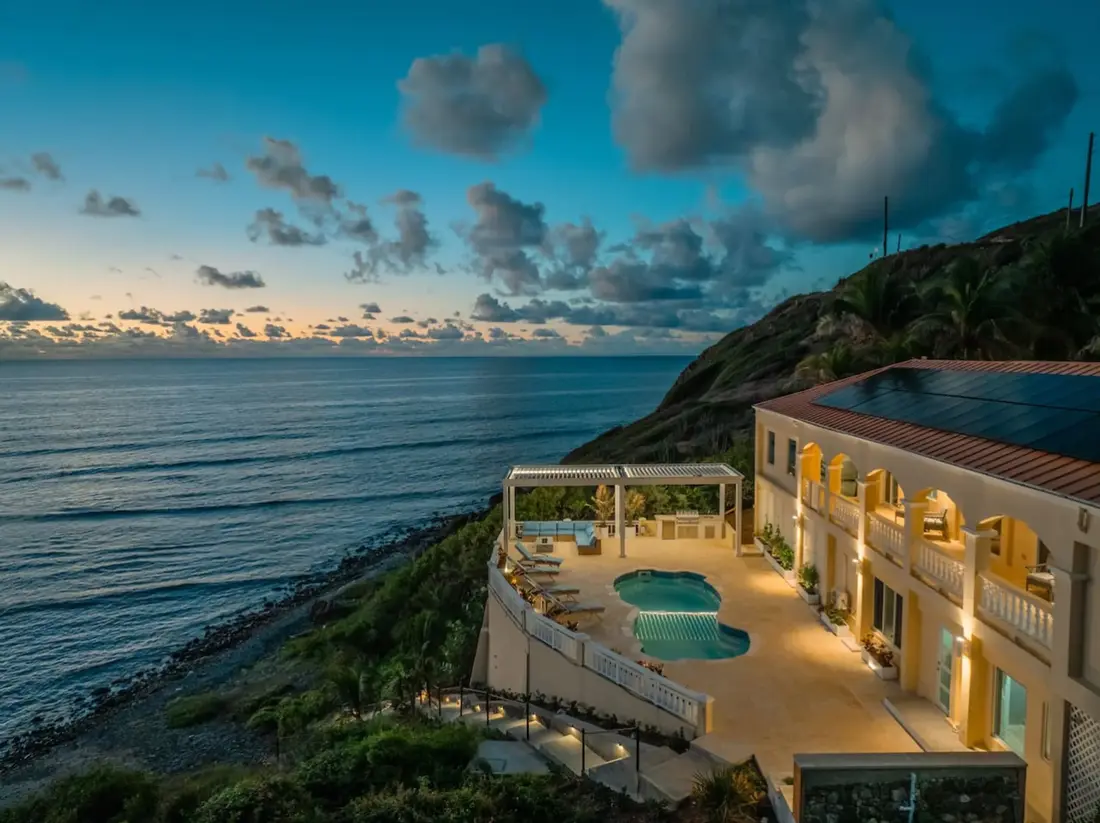
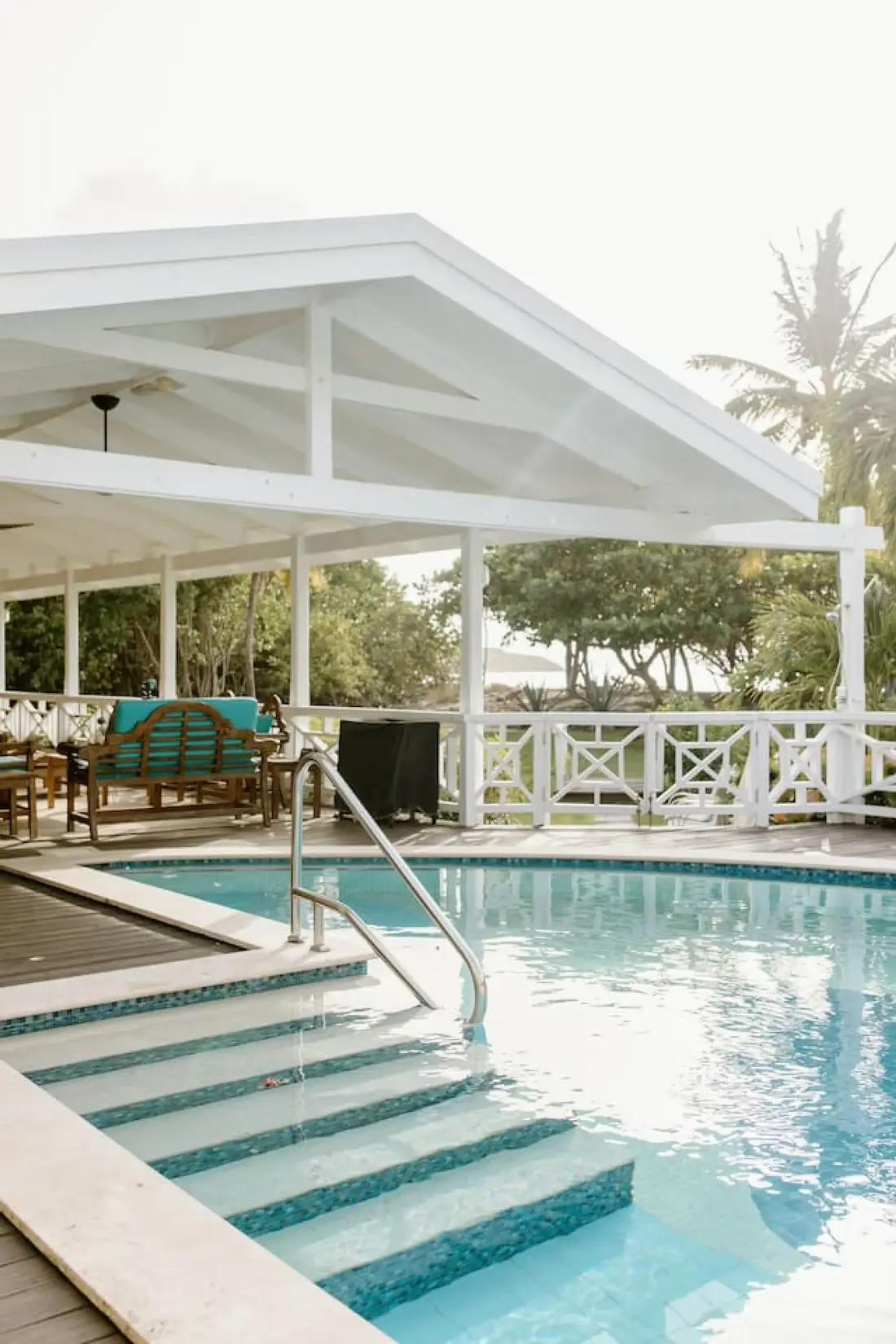
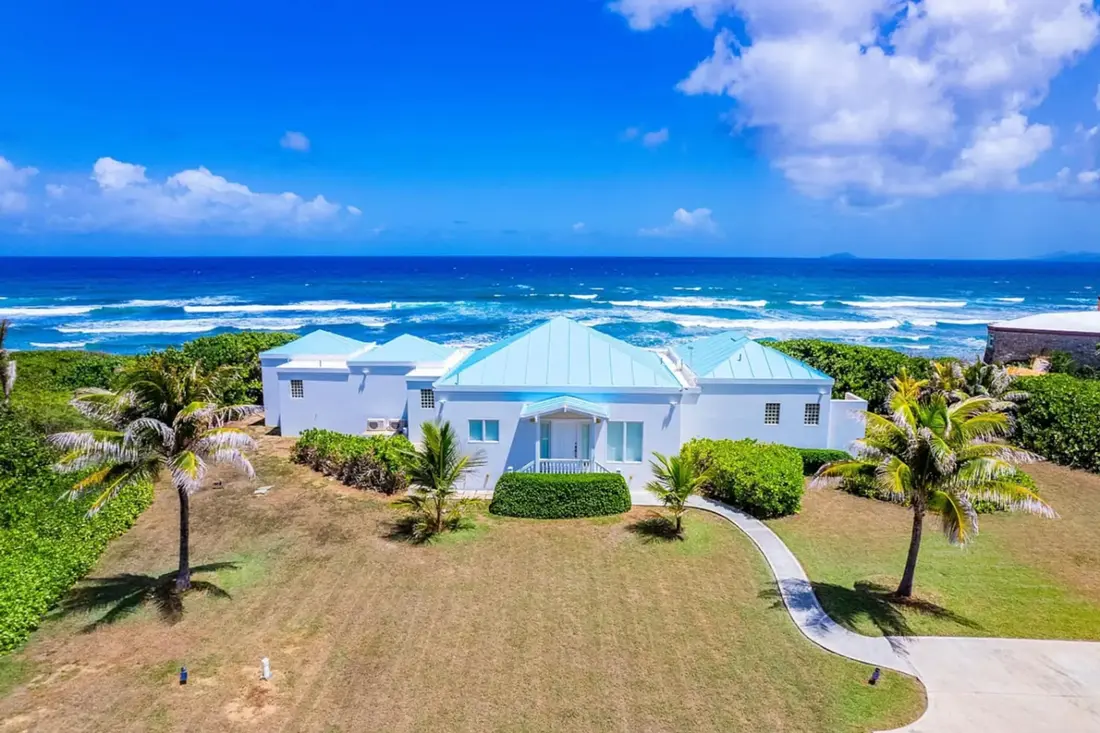
The unbanked alternative: our direct-booked homes, Sterling Point managing from the island, no platform or resort fees anywhere in the arithmetic. Shoy's Beach House owns its stretch of The Shoys' guarded sand outright — the condo-wall problem inverted; the East End villas (The Cerulean among them) face Buck Island's protected water from private pools; Christiansted's condos walk to the boardwalk; the west end holds the sunset. Full kitchens and supermarket provisioning mean the week's food bill converts from Cayman's imported-menu tier to a grocery run. Couples: homes for two; groups to twelve: the family collection. The roster: the homes.
How this page was made
Series rules: the KYD peg and cost rankings per public financial indices; Seven Mile and Stingray City per Cayman's own tourism materials; dive standing per standard references; the Level 1 advisory per the State Department, checked August 2026 — current text at travel.state.gov. Ivan's 2004 lesson per the public record. Cayman's real strengths — safety, polish, the walls, the service — are conceded throughout, because they are why the comparison matters. Our bias: the homes we manage on St. Croix, disclosed on every page. The currency math alone survives any audit.
The bottom line
Grand Cayman is the Caribbean with a wealth manager: safe, smooth, superb water — and a fee schedule in a currency built to outrank yours, behind a passport line. St. Croix is the Caribbean with the keys in your hand: a wall off the beach, sand without condos, towns without tenders, rum without imports and a bill in dollars that stay dollars. Polish is rentable; place is not. The homes are here.
Elsewhere in this series
This page is one of twenty-six. If you are still shopping the map, the verdicts nearest this comparison run as follows — each links to the full page with its own sources:
St. Croix vs the British Virgin Islands — The BVI are the Caribbean's sailing capital — reached by passport, puddle jumper and ferry. St. Croix flies you straight in, no passport at all.
St. Croix vs Turks & Caicos — Turks and Caicos sells one famous beach at luxury-resort prices. St. Croix sells a whole island for less — no passport, no Level 2 advisory.
St. Croix vs Anguilla — Anguilla perfected the quiet expensive beach. St. Croix does the quiet beach without the relay flight, the passport or the markup.
The complete set, grouped by region and passport rules, lives at St. Croix vs other destinations.
Which home fits your group
If St. Croix wins your comparison, the homes are the easy part. Groups of eight to twelve settle into the family collection; couples take a home for two; anyone who wants sand at the door starts with beachfront. Every one is managed from the island by Sterling Point and booked direct — tell us the dates and the headcount and we will point you at the one that fits.
Two practical notes that surprise first-time villa bookers. Direct booking means the rate is the rate: no platform service fees, no resort fees, and the people answering questions are the same Sterling Point team that manages the houses on the island. And every home runs a full kitchen — one run to Plaza Extra or Seaside Market on the drive from the airport covers the week, which is where a villa quietly beats a resort bill before the first beach day. How the booking works, and what it does not mean, is spelled out at book direct.
Who wrote this
SP Vacations is the vacation-rental division of Sterling Point Real Estate, a licensed real-estate operation based on St. Croix in the U.S. Virgin Islands. The team lives and works on the island it writes about: the homes in the villa collection are inspected, cleaned and managed locally, and the person who answers a booking question is on St. Croix, not in a call center three time zones away. That is the vantage point behind every page in this series — and the reason the series exists at all, since most of the destinations compared here are places our guests weighed before choosing this island.
Two standing practices shape what you read. First, the pricing wall: nightly rates and availability for the homes live only on the booking pages, never in articles, so nothing here goes stale or oversells. Second, the sourcing rule: safety statements cite the U.S. State Department, customs figures cite CBP, park facts cite the National Park Service, and anything that changes — advisories, schedules, hours — carries its checked date and a pointer to the primary source. Where a rival destination wins a category, the page says so, because a comparison that concedes nothing persuades nobody. Questions, dates or a villa to match a group — the island team is here, or call 340-205-3929.
Questions people ask
What is Camana Bay?
Grand Cayman's master-planned town center — open-air retail, restaurants and a observation tower, polished like everything on the island and priced the same. St. Croix's town centers were master-planned in the 1730s by Denmark; the polish is patina now, and dinner costs half.
Do you tip in Grand Cayman?
Service charges of 10–15% appear on most bills with tipping expected atop the KYD totals — the arithmetic compounds. St. Croix tips like the mainland, in dollars, on island-economy checks. See money and tipping.
Is the Cayman Turtle Centre worth it?
A managed conservation-and-encounter facility with entry fees to match — families rate it well. St. Croix's turtles are wild: greens over Buck Island's lagoon, hawksbills on the East End reefs, leatherbacks nesting at Sandy Point in season under refuge protection.
What is Rum Point?
Grand Cayman's barefoot north-side afternoon — hammocks, a beach bar and the famous mudslide — reached by a forty-minute drive or ferry. St. Croix's counterpart afternoons are Cane Bay's beach bar under the wall and Rainbow's sunset sand, ten-to-twenty minutes from most villas.
Is the Cayman Cookout worth attending?
For food-event travelers with the budget, yes — January's celebrity-chef weekend is the Caribbean's glossiest culinary ticket. St. Croix's food calendar runs the other direction: Taste of St. Croix's local-chef showcase and AgriFest's farm-fair plates, priced like the island.
Can you visit Cayman's sister islands easily?
Cayman Brac and Little Cayman connect by thin inter-island schedules that book early — worth it for Bloody Bay's wall. St. Croix's sisters are a 25-minute seaplane to St. Thomas and a licensed sail to Buck Island, no passport for either.
Does Grand Cayman have an off-season?
A softer summer and a quiet fall inside the hurricane season Ivan proved real in 2004 — prices ease without collapsing, because the clientele's calendar rules. St. Croix's green fall discounts properly, and its high season still leaves the beaches empty.
Why is Grand Cayman so expensive?
Three stacked reasons: the Cayman dollar is pegged about 20% above the U.S. dollar, nearly everything is imported, and the resident economy is priced to banking salaries. The result ranks among the world's costliest islands. St. Croix bills in U.S. dollars at island-economy rates — and allows $1,600 duty-free home versus Cayman's $800.
Is Seven Mile Beach worth it?
It is superb sand — wide, calm, public — lined its whole length with condos and resorts and swelled by cruise tenders in season. St. Croix's counterargument is emptiness: Sandy Point's two undeveloped miles, The Shoys' guarded crescent, Cane Bay under its wall — no towel territories.
How does the diving compare?
Both are wall islands. Cayman's North Wall and the Kittiwake are boat dives at Cayman prices; Little Cayman's Bloody Bay is a separate hop. St. Croix's Cane Bay Wall is a walk-in from the beach, the Frederiksted Pier is a famous shore night dive, and Buck Island's snorkel trail sits in a no-take monument dating to 1961.
Is Stingray City worth doing?
Once, yes — wild southern stingrays over a waist-deep sandbar is a real marvel, shared with every boat in George Town. St. Croix's counterpart wildlife moments run quieter: turtles over Buck Island's lagoon, leatherbacks nesting at Sandy Point in season, and a glowing bioluminescent bay at night.
Do I need a passport for Grand Cayman?
Yes, for every traveler, with U.S. customs at the $800 allowance on return. St. Croix requires none for U.S. citizens — a driver's license flies you home through an agriculture check with a $1,600 allowance.
Is Grand Cayman safe?
Yes — Level 1, low crime, among the region's safest, and this page says so outright. St. Croix's difference is category: as U.S. territory it carries no State Department advisory at all. On safety the two agree; the decision lives in cost, character and paperwork.
Does Grand Cayman drive on the left?
Yes — British territory — with a visitor's permit from the rental counter and a real George Town commute hour. St. Croix drives left too (a Danish inheritance), in ordinary American cars, with no permit and no rush hour.
How much more expensive is Grand Cayman, really?
Start with the currency: the KYD is pegged about 20% above the U.S. dollar, so every unmarked menu number quietly upsizes. Add world-top-tier cost-of-living rankings and resort-row rates, and comparable weeks commonly run half again to double a St. Croix villa ledger. Run your own dates — the direction is constant.
Is Little Cayman's Bloody Bay Wall worth the hop?
For dedicated divers, yes — it is among the Caribbean's storied walls, reached by a thin inter-island schedule that books early. St. Croix's counterpoint is access: its wall starts a hundred yards off Cane Bay's sand, no second aircraft required.
When is high season in Grand Cayman?
Winter, at formidable rates — holiday weeks price for a banking clientele, and January's Cayman Cookout flies in celebrity chefs at four-figure tickets. St. Croix's matching season fills villas at island prices, with its festival season and AgriFest carrying the calendar.
Is Grand Cayman in the hurricane belt?
Yes — its western position is no exemption, as Hurricane Ivan proved durably in 2004. Both islands share the June–November season and the same advice: insurance and flexible bookings, with quiet green months as the reward.
How long are the airport lines in Grand Cayman?
Owen Roberts queues badly when winter banks and cruise season coincide — expansion has chased demand for years, and hour-long immigration waits make the local press each season. St. Croix has no immigration hall in either direction.
Which is better for families?
Cayman sells managed family polish — resort kids' clubs on reliably calm sand — at Cayman prices. St. Croix sells the family a whole island: a villa with its own pool and kitchen, Chenay's shallows, Buck Island's snorkel trail and a fort to storm — see the family collection.
In this comparison
St. Croix at a glance
- U.S. territory — no passport for U.S. citizens
- Nonstops from Miami, Fort Lauderdale, Charlotte, Atlanta, Newark and Chicago
- U.S. dollars, U.S. phone plans, no foreign customs
- $1,600 duty-free allowance home (double the standard $800)
- 84 square miles — the largest U.S. Virgin Island
More comparisons
- St. Croix vs St. Thomas
- St. Croix vs St. John
- St. Croix vs Puerto Rico
- St. Croix vs Vieques & Culebra
- St. Croix vs the Florida Keys
- St. Croix vs Hawaii
- St. Croix vs the British Virgin Islands
- St. Croix vs Turks & Caicos
- St. Croix vs Anguilla
- St. Croix vs St. Barts
- St. Croix vs St. Martin
- St. Croix vs Antigua
- St. Croix vs St. Kitts & Nevis
- St. Croix vs St. Lucia
Sources
KYD peg and cost-of-living rankings per public financial and relocation indices as widely reported; Seven Mile Beach and Stingray City per Cayman tourism publications; dive sites per standard references; Level 1 advisory per the State Department (verify current). St. Croix facts from NPS, CBP and our sourced island reference. Flights verified August 2026.
St. Croix vs Grand Cayman
Grand Cayman is polished, safe and priced like the banks that built it. St. Croix matches the water and towns it — without the exchange rate or the passport.