St. Croix vs Barbados
The Caribbean's most British island makes serious rum and serious claims. So does the Danish-built American one — four hundred miles closer to home.
Barbados carries itself like the Caribbean's senior statesman: three centuries of uninterrupted British rule, a rum house that claims the world's oldest commercial distillery, a west coast nicknamed Platinum for its resorts, and a cultural calendar — Crop Over, Oistins — that draws real loyalty. It sits at the region's far southeastern edge, a long flight from most of the United States, with a busy cruise port and British-winter crowds. St. Croix answers with its own 1760 rum pedigree, Danish colonial towns, emptier sand — and a three-hour flight.
The two, side by side
| St. Croix | Barbados | |
|---|---|---|
| Passport for U.S. citizens | Not needed | Required |
| U.S. State Department advisory | None — U.S. territory | Level 1, with localized cautions noted |
| Flight from the East Coast | About 3 hours from Miami; 4½ from Newark | About 4½–5 hours from New York; the far southeast Caribbean |
| Rum credentials | Cruzan at Estate Diamond since 1760; Captain Morgan | Mount Gay, often called the world's oldest commercial distillery |
| Coasts | Calm protected beaches all around | Calm west 'Platinum Coast'; rough Atlantic east |
| Crowds | About 41,000 residents, light tourism | About 280,000 residents plus a major cruise port |
| The scene | Boardwalk dinners, beach bars, quiet nights | Oistins fish fry, Crop Over, a real nightlife |
| Diving | Cane Bay Wall and Frederiksted Pier from shore | Wrecks in Carlisle Bay by boat |
| Coming home | Agriculture check; $1,600 duty-free | U.S. customs; $800 duty-free |
| Currency | U.S. dollar | Barbadian dollar, pegged 2:1 |
Advisory levels and details are as published by the U.S. Department of State and checked August 2026. They change — read the current advisory at travel.state.gov before any international trip.
The short answer
Barbados is a real place with real depth — the rare resort island whose culture would carry on happily if tourism stopped tomorrow. If Crop Over, cricket, afternoon tea and the Oistins Friday fish fry call to you, it will reward the long flight. But for an American villa traveler the arithmetic is stubborn: Barbados is among the farthest Caribbean islands from the U.S., its famous west coast is a resort corridor, its cruise port feeds daily crowds, and the whole trip wears a passport and a customs line. St. Croix delivers the same latitude of pleasures — including a rum story just as old — at half the distance and none of the friction. The homes here are ours to manage; the facts are everyone's.
Distance is a decision
Look at a map: Barbados sits east of the entire Antilles arc, the last stop before the open Atlantic. From New York that is about four and a half to five hours nonstop; from the West and Midwest, most itineraries connect through Miami and stretch past eight. Fine for ten days; a heavy tax on seven. St. Croix sits at the top of the arc: Miami about three hours daily on American, Charlotte daily from December 17, 2026, Atlanta near-daily from December 19, Newark Saturdays from October 31, 2026, Chicago winter Saturdays, and San Juan's all-day 50-minute hop. Two travel-hours saved each way is a beach day earned. Verified August 2026:
| Airline | From | Schedule (as published Aug 2026) | Flight time |
|---|---|---|---|
| American Airlines | Miami (MIA) | Year-round, one to three flights daily by season | about 3 hours |
| American Airlines | Charlotte (CLT) | Paused until Saturdays return November 7; daily beginning December 17, 2026 | about 3¾ hours |
| American Airlines | Chicago O'Hare (ORD) | Winter Saturdays beginning December 5, 2026 | about 4¾ hours |
| Delta Air Lines | Atlanta (ATL) | Saturdays through September 5; Saturdays again from November 14; daily except Mondays beginning December 19, 2026 | about 4 hours |
| United Airlines | Newark (EWR) | Saturday nonstops beginning October 31, 2026 | about 4½ hours |
Rum against rum
This is the fun column. Mount Gay's 1703 founding date makes Barbados's claim — oft-cited as the world's oldest commercial rum distillery — and the island's rum shops (hundreds of them, by local count) are a culture unto themselves. Nobody disputes Barbados is a great rum island.
St. Croix's counterclaim is older than the United States: distilling at Estate Diamond dates to 1760, and Cruzan still runs it with the Nelthropp family name attached — tours weekdays, tastings included. Captain Morgan's modern distillery offers its own visitor center, Sion Farm pours the world's first breadfruit vodka, and Leatherback brews with rainwater. Then the American twist: CBP lets you fly home five liters duty-free from the USVI (four bought here, at least one island-made) inside a $1,600 allowance — double what a Barbados return allows. Two great rum islands; one lets you take the argument home by the case. The trail: rum on St. Croix.
Coasts and crowds
Barbados divides cleanly: the calm west — the Platinum Coast — carries the resorts, and its public beaches thread between their properties; the south is lively and condo-built; the Atlantic east at Bathsheba is spectacular, surf-hammered and mostly unswimmable. Add a cruise terminal at Bridgetown that feeds ship-day crowds into the same west-and-south corridor, and 280,000 residents on an island a fifth smaller than St. Croix, and the density math explains what visitors feel in season: company, everywhere.
St. Croix swims calm on every settled shore and holds one-seventh the population on more land. Sandy Point's two undeveloped miles on winter weekends; Cane Bay under its wall; The Shoys behind its gate (our Shoy's Beach House fronts it); Jack's and Isaac's down their cactus trail; Rainbow at sunset. Cruise calls: a handful a week at Frederiksted, versus Bridgetown's daily season traffic. The difference is not the sand's quality — both islands' is excellent — but whose towel is on it.
History: British depth, Danish charm
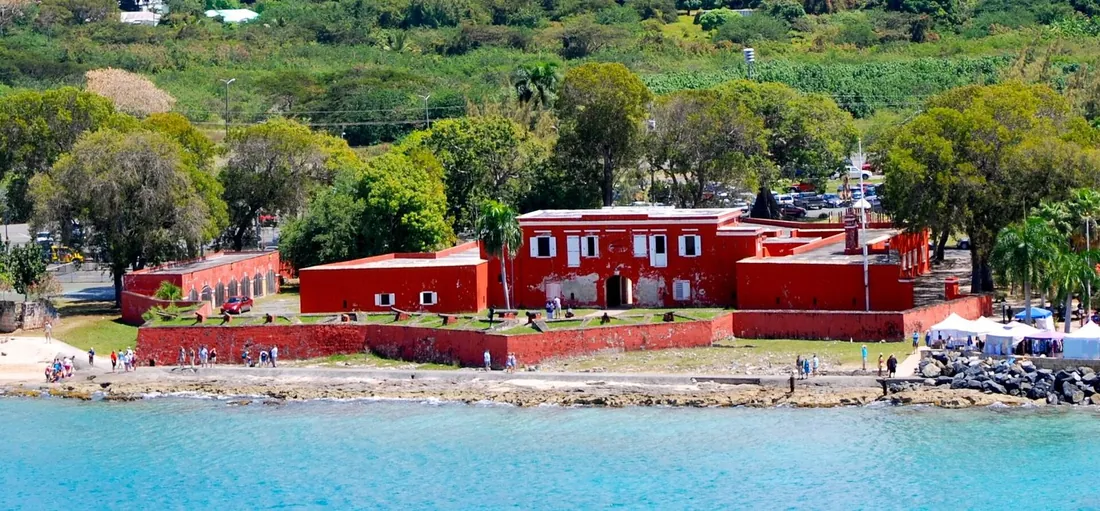
Bridgetown and its Garrison are UNESCO-listed, and Barbados's parish churches, plantation houses and George Washington House (the first president's only trip abroad) give history travelers a full slate. Credit paid. St. Croix's slate is smaller and stranger: seven flags have flown here; Christiansted's five-building National Historic Site anchors a town of Danish arcades built by enslaved African craftsmen; Fort Frederik saw an enslaved population free itself in 1848; Alexander Hamilton clerked his boyhood on Company Street; and Columbus's 1493 landfall at Salt River is the only such site on U.S. soil. See the seven flags and the historic site. Barbados's history is grander in volume; St. Croix's is closer to the sidewalk you are standing on.
Underwater
Barbados dives politely: Carlisle Bay's shallow wreck park and soft-coral reefs by boat, easygoing and warm. St. Croix dives seriously: the Cane Bay Wall falling toward abyssal depth a hundred yards off the sand, the Frederiksted Pier's famous macro and night diving — both shore entries — plus Butler Bay's wrecks, Salt River Canyon and Buck Island Reef National Monument's marked snorkel trail inside a 1961 no-take reserve. Surfers, though, should note the one Barbados card St. Croix cannot match: the Soup Bowl at Bathsheba is a famous break, and surf travelers should go to it. Divers: diving St. Croix.
The week and the wallet
Barbados prices in bands: Platinum Coast resorts at British-winter rates, the south coast more accessibly, everything in Barbadian dollars pegged two-to-one and translated at the card machine, with U.S. customs and the $800 allowance waiting at the end. It is not a bargain island in season, and its loyal British market keeps winter demand firm.
St. Croix runs the villa ledger this site describes throughout: direct-booked homes with pools, supermarket provisioning, free beaches, charter-free shore diving, single-digit attractions, U.S. dollars with no exchange spread, no foreign transaction fees, and the $1,600 allowance home. For a couple the gap is real; for a family or group it compounds daily. Compare your dates — then see the homes.
Month by month on the two islands
Barbados runs the Caribbean's most British calendar: winter high season is the London season transplanted — the Platinum Coast at full rates, flights from Heathrow and Gatwick disgorging their regulars — and the island's cultural peak is Crop Over, the summer festival that crescendos into Grand Kadooment's costumed road march in early August, with the whole island dancing and booked. January's Barbados Open Water Festival and a busy cricket calendar (a Test at Kensington Oval changes hotel math) fill the edges. September and October are the traditional quiet months. St. Croix's calendar runs its own festivals at island scale — the Crucian Christmas Festival's December–January parades, AgriFest in February, Emancipation Day on July 3 — and its fall discounts rather than empties. Both islands share the June–November season and its insurance counsel; Barbados's far-southeast position gives it a modest statistical edge on storm tracks that its tourist board rightly mentions and this page duly records. Months in detail: when to visit.
The travel day, hour by hour
The Barbados day is long because the island is far: the New York nonstop runs four and a half to five hours (when your dates catch it — frequencies thin outside peak), and connecting itineraries through Miami stretch the day past eight hours. Grantley Adams' immigration hall moves reasonably; the taxi north to the west coast adds forty minutes; call it early evening at the hotel from a morning departure. The return repeats the length into U.S. customs at the $800 allowance, Bajan-dollar receipts converting in your head at two-to-one all the way home. St. Croix's day: three hours from Miami, four and a half from Newark, rental counter, supermarket, villa by mid-afternoon — dollars in, dollars out, $1,600 allowance and five liters of Cruzan checked through a domestic bag drop.
Seven days on each
The Barbados week earns its passport: west-coast swimming mornings, the Mount Gay or St. Nicholas Abbey rum tour, Harrison's Cave's tram, the Oistins Friday fish fry with the locals, an east-coast drive to Bathsheba's wild surf, Speightstown's gallery afternoon, maybe a Kensington Oval match day if the calendar smiles. It is a proper island with proper depth, and the week uses all of it.
The St. Croix week answers depth with depth, closer: Buck Island's snorkel trail Monday; Cane Bay's wall Tuesday; Christiansted's Danish fort and arcades Wednesday; Point Udall's sunrise and the East End's beaches Thursday; Frederiksted's emancipation fort and Rainbow's sunset Friday; the rainforest, Cruzan's Estate Diamond tour and the Domino Club Saturday; the bio bay glowing after dark. Two rum pilgrimages, two historic townscapes, two full weeks — one of them without the five-hour flight or the currency math. Plans: the 7-day itinerary.
Getting around once you land
Barbados drives on the left in a dense little road network whose signage assumes you already know the parish; visitors manage fine with a rental (the local temporary permit is a small formality) or ride the island's famous blue Transport Board buses and private ZR vans — a cultural experience its fans recommend and its resorts warn about in the same breath. Distances deceive: the island is small, but Bridgetown's congestion and the narrow cross-parish lanes make the east-coast run a real outing, and west-coast dinner traffic in season crawls. Taxis are unmetered — agree the fare first, as every guide says.
St. Croix shares the left-side habit (Danish inheritance, ordinary American cars, a day-one novelty — the guide) and none of the congestion: open cane-country roads, forty minutes corner to corner, marked routes, and metered expectations at the taxi stands. The island loop is a half-day's pleasure rather than a navigation exercise.
Before you book either island
For Barbados: check the flight math from your city first — the New York nonstops thin outside peak and a Miami connection turns the day eight hours long; if Crop Over or a Test match anchors the dates, book months out and expect festival pricing; confirm your hotel's coast (west for calm swimming, south for energy, east for looking at waves only); and budget the two-to-one Bajan-dollar conversion plus the $800 allowance into the souvenir math. UK school-holiday weeks move the island's occupancy in ways American travelers don't expect — check them.
For St. Croix: book the villa direct (the homes), reserve the car for high season (how it works), calendar Buck Island and the bio bay a few days ahead in peak weeks, and put the Cruzan tour on a weekday (tour times). The packing list finishes the job.
The case for St. Croix, point by point
One: half the flight — three hours from Miami against a four-and-a-half-to-five hour haul to the arc's far corner. Two: no passport, no Bajan-dollar conversion, no customs hall — and $1,600 of allowance against $800. Three: rum history that concedes nothing — Estate Diamond's 1760 tradition against Mount Gay's 1703 claim, with five duty-free liters flying home. Four: swimmable coasts in every direction against an island where the whole east side is for looking. Five: one-seventh the population density and a fraction of the cruise calls. Six: walk-in wall diving and a snorkel-trail monument against pleasant boat wrecks. Seven: villa economics with supermarket provisioning against Platinum Coast rates. Eight: two historic towns kept by the National Park Service, with Hamilton's streets and an emancipation fort. Nine: U.S. phones, banking and no roaming surprises. Ten: the same trade-wind winter at two-thirds the travel and a fraction of the cost. Barbados is the senior statesman; St. Croix is the same century, closer to home.
Who should pick which island
Pick Barbados if: Crop Over or a Test match sets the dates; the British-Caribbean texture — afternoon tea to rum shop — is the attraction; surfing Bathsheba's Soup Bowl is on the list; the Concorde exhibit and Mount Gay's original warehouse call to the connoisseur; or London friends are meeting you halfway. Pick St. Croix if: flight time should be half; the rum pilgrimage works as well at 1760's Estate Diamond as at 1703's Mount Gay (taste both, decide); beaches should be swimmable on every coast rather than one; the budget prefers island prices and U.S. dollars; or the history itch scratches better walked daily than toured once. Two statesmen, one ocean apart — and only one within a morning of Miami.
When Barbados is the right call
Crop Over, if the festival calendar is the trip — nothing on St. Croix matches that scale of carnival (though the Crucian Christmas Festival keeps its own December–January season). Cricket pilgrims, tea-and-garden travelers and Anglophiles will find the island's British texture nowhere else in the region. Surfers belong at Bathsheba. And travelers already touring the southern Caribbean can treat Barbados as its natural grand terminus. For the ordinary miracle of a warm quiet week within a short flight of home, the arc's northern end wins.
A rainy day on each island
Barbados takes a rainy day in stride better than most: Harrison's Cave's tram runs underground regardless, George Washington House and the Garrison's museum carry a historical morning, the Mount Gay and St. Nicholas Abbey tours pour indoors, and Bridgetown's synagogue and parliament rooms round the list — a proper cultural bench, credited. St. Croix matches it at closer range: Fort Christiansvaern and the Steeple Building, the Whim estate museum, Frederiksted's arts center, and its own three-stop distillery trail with Cruzan's working tour at its head. Call the wet-day column a rare draw — then note whose sunny days sit three hours closer.
If you choose Barbados anyway
Then lean into what only Barbados has. Time the trip to Crop Over or a Kensington Oval match if the culture is the point — the island at festival pitch is worth the flight. Stay west for swimming, south for value and nightlife, and visit the east to watch Bathsheba break without planning to swim it. Do Oistins on the Friday, one plantation-house rum tour (St. Nicholas Abbey's still and steam mill beat the big names for atmosphere), and the island's north point when the crowds thin. Ride one ZR van for the story and taxi otherwise with fares agreed first. Book the New York nonstop the moment dates firm — its frequencies thin outside peak — and convert the Bajan-dollar menus in your head before ordering, not after.
Where you would stay on St. Croix
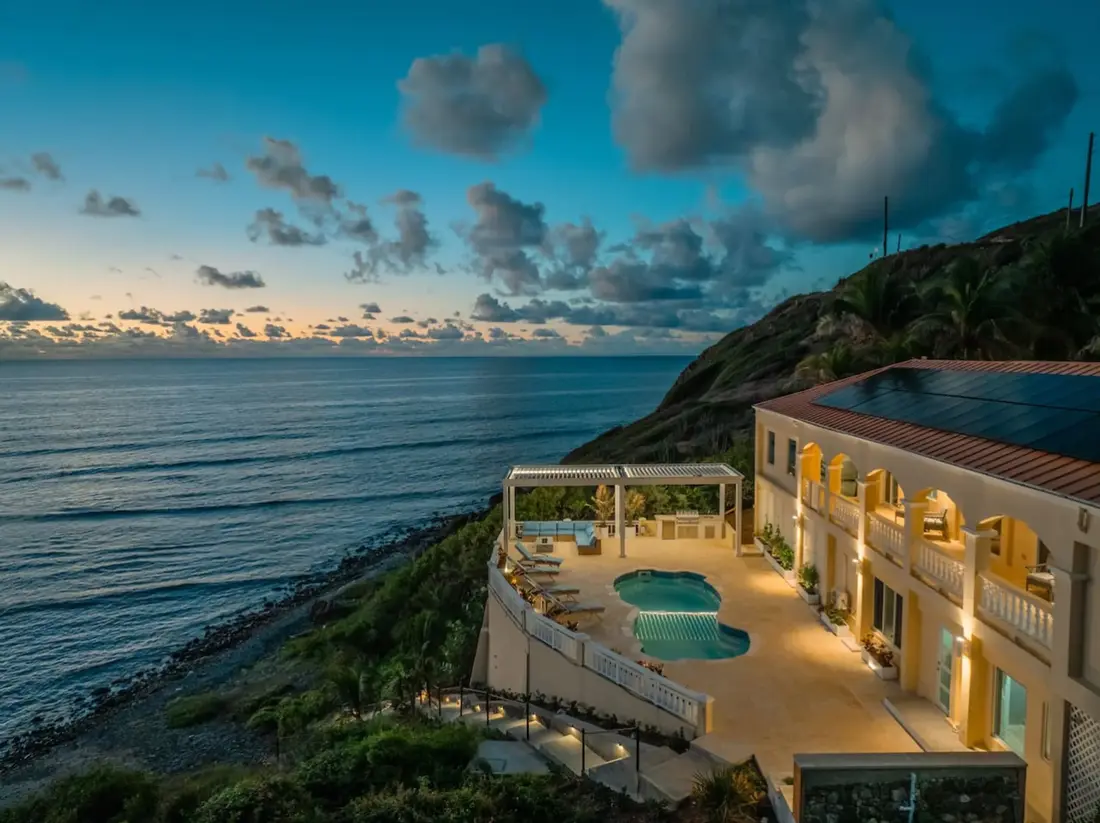
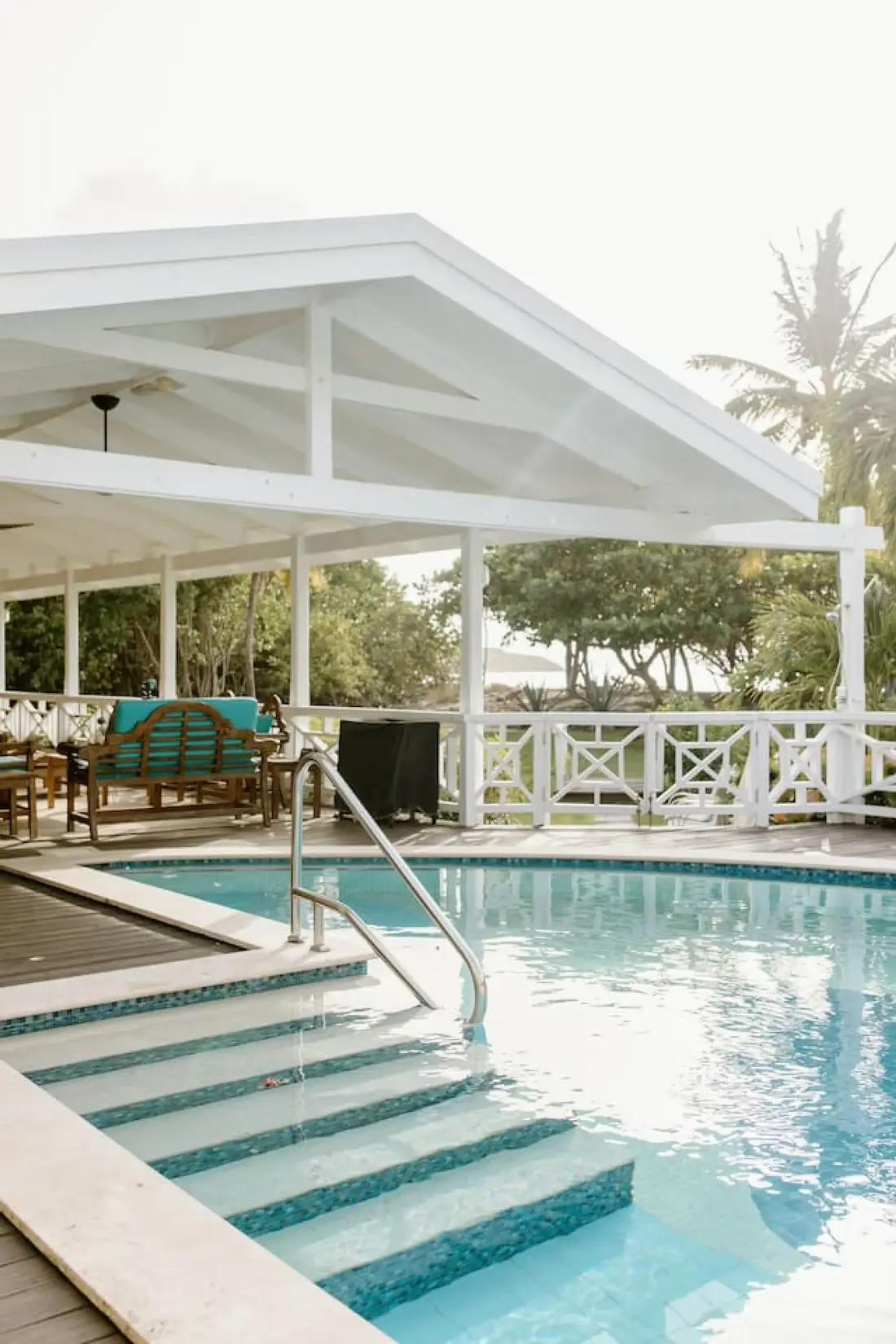
The near-island alternative: our direct-booked homes managed on-island by Sterling Point. Shoy's Beach House on The Shoys' guarded crescent; East End villas — The Cerulean among them — facing Buck Island from private pools; Christiansted condos in walking range of the boardwalk's dinner rows; west-end stays for the sunset coast. Full kitchens, supermarket provisioning, no platform fees, sleeps two to twelve across the homes for two and the family collection. The rum cellar stocks itself on the way home: five duty-free liters under the $1,600 allowance. The roster: the homes.
How this page was made
Series rules: advisory standing per the State Department (Barbados's Level 1 with localized notes), checked August 2026 — read current text at travel.state.gov; flights verified the same month; Mount Gay's 1703 claim cited as the distillery states it; Bridgetown's UNESCO listing per UNESCO; crowd and price characterizations per public statistics and stated as patterns. Barbados's genuine depth — the culture, the cricket, the rum shops, the Soup Bowl — is conceded throughout. Our bias: the homes we manage on St. Croix, printed on every page of this series. The facts check out either way.
The bottom line
Barbados is the long-haul statesman: polished, cultured, far, and busy in season. St. Croix is the near-shore equivalent with the same-vintage rum, calmer coasts, emptier sand and no passport — the 1760 distillery against the 1703 one, the Danish arcades against the Garrison, three hours against five. If the festival or the surf calls, fly the distance. If the week itself is the point, it lives closer than you thought. The homes are here.
Elsewhere in this series
This page is one of twenty-six. If you are still shopping the map, the verdicts nearest this comparison run as follows — each links to the full page with its own sources:
St. Croix vs the British Virgin Islands — The BVI are the Caribbean's sailing capital — reached by passport, puddle jumper and ferry. St. Croix flies you straight in, no passport at all.
St. Croix vs Turks & Caicos — Turks and Caicos sells one famous beach at luxury-resort prices. St. Croix sells a whole island for less — no passport, no Level 2 advisory.
St. Croix vs Anguilla — Anguilla perfected the quiet expensive beach. St. Croix does the quiet beach without the relay flight, the passport or the markup.
The complete set, grouped by region and passport rules, lives at St. Croix vs other destinations.
Which home fits your group
If St. Croix wins your comparison, the homes are the easy part. Groups of eight to twelve settle into the family collection; couples take a home for two; anyone who wants sand at the door starts with beachfront. Every one is managed from the island by Sterling Point and booked direct — tell us the dates and the headcount and we will point you at the one that fits.
Two practical notes that surprise first-time villa bookers. Direct booking means the rate is the rate: no platform service fees, no resort fees, and the people answering questions are the same Sterling Point team that manages the houses on the island. And every home runs a full kitchen — one run to Plaza Extra or Seaside Market on the drive from the airport covers the week, which is where a villa quietly beats a resort bill before the first beach day. How the booking works, and what it does not mean, is spelled out at book direct.
Who wrote this
SP Vacations is the vacation-rental division of Sterling Point Real Estate, a licensed real-estate operation based on St. Croix in the U.S. Virgin Islands. The team lives and works on the island it writes about: the homes in the villa collection are inspected, cleaned and managed locally, and the person who answers a booking question is on St. Croix, not in a call center three time zones away. That is the vantage point behind every page in this series — and the reason the series exists at all, since most of the destinations compared here are places our guests weighed before choosing this island.
Two standing practices shape what you read. First, the pricing wall: nightly rates and availability for the homes live only on the booking pages, never in articles, so nothing here goes stale or oversells. Second, the sourcing rule: safety statements cite the U.S. State Department, customs figures cite CBP, park facts cite the National Park Service, and anything that changes — advisories, schedules, hours — carries its checked date and a pointer to the primary source. Where a rival destination wins a category, the page says so, because a comparison that concedes nothing persuades nobody. Questions, dates or a villa to match a group — the island team is here, or call 340-205-3929.
Questions people ask
What is Harrison's Cave?
Barbados's show cave — an electric tram through lit limestone galleries, a solid family rainy-day ticket. St. Croix's underground is smaller and boozier: fort vaults and rum cellars; its geology performs underwater instead, at the Cane Bay drop-off.
Is Bridgetown worth a day?
Yes — the UNESCO-listed Garrison, parliament buildings, the synagogue and a real capital's street life, best on a non-cruise morning. Christiansted answers at village scale with the NPS site and arcades — and essentially never shares itself with a ship.
How is the surfing in Barbados?
The Soup Bowl at Bathsheba is one of the Caribbean's best-known surf spots and the island's east coast breaks draw serious surfers year-round — a real specialty St. Croix does not contest. St. Croix's boards are paddleboards on calm bays; its adrenaline is the wall.
Which is easier with kids?
St. Croix, on logistics: shorter flights, no passports, a villa kitchen, calm shallows at Chenay and a fort to storm. Barbados family trips run well too — at five-hour-flight distance with conversion math and busier beaches.
What is a ZR van?
Barbados's privately run minibus fleet — fast, loud, soca-soundtracked and beloved-slash-feared by visitors; ride one once for the story. St. Croix's public options are taxi stands and your own rental; the soundtrack is up to you.
Is St. Nicholas Abbey worth visiting?
Yes — a 350-year-old plantation house with a working steam mill and small-batch rum, the island's most atmospheric tour. St. Croix's counterpart hour is Estate Whim's museum plus Cruzan's working distillery, ten minutes apart. See Whim.
When is cricket season in Barbados?
International fixtures cluster December through April at Kensington Oval, and a Test match reprices hotels — check the calendar either to catch one or to dodge one. St. Croix's winter calendar peaks gentler: festival season, AgriFest and Mardi Croix.
Which has better rum tours?
A genuine tie worth settling in person: Mount Gay's heritage pour and St. Nicholas Abbey's steam-mill charm against Cruzan's working Estate Diamond tour and Captain Morgan's visitor center — with St. Croix's five-liter duty-free rule as the tiebreaker your suitcase understands.
How far is Barbados from the U.S.?
Farther than most travelers guess — the island sits at the Caribbean's southeastern edge: about 4½–5 hours nonstop from New York and 8-plus with connections from much of the country. St. Croix is about 3 hours from Miami and 4½ from Newark, verified August 2026.
Is Barbados safe?
Broadly yes — the State Department has listed Barbados at Level 1 with localized cautions (certain Bridgetown areas at night). Advisories change; check travel.state.gov. The comparison with St. Croix turns on distance, crowds and cost rather than safety.
Which island has better rum?
A tie worth tasting twice. Barbados fields Mount Gay's 1703 claim and a rum-shop culture; St. Croix fields Cruzan's Estate Diamond tradition dating to 1760, Captain Morgan's visitor center and a $1,600 duty-free allowance that flies five liters home — double what a Barbados trip returns with.
Can you swim everywhere in Barbados?
No — the Atlantic east coast is rough and mostly unswimmable (spectacular for surfers at Bathsheba); calm water concentrates on the resort-lined west and busy south. St. Croix's settled shores swim calm year-round, and its beaches are not threaded between resort properties.
Do I need a passport for Barbados?
Yes, plus Barbadian-dollar exchange and U.S. customs at the $800 allowance on return. St. Croix: no passport for U.S. citizens, U.S. dollars, agriculture check only, $1,600 allowance.
Is Barbados crowded?
In season, yes by island standards: 280,000 residents on a smaller island than St. Croix, a major cruise terminal at Bridgetown, and a devoted British winter market. St. Croix runs about 41,000 residents, light tourism and a handful of weekly cruise calls.
Do visitors need a permit to drive in Barbados?
A small temporary driving permit, arranged through the rental company — a formality, plus left-side driving on dense parish lanes with unmetered taxis as the alternative. St. Croix also drives left, in ordinary American cars on open roads, no permit required beyond your license.
Can you swim on Barbados's east coast?
Mostly no — the Atlantic side at Bathsheba is surf-hammered and current-swept, spectacular for surfers and photographers only; swimming lives on the west and south. Every settled coast of St. Croix swims calm, from Cane Bay to Frederiksted.
What is Oistins on a Friday?
Barbados's beloved fish-fry night — grilled marlin, music and the whole island out, and a fair thing to envy. St. Croix's counterparts are the boardwalk's evening tables, west-end sunset bars and a Jump Up when the calendar obliges. See Jump Up.
When is Crop Over in Barbados?
The festival season builds through July and crescendos at Grand Kadooment's road march in early August — the island's cultural peak, booked far ahead. St. Croix's carnival season is the Crucian Christmas Festival, late December into early January, with parades in Frederiksted.
Is Barbados outside the hurricane belt?
Not outside, but favorably placed — its far-southeast position gives it a statistical edge on storm tracks that its tourism board fairly cites. Both islands share the June–November season and the same practical advice: insurance and flexible bookings.
What currency does Barbados use?
The Barbadian dollar, pegged two-to-one to the U.S. dollar — cards work everywhere and the math is constant. St. Croix uses the U.S. dollar outright, with no conversion, no foreign transaction fees and the $1,600 duty-free allowance home.
Which is better for diving?
St. Croix, comfortably: shore-entry signatures at Cane Bay and the Frederiksted Pier, wrecks, canyon walls and Buck Island's protected snorkel trail. Barbados offers pleasant boat diving in Carlisle Bay — and, separately, serious surfing at the Soup Bowl.
In this comparison
St. Croix at a glance
- U.S. territory — no passport for U.S. citizens
- Nonstops from Miami, Fort Lauderdale, Charlotte, Atlanta, Newark and Chicago
- U.S. dollars, U.S. phone plans, no foreign customs
- $1,600 duty-free allowance home (double the standard $800)
- 84 square miles — the largest U.S. Virgin Island
More comparisons
- St. Croix vs St. Thomas
- St. Croix vs St. John
- St. Croix vs Puerto Rico
- St. Croix vs Vieques & Culebra
- St. Croix vs the Florida Keys
- St. Croix vs Hawaii
- St. Croix vs the British Virgin Islands
- St. Croix vs Turks & Caicos
- St. Croix vs Anguilla
- St. Croix vs St. Barts
- St. Croix vs St. Martin
- St. Croix vs Antigua
- St. Croix vs St. Kitts & Nevis
- St. Croix vs St. Lucia
Sources
Mount Gay's 1703 claim per the distillery's own history as widely cited; Bridgetown and its Garrison per UNESCO; population and cruise figures per public statistics; advisory status per the State Department (verify current). St. Croix rum history per Cruzan; other facts from NPS, CBP and our sourced island reference. Flights verified August 2026.
St. Croix vs Barbados
Barbados is polished, popular and far. St. Croix matches the rum heritage and the sand, closer, quieter and without a passport.