AgriFest
The Virgin Islands' agriculture and food fair fills Estate Lower Love each February with farm stands, plates, and livestock ribbons.
AgriFest is the largest farm show and food fair in the U.S. Virgin Islands, three days each February when St. Croix's farmers, cooks, school groups and families gather on the old sugar land at Estate Lower Love. Its formal name is the Agriculture and Food Fair of the U.S. Virgin Islands; the 2026 fair, its 54th, ran February 14 to 16. This page is the definitive guide to AgriFest: what it is, where it came from, the animals and crops judged in the show rings, the food village at its center, the crafts and music, how to make a day of it, and how to pin down the dates for the year you travel.
What AgriFest is
AgriFest is the territory's agricultural fair, staged on St. Croix over a long weekend in February. The name on the official program is the Agriculture and Food Fair of the U.S. Virgin Islands; nearly everyone shortens it to AgriFest. It is the biggest event of its kind in the territory, and it bills itself as the largest agricultural fair in the Caribbean. Three public bodies run it together: the V.I. Department of Agriculture, the University of the Virgin Islands School of Agriculture, and the V.I. Lottery, which helps pay for it.
What separates AgriFest from the island's carnival-season parades is its purpose. It is a working farm show first and a party second. Farmers bring animals and crops to be judged, the department and the university mount education booths, and the food is cooked by island kitchens rather than concession trucks. Growers, ranchers, home cooks, craftspeople and youth groups come from all three U.S. Virgin Islands, and the fair draws farming delegations from around the eastern Caribbean; recent programs have listed guests from Antigua, Barbuda, St. Kitts and Nevis, St. Lucia, Grenada and Guyana. It draws big crowds across the three days, and for an island of about forty thousand residents it works as something close to a yearly reunion, with returning family, old classmates and neighboring farmers all in the same field.
For a visitor it reads less like a tourist attraction than a homecoming. Crucians who have moved away time their trips home around it, and the crowd is overwhelmingly local. That is exactly the reason to go. It is the most complete day of St. Croix's own food and farming culture on the calendar, and anyone can join it for the price of a ticket at the gate. For how the fair fits the rest of the island's year, see a year of events.

Where the fair came from
AgriFest has a longer history than its edition numbers let on. Its ancestor was a run of Agricultural Field Days held in the 1930s at the old Agricultural Experiment Station in Estate Anna's Hope, where the island showed off fruit, vegetables, poultry, livestock, local drinks, baked goods and cooked plates, and gave awards to its best farmers. Those field days faded through the war years and the decades after, as sugar collapsed and the island's economy turned toward oil and tourism. By the time the island's last working sugar factory closed in the 1960s, much of the everyday farming knowledge those early fairs had celebrated was at risk of going with it, and reviving the fair, when it came, was in part an effort to hold onto it.
The fair as St. Croix now knows it dates to the early 1970s. In 1971 the territory's agriculture commissioner, Rudolph Shulterbrandt, pulled together a group to revive it, and the first modern fair followed in 1972, held at Estate Lower Love under the Department of Agriculture. The fairgrounds carry his name today, the Rudolph Shulterbrandt Agricultural Complex, and the fair has run there almost every year since. It has taken hits and recovered: Hurricane Hugo tore up the island's farmland in September 1989 and set the 1990 fair back, but the event returned with force in 1991, and a mid-1990s push under Commissioner Arthur C. Petersen Jr. added the permanent booths, tents, power and facilities the grounds still rely on.
The edition count runs a step behind the years because of one gap. The 49th fair was held in early 2020; the 2021 edition was called off during the pandemic; and the fair came back in 2022 as its 50th. Every year since has moved up by one, which puts the 2026 fair at the 54th and the 2027 fair at the 55th. Under the numbers is a plain mission the organizers restate each year: to keep the island's farming alive and visible, on land that grew sugar for two centuries, back when St. Croix was called the breadbasket of the Virgin Islands.
The livestock show
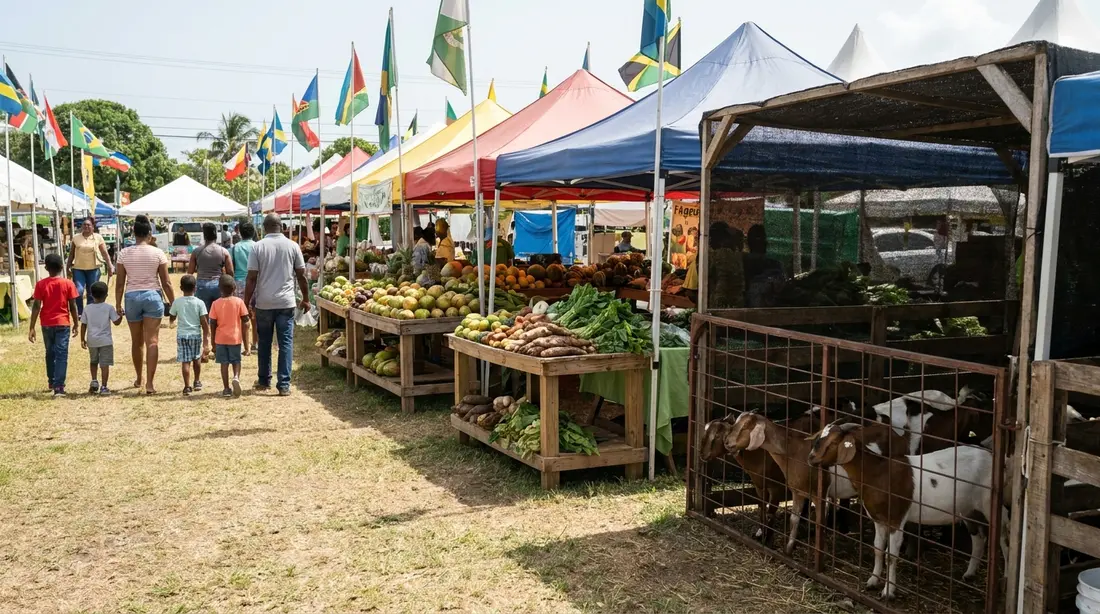
The animals are the oldest part of the fair and still one of its biggest draws. Farmers from across the territory bring their best stock to be penned, shown and judged in the Frits E. Lawaetz livestock pavilion and the surrounding ground. Walk through and you pass cattle, pigs, sheep, goats, chickens, ducks, rabbits, and the occasional emu and peacock, most raised by working farmers and some by students showing an animal they kept for a school or youth program. Judges award ribbons across the classes, and the weekend's top honor, Farmer of the Year, is announced on the Saturday. The larger animals are led out for judging in front of the crowd, and people gather at the rails to watch a farmer walk a prize bull or a champion goat; for a lot of local families that is the part of the weekend they return for every year.
Two of the breeds in the rings are St. Croix's own gifts to world agriculture, and both are worth recognizing. The deep-red Senepol cattle you will see were bred on this island from West African stock across more than a century, developed for beef and for tolerating tropical heat, and now raised on several continents; the full breeding story sits in our Crucian food guide. The white hair sheep in the pens are another island breed, St. Croix's heritage sheep, prized for thriving in the tropics and known well beyond the Caribbean. Seeing the living animals behind the local beef and mutton on the food-village plates is one of the quiet pleasures of the fair, and a reminder that this is a farm show and not a food court.

Produce, plants and the Farmer of the Year
Alongside the animals runs the harvest. The fair sets up a farmers' market of the island's crops, from lettuce, cabbage, tomatoes and peppers to herbs, root vegetables, tropical fruit and spices such as nutmeg, much of it entered for judging and plenty of it for sale to carry home. Nurseries and growers bring plants and seedlings by the tableful, so a lot of visitors leave with a fruit tree or a pepper start for the yard. The produce competition matters to the people in it; the island's best-known growers, among them Grantly Samuel, a repeat Farmer of the Year, exhibit here, and a ribbon carries real standing in a small farming community. The spread on the tables is a point of pride, a yearly answer to the old assumption that a small, half-dry island cannot feed itself, and alongside the raw crops sit the preserves, sauces and seasonings that island cooks put up from them.
The Farmer of the Year award is the ceremonial center of the weekend. It comes on Saturday, following the formal opening ceremony that starts the fair at ten in the morning, and it honors a full season of work rather than a single prize animal or crop. The department and the university also use the produce tents to teach, with demonstrations, growing advice and displays built around each year's theme; the 2026 theme, "Agriculture and Technology: An Ideal Mix in 2026," paired traditional farming with the tools now reaching island growers. To see the market up close on an ordinary week, the Saturday farm market and roadside stands are mapped in our groceries and provisioning guide.
The food village
For a large share of the crowd, the food is the fair. AgriFest sorts roughly into two big sheds and the open ground between them, one side given to the farm exhibits and the other to the cook stalls, and the food side runs on a scale nothing else on the island matches. Dozens of vendors set up shoulder to shoulder, most of them island cooks, church groups and community clubs rather than restaurants, competing for the day's reputation and sometimes a ribbon of their own. The cooking is judged in its own contest, so a plate you buy may have taken a prize that morning, and the stalls that win tend to draw the longest lines by lunchtime.
This is the single best place and time to eat the whole range of Crucian cooking, which is why we point you to the dishes instead of repeating them here. The Crucian food guide covers the plates you will meet, from kallaloo and fish and fungi to stewed meats and souse, and the pate and johnny cakes guide covers the fried-dough stalls that pull the longest lines. A few things the fair does better than anywhere else are worth flagging: guavaberry tarts and the layered Vienna cake from the baking tables, cocoa cheese and other old-time coconut candy, cups of maubi and seamoss from the drink coolers, and fresh cane juice run through a crank press on the spot, a direct taste of the crop that built the island. Bring cash, since the stalls take little else, and eat early, because the specialties sell out and the popular booths build lines by midday.
Crafts, music and the stage
Between the farm sheds and the food, AgriFest is also a market and a concert. Craft vendors sell goods made on the island, from jewelry, soap and woodwork to art, plants and preserves, and it is a dependable place to find things made on St. Croix rather than imported for the cruise trade. A stage runs through each day with a program that is pure Virgin Islands: steel-pan orchestras, many of them high-school bands, cultural dance troupes, quadrille sets moving to the scraping pulse of quelbe, and live bands into the evening.
The fair is one of the surest places on the island to see mocko jumbies, the stilt dancers who move above the crowd through the weekend; recent fairs have featured the Guardians of Culture Mokojumbies among the performers. Quelbe, the folk music that carries the whole thing, is the territory's official traditional sound, built on a scraped gourd, a triangle, banjo, guitar and a flute, with lyrics that comment on island life. The history of both the stilt dancers and the scratch bands is told in our mocko jumbies and quelbe guide. A daily fashion show rounds out the stage schedule.
The children's fair
AgriFest is built for families, and a good part of it is aimed squarely at children. The livestock pens double as a petting zoo where kids meet goats, rabbits, chickens and calves up close, and the fair keeps up the old habit of donkey-cart rides alongside a set of carnival rides. Past the fun, the fair takes its role in raising the next generation of farmers seriously: 4-H members and other youth groups show animals they raised, and the department, the university, local schools and the U.S. Department of Agriculture run education booths pitched at young visitors.
That focus on youth is not decoration. Farming on a small island depends on young people choosing to stay in it, and the fair is where a child who fed a goat all year gets to show it, win a ribbon, and be seen doing it by the whole community. For a visiting family it makes AgriFest one of the easiest outings on the island: cheap to enter, thick with animals and food, and the kind of open ground where children can roam a little. Our February guide sets the fair inside the wider month if you are planning a family week around it.
Attending AgriFest well
A few practical things separate a good AgriFest day from a hot, crowded one. The fair falls on the Presidents' Day weekend, one of the busiest stretches of the island's busiest month, and it pulls a genuine crowd. Saturday and the Monday holiday are the peak days; the roads toward Estate Lower Love back up through the late morning, and parking on the grounds fills. The reliable move is to come early. Friday morning is the quietest of the three days, with the shortest food lines and the fullest stalls before anything sells out, and the cool early hours are the best time for the animals and the exhibits, which leaves the shaded afternoon for the stage.
The rest is common sense for an outdoor event in a Caribbean February. The site is large and mostly shadeless, so a hat, sunscreen, water and real walking shoes all earn their place. Carry cash in small bills, because most vendors take nothing else and the machines near the gate run dry. If you can, spread the fair over more than one day; a single visit covers it, but the food alone rewards a second lap, and a weekend pass makes that cheap. As for what to eat first, get a pate in your hand while you decide, then follow the longest local line, because on this island a line of Crucians outside a food stall is the surest review there is.
Getting to Estate Lower Love
The fairgrounds lie near the middle of St. Croix, off Centerline Road, the main route that runs the length of the island. Villas around Christiansted and the East End are roughly twenty minutes away, and Frederiksted on the west end is a shorter drive still. No public bus suits a fair day, so plan to drive or to take a taxi, and expect the approach to slow from mid-morning as the crowd arrives; on the busy days, marshals direct parking on and around the grounds. Come early enough and the parking mostly solves itself.
Remember the island's two driving quirks. Traffic keeps to the left, in the same left-hand-drive cars used on the mainland, a combination that catches newcomers out at junctions, so ease through the mid-island intersections and take extra care driving home tired after a day in the sun. And nobody here runs Uber or Lyft, so a car or a cab is how you travel. For how taxis work and what they charge, see taxis and getting around; the getting-around page covers the rest; and for your own car, the renting a car guide explains why the island's fleet thins out in February.
The fair's dates
AgriFest is an annual fixture of the Presidents' Day weekend, the long weekend around the third Monday of February. In practice that has meant the fair runs Friday through Sunday of that weekend, or through the Monday holiday, in the middle of the month. The 2026 fair ran February 14 to 16, and the 2027 dates have been listed as February 13 to 15. Because the holiday shifts by a few days from year to year, and because the organizers occasionally adjust, the safe approach is to confirm the current year's dates once you have travel weeks in mind.
The dates and the year's theme are announced by the organizers ahead of the season. The official fair website, the V.I. Department of Agriculture, the University of the Virgin Islands and the territory's tourism office all carry them, and the fair's own social media tends to post them first. If your trip is built around AgriFest, book the villa and the rental car early regardless, because the fair sits inside peak season and the island's small supply of homes and cars tightens for that weekend; our renting a car guide explains why the fleet runs short. The table below lists the recent editions we have been able to confirm.
| Year | Edition | Dates, at last check |
|---|---|---|
| 2020 | 49th | February, Presidents' Day weekend |
| 2021 | Not held | Cancelled during the pandemic |
| 2022 | 50th | February, Presidents' Day weekend |
| 2023 | 51st | February, Presidents' Day weekend |
| 2024 | 52nd | February, Presidents' Day weekend |
| 2025 | 53rd | February, Presidents' Day weekend |
| 2026 | 54th | February 14 to 16 |
| 2027 | 55th | February 13 to 15, announced |
AgriFest in the February calendar
AgriFest anchors a busy island February, and it helps to know how it sits among the month's other events, because visitors mix them up. It is not a carnival and not a parade. It is a farm and food fair, held on fixed fairgrounds, with a gate ticket. That sets it apart from the island's Christmas-season carnival, the Crucian Christmas Festival, which takes over Frederiksted at the turn of the year and is a different kind of event.
Within February, AgriFest shares the calendar with two lighter gatherings. Mardi Croix, the island's own Mardi Gras, is a costume parade and beach party on the North Shore, usually a Saturday earlier in the month. A Jump Up street night often lands in Christiansted around Valentine's Day. February is also the island's driest, sunniest and most expensive stretch, with humpback whales passing offshore at their winter peak; the full picture of the month, weather, crowds and all, is in our St. Croix in February guide. If food is the draw, the fair has two warm-weather cousins worth knowing: Taste of St. Croix, the chefs' tasting event in June, and the pate festival described in the pate and johnny cakes guide. Between them, these events make late winter and early summer the two seasons when the island's food comes out in public in force.
What to expect at a glance
The fair in brief. Dates, hours and prices are set again each year, so treat the figures below as recent rather than fixed, and confirm them as your travel dates firm up.
| What to expect | AgriFest on St. Croix |
|---|---|
| What it is | The U.S. Virgin Islands' agriculture and food fair, held on St. Croix |
| When | Presidents' Day weekend in February; February 14 to 16 in 2026 |
| Where | Rudolph Shulterbrandt Agricultural Complex, Estate Lower Love |
| Hours | 9 a.m. to 6 p.m. daily in 2026; opening ceremony 10 a.m. Saturday |
| Admission | Modest; 8 dollars adults, 5 children, 6 seniors in 2026, weekend passes sold |
| The farm side | Livestock show, produce judging, plant and seedling sales, education booths |
| The food side | Dozens of Crucian food and drink stalls; the year's best local eating |
| For children | Petting zoo, donkey-cart and carnival rides, youth exhibitors |
| On stage | Steel pan, quelbe, mocko jumbies, cultural dance, a daily fashion show |
| What to bring | Cash, a hat, sunscreen, water, walking shoes |
| Best timing | Friday morning for short lines; early each day for the animals |
Questions guests ask
What is AgriFest?
AgriFest is the U.S. Virgin Islands' agriculture and food fair, held on St. Croix over a three-day weekend each February. Its formal name is the Agriculture and Food Fair of the U.S. Virgin Islands, and it is the territory's largest farming event, run by the V.I. Department of Agriculture with the University of the Virgin Islands. It combines a livestock show and produce judging with a huge food village of Crucian cooking, a craft market, agricultural education and a stage of local music. The crowd is mostly local, and for a visitor it is the fullest day of island food and farming culture on the calendar.
When is AgriFest, and how do I find the dates?
It runs on the Presidents' Day weekend, around the third Monday of February, for three days in the middle of the month. The 2026 fair was February 14 to 16, and the 2027 dates have been given as February 13 to 15. The holiday moves a little each year, so treat those as a guide and confirm before you book. The organizers announce the dates and the year's theme ahead of the season; the official fair website, the Department of Agriculture, the university and the territory's tourism office all carry them, and the fair's social media usually posts them first.
How much does it cost to get in?
Not much. Admission for the 2026 fair was set at 8 dollars for adults, 5 for children and 6 for seniors, with weekend passes available for anyone planning more than one day. Prices are modest and are set fresh each year, so check the current figure before you go rather than relying on an old number. Everything inside runs on cash, so bring small bills for the gate, the food stalls, the craft vendors and the rides. The machines near the entrance are not something to count on.
What is there to do at AgriFest?
More than a single visit can cover. The farm side has a livestock show with cattle, goats, sheep, pigs, poultry and more, produce and plant judging, plants and seedlings for sale, and education booths from the department, the university and the schools. The food village holds dozens of stalls cooking the full range of Crucian dishes. There is a craft market of island-made goods, a stage of steel pan, quelbe, cultural dance and mocko jumbies, a daily fashion show, and rides and a petting zoo for children. On the Saturday, the fair names its Farmer of the Year.
What should I eat at AgriFest?
Start with a pate, the island's fried turnover, then work the food village by following the longest local lines. The fair is the best single place all year to eat Crucian cooking, so try the things that are hard to find otherwise: kallaloo, fish and fungi, stewed goat, guavaberry tarts, a slice of layered Vienna cake, and cocoa cheese from the candy tables. Wash it down with maubi, seamoss or fresh cane juice pressed on the spot. Our Crucian food guide and pate guide say what each dish is, so you can order with some idea of what you are getting. Come hungry and come early.
Is AgriFest good for kids?
Very. Children take to the animals first, and the fair leans into it with a petting zoo, donkey-cart rides and carnival rides, plus youth exhibitors, including 4-H members, showing animals close to their own age. The food is cheap and endless, the grounds are open enough for kids to move around, and the stage keeps them entertained between plates. It is one of the more affordable family days on the island. Bring sun cover and water, since the site is large and mostly out in the open, and plan to go in the morning before the heat and the crowds build.
How is AgriFest different from the island's carnival?
They are separate events with separate purposes. AgriFest is a farm and food fair on fixed fairgrounds at Estate Lower Love in February, with a gate ticket, livestock, produce and food at its core. The Crucian Christmas Festival is St. Croix's carnival, staged in Frederiksted around Christmas and the new year, with pageants, competitions, J'ouvert and two street parades. Mardi Croix, also in February, is a small Mardi Gras parade and beach party on the North Shore. AgriFest is the one about farming and food; the others are about music, costume and parade. All three are covered in their own guides.
AgriFest from our villas
Estate Lower Love sits near the center of St. Croix, within an easy drive of the homes we manage around Christiansted and the East End and closer yet to the west end, so a fair day fits a stay at any of them. The Cerulean and the other East End homes put you about twenty minutes out; beachfront Shoy's Beach House sits minutes from Christiansted and the town's dinner tables; and Sunset Sea-Clusion toward Frederiksted is the shortest run of all to the fairgrounds. Since the fair lands squarely in peak season, the whole villa collection fills months ahead for that weekend, so reach out early and let us know AgriFest is what brings you, and we will steer you to the plates worth the drive.
Sources
Written from official and first-party sources, checked August 2026. Hours, prices and event dates change — confirm before you go.
In this guide
Stay nearby
On The Shoys beach: six bedrooms, six baths, pool and hot tub, room for twelve, and the beach through the back garden.
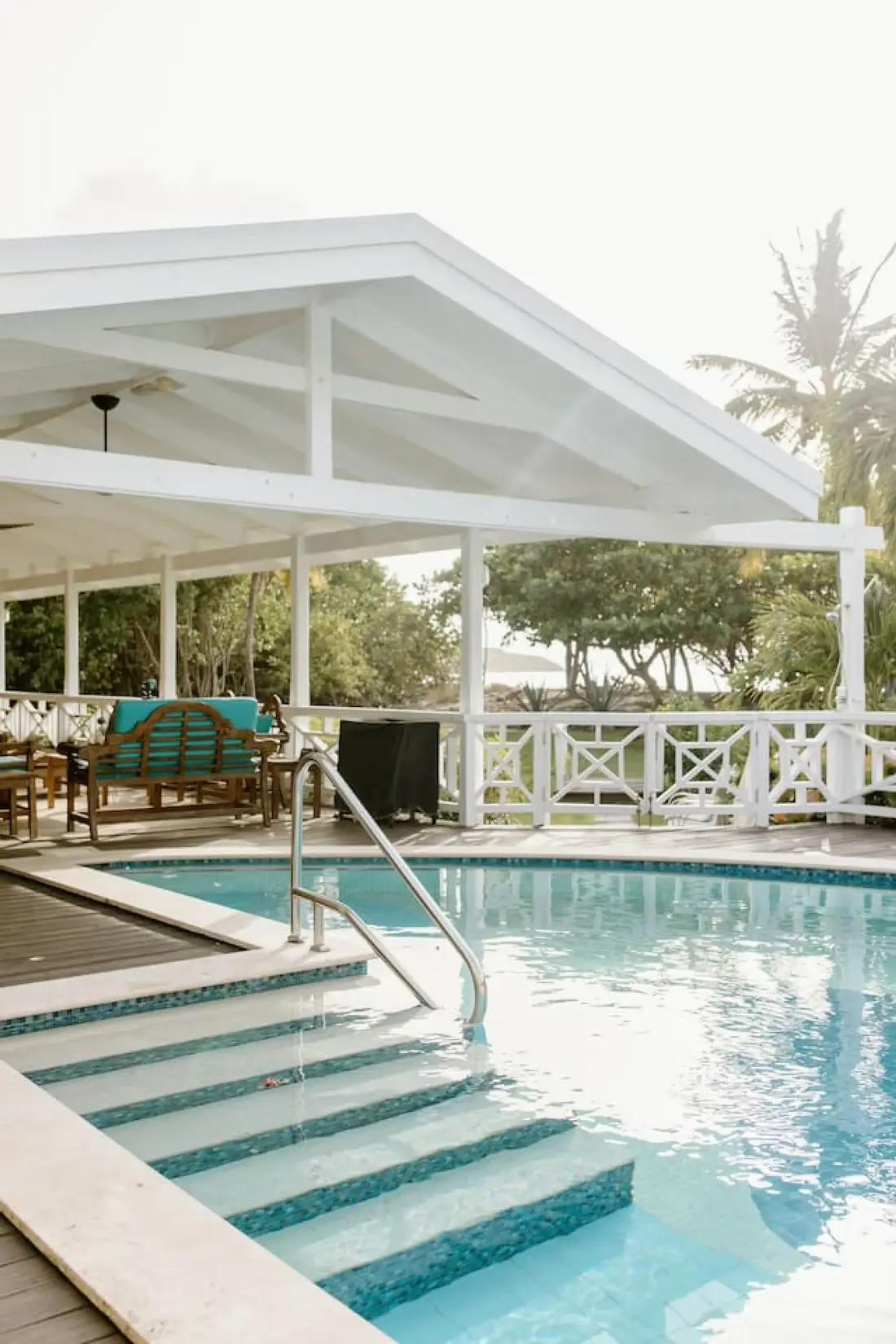 Shoy's Beach House6 bd · 6 ba · sleeps 12 · Christiansted
More in Events & Festivals
Sources
7 references, listed in full at the end of this guide — official park, refuge, tourism-board and business sources, checked August 2026.