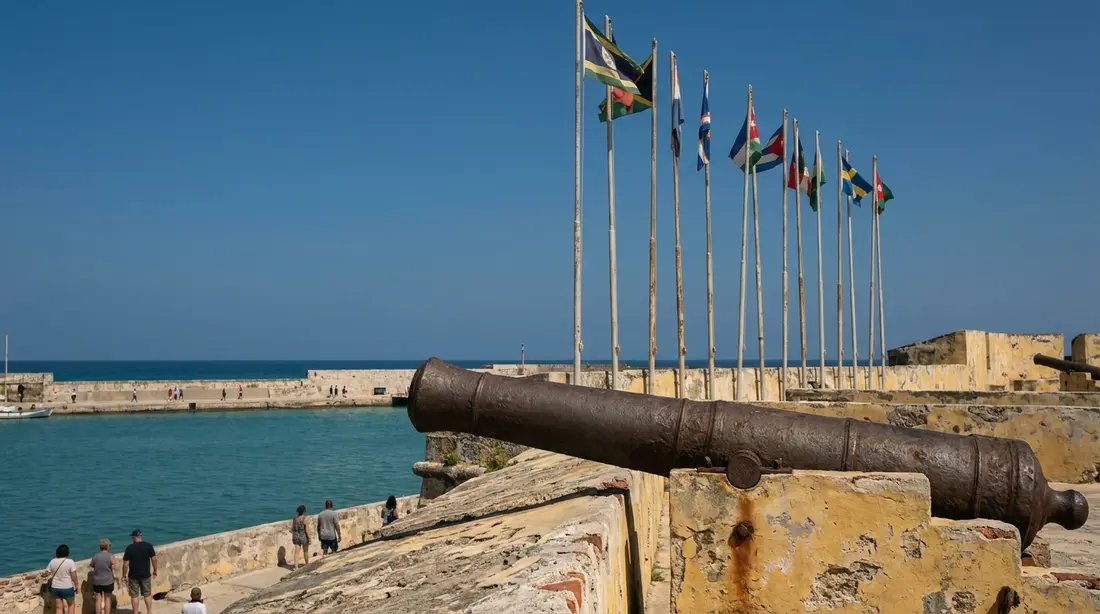
The Seven Flags of St. Croix
Spain, the Netherlands, England, France, the Knights of Malta, Denmark, and the United States: how one island changed hands seven times.
Seven sovereign flags have flown over St. Croix: Spain, the Netherlands, England, France, the Knights of Malta, Denmark and the United States. That is the full political history of the island in one sentence, and it is a crowded history for 84 square miles. This page walks the whole sequence in order, flag by flag, with the dates the record supports and links to our deeper guides on each era. If you want to understand why a Caribbean island with Danish forts has a French name, an English-speaking population and an American passport, the answer runs through all seven.
The count and the fine print
The canonical list, the one you will hear on the island and read in the territory's own materials, runs Spain, the Netherlands, England, France, the Knights of Malta, Denmark, the United States. The order is roughly chronological by first arrival, and the big date brackets look like this: Spain claimed the island from 1493; Dutch and English settlers farmed it side by side from about 1625; France seized it in 1650 and held sovereignty, in one form or another, until 1733; the Knights of Malta owned it outright from 1651 to 1665 under French protection; Denmark bought it in 1733 and kept it for 184 years; the United States has flown its flag since March 31, 1917.
Historians add fine print, and the fine print is worth knowing because it makes the story more interesting rather than less. The Dutch and English flags flew at the same time, over rival settlements a few miles apart, so the sequence is a braid rather than a chain at that point. Spain's flag technically went up twice, once as an empty claim after 1493 and again for a few months in 1650 when a Spanish force from Puerto Rico held the island in arms. France's presence brackets the Knights on both sides, so you could count its flag two or three times. And one of the seven owners was a crusading military-religious order rather than a country, which is the detail that wins bar bets. Some writers therefore say six nations and seven flags; others quietly reorder England ahead of the Netherlands. The count of seven is a fair summary, and everyone on St. Croix uses it. Just know it smooths a messier record, and the mess is told below.
Before the flags
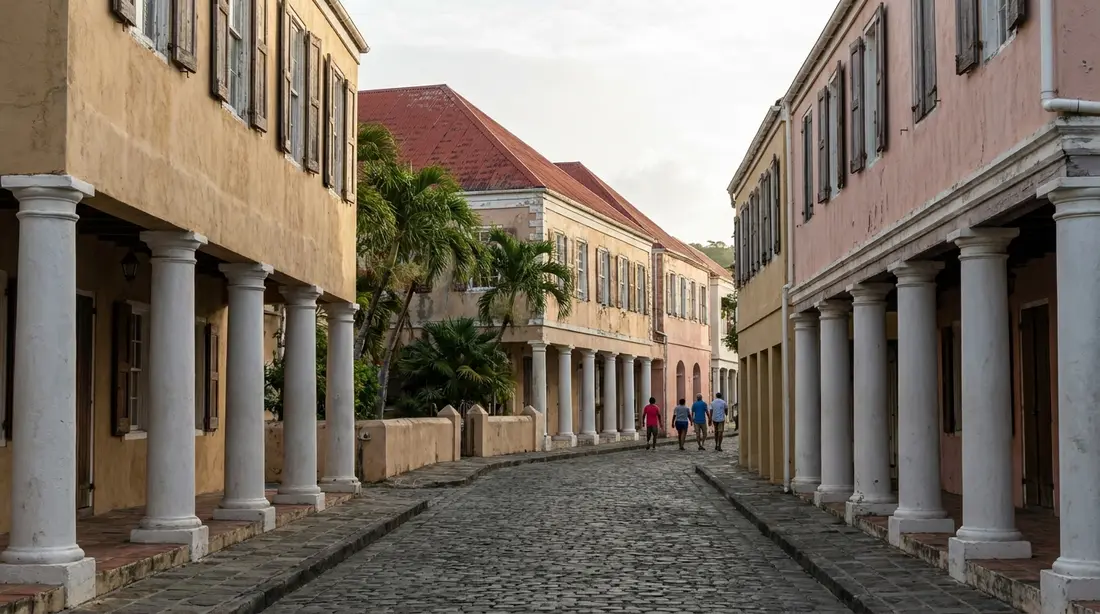
People lived on St. Croix for roughly two thousand years before any European ensign arrived. The Igneri came first, then the Taino, who called the island Ay Ay, usually translated as "the river," and later the Kalinago, the people the Spanish chronicles call Caribs, who knew it as Cibuquiera, "the stony land." By 1493 the north-shore settlement at Salt River Bay was a Kalinago town on ground the Taino had made a regional ceremonial center. That whole story, the archaeology, the ball court, the events of November 14, 1493 and the fight the chroniclers named the Cape of the Arrows, belongs to our Salt River guide, and this page will not shortchange it by compressing it. The one-line version: the first flag was planted on an island that was already somebody's home, and within a century of that planting the people whose home it was were gone from it, carried off by Spanish slave raids and disease.
Spain's claim, 1493 to 1650
Columbus reached St. Croix on his second voyage, named it Santa Cruz, Holy Cross, and sailed on after a single bloody afternoon. Spain's flag over the island was, from that day forward, a legal position rather than a settlement. No Spanish town was ever built here, no fort, no mission, no plantation. What Spain did instead was raid: royal policy in the early 1500s licensed the capture of Kalinago people for slave labor on Hispaniola and Puerto Rico, and those raids, together with epidemic disease, emptied the island. English accounts from the 1590s describe Santa Cruz as uninhabited, and archaeologically the settlement record simply stops in the late 1500s.
So the first flag's era is a paradox: a century and a half of ownership with nothing built and everything destroyed. Spain defended the claim exactly once, in 1650, and the circumstances of that one defense are covered below, because 1650 is the pivot year of the whole story. What Spain permanently left is the name. Santa Cruz passed into French as Sainte-Croix, into Danish as Sankt Croix, and into American English as Saint Croix, pronounced "croy." Every later flag flew over an island still named for a Spanish claim that never amounted to a single house.
The Dutch and English colonies, 1625 to 1650
The second and third flags arrived together. Around 1625, in the years when northern European planters were pushing into the Caribbean gaps Spain could not police, Dutch and English settlers landed on the empty island and planted separate colonies. The English took ground toward the west end and put in cane and tobacco; the Dutch settled by the fine natural basin on the north shore, the harbor the Danes would later build into Christiansted, and were joined there by French Huguenot refugees. One account has the Dutch settlement, enlarged by 1642, going under the name Nieuw Zeeland. On the evidence of what came later, neither colony was large, and neither trusted the other.
The two-colony arrangement ended in blood. The surviving accounts were all written down later and disagree on details, but their outline is consistent: a quarrel between the rival governors turned violent in the mid-1640s, the English governor was killed, an English reprisal followed, and the Dutch and their Huguenot neighbors abandoned the island, leaving England in sole possession by about 1645. The Dutch flag over St. Croix therefore flew for perhaps twenty years, over one settlement, and left almost nothing behind that a visitor can point to. The English colony carried on alone for five more years, long enough to draw exactly the wrong kind of attention.
One physical relic of this period survives, and it is older than anything Danish on the island: the triangular earthen fort at the mouth of Salt River Bay, begun by English hands in 1641 and finished by Dutch ones in 1642, later renamed Fort Sale by the French. The National Park Service ranks it among the oldest surviving European earthworks in the Americas, and you can stand on its banks today; our Salt River guide tells its story in full.
The violent year of 1650
In August 1650 Spain finally enforced its 157-year-old claim. Five ships out of Puerto Rico landed a force reported at 1,200 men, overwhelmed the English colony, and killed or expelled its settlers. The Dutch tried to take advantage, sending two ships to snatch the island while it was in play, and were beaten off by the small Spanish garrison. Then came the French. Philippe de Longvilliers de Poincy, the governor-general of the French islands, ruling from his stronghold on St. Kitts, sent an expedition that surprised the Spanish caretaker force, about sixty men by the usual account, and took the island before the year was out. Four flags had flown over St. Croix in a matter of months. From 1650 the island was French, and its next 83 years would be shaped by decisions made in St. Kitts, Paris and, improbably, Malta.
France's first attempt at settlement was a disaster of its own. Some 300 colonists were planted on the island, and within a year fever had killed a reported two-thirds of them along with two successive governors. St. Croix in the 1650s was a frontier that consumed people, which is part of why its owner was willing to consider an unusual buyer.
France and the Knights of Malta, 1651 to 1665
The strangest entry on the list deserves the fullest explanation. The Sovereign Military Order of St. John of Jerusalem, called the Knights of Malta after the island fortress they ruled, was a Catholic military-religious order founded during the Crusades. By the 1600s it was a naval power in the Mediterranean, an aristocratic institution drawing members from across Catholic Europe, and, crucially for this story, heavily French in membership. Many French colonial officers were Knights, and the most powerful of them was de Poincy himself.
The mechanism that put a crusader flag over a Caribbean island was corporate failure. The French Caribbean was administered by a chartered firm, the Compagnie des Iles de l'Amerique, and by mid-century the company was bankrupt. Its islands went up for sale, and de Poincy, whose position depended on who bought them, persuaded his own order to be the buyer. In 1651 the Order's ambassador in France, Jacques de Souvre, signed the purchase, approved by Grand Master Giovanni Paolo Lascaris in Malta: four islands, the French portion of St. Kitts, St. Martin, St. Barthelemy and St. Croix, for 120,000 livres. Accounts differ on the details of St. Croix's inclusion, with one tradition holding that de Poincy paid for it out of his own fortune and made it over to the Order, and French crown confirmation of the arrangement followed a couple of years after the signing, which is why some histories date the interlude from 1651 and others from 1653. Either way, the Order of Malta became the only institution of its kind ever to own American colonies, holding them as a feudal proprietor while Louis XIV kept nominal sovereignty overhead.
The Knights' rule was, in practice, de Poincy's rule; he governed the four islands from St. Kitts until his death in 1660 and never made St. Croix his home. The island itself stayed turbulent, with a settler rebellion against the Order's control in 1657 that had to be put down and answered with new fortifications, clearing and planting. As a business, the venture failed. The colonies ran at a loss, the Order still owed money on the purchase, and in 1665 it sold its Caribbean rights to the newly chartered French West India Company and returned its attention to the Mediterranean. Fourteen years, no monuments, one permanent contribution: the seventh flag in the count, and the story every Crucian schoolchild gets to tell about a crusader order in the Caribbean.
The French colony and the empty years, 1665 to 1733
Under the French West India Company, and after 1674 under the French crown directly, once that company too had failed and the king absorbed its debts and its islands, St. Croix was a modest plantation colony. It grew tobacco, indigo, cotton and some sugar, and it never flourished. The harbors were awkward for the ships of the day, the colony sat exposed in wartime, and France's Caribbean energy was flowing west to Saint-Domingue, the future Haiti, which was becoming the richest colony on earth.
The end came administratively. In 1695, with France at war with England and the Dutch Republic, the crown ordered the colony evacuated, and its settlers and enslaved workers were shipped to Saint-Domingue. For the next 38 years St. Croix was a French flag over an empty island once more, visited by woodcutters, hunters and passing crews, its estates going back to bush. It is one of the odder facts in Caribbean history that the most fought-over small island of the 1600s spent the first third of the 1700s abandoned, and that its greatest century began with a real-estate transaction rather than a battle.
Denmark's purchase, 1733
Denmark entered the Caribbean in 1672 on St. Thomas and added St. John in 1718, both of them steep, dry islands better suited to harbors than to cane. The Danish West India & Guinea Company, the chartered firm that ran the colony, wanted flat, fertile land, and idle St. Croix was exactly that. The contract was signed in Copenhagen on June 15, 1733, Louis XV ratified it on June 28, and the price was 750,000 livres, paid half in French coin and the balance over eighteen months. On November 16, 1733 the company named Frederik Moth the island's first Danish governor, and on January 8, 1734 the French colors came down in a ceremony on the Christiansted waterfront, beside the ground where Fort Christiansvaern would shortly rise. The sixth flag would fly longer than the previous five combined had flown over actual settlements.
The Danes built fast and on paper. Moth laid out Christiansted in 1734 and named it for King Christian VI; surveyors cut the island into a grid of estates that still organizes Crucian addresses today; and Frederiksted followed on the deep-water west coast in 1751. A census in 1742, nine years in, already counted 120 sugar and 122 cotton plantations, worked by 1,906 enslaved Africans against 360 whites, and those two numbers moving apart is the entire Danish economic story in miniature. In 1754 the chronically indebted company was wound up and the crown of Frederik V took the islands over directly, effective January 1755, opening the trade to all Danish subjects. By then the enslaved population had reached 7,566; at the sugar economy's late-1700s height it stood between 18,000 and 20,000 people on this one island.
The Danish century and a half
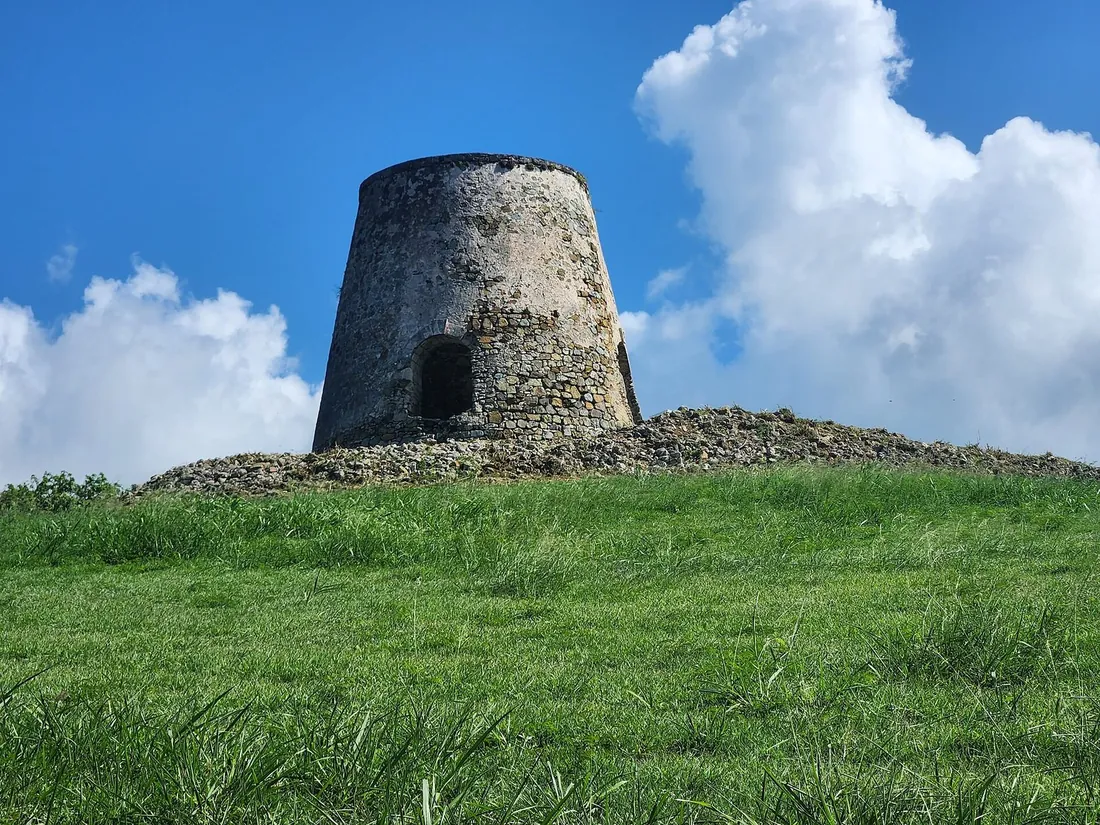
The Danish era, 1733 to 1917, is the era every visitor walks through, and it is the one this site covers in the greatest depth elsewhere. This page keeps to the spine and points you onward. The machinery of the sugar port, the fort, the scale house, the customs house and the warehouse whose courtyard held slave auctions until Denmark's 1792 abolition decree took effect in 1803, is the subject of the Christiansted National Historic Site guide. The plantation side of the same economy is at Estate Whim, and the stone towers standing in pastures island-wide are decoded in the sugar mill ruins guide. A teenage clerk named Alexander Hamilton learned commerce on the Christiansted wharves in this era before sailing north in 1772. Enslaved people who escaped the estates held out for generations in the cliff country of the northwest, a history told in the Maroon Ridge guide.
Freedom was taken rather than given. On July 3, 1848, thousands of enslaved Crucians massed before Fort Frederik behind Moses Gottlieb, called General Buddhoe, and Governor-General Peter von Scholten proclaimed emancipation on the spot; the full account, hour by hour, is in the Fort Frederik guide, and the holiday it created is covered under Emancipation Day. Thirty years of exploitative contract labor later, the island answered with the 1878 Fireburn, the labor revolt led by Queen Mary Thomas and her fellow queens that forced the labor laws open.
Around these events the colony was sliding. European beet sugar ate the price of cane from the 1820s onward, emancipation ended the plantation labor system, drought and storms did their part, and in 1871 the colonial capital itself moved from Christiansted to Charlotte Amalie on St. Thomas. By the late 1800s the Danish West Indies cost Copenhagen more than they returned, and Denmark began looking for a buyer. There was only ever one serious candidate.
Three treaties to sell the islands
The American purchase took fifty years and three attempts, a fact that surprises most visitors.
The first attempt came in 1867, a treaty covering St. Thomas and St. John only. Denmark ratified it that October, and then the U.S. Senate simply never acted, distracted by the impeachment fight around President Andrew Johnson and unnerved by natural disasters that battered the islands while the treaty sat. The second attempt, a 1902 treaty covering all three islands at a price of five million dollars, passed the American side and died in Denmark, where the Landsting, the upper house, deadlocked 32 to 32 on October 22, 1902, with objectors noting that the deal gave the islanders neither a vote on the matter nor U.S. citizenship.
The third attempt was driven by war. By 1915 Germany's submarine campaign had Washington thinking hard about the sea lanes to the new Panama Canal, and about what would happen to Denmark's colonies if Germany overran Denmark itself: a German-held St. Thomas would put U-boats astride the Caribbean approaches. The United States pressed, and this time money was no object. The treaty was signed on August 4, 1916 at the Biltmore Hotel in New York by Secretary of State Robert Lansing and the Danish minister Constantin Brun; the U.S. Senate consented on September 7; Denmark put the question to its voters on December 14, 1916, the first national referendum in Danish history, and 64 percent said sell; and ratifications were exchanged on January 17, 1917. The price for the three islands was $25 million in gold.
Transfer Day, March 31, 1917
The handover was staged simultaneously across the islands on the afternoon of March 31, 1917, days before the United States entered the First World War. In Washington, Lansing handed Brun a Treasury warrant for the $25 million, the Treasury having calculated that actual gold coin would weigh close to 48 tons. On St. Croix the ceremonies ran in both towns. At Christiansted, Danish gendarmes and U.S. Marines formed up on the wharf facing Fort Christiansvaern at 3:30, the government secretary read the royal act of cession, and on the strokes of the Steeple Building clock near four the Dannebrog came down and the Stars and Stripes went up. At Frederiksted the cruiser USS Olympia had anchored at noon; at four the proclamation was read, a Lutheran minister prayed for both nations, and the guns fired 21 rounds for each flag. The islanders had wanted this outcome, overwhelmingly: in their own plebiscite the vote for transfer ran above 99 percent. The anniversary is still marked every year, and our Transfer Day guide covers the observances.
What the seventh flag did not immediately deliver was citizenship. The treaty left the islanders' status unsettled, and for a decade Virgin Islanders were U.S. nationals under naval administration without being U.S. citizens. Congress closed most of the gap on February 25, 1927, granting citizenship to former Danish subjects who had been resident in the islands on January 17, 1917, the treaty's ratification date, and still lived in the islands, the mainland or Puerto Rico, unless they had formally opted to keep Danish citizenship. A second act on June 28, 1932 swept in natives of the islands living anywhere in the United States and its possessions, regardless of where they had been in 1917. So the accurate dates for "Virgin Islanders became Americans" are 1917, 1927 and 1932, depending on which American right you mean, and Crucians will note that the franchise for president is still not among them.
What each flag left behind
The seven-flags story is not an abstraction; it is legible on a road map. The island's own name is a Spanish idea, translated by the French, respelled by the Danes and finally frozen in its French form under the American flag. The estate names that serve as Crucian addresses, assigned under Danish rule to a planter class that spoke many languages, come in English (Judith's Fancy, Anna's Hope, Lower Love, Barren Spot, Sion Farm), in French (La Grange, La Vallee, La Reine, Grande Princesse, Mon Bijou) and in Danish and creolized forms besides. The street grids of both towns still carry their Danish names, Kongensgade under King Street, Strandgade under Strand, and the Danish architecture walk decodes them sign by sign along with the yellow ballast brick and the arcades. English itself is a flag relic: under Danish rule the planters, the trade and eventually the whole island ran on English, which is why 184 years of Denmark left so little Danish in Crucian speech.
| Flag | Over St. Croix | How it ended | What survives |
|---|---|---|---|
| Spain | 1493-1650 (claim only; garrison briefly in 1650) | French force expelled the Spanish garrison, 1650 | The island's name; the emptied island itself |
| Netherlands | c. 1625-mid-1640s (settlement at the Christiansted basin) | Withdrew after the governors' feud turned deadly | Little beyond the record; a share of the 1641-42 Salt River earthwork |
| England | c. 1625-1650 (west-end settlement, then sole control) | Expelled by the Spanish invasion of August 1650 | The other share of the earthwork; the language, re-rooted under Denmark |
| France | 1650-1733 (sovereignty; colony evacuated 1695) | Sold to the Danish company, 1733 | The name Sainte-Croix; French estate names on the map |
| Knights of Malta | 1651-1665 (proprietors under French sovereignty) | Sold to the French West India Company at a loss | No structures; the count's seventh flag and best story |
| Denmark | 1733-1917 | Sold to the United States, ratified January 17, 1917 | Both towns, the forts, street names, estate grid, July 3 and March 31 |
| United States | March 31, 1917-present | Current flag | The dollar, citizenship (1927/1932), the National Park units, the spelling |
For where to stand in each era: Salt River for everything before 1733, the Christiansted waterfront and town grid for the Danish machine, Estate Whim and the mill towers for sugar, Fort Frederik for 1848, and either fort on March 31 for the transfer observance.
The phrase on the island today
"Seven flags" is how St. Croix tells its own story. The phrase turns up in territorial histories, tourism copy, business names and school lessons, and it is on the map itself: a residential road in the East End quarter carries the name Seven Flaggs Road, double g and all. Used well, the phrase says something true and unusual, that this small island was owned in turn by most of the maritime powers of early modern Europe plus one crusading order, a count that outdoes even the six flags Texas is famous for. Used lazily, it can flatten the story into a parade of European owners, when the continuous thread of the island's history since 1734 is the African and Afro-Caribbean people who built everything the flags presided over, and who forced the two dates, July 3, 1848 and October 1, 1878, that Danish rule is actually remembered for. The best local tellings keep both threads in hand, and a visitor repeating the phrase should too. Count the flags, then go to the fort ramparts and the Whim yard and learn who the island belonged to in the sense that outlasts sovereignty.
Questions guests ask
Is the list of seven flags settled, or do historians disagree?
The membership of the list is settled: Spain, the Netherlands, England, France, the Knights of Malta, Denmark and the United States all held or claimed the island, and no serious account adds an eighth power. What varies is the arithmetic. Spain's flag flew twice if you count its 1650 garrison, France's two or three times depending on how you treat the Knights' interlude, and the Dutch and English flags flew simultaneously rather than in sequence. Exact start dates for the Dutch-English period wobble between about 1625 and the early 1630s depending on the source, and the Knights' tenure is dated 1651 or 1653 to 1665. Seven remains the fair, agreed summary.
Why did the Knights of Malta own a Caribbean island?
Because the French chartered company that administered the French Caribbean went bankrupt, and the governor-general on the spot, Philippe de Longvilliers de Poincy, was himself a Knight of the Order. To protect his own position he persuaded Grand Master Lascaris to buy the company's four islands in 1651 for 120,000 livres, St. Croix among them. The Order ran them as a feudal proprietor under Louis XIV's nominal sovereignty, made no money, faced a settler rebellion on St. Croix in 1657, and sold out to the French West India Company in 1665. It remains the only crusader order ever to have owned American colonies.
Did Columbus himself raise the first flag on St. Croix?
He named the island and claimed it, but he stayed aboard ship; the men who landed at Salt River Bay on November 14, 1493 were an armed shore party sent for water. The landing produced the first recorded armed clash between Europeans and Native people in the Americas, and the site is the only documented ground in a U.S. territory where a Columbus expedition came ashore. The full story, including what the Spanish chronicles do and do not support, is in our Salt River guide.
Why does the island have a French name after 184 years of Danish rule?
Denmark never renamed it. The Danes bought Sainte-Croix from France in 1733 and simply carried the name over as Sankt Croix, just as the French had carried over the Spanish Santa Cruz. Danish naming energy went into the new towns instead, Christiansted for Christian VI and Frederiksted for Frederik V. After 1917 the American administration fixed the spelling as Saint Croix, French form, English pronunciation, "croy." The island's name is therefore a fossil of three flags at once, which makes it the tidiest single artifact of the whole seven-flag story.
When did Crucians actually become U.S. citizens?
Later than most people assume. The 1917 transfer made islanders U.S. nationals without citizenship, and the gap lasted a decade. An act of February 25, 1927 granted citizenship to former Danish subjects who had been living in the islands when ratifications were exchanged on January 17, 1917 and were still residing in the islands, the mainland or Puerto Rico; a further act of June 28, 1932 extended it to island natives living anywhere in the United States or its possessions regardless of their 1917 residence. Virgin Islanders remain U.S. citizens who cannot vote for president while residing in the territory.
Can you see anything on the island from the flags before Denmark?
One structure: the triangular earthen fort at the western entrance of Salt River Bay, begun by the English in 1641, completed by the Dutch in 1642 and renamed Fort Sale by the French, whose banks are still clearly readable on the ground. Everything else pre-Danish is either archaeological, held in museum collections, or written record. The Kalinago and Taino era survives at the same bay in the landing site and the excavated ball-court ground. Everything you can walk into, the forts, the towns, the estates, dates from 1734 onward; that is precisely why the Danish era dominates the visitor's St. Croix.
What is the best one-day route through all seven flags?
Start at Salt River Bay for the first five: the 1493 landing beach, the Kalinago town site and the 1641-42 earthwork cover Spain, the Netherlands, England, France and, by way of its ownership years, the Knights. Drive east into Christiansted for Denmark at full strength, the fort, the wharf buildings and the street grid, then cross the island to Frederiksted for the 1848 emancipation ground at Fort Frederik. Finish with the seventh flag flying over either fort, or, if your dates allow, on March 31, when the transfer is observed. It is about 25 miles of driving for five centuries of sovereignty.
Villas along the seven-flags route
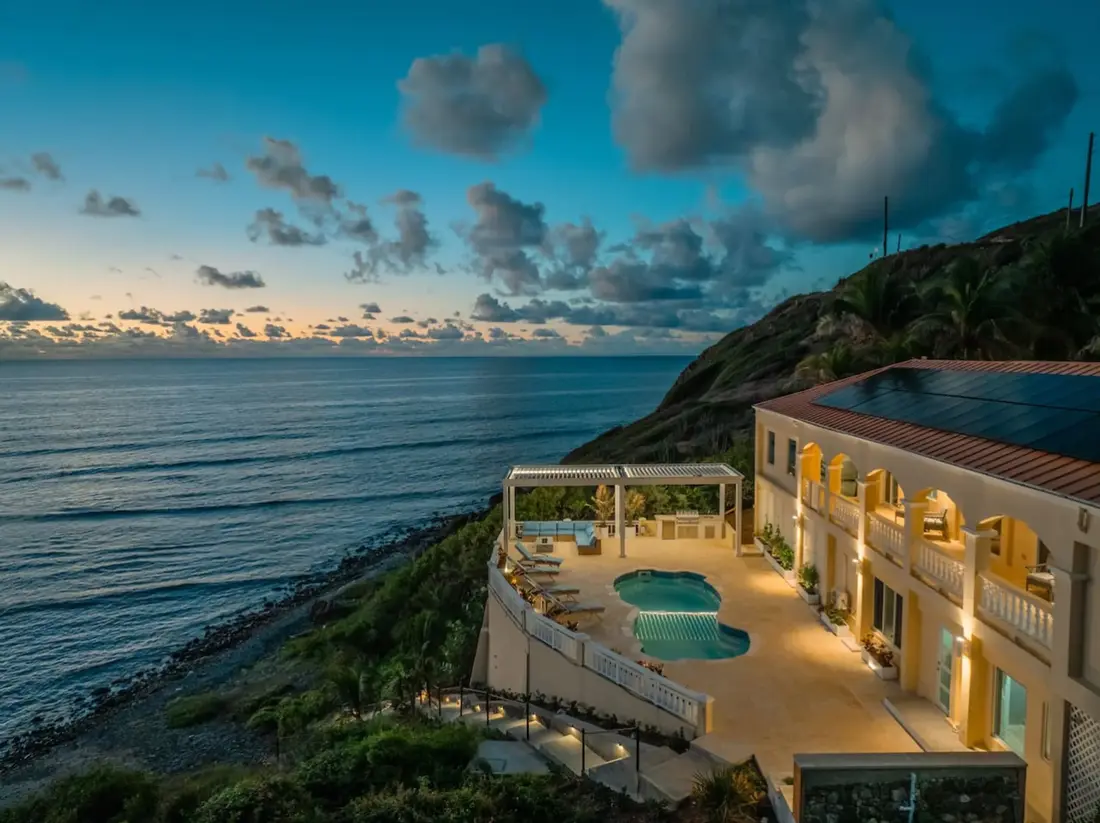
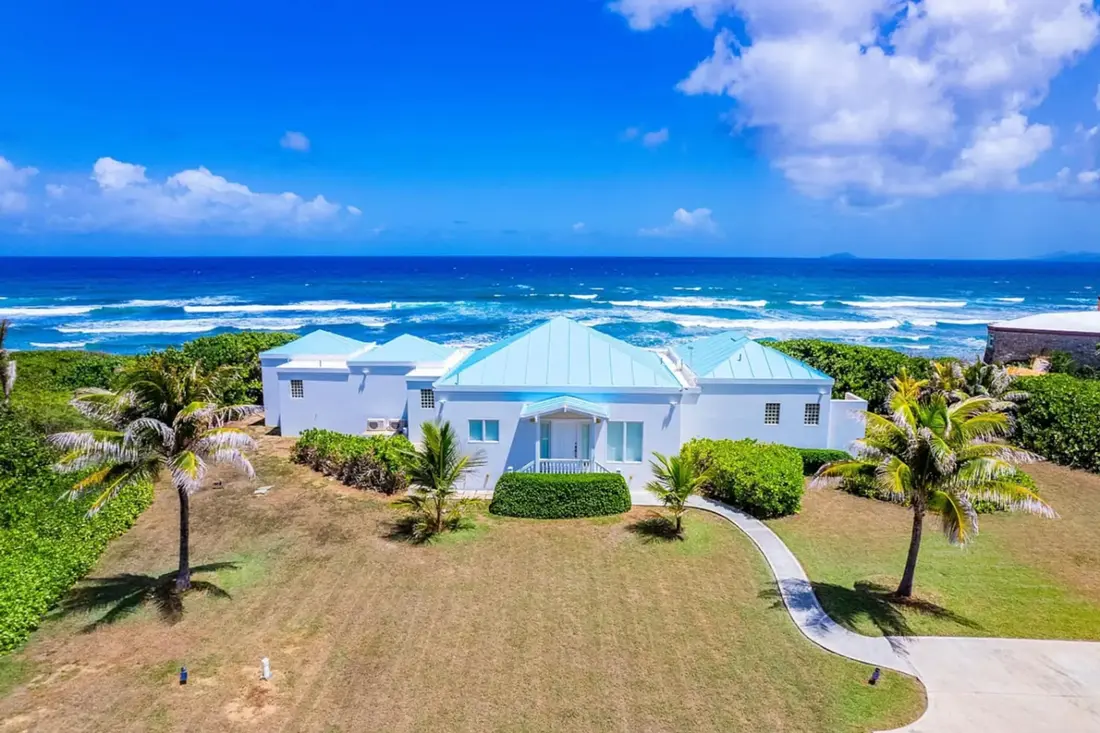
Every era on this page sits within a 40-minute drive of our homes. Guests at The Cerulean and the rest of the East End collection reach Christiansted's Danish waterfront in about 15 minutes and Salt River Bay in 25, which puts five flags before lunch within easy reach. Sunset Sea-Clusion on the west end faces the Frederiksted shore where the 1848 and 1917 stories played out, with Fort Frederik minutes away. Tell us when you book if the history is a centerpiece of your trip and we will sequence the sites against your dates, including any Transfer Day or Emancipation Day observances that fall during your stay. The full portfolio is on our villas page.
Sources
Written from official and first-party sources, checked August 2026. Hours, prices and event dates change — confirm before you go.
In this guide
Stay nearby
On The Shoys beach: six bedrooms, six baths, pool and hot tub, room for twelve, and the beach through the back garden.
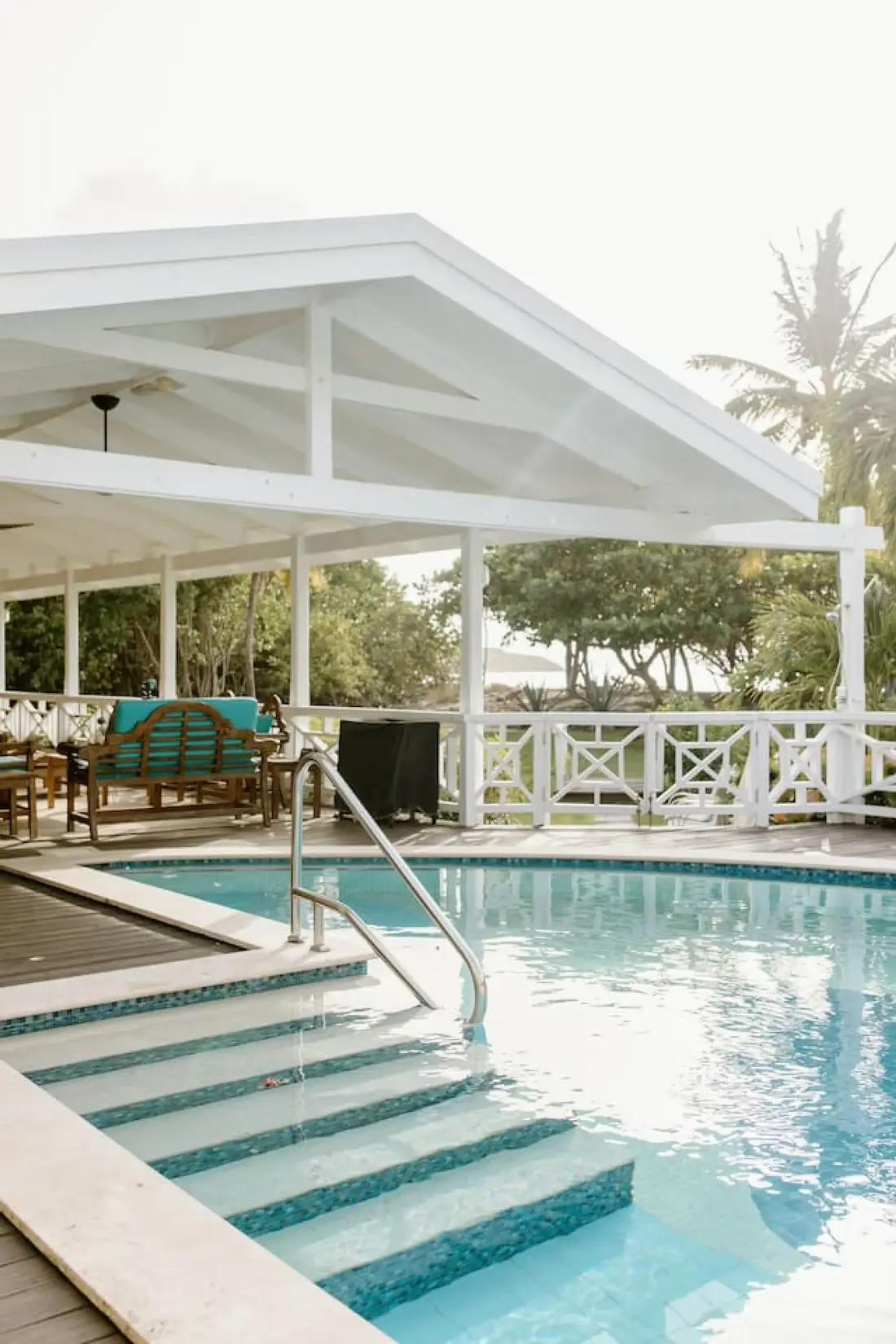 Shoy's Beach House6 bd · 6 ba · sleeps 12 · Christiansted
More in History & Culture
Sources
12 references, listed in full at the end of this guide — official park, refuge, tourism-board and business sources, checked August 2026.