Emancipation Day, July 3
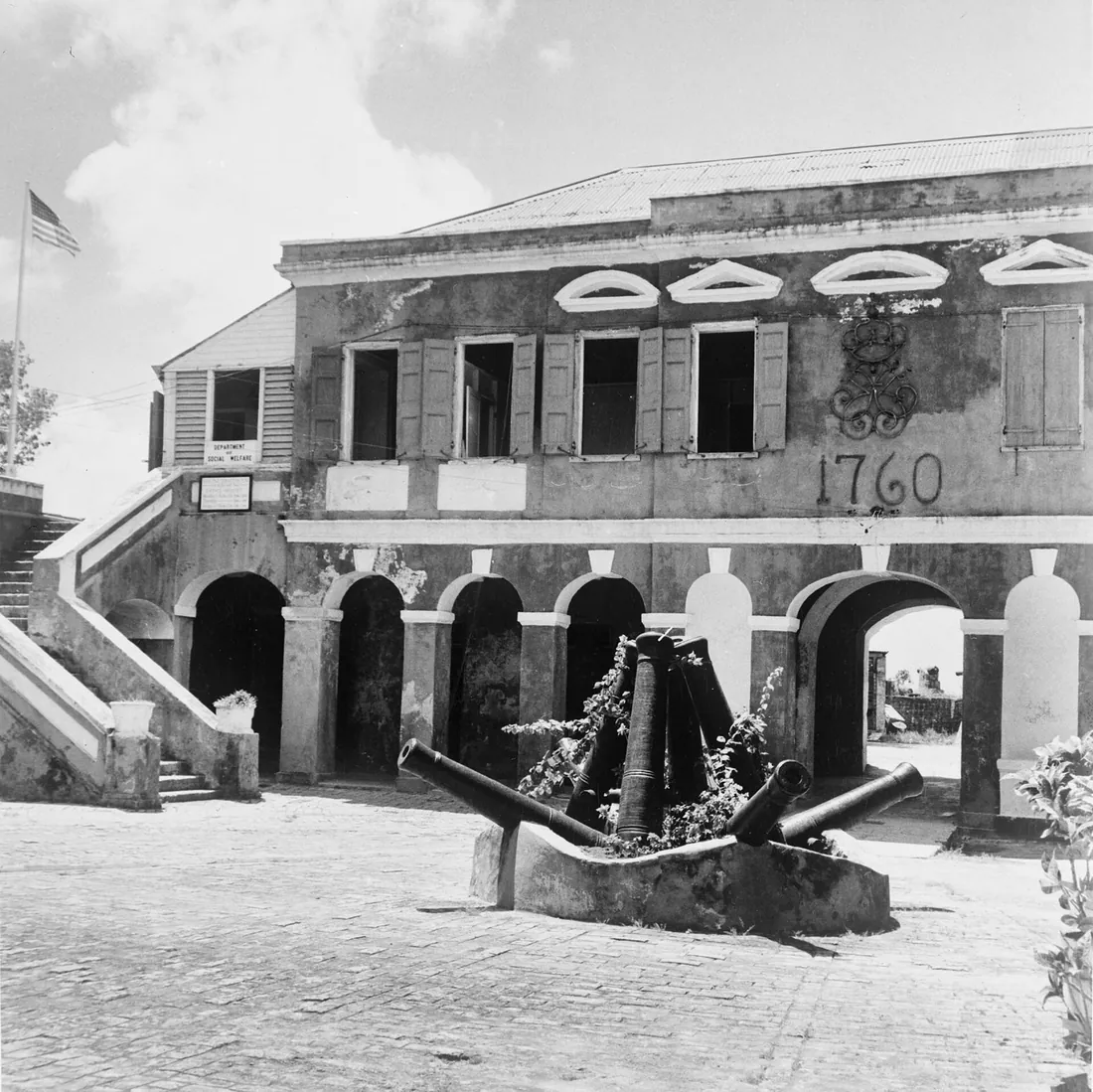
The 1848 march on Fort Frederik made July 3 a Virgin Islands holiday. Where the history happened and how the day is marked.
Emancipation Day falls on July 3, and it is the most important date on the Crucian calendar. It marks the morning in 1848 when the enslaved people of the Danish West Indies took their freedom at Frederiksted, and it has been a paid territorial holiday every year since. This page covers the holiday as St. Croix keeps it now: the walk across the island before dawn, the ceremonies at the red fort and the park below it, the music and food that fill the afternoon, what shuts for the day, and how a visitor can join in without getting underfoot. The blow-by-blow history of 1848 lives on two other pages, linked below, so this one stays with the observance.
The holiday and the date
July 3 is a public holiday across the U.S. Virgin Islands, listed in the territory's own roster of holidays as the day that recognizes the 1848 abolition of slavery in the Danish West Indies. Unlike the island's carnival, which drifts by a few days each year, Emancipation Day never moves: it is pinned to the calendar date of the event itself. Government runs on a holiday schedule, and the island treats the occasion as a civic one first and a celebration second. Crucians will tell you it is the most consequential date in their history, ahead even of the 1917 transfer to the United States, because it is the day the island's majority stopped being property. The island's other great historical holiday, Transfer Day on March 31, marks the 1917 sale of the Danish West Indies to the United States; Emancipation Day is the older of the two, and for most Crucians the deeper one.
The observance has a single address. Frederiksted, the west-coast town where freedom was proclaimed, answers to a second name, Freedom City, and that is where the day is kept. A town of a few hundred residents on an ordinary afternoon draws thousands on July 3, and the ceremonies, the walk's finish line and the evening program all gather along its waterfront. All three U.S. Virgin Islands keep the holiday, but St. Croix's observance is the largest, because this is the island where it happened.
What July 3 commemorates
The short version runs like this. In 1847 the Danish king set out a slow road away from slavery: children born to enslaved mothers would be free, and everyone already held would serve twelve more years, until 1859. On St. Croix that offer satisfied no one, since it asked field workers to wait out most of a lifetime for what British and French islands nearby already had. Britain had emancipated its Caribbean colonies in the 1830s, and France had done the same in its own islands only that spring, a few weeks before July 3. The people on the Danish estates knew it.
They did not wait. Late on July 2, 1848, the signal moved across the western estates through the night, and by first light a crowd the accounts put near eight thousand stood outside Fort Frederik. At its head was a skilled sugar worker named Moses Gottlieb, remembered across the island as General Buddhoe, with a lieutenant called Martin King. The demand was freedom that day, and the threat behind it was to burn the town. Governor-General Peter von Scholten came west from the capital at Christiansted, saw that his handful of soldiers could not turn back a crowd that size, and declared the enslaved free on the spot rather than open fire.
Roughly 17,000 people were enslaved on St. Croix that summer, with about 5,000 free residents of color living alongside them. Their freedom arrived eleven years before Copenhagen's own 1859 deadline, and a full seventeen years before the Thirteenth Amendment ended slavery across the United States in 1865. Virgin Islands historians often place the rising as the Caribbean's second successful revolt against slavery, after the revolution in Haiti.
The freedom won that morning was real but incomplete. A labor law the next year tied the newly freed workers to the estates on yearly contracts, and the grievances that built under it broke out three decades later in the 1878 Fireburn, the revolt that reshaped the same west-end town. That is one reason the circuit further down runs past the Fireburn as well: on St. Croix, freedom was taken in stages, and 1848 was the first of them.
This page keeps the history to that summary by design. The two-day record, the roles Buddhoe and von Scholten played, and what became of each man afterward are set out in full in the Fort Frederik and emancipation guide. The island's whole run of colonial owners, and where 1848 sits among them, is traced in the seven flags of St. Croix.
The Fort-to-Fort Freedom Walk
The signature act of the modern holiday is a walk. Before sunrise on July 3, a group sets out from Fort Christiansvaern on the Christiansted waterfront and covers roughly 15.6 miles west across the island to Fort Frederik, arriving through the morning. The route links the two Danish forts, the seat of colonial government at one end and the place where freedom was proclaimed at the other, and doing it on foot in the dark is the point: a physical act of remembrance rather than a parade.
The route is not arbitrary. Fort Christiansvaern, where the walk begins, was the colonial government's stronghold, and it is the jail that held Buddhoe for months after July 3 before Denmark deported him from the island. Fort Frederik, where it ends, is where the crowd had forced the freedom in the first place. Covering the ground between the two on foot binds the halves of the story together. Walkers head west along the island's cross-island roads in the cool before sunrise, support vehicles trailing the line with water, and the front of the group times its arrival to the start of the morning ceremony.
Former senator Positive Nelson, later the territory's commissioner of Agriculture, started the walk more than two decades ago, and it has grown into the day's anchor; by 2022 it was in its twenty-second year. Start times have run early, around four or five in the morning depending on the year, to beat the July heat and to reach Frederiksted for the ceremonies. Turnout has run to a hundred walkers and more, with community groups, a local Kappa Alpha Psi chapter and business sponsors among the regulars. It draws a mix of ages and of church, civic and fraternal groups, and finishing the full distance has become a point of pride for the people who make it year after year. Anyone can join. If you do, treat it as the serious distance it is: real shoes, a headlamp, water, and a plan to be picked up if the miles outrun you. July mornings are hot even before the sun clears the hills, and the July guide covers what that heat asks of a visitor.
Ceremonies at the fort and Buddhoe Park
The civic heart of the day sits at Fort Frederik and the waterfront green beside it, Buddhoe Park. When the walkers arrive, the formal program begins. A wreath is laid in tribute to the people who forced the emancipation. Culture bearers pour a libation, water tipped to the ground, in a Calling of the Names ceremony that recites those killed, wounded or arrested in the 1848 rising, so the individuals stand named rather than folded into a number. Prayers, remarks from senators and other officials, and readings by historians and orators follow, retelling the story on the ground where it happened.
The exact running order shifts from year to year, set by the organizing committee, but the shape holds: an invocation, the wreath and the libation, then the speeches, then the turn to performance. Some years add a historical reenactment or a short skit that stages the confrontation at the fort. The speeches reward staying for, even as a visitor, since Crucian orators tend to run the line straight from 1848 to the island's present, and the day is as much about that argument as about the past.
The backdrop to all of it is the bronze at the center of the park: a figure of Buddhoe raising a conch to his lips and a cane knife in his fist, which the day's speakers gesture toward and the crowd gathers around. The statue's own history sits in the circuit section below. The ceremonies are open to the public and cost nothing, and they are the reflective, deliberate part of the day; visitors are welcome to stand with the crowd for them.
The cultural program
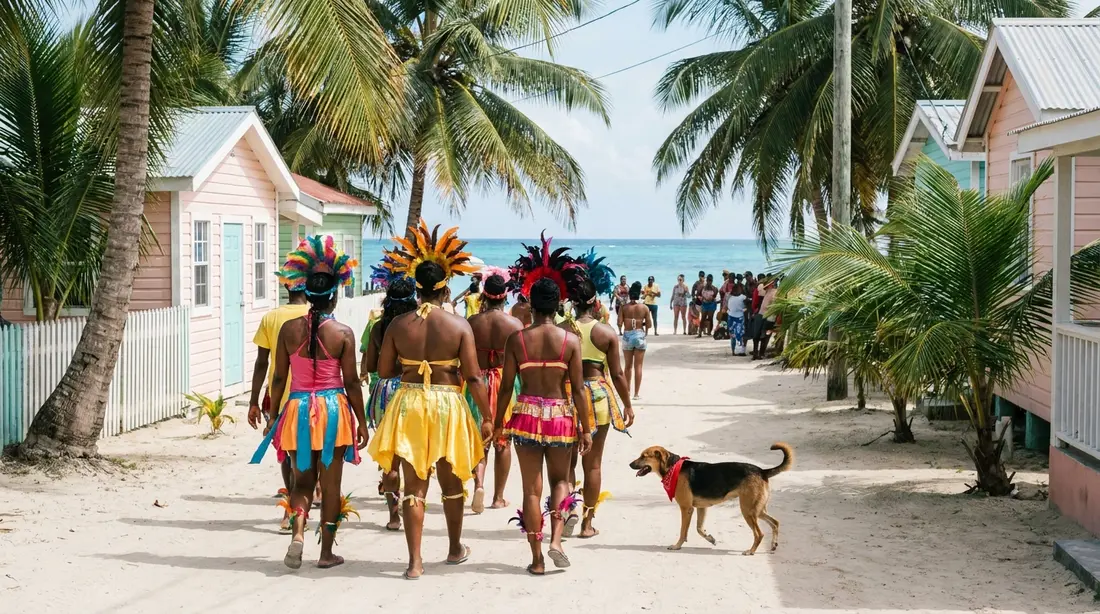
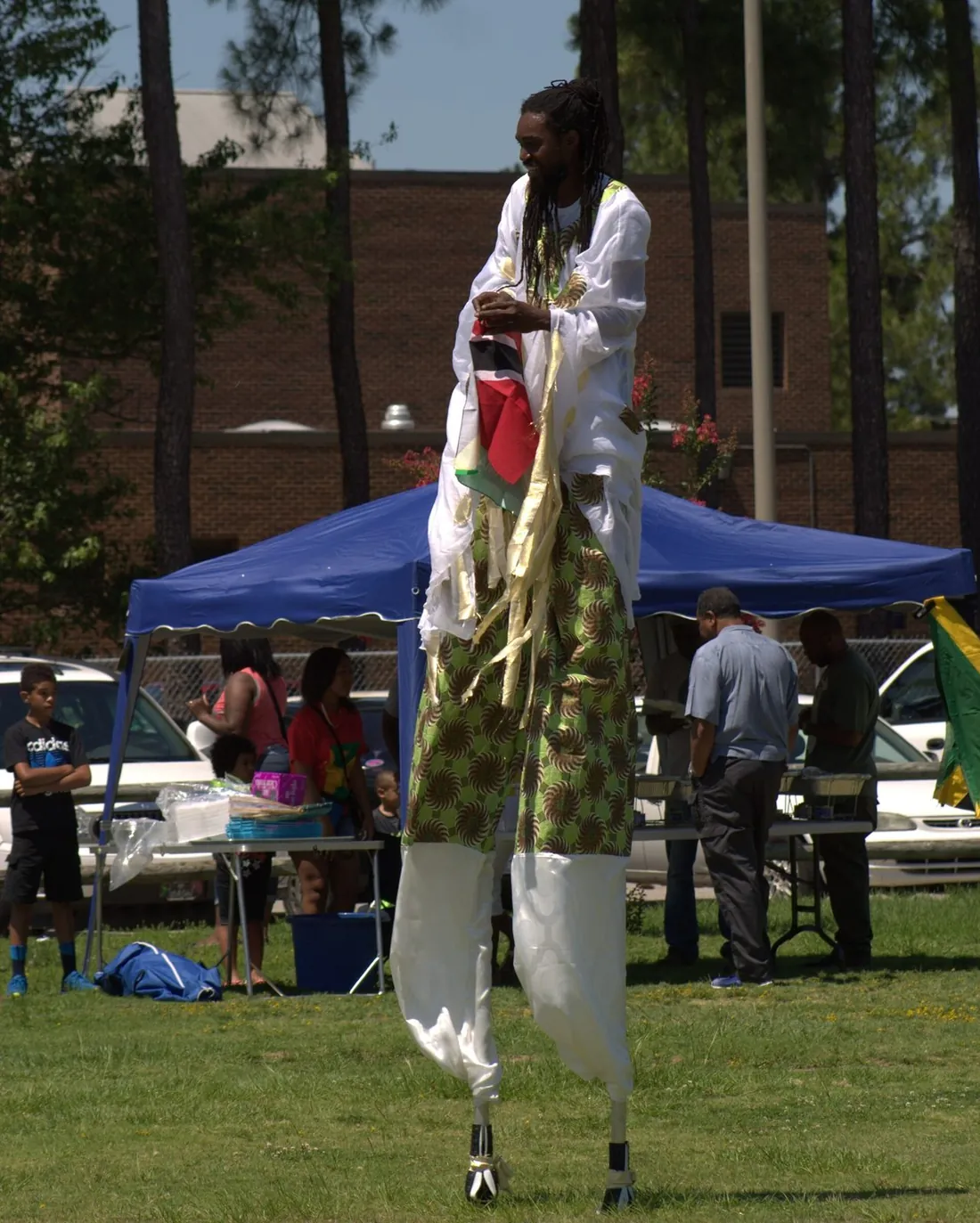
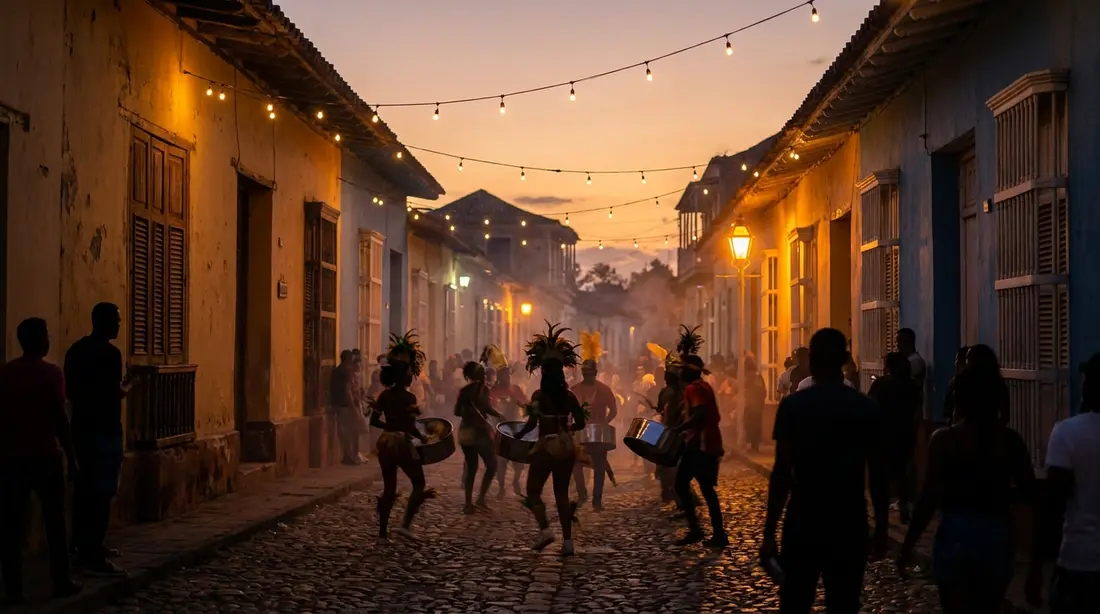
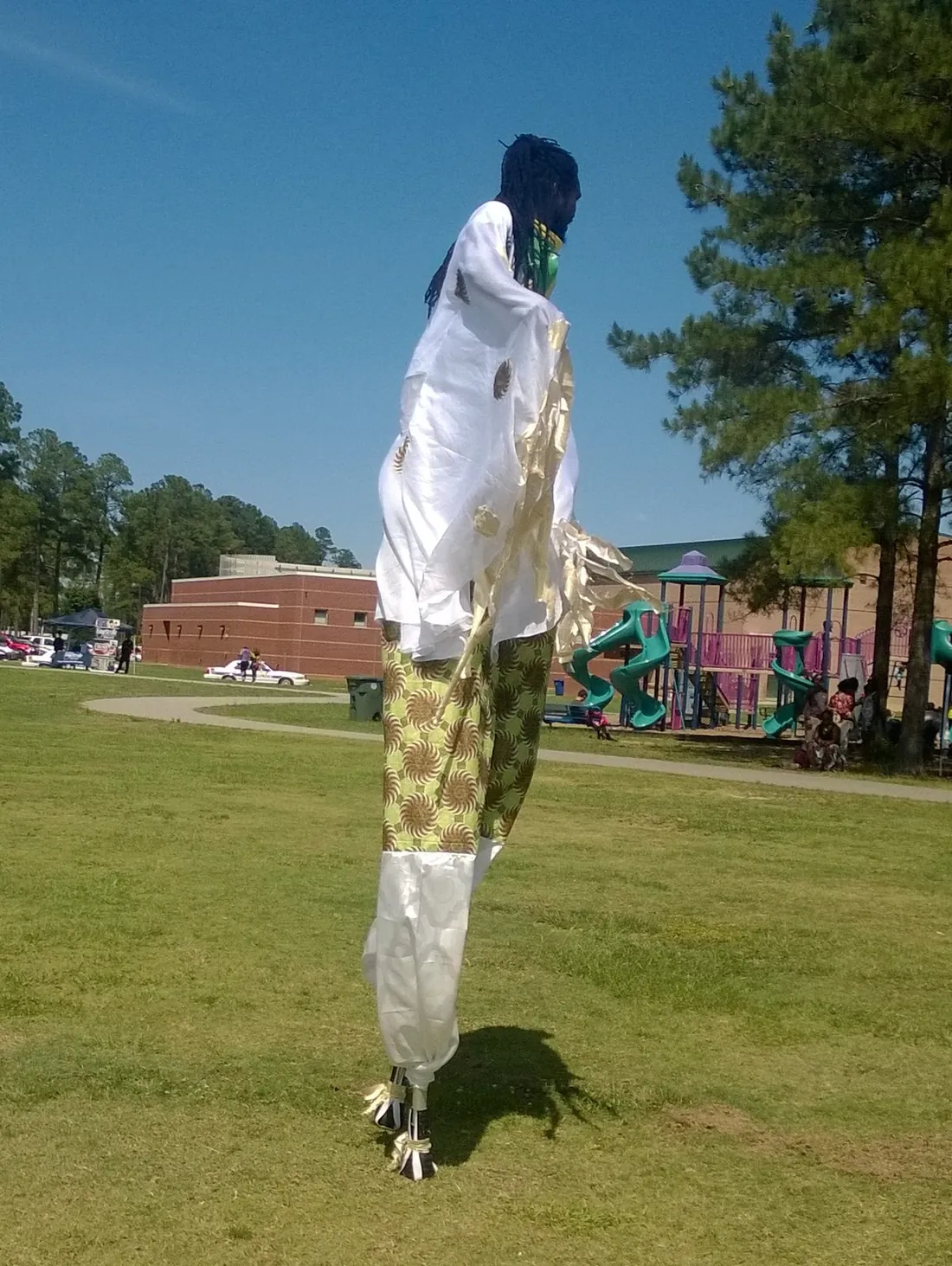
Once the ceremonies close, the mood lifts and the day turns to a community festival. Quadrille dancers take the ground, keeping up the formal figure-dance the island has held onto since the Danish era; school and community troupes drill for it, and groups such as the Juanita Gardine Elementary quadrille dancers have paraded down King Street to Buddhoe Park in their whites. Moko jumbies work the crowd on their stilts, the same towering figures that lead the island's carnival. Children run the old-time games, and rows of vendors set up along the waterfront with plates of local food, cold drinks and locally made crafts. School troupes are a fixture of the program, and for many Crucian children the day is where the history and the dances get handed on.
The program stretches into the evening, and in most years it hands off directly to the next day's celebration. What a visitor sees over the course of July 3 is a single day carrying two moods in order: the walk and the ceremonies in the morning, all memory and names and wreaths, then music, dancing and food from the afternoon on.
Quelbe and the food of freedom
The sound of the day is quelbe, the Virgin Islands' own traditional folk music, the work of scratch bands whose name comes from the improvised, roughly built instruments it grew out of. Long-running groups like Ten Sleepless Knights have played the fort on July 3, and quelbe is the music the quadrille sets move to. It is the island's own sound, carried down from the plantation era, which is why it belongs to a freedom holiday more than any imported style would. The Virgin Islands named quelbe its official music in 2003 and required that it be taught in the public schools, so hearing a scratch band live on the waterfront is a different thing from hearing a recording.
The food is Crucian, and the vendors' tables are a fast tour of it: pate, the fried turnover stuffed with saltfish or beef; johnny cakes; kallaloo, the green stew with West African roots; fungi with fish; roast pork, stewed chicken and peas and rice; local juices. It is the same cooking laid out in the Crucian food guide, and the fried-dough staples get their own page in the pate and johnny cakes guide. Eating it on Emancipation Day, from a folding table on the Frederiksted seafront, is the most direct way a visitor takes part in the culture the day is about.
Freedom City
Frederiksted carries the name Freedom City for a plain reason: freedom was demanded and declared here, not handed down from a capital. The whole town wears the connection, from the red fort at the north end of the waterfront to Buddhoe Park below its walls, and July 3 is the day the name does its heaviest work. The town's founding, its Danish grid, its architecture and its year-round life are laid out in the Frederiksted guide; on Emancipation Day it stops being a quiet west-coast port and becomes the island's gathering place. Expect the waterfront full, the side streets parked up, and the sunset the town is known for closing a long day.
The waterfront that carries the day is compact. The red fort stands at the north end, with Buddhoe Park and its bronze directly beneath the walls; the cruise pier runs into the sea from the middle of the front, and the vendors line the seafront between them. That is why the whole day, ceremonies, food, music and the evening fireworks, falls within a few minutes' walk. On an ordinary summer afternoon the same stretch can be close to empty, which makes July 3 the town's fullest day of the season.
Freedom Week and the Fourth of July
July 3 rarely stands alone. Around it the territory runs what is often billed as Freedom Week: concerts, panels and workshops, historical talks, and in some years a skit or a reenactment of the march to the fort, spread across the days on either side. Programs are set close to the date by the organizing committee and the Frederiksted community, so the way to catch them is to check the island calendars once your travel dates are fixed.
The round-number anniversaries scale all of this up. July 3, 2023 marked 175 years of freedom, and the territory ran a year-long commemoration under a dedicated committee, including a multi-artist exhibition mounted inside the Fort Frederik Museum that carried on toward July 2024. A trip that lands on one of the decade or half-century marks will meet a fuller program than an ordinary year.
The next day belongs to the United States. July 4 follows immediately, and St. Croix marks it on the same Frederiksted waterfront with a beach party and fireworks over the cruise pier. The two dates sit together with an odd historical rhyme: Fort Frederik is credited with sending one of the earliest foreign salutes to an American-flagged ship, back in 1776, so the west end has marked United States independence for nearly as long as there has been one. For a visitor, July 3 and July 4 read as a two-day stretch of holiday on the west end, and the wider month, Mango Melee included, is covered in the July guide and the island's year of events.
Emancipation Day and the Crucian Christmas Festival
Visitors sometimes expect Emancipation Day to look like the island's carnival. It does not. The Crucian Christmas Festival, the island's carnival, spans the last week of December and the opening days of January and is a full party of pageants, competitions and the King Street parades. Emancipation Day is a civic and commemorative holiday: it opens in reflection and only then turns festive, and its scale is a single day rather than a season. The two do share a home town, since the Christmas Festival's parades and Emancipation Day's ceremonies both belong to Frederiksted, and both lean on the same cultural forms, quadrille, quelbe and moko jumbies. Knowing the difference in purpose helps set expectations: one is the island at play, the other is the island remembering how it became free. A visitor who wants to see quadrille and moko jumbies without timing a whole festival will find both on Emancipation Day in a single afternoon.
Emancipation Day and Juneteenth
Mainland visitors often reach for Juneteenth as the comparison, and it is worth being clear on the difference. Juneteenth, June 19, marks June 19, 1865, when a Union general announced freedom to the enslaved people of Galveston, Texas, at the close of the Civil War; it became a U.S. federal holiday in 2021. St. Croix's Emancipation Day is a separate event with its own date and its own history: July 3, 1848, seventeen years earlier, under Danish rule rather than American, and won by the enslaved people themselves rather than announced by an occupying army. Both are freedom holidays, and Virgin Islanders keep both, but on St. Croix the older, local date is the one that carries the weight.
The freedom-history circuit
Emancipation Day is the calendar entry; the story behind it is written across the island for anyone who wants to follow it beyond July 3. Four sites and one later revolt make the circuit:
- Fort Frederik — the red Danish fort where the proclamation was made, now a museum, and the address of the July 3 ceremonies.
- The Freedom statue in Buddhoe Park — Ghanaian-American sculptor Bright Bimpong's bronze of Buddhoe with a conch and a cane knife, unveiled in 1998, a century and a half after 1848; a cast was later presented to Denmark. The park and statue are covered in the Frederiksted guide.
- Estate Whim — the restored sugar plantation that shows the world the rising ended; its great house has been shut inside since 2017, though the grounds and windmill stay open.
- Maroon Ridge — the north-west cliffs where people who escaped the estates held free ground for generations, now the territory's largest park.
- The Fireburn — the 1878 labor revolt that broke the contract system thirty years after emancipation, led by four women and centered on the same town.
Seen together, they explain why the island treats July 3 the way it does: freedom here was taken in stages, and each site holds one of them.
Visiting on July 3
Visitors are welcome at Emancipation Day, and joining in is a good way to spend the day, as long as you read the room. The morning is memory: stand for the wreath-laying and the libation, hold your questions for afterward, follow the crowd's lead on when to be quiet, and photograph the public program rather than pushing a lens into a solemn moment. The afternoon is open celebration, and by then a camera and a plate of pate are exactly the right things to have. Dress for a hot day in the open: the morning ceremonies run under a strong sun and the afternoon program offers little shade, so a hat, water and reef-safe sunscreen belong in the bag next to the camera.
For many Crucian families July 3 is also, simply, a day off at the beach, and the west-end shores fill accordingly. If the ceremonies are not your plan, Rainbow Beach, the town beach and Dorsch Beach all sit minutes from the fort and all face the sunset. Either way, come to the west end early. From Christiansted the drive runs about forty minutes, and from the East End closer to an hour, so an early start earns its keep twice on a holiday. Frederiksted parks up, so leave the car up by the fort or down by the beach and cross the last stretch on foot; remember the island drives on the left and has no rideshare, so settle the trip home before you set out. The full logistics are on our getting around page.
What's open and what's closed
Emancipation Day is a full public holiday, so the government side of the island stops. The tourist side mostly runs, with gaps worth planning around, especially in the morning while the ceremonies are on.
| Status | On July 3 |
|---|---|
| Closed | Government offices, courts, public schools, banks and the post office |
| Varies | Shops and restaurants are hit or miss, with more of them shut in the morning; grocery stores may cut their hours |
| Open | Beaches, most dive shops and tour boats, gas stations, and the free ceremonies at Fort Frederik and Buddhoe Park |
| Plan ahead | Provision the villa before July 3, since July 4 is a holiday too and the pair can leave stores on short hours two days running |
Emancipation Day at a glance
| Item | Detail |
|---|---|
| Date | July 3, every year, fixed to the calendar date |
| Status | Paid U.S. Virgin Islands territorial holiday |
| Marks | The 1848 end of slavery in the Danish West Indies |
| Where | Fort Frederik and Buddhoe Park, Frederiksted (Freedom City) |
| Signature event | The Fort-to-Fort Freedom Walk, about 15.6 miles, before dawn |
| Ceremonies | Wreath-laying, libation and Calling of the Names, orators |
| Cultural program | Quadrille, quelbe scratch bands, moko jumbies, food and craft vendors |
| The next day | July 4, U.S. Independence Day, fireworks over the pier |
Questions guests ask
What is Emancipation Day, and why July 3?
It is the U.S. Virgin Islands holiday marking the end of slavery under Danish rule. The date is July 3 because that is the day it happened: on that July morning in 1848 some eight thousand enslaved Crucians gathered at Fort Frederik in Frederiksted, and Governor-General Peter von Scholten declared them free instead of ordering his soldiers to fire. That freedom came a full seventeen years before slavery ended on the American mainland. July 3 has been a territorial holiday ever since, and it is widely considered the most important date in St. Croix's history.
Can visitors attend the ceremonies?
Yes. The ceremonies at Fort Frederik and Buddhoe Park are public and free, and visitors are welcome to stand with the crowd. The morning program is reflective, with a wreath-laying, a libation ceremony and speeches, so join it the way you would any memorial: quietly, taking the crowd's lead, and photographing the public events rather than intruding. The afternoon program of music, dance and food is open celebration that anyone can enjoy. Attending respectfully is one of the more meaningful things a visitor can do on the island in July.
What is the Freedom Walk, and can I join it?
The Fort-to-Fort Freedom Walk is a roughly 15.6-mile trek that sets out before dawn from Fort Christiansvaern in Christiansted and finishes at Fort Frederik in Frederiksted, covering the distance between the two forts. Former senator Positive Nelson started it more than twenty years ago, and it now anchors the holiday. Anyone can walk it, and a hundred or more people usually do, but it is a real distance in tropical heat: bring proper shoes, water and a light, start with the group in the dark, and arrange a ride in case the miles get ahead of you.
What is open on July 3?
Government offices, banks, courts, public schools and the post office close, since it is a public holiday. Beaches, most dive shops and tour boats, and gas stations generally operate, and the ceremonies at the fort run all day. Restaurants and shops are a mixed bag, with more of them shut in the morning, and grocery stores may cut their hours. Because July 4 is a holiday too, it pays to provision your villa before the pair. Confirm any specific restaurant or tour directly, since small-island hours move around the holidays.
How is Emancipation Day different from Juneteenth?
They are separate holidays with separate histories. Juneteenth, June 19, marks the 1865 announcement of freedom in Galveston, Texas, at the end of the U.S. Civil War, and became a federal holiday in 2021. St. Croix's Emancipation Day marks July 3, 1848, when the enslaved people of the then-Danish island won their own freedom, seventeen years earlier and under a different flag. Both are freedom holidays, but on St. Croix the July 3 date is the local and older one, and it is the day the island keeps.
Where should I be to experience the day?
Frederiksted, the town Crucians call Freedom City. The Freedom Walk finishes there, the ceremonies are held at Fort Frederik and Buddhoe Park on the waterfront, and the cultural program and vendors gather along the same seafront through the afternoon and evening. Come early, since the town fills and parking near the pier goes first; park toward the fort or the beach and walk. If you would rather have a quiet day, the west-end beaches a few minutes away fill with local families and face the sunset that closes the holiday.
Staying near Frederiksted for July 3
Emancipation Day runs on the west end, so a stay that puts you near Frederiksted turns the holiday into a short walk rather than a cross-island drive. Our west-coast home, Sunset Sea-Clusion, sits in Frederiksted itself, minutes from the fort, the ceremonies and the sunset. Guests on the East End, at The Cerulean or elsewhere in the East End collection, sit about an hour from the west end and usually give July 3 a full day. If the freedom-history circuit or the July 3 program matters to your trip, tell us when you book and we will help line up the days around it. Every home in the collection is on our villas page.
Sources
Written from official and first-party sources, checked August 2026. Hours, prices and event dates change — confirm before you go.
In this guide
Stay nearby
On The Shoys beach: six bedrooms, six baths, pool and hot tub, room for twelve, and the beach through the back garden.
 Shoy's Beach House6 bd · 6 ba · sleeps 12 · Christiansted
More in Events & Festivals
Sources
12 references, listed in full at the end of this guide — official park, refuge, tourism-board and business sources, checked August 2026.