The Sea Turtles of St. Croix
Leatherbacks, greens, and hawksbills all nest here — at Sandy Point, Buck Island, and the East End bays. Where and when, respectfully.
Three sea turtle species use St. Croix: the green, the hawksbill and the leatherback. Two of them live in the water you will snorkel this week. Green turtles graze the seagrass in the shallow eastern bays, hawksbills pick over the reefs, and a swimmer who picks the right bay on an ordinary morning has a genuine chance of sharing the water with one or both. The leatherback is different; it nests here famously and swims here invisibly, far offshore, and it has its own page. This guide is about the turtles you can actually meet: where each species feeds, how to recognize which one is in front of your mask, and how to behave so the encounter costs the animal nothing.
Two residents and one ghost
Start with a distinction that saves visitors a lot of confusion. Greens and hawksbills are coastal turtles. After their early years in the open ocean, young turtles of both species settle into nearshore habitat, seagrass flats for greens, reef structure for hawksbills, and stay for years, feeding in the same bays month after month. That is why a snorkeler can meet one on a Tuesday in any season: the turtles in Chenay Bay or along the Buck Island reef are locals, on their home range, doing their daily work. Every month of the calendar offers a fair shot at them.
The leatherback follows the opposite plan. It never settles on a coast. It hunts jellyfish across whole ocean basins, dives to depths no snorkeler will ever see, and touches St. Croix only when females come ashore at night, March through July, to lay eggs on the sand at the island's southwest tip. Guests sometimes ask which snorkel spot gives the best odds of a leatherback, and the truthful answer is none of them; in-water sightings by swimmers are a freak event here. The way to see one is a guided nesting-season program, covered in the turtle watch guide.
Telling the two apart
Once a turtle appears, identification takes about ten seconds if you know the three checkpoints: the head, the shell edge and the setting.
- Head. A green turtle has a small, blunt, rounded head with a single pair of large scales between the eyes. A hawksbill carries a narrow, tapered head that ends in a hooked, raptor-like beak, the feature the species is named for.
- Shell. A green's carapace is smooth-edged, with the scutes fitted side by side like tile; NOAA describes five central scutes flanked by four pairs of lateral ones, in browns, greys and olive tones. A hawksbill's scutes overlap like roof shingles, the rear rim of the shell is saw-toothed, and the pattern is a marbled mix of amber, orange, red, yellow, brown and black, the "tortoiseshell" of the old trade.
- Setting. Habitat is the giveaway at distance. A turtle with its head down in grass over a sandy bottom is almost certainly a green. A turtle nosing into crevices on coral or working a patch of sponge is almost certainly a hawksbill.
Size separates adults too. NOAA puts mature greens at 3 to 4 feet and roughly 250 to 400 pounds, while hawksbills top out smaller, 2 to 3.5 feet and 100 to 150 pounds. Most turtles in Crucian bays are juveniles and subadults, so expect dinner-plate to coffee-table sizes rather than the full-grown figures.
| Checkpoint | Green turtle | Hawksbill turtle |
|---|---|---|
| Adult size (NOAA) | 3–4 ft, 250–400 lb | 2–3.5 ft, 100–150 lb |
| Head | Small and rounded; one pair of scales between the eyes | Narrow and pointed; hooked beak |
| Shell edge | Smooth, scutes side by side | Overlapping scutes; serrated rear rim |
| Color | Brown, grey, olive above; pale below | Marbled amber, orange, red, yellow, brown, black |
| Meal | Seagrass and algae | Mainly sponges |
| Typical setting | Grass flats over sand | Coral heads, walls, ledges |
| Federal status | Threatened (North Atlantic population) | Endangered since 1970 |
The green turtle
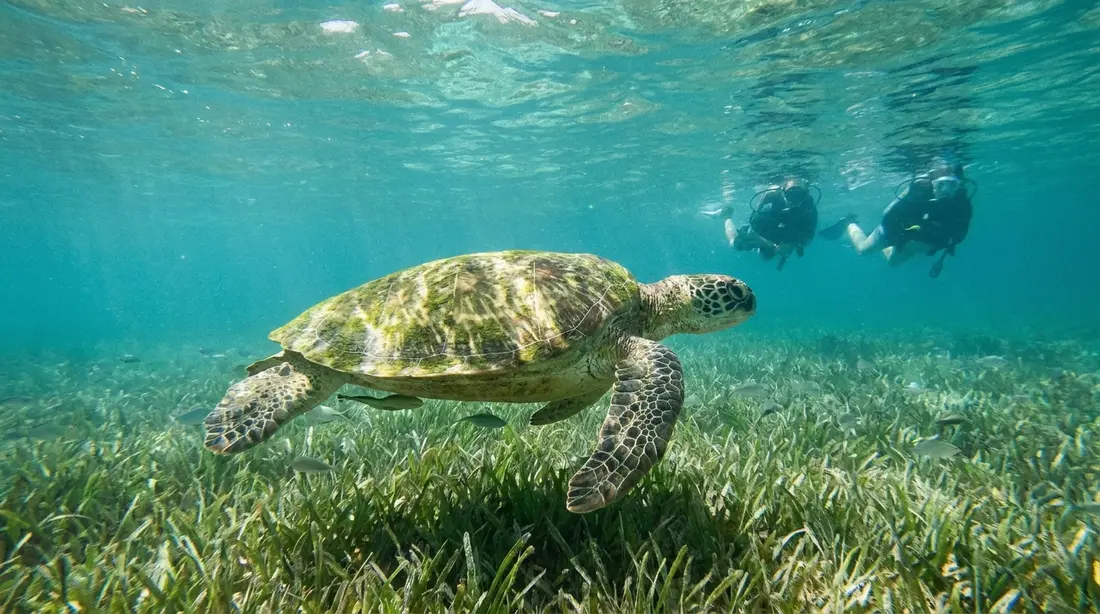
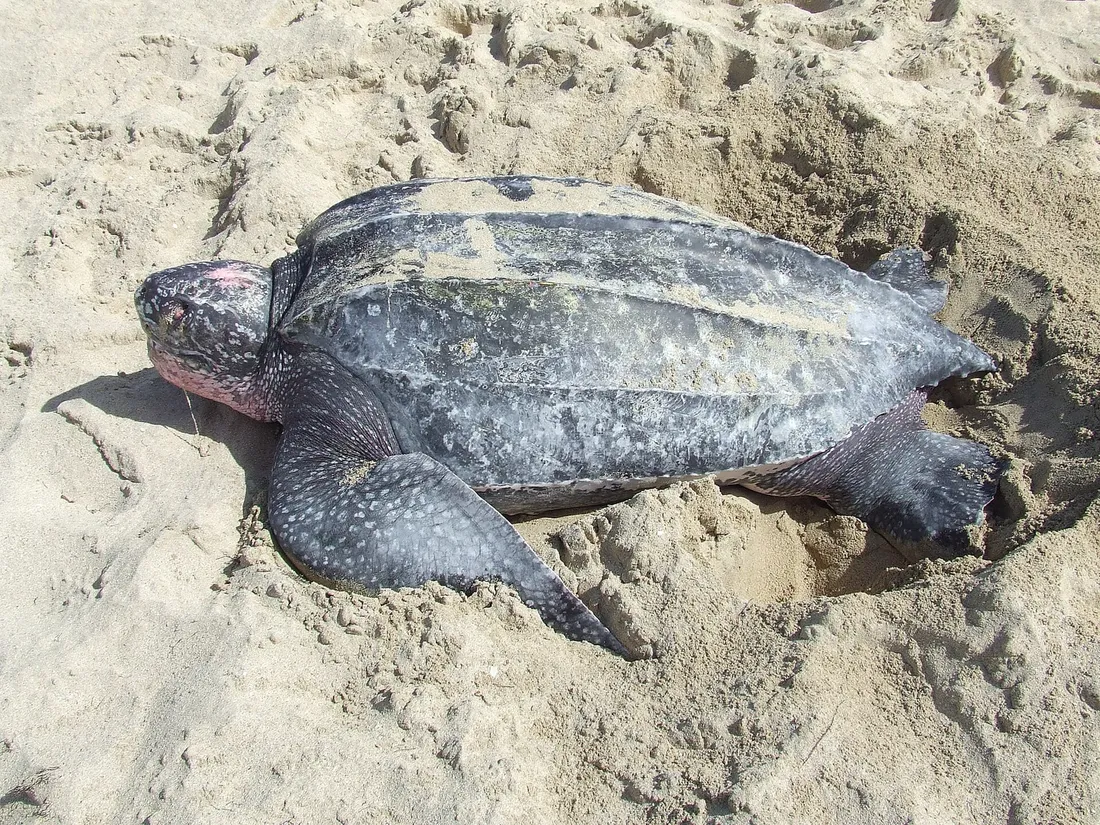
The green is the vegetarian of the family, the only sea turtle whose adults live on plants. NOAA lists seagrasses and algae as the staple diet, and the name comes from the color the diet gives the animal's body fat; the shell itself is brown and olive. The beak has finely serrated edges, a cutting tool for cropping grass blades, and it shapes everything about how you will see the species behave. Adults reach a few hundred pounds, which makes the green the second-largest turtle in these waters after the leatherback, though the ones sharing a Crucian bay with you are usually younger and far smaller.
Legally, every green in U.S. waters carries Endangered Species Act protection. A 2016 federal rule divided the species into 11 regional populations; the North Atlantic population, which includes the Virgin Islands, is listed as threatened, and several Pacific and Mediterranean populations are listed as endangered. The species was once the target of an industrial appetite, green turtle soup above all, and the Caribbean populations swimming today are a remnant of what the first European accounts describe. Recovery is real and visible on St. Croix; the National Park Service reports green numbers rebounding at Buck Island after decades of protection.
Females mature late and breed on a slow clock. NOAA's figures: a migration to the nesting grounds every 2 to 5 years, clutches laid at roughly two-week intervals across a season, about 110 eggs in each. Greens nest on St. Croix's own beaches, which few visitors realize while watching one graze at arm's-length depth.
Watching a green graze
An encounter with a feeding green has a rhythm, and knowing it turns a thirty-second glimpse into a long, calm observation. The turtle works the bottom the way a cow works a field: head down, unhurried, cropping a few blades at a time, shuffling forward a body length, cropping again. Every few minutes it lifts its head, angles up, and rises for air, a breath or two at the surface, sometimes with an audible sigh, then a slow glide back down to the same patch. If nothing disturbs it, a green may work one strip of meadow for as long as you care to hang at the surface and watch.
The grazing itself is ecology in motion. By cropping the same plots again and again, greens keep seagrass in a short, young, fast-growing state, and the National Park Service notes that research at Buck Island shows this grazing regulates the productivity of the whole seagrass system. The meadow feeds the turtle; the turtle, in turn, gardens the meadow, and the conch, rays and juvenile fish that live in it are downstream beneficiaries. When you watch a green mow its patch of Chenay Bay, you are watching maintenance work the bay depends on.
Two practical notes. First, a grazing turtle kicks up sand and drifts slowly; position yourself off to the side, hang still, and let the feeding bring the animal past you. Second, the surfacing moments are the vulnerable ones, and the etiquette section below deals with them directly.
Where the greens are
Find the seagrass and you have found the greens. On St. Croix the grass grows thickest in the shallow, sheltered bays of the East End and the north shore's protected coves, which produces a reliable pattern.
- Chenay Bay is the standard-issue first sighting. The bay is shallow, calm and grassy nearly from the sand out, easy water for beginners, and turtles feed there so regularly that a patient hour rarely comes up empty. It is also the island's gentlest place to watch one, because the depth lets you observe from the surface without ever needing to dive.
- Jack's and Isaac's Bays on the far East End mix grass flats with reef lines, so both species turn up. The bays sit inside a Nature Conservancy preserve reached on foot, and the effort filters the crowds; turtles here feed with very little company.
- The East End generally — Southgate and Coakley Bay carry grass too, and paddlers see turtle heads pop up on quiet mornings; the paddleboarding guide covers those launches.
- The Buck Island lagoon — the sand-and-grass shallows inside the reef, off Turtle Beach, hold feeding greens, and sightings from the boat or at anchor are a routine bonus of a Buck Island trip. Skippers often point one out before anyone has fins on.
Time of day matters less than sea state. Calm, clear water on a windless morning gives the best viewing anywhere; a churned-up bay hides a turtle thirty feet from you.
The hawksbill
The hawksbill is the reef specialist, and its whole anatomy says so. The narrow head and hooked beak reach into cracks and crevices no other turtle can work, and the diet at the end of that beak is the strangest in the family: NOAA identifies the hawksbill as the only sea turtle that can live mainly on sponges, filling out the menu with algae, mollusks, crustaceans, urchins, small fish and jellyfish. Sponges are laced with glass-like spicules and chemical defenses that would ruin most digestions; the hawksbill eats them anyway, which hands it a food supply with almost no competitors.
That appetite is why biologists call the species a keeper of reef health. Sponges compete with corals for the same real estate, and left uncropped they can overgrow and smother the slow-building colonies a reef depends on. A resident hawksbill functions as a pruning service, opening space for corals to recruit and grow, one more reason a living reef and its turtle belong in the same sentence. NOAA credits the species with a key role in the working of these ecosystems, and the healthiest reef tract on St. Croix, Buck Island's, runs on exactly this arrangement.
The gorgeous shell nearly finished the species. Overlapping amber-and-black scutes were the raw material of the tortoiseshell trade, combs, spectacles, jewelry, and NOAA states that hunting for shell nearly drove the hawksbill to extinction. International commercial trade is banned today and the animal has been listed as endangered since 1970, the first year of the endangered species list, though illegal trade still surfaces elsewhere in the world. Every hawksbill circling a Crucian coral head is a survivor of that history.
Where the hawksbills are
Hawksbills hold territory around structure: coral heads, ledges, walls and anything encrusted with sponge. On St. Croix that translates to a short list of dependable neighborhoods.
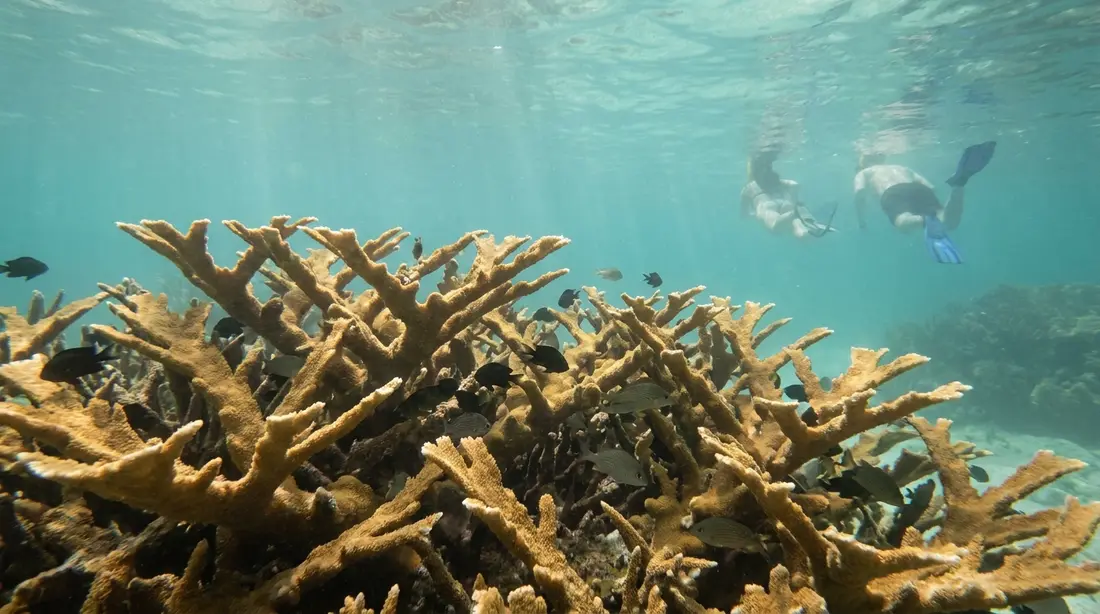
- Buck Island is the stronghold. The monument's elkhorn barrier reef and its back-reef gardens are classic hawksbill foraging ground, and snorkelers on the underwater trail meet them working the coral at close range. The island's beaches double as the species' most closely studied nesting site in the territory.
- Cane Bay — the reef shelf and the top of the famous wall hold turtles alongside the sharks and rays the site is known for; divers and strong snorkelers cross paths with hawksbills cruising the drop-off's rim.
- Frederiksted Pier — the sponge-crusted pilings are exactly a hawksbill's pantry, and dive reports include the occasional turtle threading the columns. Go for the seahorses and octopus and count a turtle as the bonus.
- Jack's and Isaac's reef lines — where the East End grass gives way to coral, the two species trade places within a single swim.
The full ranking of entry points and conditions lives in the snorkeling beaches guide and the island-wide snorkeling overview.
The leatherback, briefly
The third species outweighs the other two combined and is the one you will almost never see. Leatherbacks are open-ocean animals, jellyfish hunters built for distance and depth, with a rubbery ridged back in place of a hard shell and a range that spans entire oceans. They do their swimming far from any snorkel bay; their presence in Crucian nearshore water amounts to females staging offshore during the spring nesting months, out of sight of anyone on a reef. A swimmer's odds of meeting one here round to zero, and no tour can change that, so treat any promise of leatherback snorkeling with suspicion. The biology of the animal, the record sizes, the dives, the strange warm-bodied physiology, fills the leatherback species page.
What St. Croix does offer is the species' most important U.S. nesting beach. The sand at the island's southwest corner records more leatherback nesting than any other shore under the American flag, protected inside a federal refuge with a strict calendar and a decades-long research program; the Sandy Point refuge guide covers the place, and guided spring watch nights are the single sanctioned way to stand near a nesting female.
Conduct in the water
All three species are federally protected, and the rules of engagement come from NOAA's marine life viewing guidelines rather than from anyone's preference. The core of them:
- Keep real distance. NOAA's general guidance asks viewers to stay well back from sea turtles in the water, up to 50 yards where conditions allow; its Hawaii program, managing the heaviest turtle-snorkeler traffic in the country, sets 10 feet as the working minimum on land and in water. In a small Crucian bay, treat several body lengths as your floor and give more whenever you can.
- Never position yourself above a turtle. This is the one snorkelers break constantly without meaning to. A turtle must reach the surface to breathe, and a swimmer hovering overhead is a lid on its airway. Stay to the side, at the animal's level of the water column or shallower but always off its vertical line.
- No chasing, no touching, no feeding. NOAA's language is flat: do not swim after, ride, pet or attempt to interact with a wild turtle, and never feed one. A pursued turtle abandons feeding grounds it needs; a touched turtle can lose the protective film on its skin and shell; and all of it qualifies as harassment of a listed species, which carries federal penalties.
- Read the animal and yield. NOAA's own cue list: sudden changes of direction or speed, or a long escape dive, mean the turtle is disturbed and you back away. A relaxed turtle keeps feeding with you in view. That is the encounter you want, and it only happens when the turtle concludes you are furniture.
- From a boat, slow to no-wake around turtles, shift to neutral when one appears, and never box an animal between hull and shore. Strikes are a documented killer of both resident species.
Breathing and why crowding hurts
The reason the no-hovering rule matters is plumbing. A sea turtle is a reptile holding its breath, and the length of the hold depends entirely on what the animal is doing. The State of the World's Sea Turtles project puts the figures in round numbers: minutes-scale dives during active feeding, with routine submergences stretching toward 45 minutes when the animal takes it slow, and rest periods of 4 to 7 hours when a turtle parks itself under a ledge and drops its heart rate to a beat every few minutes. The green grazing in front of you is on the short end of that spectrum, surfacing every few minutes, which is exactly why encounters are so frequent in the grassy bays, and exactly why the surface above a feeding turtle must stay open.
Stress rewrites the math. A frightened turtle burns through stored oxygen at a sprint, and the same body that idles for hours can drown in minutes when it panics, the mechanism that kills turtles in fishing nets. A crowd of snorkelers pressing in does a milder version of the same damage: it forces the animal off its feeding, spikes its oxygen use, and teaches it to abandon a bay it needed. Small group, wide spacing, still bodies. The turtle handles the rest.
Cameras, flash and the photo you actually want
Daylight snorkeling photos need no flash; the water is bright, and ambient light renders a turtle better anyway. Keep the camera on zoom or crop later, and hold the viewing distance while shooting, because a lens has a way of pulling people forward without their noticing. Skip the selfie arm's-length composition entirely; if the turtle fills the frame of a phone at arm's length, you are several body lengths too close. After dark the standard flips from discretion to prohibition: no flash and no white light anywhere near a turtle on a nesting beach, where a single burst can turn a female back to the sea or scatter hatchlings away from it. The best turtle photograph from a St. Croix trip is nearly always the calm one, a green over grass, shot level, from distance, with the animal ignoring you.
Spots, species and seasons
Everything above condenses into one planning table. Water sightings hold up in every month because the greens and hawksbills are residents; the season column mostly marks what is happening on the sand.
| Spot | Likely species | Best window | Notes |
|---|---|---|---|
| Chenay Bay | Green | Any month; calm mornings | Shallow grass flats; the easiest first turtle on the island |
| Jack's and Isaac's Bays | Green and hawksbill | Any month; hike-in | Preserve beaches; both are nesting shores, so mind the dry sand in summer |
| Buck Island | Hawksbill on the reef, green in the lagoon | Any month, by boat | Underwater trail sightings routine; beaches closed after sunset for nesting |
| Cane Bay | Hawksbill | Any month; flat north-shore days | Reef shelf and wall rim; longer swim, for confident snorkelers |
| Frederiksted Pier | Hawksbill, occasional | Any month; no cruise ship in port | Sponge-covered pilings; turtles are a bonus, macro life is the show |
| Sandy Point | Leatherback, green, hawksbill on the sand | Guided spring nights only | Shore access tightly scheduled; no snorkel destination |
| Ha'penny Beach | Nesting shore, rare in-water sightings | Walkers year-round | South-shore nesting sand; respect marked areas in season |
The turtle year on St. Croix
In the water, the calendar barely moves: resident greens and hawksbills feed in the same bays in January and in July. On the beaches, the year has a clear shape.
Spring. Leatherback females start crawling at Sandy Point in March and continue through July, give or take, entirely at night. The refuge seals itself to the public from April 1 until the September reopening to protect them, having run Saturday and Sunday daytime access, 10 to 4, through the cooler months; reserved spring watch nights with the St. Croix Environmental Association and the St. Croix Sea Turtle Project are the sanctioned exception, detailed in the turtle watch guide.
Summer into fall. The hard-shelled species take over the nesting shift. NOAA gives the hawksbill an April-to-November season, and greens run from midsummer deep into autumn, on Buck Island, the East End nesting bays, Ha'penny and Sandy Point itself. Island guidance sums the whole rotation as turtles ashore on Crucian beaches from April into September and beyond. Nests incubate roughly two months, so hatchlings are boiling out of late-season nests well after the summer crowds leave.
What a beachgoer sees. Mostly, tracks: wide crawl marks on morning sand, or staked-off nest plots on the East End bays. Occasionally more, a dawn straggler hatchling, a night nester on a quiet shore. The rules write themselves from the biology: keep lights and flash off nesting sand at night, leave tracks, stakes and nests exactly as found, fill in any hole you dig, keep dogs leashed and away from the dune line, and never join a nesting or hatching event uninvited; watch from well back and let it finish.
The wrong way to help. Do not carry hatchlings to the sea, refloat a beached turtle, cut lines off an entangled one or move an injured animal. Good intentions here injure turtles and break federal law. The right move is one phone call: the territory's Sea Turtle Assistance and Rescue network, STAR, takes reports of dead, sick, injured, hooked or disoriented turtles anywhere in the USVI, around the clock, at 340-690-0474 at last check, with the refuge's wildlife biologist coordinating response on St. Croix. Save the number before a beach week; the report you phone in is the most useful thing a bystander can do.
What can hurt them
The threat lists NOAA publishes for greens and hawksbills read nearly the same, and three items touch a visitor's choices directly. Boat strikes kill coastal turtles every year, which is why the no-wake habit around grass flats and reef lines belongs to every charter and rented dinghy. Plastic does its damage quietly, a swallowed bag or a drifting loop of line, and every wrapper that leaves the beach in your bag is subtracted from that stream. Artificial light rearranges nesting: shorefront bulbs and phone screens can turn females away and steer hatchlings inland, so darkness near nesting sand in season is a form of protection anyone can practice. Behind those three sit the bigger machines, bycatch in fishing gear, habitat loss, egg harvest elsewhere in the Caribbean, and disease; NOAA lists fibropapillomatosis, a tumor-causing condition, among the pressures on green turtles across their range. None of it requires a visitor's despair; all of it rewards a visitor's tidiness.
Who keeps count
St. Croix carries two of the longest-running sea turtle study efforts in the hemisphere: night patrols have tagged nesting leatherbacks at Sandy Point since the 1970s, and the National Park Service program on Buck Island has identified every nesting hawksbill and green it can reach since the late 1980s, flipper tags, microchips and three decades of files on individual females, through which Buck Island's hawksbill rookery grew from roughly a dozen nesters in the 1970s to several hundred today. The working ends of both stories, and how a guest can brush against them, live on the refuge page and the leatherback page.
Snorkeling for turtles with kids
A green turtle is the best wildlife encounter on the island for a child, because it happens in shallow, calm, standing-depth water at a pace a beginner can match. Chenay Bay is the venue: grass bottom, no surf, short swim, and turtles that tolerate quiet company. Set the rules on the sand first, and frame them as skills rather than restrictions: we stay behind the adult, we keep our fins quiet, we never swim over the turtle, and the winner is whoever watches longest without making it move. Kids take to that scoring instantly. Put the smallest snorkeler on a boogie board or noodle so nobody paddles frantically, position the adult between children and animal, and quit while the encounter is still calm. A child who watches a wild turtle graze for ten minutes remembers it for decades; the rest of the family logistics are in traveling with kids, and the wider animal cast in the wildlife guide.
Questions guests ask
How close can I get to a sea turtle?
Federal guidance wants distance: NOAA's general viewing guidelines run to 50 yards, and its Hawaii rule of thumb, built for crowded turtle water, is never inside 10 feet. In practice on St. Croix, hold several body lengths, stay level or off to the side rather than overhead, and let the turtle set any closer terms. Turtles frequently ignore still snorkelers and feed within a few yards of them; that is the animal's choice and it is fine. The violation is you closing the gap, and touching or chasing a listed species is a federal offense, on top of being the fastest way to end the encounter.
Which spot gives the best odds of swimming with a turtle?
Chenay Bay, for greens, on any calm morning; it pairs the island's thickest easy-reach seagrass with water shallow enough for beginners, and patient visitors connect there more often than anywhere accessible by car. For hawksbills, the Buck Island underwater trail is the closest thing to a scheduled appointment, since the trip puts you over prime foraging reef with a guide who knows the residents. nothing is certain with wild animals, and a windy, murky day lowers all odds everywhere, so build in a second morning if the first blows out.
Can I hold or touch a turtle for a photo?
No. All three species here are protected under the Endangered Species Act, and touching, riding, holding or pursuing one is harassment under federal law, enforceable by real fines. It is also bad for the animal in immediate ways: handling strips protective films, stress burns oxygen a diving reptile budgets carefully, and a grabbed turtle can injure itself thrashing. No St. Croix operator will invite you to touch one, and any outfit anywhere that does is teaching you to break the law. Shoot from distance, without flash, and the photos come out better anyway.
What should I do if a turtle swims toward me?
Hold still and enjoy the best possible version of the encounter. Curious juveniles sometimes approach snorkelers on their own, and the rules do not require you to flee, only to stay passive: keep your hands in, keep your fins quiet, do not reach out, and let the animal inspect and leave on its schedule. Drift gently backward if you want distance restored. What you must never do is convert its curiosity into a chase or a touch, and if the turtle heads up, clear the vertical, it is going for a breath, and the surface above it needs to be open.
What do I do if I find a hatchling, or an injured turtle?
Call the STAR network, the USVI's sea turtle rescue line, at 340-690-0474 at last check, day or night, for anything wrong: a stranded or listless turtle, an entangled or hooked one, a dead one, or hatchlings heading the wrong way. Do not lift, carry, refloat or "help" the animal yourself; even hatchlings need their crawl to the water, and mishandling is both harmful and illegal. Note the location precisely, keep people, dogs and lights away, and stay until a responder or their instructions reach you. A healthy hatchling crawling seaward needs exactly one thing from you, which is an undisturbed path.
When is turtle season on St. Croix?
For swimmers, there is no season; greens and hawksbills live here year-round, and January snorkeling meets the same residents as July. On the beaches, nesting runs from March, when leatherbacks begin at Sandy Point, through the summer greens and hawksbills, with island guidance placing turtles ashore from April into September and hatchlings emerging into the fall. The organized watching, the reserved night programs at Sandy Point, concentrates in April and May and fills as soon as dates post, so a guest who wants a nesting night should book it before booking dinner reservations.
Is it legal to snorkel with turtles at Buck Island?
Yes, within the monument's rules. Buck Island Reef National Monument is open to visitors by day through the licensed concessionaires or by private-boat permit, and finding turtles while snorkeling the lagoon and trail is expected and welcome. The same federal conduct rules apply, no touching, chasing, feeding or crowding, and the monument adds its own layer: the island closes from sunset to sunrise, in part to keep its nesting beaches dark and undisturbed, and rangers patrol. Book the trip through the boat tour guide and let the crew brief you on the day's rules.
Villas close to the turtle water
The turtle-densest snorkeling on the island, Chenay Bay's grass flats and the Jack's and Isaac's trail, sits minutes from our East End villas, which makes a before-breakfast turtle swim a realistic daily habit rather than an outing. Dragonfly Villa and Moko Vista both put those bays and the Buck Island departure docks within easy reach. Guests aiming at a spring turtle watch night should look west instead: Sunset Sea-Clusion is about 15 minutes from the Sandy Point gate, a short late-night drive home after a program ends. Browse all villas and pick the coast that matches the turtles you are after.
Sources
Written from official and first-party sources, checked August 2026. Hours, prices and event dates change — confirm before you go.
In this guide
Stay nearby
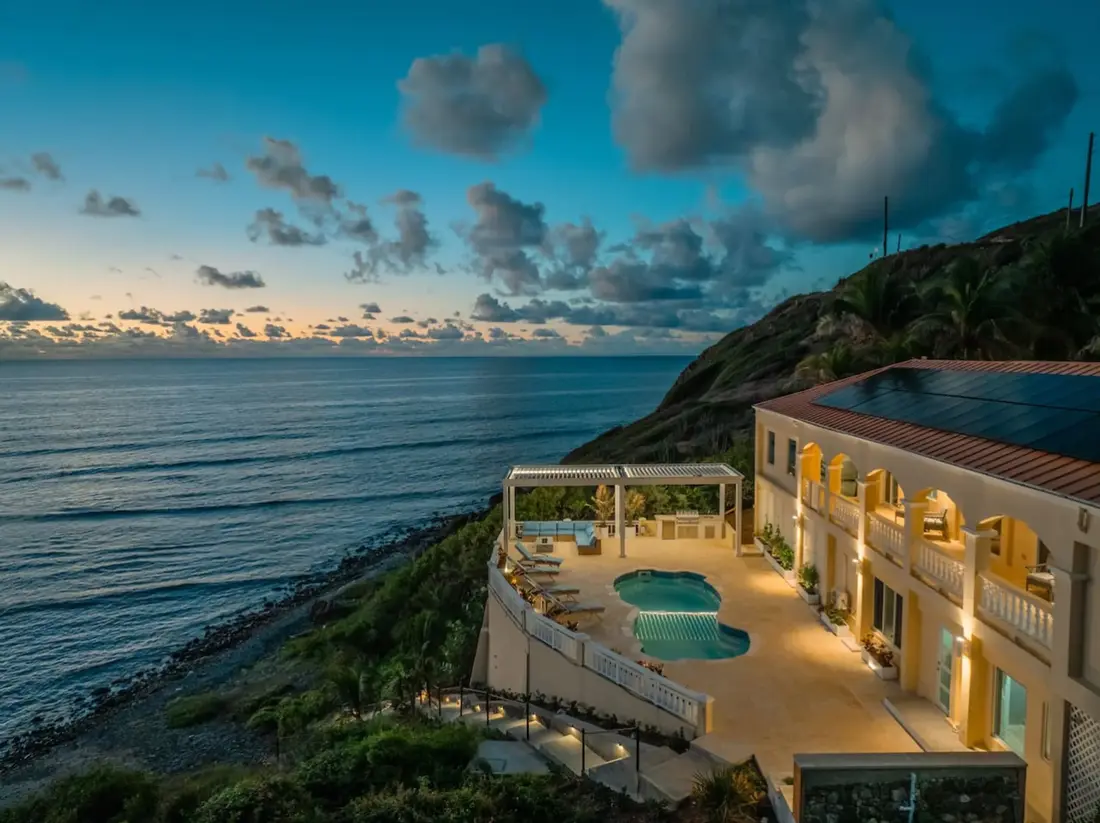
Private oceanfront on the East End with a sandy, swimmable beach, pool, outdoor kitchen and a separate guest cottage. Sleeps twelve.
 The Cerulean5 bd · 5 ba · sleeps 12 · Christiansted
More in Nature & Wildlife
Sources
11 references, listed in full at the end of this guide — official park, refuge, tourism-board and business sources, checked August 2026.