Ha'penny Beach
A long, wild south-shore beach for morning walks, shoreline fishing, and space to yourself. Also a sea turtle nesting shore.
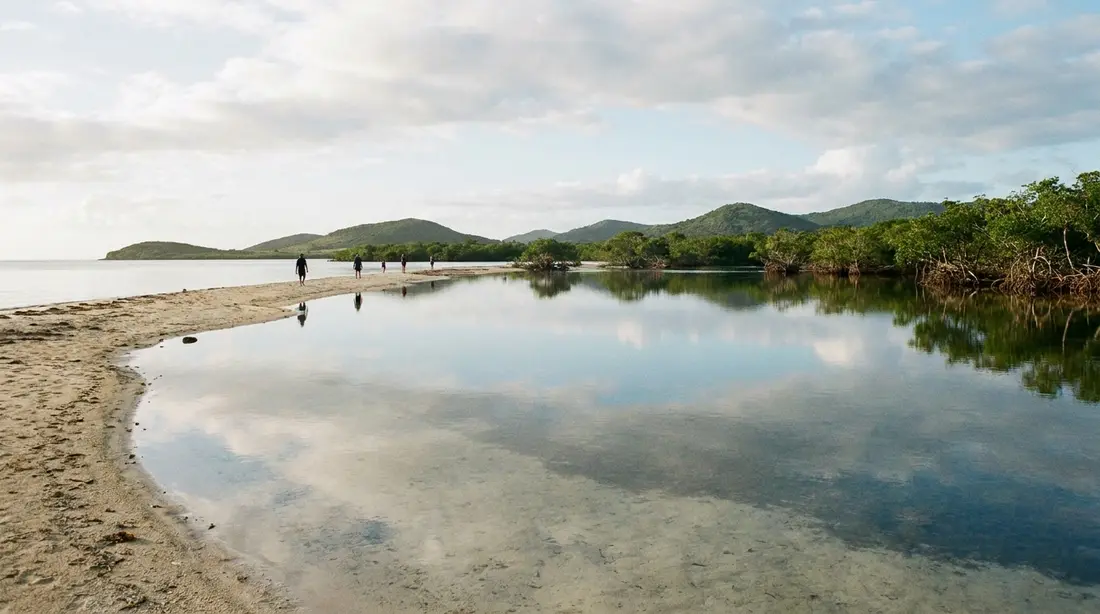
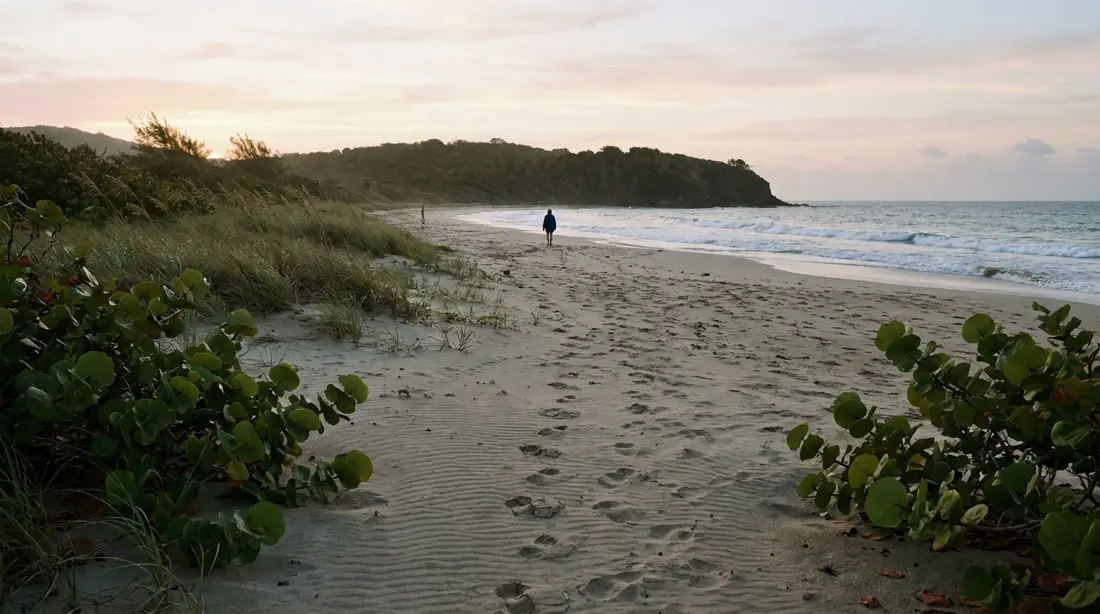
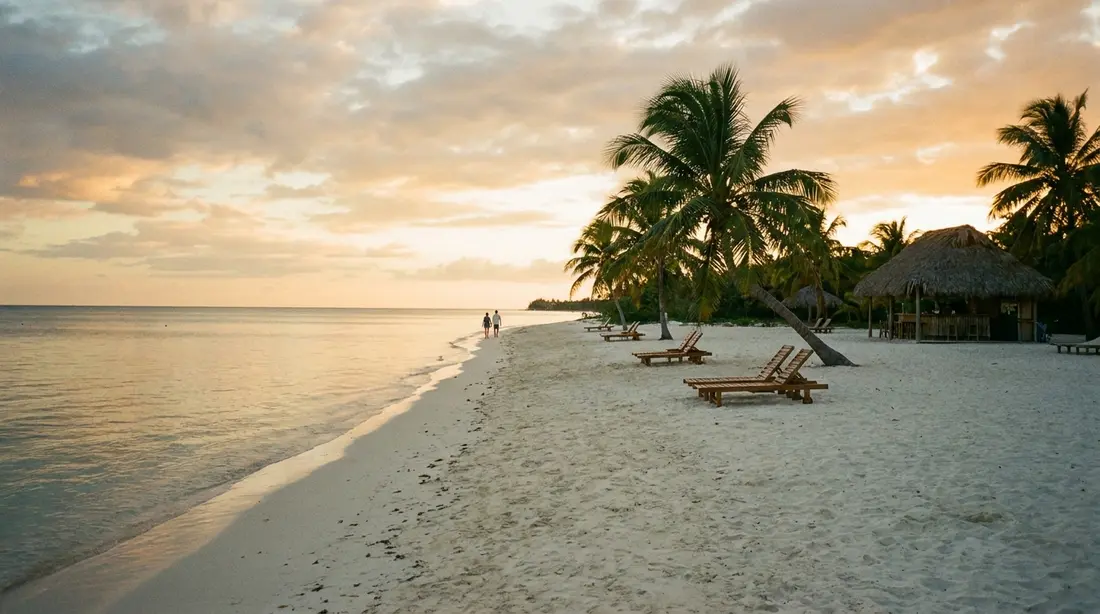
Ha'penny Beach is about a mile of soft white sand on St. Croix's south shore, reached by a half-mile dirt road, with no buildings on the beach, no services, and on a weekday often no people. Locals walk it, run dogs on it, fish from it, and surf it; the island's surf school teaches beginners here; green and hawksbill turtles nest in its sand. This page covers the whole of it: the names, the road in, the water as it actually behaves, and how to spend a day on a shore that provides nothing and asks nothing.
Three names, one bay
Maps and locals use several names for this shoreline, and all of them are current. Ha'penny is the common one, spelled Halfpenny or Haypenny in older references and pronounced "hay penny" on the island. The bay also carries the name Manchineel Bay, after the toxic beach tree that grows along this coast and gets its own section below. Where the coin name came from is something we have not found written down anywhere reliable, so we will not invent a story for it; the halfpenny was small change in the colonial Caribbean, and the name has simply stuck to this bay for a long time.
The land behind the beach belongs to Company Quarter, one of the administrative quarters the island has carried since the Danish era, sitting directly south of Christiansted. That puts Ha'penny closer to town than most visitors guess: the two are separated by the width of the island's mid-section rather than by its length, and the drive from Christiansted runs roughly 20 minutes.
Getting there
The turn is the whole trick. Ha'penny sits off South Shore Road, Route 62, and the entrance announces itself only as a pair of pink concrete pillars on the south side of the road. There is no big sign and no lot visible from the pavement; if you have not been told about the pillars, you drive past. Turn between them and follow the dirt road south about half a mile until the sand appears, with informal dirt parking right beside the beach.
The road is the filter that keeps this beach quiet, so take its measure before you commit. It is unpaved the whole way, and its condition moves with the weather: graded and easy in dry stretches, rutted and puddled after rain. Visitor reports disagree about whether four-wheel drive is needed, which tells you the truth is "it depends on the week." In dry conditions an ordinary rental car makes it at a crawl; after heavy rain, a low sedan is the wrong tool, and the careful move is to go elsewhere that day rather than test it. Drive the whole track at walking pace, take the lines around the holes rather than through them, and remember the island drives on the left even on dirt; the driving primer covers the rest of the adjustment.
The sand
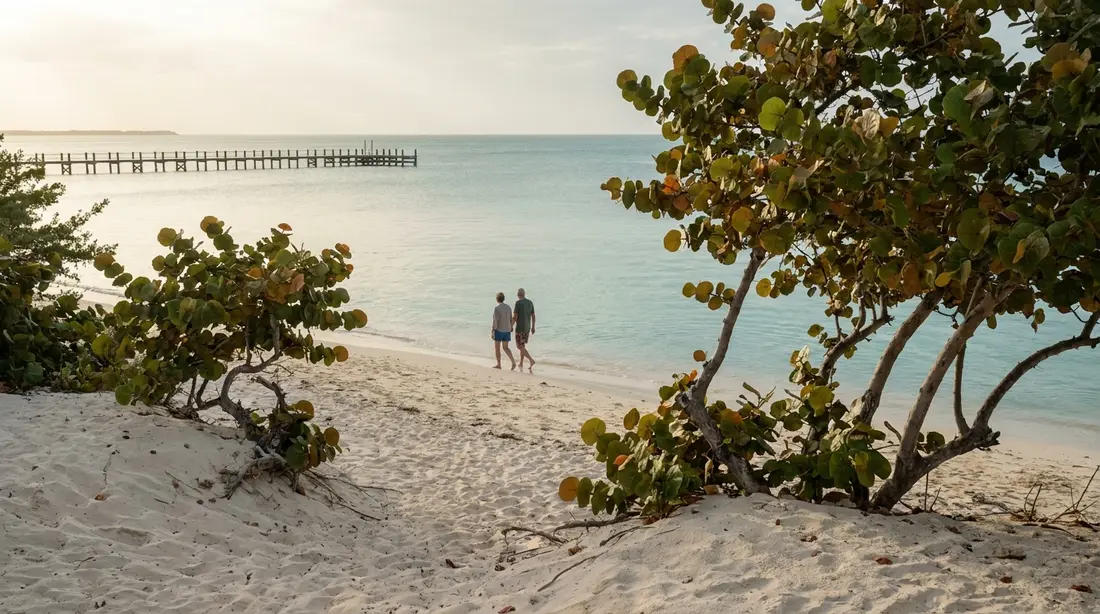
What waits at the end of the road is one of the longest continuous strands on St. Croix: roughly a mile of sand, described in more than one account as a bit over that, soft underfoot for most of its length and backed by low green scrub rather than buildings. A small private members' club operates behind one stretch of the bay at last check, and a scatter of homes sits in the hills above, but at sand level the impression is of a shoreline left alone. There is no bar, no rental stand, no restroom block, and no vendor walking the beach.
The emptiness is the feature, and it is worth describing. On a typical weekday you can arrive mid-morning, put a chair down at the parking end, and see the full curve of the bay with nobody on it; whatever company appears tends to be a dog walker at one end or a shore fisherman at the other. Weekends are different in kind, with island families claiming stretches of sand, coolers out, music on, and the beach doing its other job as a local gathering place. The flat mile has even served as a course for beach relays. Both versions are worth having; pick your day for the one you want.
Along the wrack line the beach collects what the open Caribbean sends it: driftwood, sea fans, seaweed in season, the occasional battered float. Driftwood shelters knocked together from that material have stood on this beach over the years, the kind of improvised structure that turns up on remote shores all over the region. For what you may and may not pocket while walking, see the beachcombing section below.
The manchineel trees
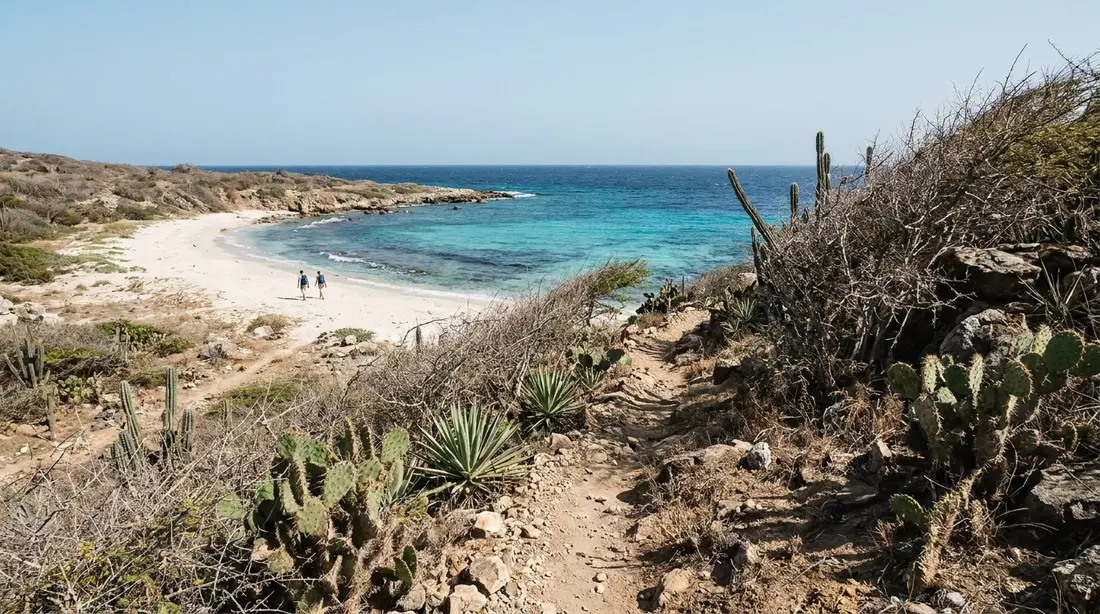
The bay's older name is a warning label, and it deserves a paragraph rather than a footnote. Manchineel trees grow along this coast, and the manchineel is among the most poisonous trees in the hemisphere: sap, bark, leaves and fruit are all toxic, contact causes chemical burns, and getting the sap in your eyes can swell them shut or worse, which is why the National Park Service posts warnings about the species across the Virgin Islands. The tree looks harmless, a rounded green beach tree with small shiny leaves and little green fruit resembling crabapples.
Three rules cover it. Do not touch the trunk, branches or leaves. Do not eat or even handle the green fruit, and make sure children understand this before they range down the beach. And do not stand or picnic beneath one when rain is falling or the leaves are dripping, because water running off the foliage carries the irritant with it. Set up on open sand or by vegetation you can identify, and the tree is a curiosity instead of a problem.
Swimming
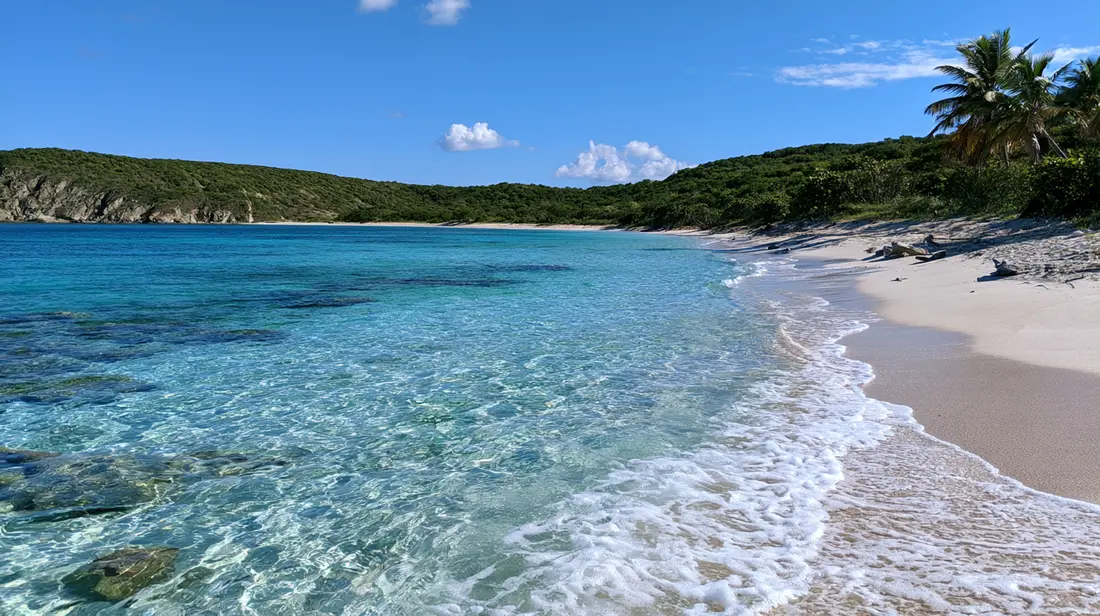
This is the south shore, and the water tells you so. The bay's sea state swings between calm and rough depending on wind and swell, with none of the day-in, day-out placidity of the leeward west coast. On a settled morning the water here is clear, the bottom is sand for most of the bay, and the entry is gradual without being endlessly shallow: a real swim is available, and residents take it regularly. When the trades have been running hard, the same bay carries shorebreak and moving water, and the right use of it shifts from swimming to wading, cooling off to the waist, and walking.
Keep two local specifics in mind. First, enter over sand. The rockier ground toward the eastern end of the bay holds sea urchins, and bare feet find them the hard way; the sandy central stretch is the entry point. Second, count the resources around you: no lifeguard, no staff of any kind, thin cell coverage in spots, and on many days no other people. That arithmetic argues for a conservative line in the water. Swim when the surface is settled, stay inside your depth when it is not, keep children in hand on any day with white water showing, and give the ocean the deciding vote. The island keeps flat, sheltered water fifteen to twenty-five minutes away at Chenay Bay and the west coast when the south shore says no.
One more data point in the beach's favor: Ha'penny is among the several dozen beaches across the territory whose water quality the government monitors on an ongoing basis, so advisories, when they exist after heavy rain, are published rather than left to guesswork.
Surf lessons
Ha'penny is where St. Croix learns to surf. St. Croix Surf and SUP, founded in 2022 by Bryce Scott, a Crucian who has surfed the island's waves for over three decades, and his wife Amanda Dimas, runs its beginner, intermediate and advanced lessons on this beach, and at last check it remained the only locally owned, licensed surf school operating on St. Croix. Introductory lessons have run about $75 for a two-hour session, in group or private form, with multi-session packages available; confirm current prices and meeting details when you book, since small island operations adjust season to season.
The choice of venue is instructive, because it explains the beach. A learner wants a wave that breaks over sand rather than reef or rock, small enough to be manageable on most days, with room to fall and nobody to collide with, and Ha'penny supplies all three: a sand-bottom beach break, south-shore energy that produces rideable waves far more often than the sheltered coasts, and a lineup that is usually empty. The same qualities that make the bay a thinking swimmer's beach make it a beginner surfer's classroom. Experienced surfers work this shore too, on their own reading of the forecast; if you surf and travel with a board, watching the bay for twenty minutes will tell you more than any writeup. For the island's flat-water paddling scene, a different sport on different shores, see paddleboarding on St. Croix.
Walking and beachcombing
The mile is the argument. Very few St. Croix beaches let you walk in a straight line long enough to fall into a rhythm, and Ha'penny is one of them: firm sand near the waterline, a reliable breeze, the scrub line on one side and open Caribbean on the other, and a turnaround point far enough away to earn the trip. Walkers and runners use it at first light before the heat, and dog owners treat it as the island's unofficial dog beach, with room for an animal to run flat out without reaching anyone. Shore fishermen work the breaks in the bars at either end, a St. Croix beach tradition this strand shares with Grapetree further east.
Beachcombing here is a looking activity more than a collecting one, and the law is the reason. Territorial rules bar removing sand, corals and shells from Virgin Islands beaches, and travel guidance is blunt that such souvenirs can be confiscated at the airport; the beaches are made of exactly that material, and the turtles that nest here depend on it. Photograph the sea fans and the whelk shells and leave them in the wrack line. If collecting is the itch, sea glass is the legal outlet, and the island's supply of it concentrates on the old working waterfront at Frederiksted; the sea glass guide covers where and how.
Turtles on this sand
Ha'penny's long, dark-quiet, undeveloped strand is exactly what nesting sea turtles select for, and both green and hawksbill turtles use it, part of a nesting map that also takes in Buck Island, the East End bays and Sandy Point. The broad season runs from spring deep into fall, with hard-shelled species most active from summer onward and nests incubating about two months, so a marked nest can sit on this beach long after the female is gone.
The conduct rules are simple and non-negotiable. Give any marked or roped area of sand a wide berth. Never disturb tracks, which researchers read like a logbook. No lights on the beach at night in season, because artificial light disorients both nesting females and emerging hatchlings. And if you are lucky enough to cross paths with a turtle on the sand, stay back, stay dark and let her work. The organized, sanctioned way to see nesting up close is a guided watch, covered in turtle watch season; the species themselves get the full treatment in sea turtles of St. Croix.
Coming alone
A beach with nobody on it runs on trailhead logic, and it is worth stating the protocol once. Leave the car visibly empty at the dirt lot, valuables back at the villa, doors locked; an empty cabin is the entire defense, and it works. Tell someone at the house where you went and roughly when you expect to be back, the same courtesy you would pay before a solo hike. Check your phone at the parking area so you know what coverage you actually have rather than assuming it. And solo swimming off an empty shore deserves an extra notch of caution beyond solo walking, which costs nothing at all. None of this reflects anything sinister about Ha'penny, whose record is that of a quiet local beach; it reflects the arithmetic of any remote shore anywhere. The island-wide version of this thinking lives in safety and common sense.
When to come
The day has a shape here, and the shape is the wind. The trades sit at their lightest around sunrise and build through the middle of the day, so the bay's calmest, clearest water and coolest walking are both morning goods; by mid-afternoon the same beach is breezier, the water has more texture, and the light turns harsh before it turns golden. Surf students meet in the morning for the same reason. If you want the swim, come early. If you want the wind at your back on a long walk, afternoon works fine.
Across the year, the south shore rewards the light-wind months. Late spring through summer generally brings this bay its longest runs of settled water, which is also when the nesting season asks for the most care after dark. Winter's strong trade episodes put push and chop into the bay for days at a time, turning it into a walking and watching beach, still empty, still worth the drive, with the surf school's students getting their money's worth. Fall trades the statistical storm risk of the season for the emptiest months of all. The island-wide calendar, rain, heat, crowds and prices included, is in weather and when to visit.
One seasonal note worth planning around: Sandy Point, the island's famous two-mile strand, admits visitors only on winter weekends and closes completely from April through August. Ha'penny holds no hours and takes no season off, which makes it the standing answer for a long, empty beach on any summer day, and the closest thing to the Sandy Point experience you can have on a Tuesday.
What to bring
Assume the beach provides zero and pack accordingly: water in real quantity, because the south side is hot and dry and the car may be a long walk behind you; sun cover, since natural shade is scarce and some of what exists is manchineel; food, chairs, and a bag to carry every scrap back out, because there is no trash pickup on a beach with no services. Footwear matters more than usual here, both for the hot soft sand and the urchin rock toward the east end. Reef-safe sunscreen is the standard for the whole territory. The complete island checklist is in the packing list.
Pairing the day
Ha'penny anchors a south-side day well. Eastward, Route 62 joins the south coast roads toward Great Pond, the roadside lagoon that is one of the island's better birding stops, covered in the wildlife guide, and continues toward Grapetree and the East End, so a morning here can roll into an afternoon on the island's other quiet windward strand. Back over the hill, Christiansted's restaurants and the boardwalk are twenty minutes away, close enough that a morning at Ha'penny and lunch in town is an ordinary sequence rather than an expedition. And the beach makes a fair second stop on the around-the-island drive for anyone who wants one taste of the undeveloped south coast without giving it a full day. The complete ranking of every strand on the island is in the beach rundown.
Reading the day
| Conditions | The water | Who the day suits |
|---|---|---|
| Settled morning, light wind | Clear and swimmable over sand; the bay at its best | Swimmers, families with confident kids, surf students, walkers |
| Trade-wind afternoon | Chop and texture; wading fine, swimming a judgment call | Walkers, runners, dog owners, fishermen, readers under an umbrella |
| After a windy stretch or winter swell | Shorebreak and moving water; stay out or stay shallow | Surfers, walkers, watchers; families should use the sheltered bays |
| After heavy rain | Sea is fine but the dirt road may be the problem | High-clearance vehicles only, or save it for a drier day |
Ha'penny at a glance
| Item | The short answer |
|---|---|
| Where | Mid-south shore, directly south of Christiansted; roughly a 20-minute drive |
| Access | Pink pillars off Route 62, then about half a mile of dirt road; free parking by the sand |
| Length | About a mile of continuous sand |
| Facilities | None of any kind |
| Water | Sand bottom, calm to rough by the day; no lifeguard; urchins near the rocky east end |
| Known for | Solitude, long walks, dogs, shore fishing, surf lessons, turtle nesting |
| Crowds | Near-empty weekdays; local family gatherings on weekends |
Questions guests ask
Can we swim at Ha'penny, or is it walk-only?
You can swim, on the right day. The bay has a sandy bottom through most of its length and clear water that residents swim in regularly, and a calm morning here is a good swim. The qualifier is that this is the windward side, so the margin between a swimming day and a wading day is set by the recent wind. Look at the water before you commit: an even, quiet surface means yes, visible white water means keep it shallow. There is no lifeguard and often no one else on the sand, so the conservative read is the correct one.
Will a regular rental car make the dirt road?
Usually, driven slowly, in dry weather. The half-mile track from the pink pillars is graded dirt whose condition depends on how recently it rained and how recently it was worked on; reports from visitors run from "no problem in a sedan" to "wanted four-wheel drive." Treat it as a walking-pace road, steer around the ruts, and if the island has had days of heavy rain, point the car at a paved-access beach instead and come back later in the week. Getting in has never been the hard part; getting in without wincing is about patience.
Is the beach really empty, or just quiet?
Weekdays, empty is the normal condition: it is common to see the whole mile with a person or two on it, and sometimes no one. The beach has no facilities and an unmarked dirt entrance, which filters out nearly all visitor traffic. Weekends flip it into a local beach, with families, grills and music at the accessible end, though even then the far half of the strand usually stays open. If solitude is the point of the trip, come Monday through Friday and come in the morning.
Can beginners really learn to surf here?
Yes, and this is the island's designated classroom for it. St. Croix Surf and SUP, the locally owned school founded in 2022 by lifelong Crucian surfer Bryce Scott and Amanda Dimas, teaches at Ha'penny because the wave breaks over sand, arrives at learner size on most days, and has no crowd to negotiate. Two-hour introductory lessons have run about $75 at last check, with private and group formats and progressions for intermediate surfers. Book ahead rather than showing up, since the school schedules around conditions.
Can we bring the dog?
Ha'penny is probably the best dog beach on St. Croix and is used exactly that way by residents: a mile of sand with nobody to bother, room to run off-lead where it is safe and legal to do so, and shallows for a cooling splash. Bring fresh water for the animal, since there is none on site, keep the dog away from any marked turtle nest and clear of the manchineel fruit on the sand, and pack out what the dog leaves behind the same as everything else.
Can we take home the shells we find?
No. Territorial rules protect sand, shells and coral on Virgin Islands beaches, and confiscation at the airport is a real outcome, so the finds stay on the beach; photographs travel better anyway. The one collectible the rules leave open is sea glass, which is human debris rather than beach material, and the best hunting for it is on the west coast around Frederiksted rather than here. Treat Ha'penny's wrack line as a museum with no gift shop.
Staying near Ha'penny
Most of our homes put this beach inside an easy half-day: from the Christiansted-side houses, including Shoy's Beach House on its own calm strand, the drive over to the south shore runs about twenty minutes, which makes Ha'penny the change-of-pace morning next to a week of sheltered-bay swimming. From the East End hilltops, Dragonfly Villa and Moko Vista, the south coast road heads this way past Great Pond and Grapetree. Tell us what your group wants from a beach week and we will say which house fits; pointing guests at the right mile of sand is most of the job.
Sources
Written from official and first-party sources, checked August 2026. Hours, prices and event dates change — confirm before you go.
In this guide
Stay nearby
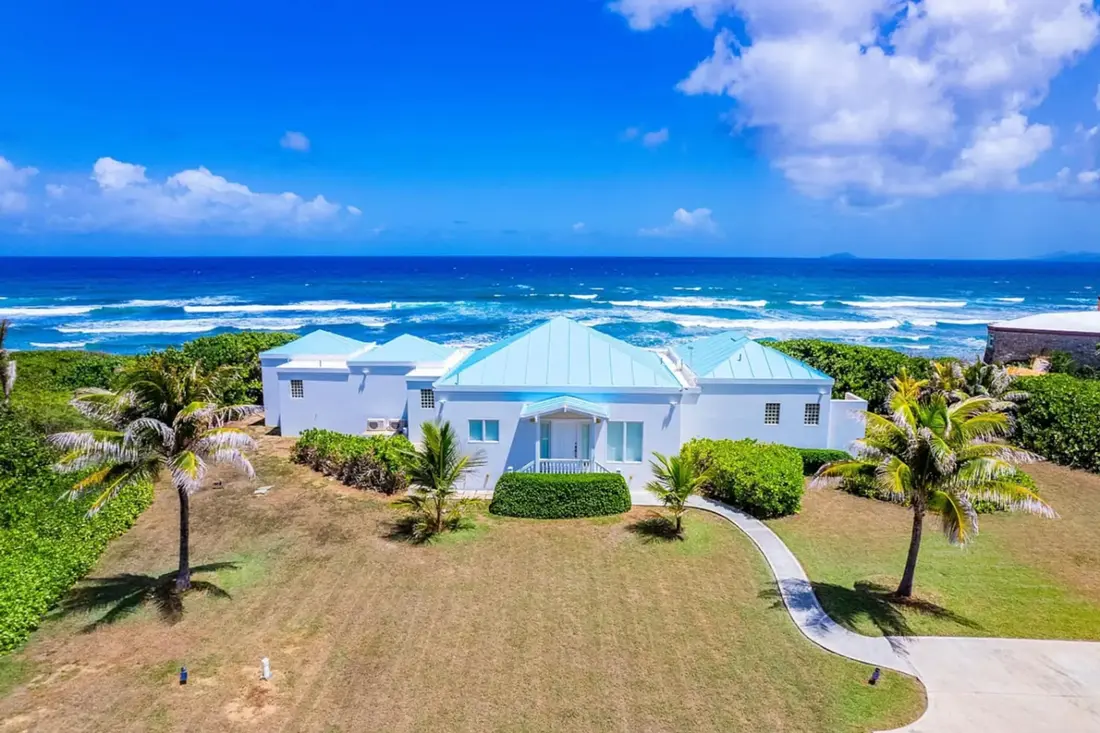
Private oceanfront on the East End with a sandy, swimmable beach, pool, outdoor kitchen and a separate guest cottage. Sleeps twelve.
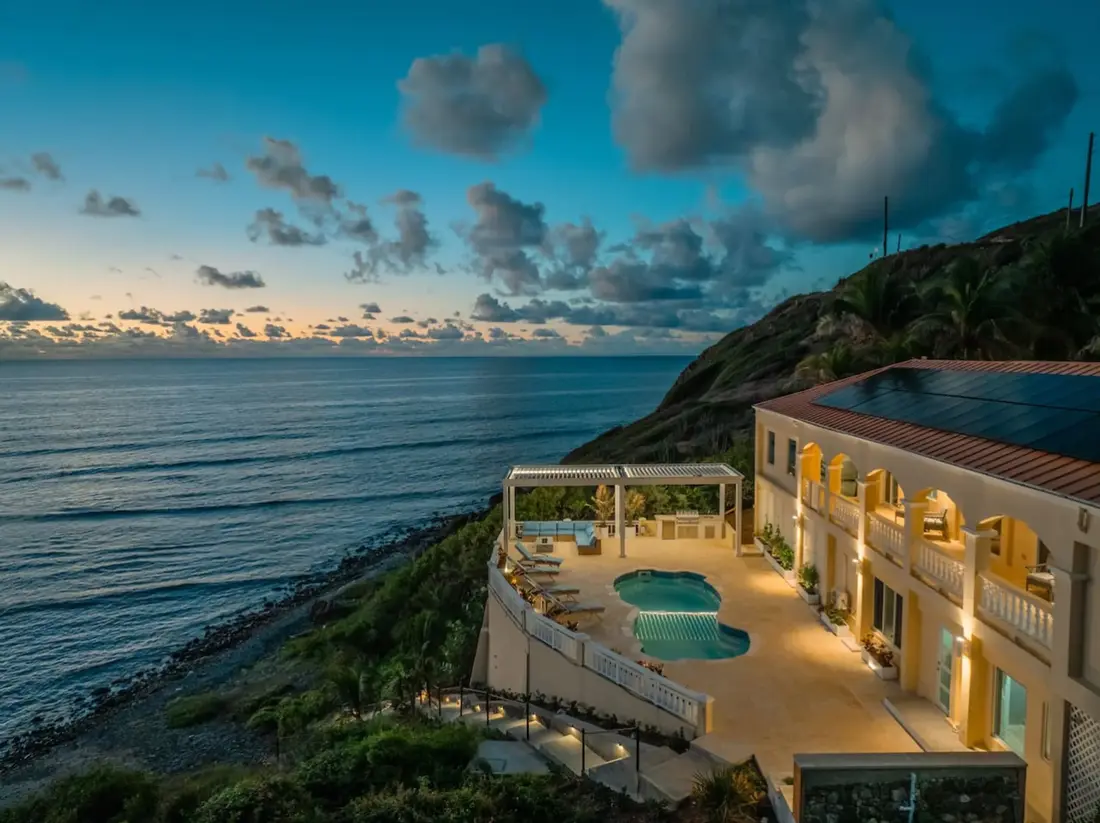 The Cerulean5 bd · 5 ba · sleeps 12 · Christiansted
More in Beaches
Sources
11 references, listed in full at the end of this guide — official park, refuge, tourism-board and business sources, checked August 2026.