Learning to Dive on St. Croix
PADI shops in both towns teach first-timers in calm, clear, warm water. Where to start, what certification takes, and which sites come first.
Plenty of people take their first breath underwater on St. Croix, and the island's geography explains why. The training water is warm in every month, the two classic teaching sites are entered from a beach rather than a rolling boat, and classes stay small because the island itself is small. This page covers the whole path: what an intro dive is and what it is not, how Open Water certification actually fits into a vacation week, the referral option for people who started at home, the medical form that surprises some students, the rules for certifying kids, and where your first real dives happen once the card is yours. The island-wide site catalog lives in the St. Croix diving guide; this one is about becoming the person who can use it.
Why St. Croix works as a classroom
Learning to dive has two enemies: cold and chop. St. Croix removes both. The sea here stays swimmable all year, warm enough that students train in a swimsuit or a thin wetsuit instead of fighting a thick one that changes their buoyancy every few feet (see weather and when to visit). And the west coast at Frederiksted sits in the lee of the trade winds, so the water off the town beach is commonly flat when the rest of the island has whitecaps. New divers get glassy conditions on the exact days they need them.
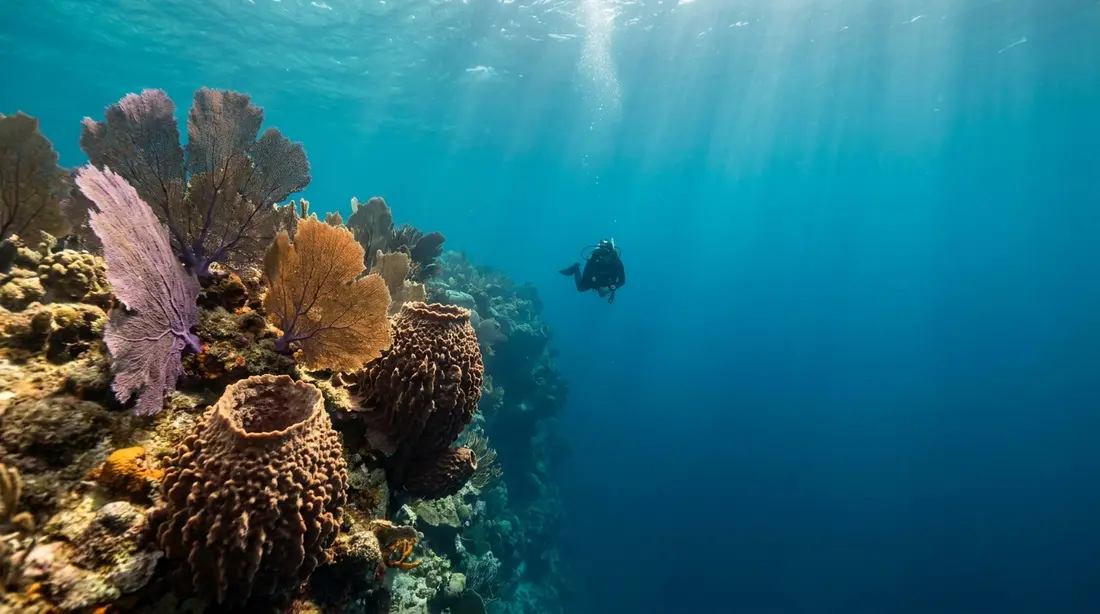
The teaching geography is the other half. The Frederiksted Pier gives instructors a sand bottom in roughly 25 feet of protected water, walkable from shore, with enough marine life that a skills session doubles as a real dive. Cane Bay adds a second classroom on the north shore: shallow sand and reef inside the mooring line, with the famous drop-off waiting a hundred-yard swim away. A student can spend day one kneeling on sand at 15 feet and finish the course hanging over the edge of the Cane Bay Wall, whose top sits within entry-level depth limits. Few places hand a brand-new diver a graduation dive of that caliber without a boat ride.
Class size is the quiet advantage. This is an island of about 41,000 people with a handful of dive shops, so courses run as private or near-private lessons far more often than they do at high-volume resort destinations. One Frederiksted operation caps its boats at six divers; the shops in both towns publish tailored schedules rather than conveyor-belt start dates. The student-to-instructor ratio you pay extra for elsewhere tends to be the default here.
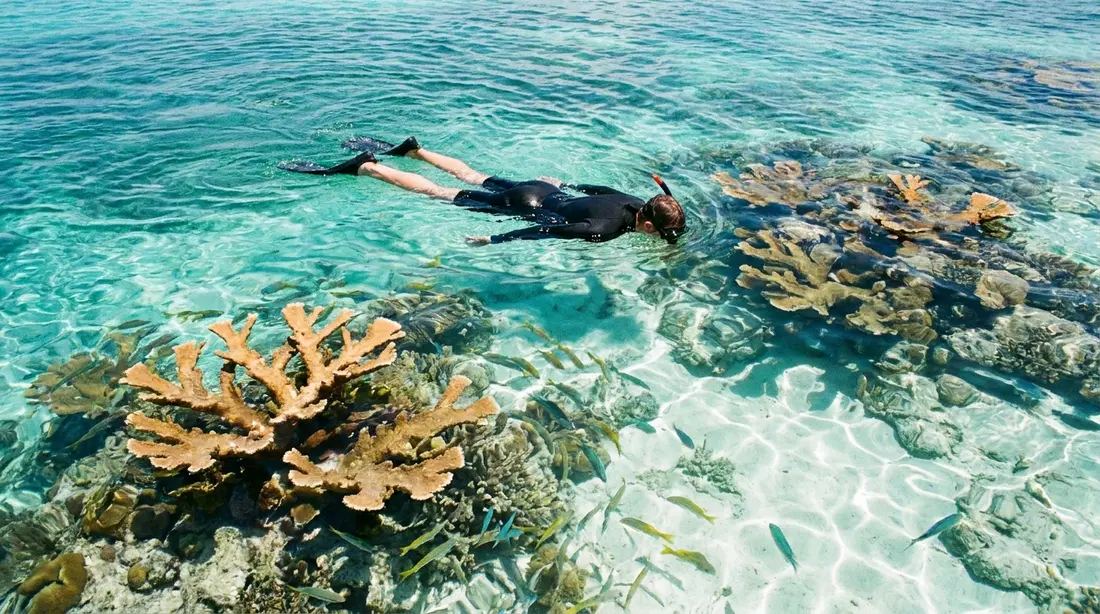
The four ways in
Every dive shop on the island sells some version of the same four products, whatever names the brochures use. First, the introductory dive: a supervised taste of scuba with no exam, no card, and no commitment. Second, Open Water certification: the full entry-level license, earned over several days, valid for life. Third, the referral: you complete the classroom and pool portions with a shop at home, then fly here for the final open-water dives. Fourth, continuing education for people who already hold a card: refreshers for rusty divers, then advanced ratings and specialty courses. PADI also offers a half-step called the Scuba Diver rating, sold on the island by the two-town shop St. Croix Ultimate Bluewater Adventures: fewer training dives than Open Water, a card that requires diving alongside a professional, and an upgrade path to the full certification when time allows. The sections below take each path in turn.
Intro dives: Discover Scuba and try-scuba sessions
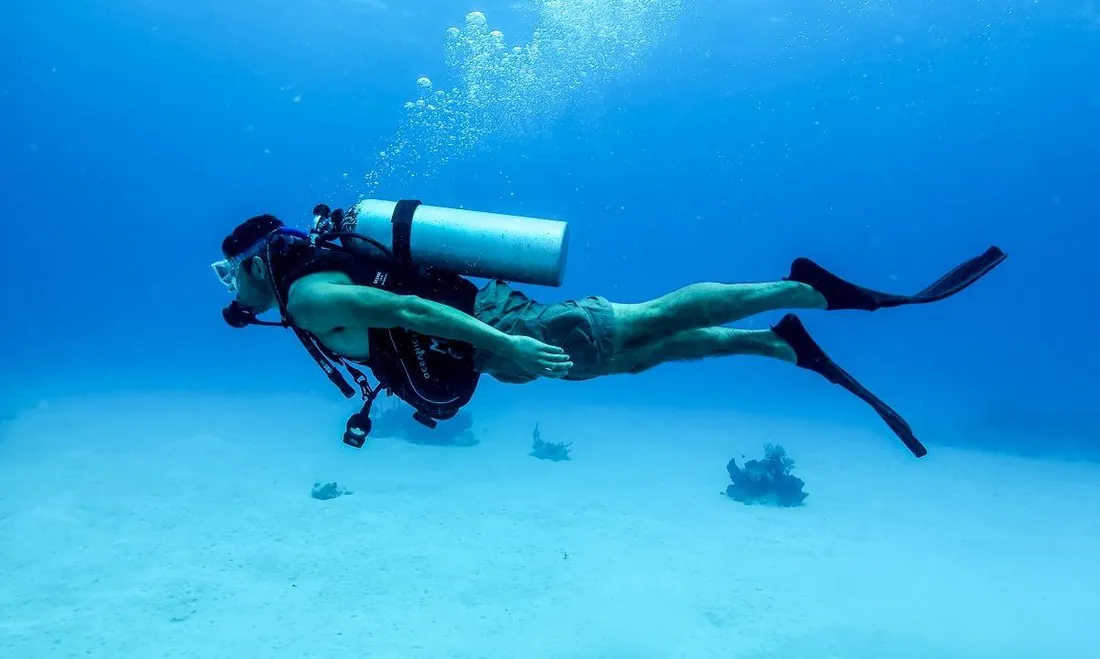
An intro program exists to answer one question cheaply: do you like breathing underwater? Under PADI's version, called Discover Scuba Diving, a participant must be at least 10 years old, with no upper age limit. An instructor teaches a few fundamentals, fits the gear, and takes you into pool-like water first; the shallow session is capped at 20 feet, and the optional ocean dive that follows is capped at 40. A typical dive runs 30 to 50 minutes depending on how fast you breathe your tank down. You do not need to be a strong swimmer, only comfortable keeping yourself at the surface. On St. Croix the ocean portion commonly happens under the Frederiksted Pier, which means first-timers get seahorse habitat as their trial run.
Two things an intro dive is not. It is not a certification: no card is issued, and you cannot rent tanks or dive independently afterward. And it is not a license to explore; the instructor stays with you the entire time and controls the depth. What it can be is a head start. PADI allows the Discover Scuba ocean dive to count toward the Open Water course if the paperwork is arranged in advance and you begin the full course within 12 months. Say so when you book, because the credit is not automatic.
The local menu at last check: St. Croix Ultimate Bluewater Adventures sells Discover Scuba in one-tank and two-tank versions from its Christiansted and Frederiksted shops. Cane Bay Dive Shop and Blue Salt Divers both run the PADI program. Crucian Adventure Divers offers PADI Try Scuba sessions from its King Street storefront in Frederiksted. Nep2une Scuba, which teaches under the SSI system, calls its version Basic Diver: a half-day at the pier priced at last check at $125 for a solo student and $100 a head for two or more. Sweet Bottom Dive Center runs first-timer experiences on the north shore at Cane Bay and the Carambola resort beach.
Open Water on a vacation schedule
Open Water Diver is the certification the word "certified" means in this sport: a lifetime card, recognized worldwide, qualifying you to dive with a buddy, without a guide, to 60 feet. Earning it involves three blocks of work. Knowledge development covers the physics and safety rules, and nearly every student now does it online before travel. Confined-water training, five sessions in pool-like conditions, builds the physical skills. Then come at least four open-water dives, where you repeat those skills in the sea and the instructor signs off. There is also a watermanship check: a 200-meter swim with no time limit and any stroke you like, or 300 meters wearing mask, fins and snorkel, plus 10 minutes of treading water or resting at the surface.
The real arithmetic for a traveler: two to four days of island time once the book work is done at home. Nep2une publishes the tightest verified schedule, a two-and-a-half-day course run from the Frederiksted waterfront, with the confined-water skills and the certification dives all based at the pier; at last check it priced the shore-based version at $725 for one student and $650 each for two or more, with a variant that finishes on boat dives for $850 and $775. Other shops quote on request and shape the calendar around you; Cane Bay Dive Shop describes its courses as tailored to the student's schedule, with training at both the pier and the Cane Bay shallows. Plan the days loosely. A course crammed against a fixed departure fails the moment weather or a stuffy ear costs you an afternoon, and instructors will not rush a student through a skill that has not clicked.
A realistic day-by-day, using the common two-shop pattern: day one is gear fitting, a review of the eLearning, and the first confined-water sessions on sand in waist-to-chest-deep water, moving deeper as skills stack up. Day two finishes the confined work and usually banks the first two open-water dives. Day three delivers dives three and four, deeper and with more navigation, and ends with paperwork and a processed certification. Students who struggle with a skill get a day four; nobody fails for needing repetition.
eLearning before you fly
The single best scheduling decision a future diver makes is finishing the theory at home. PADI's Open Water eLearning takes most students roughly eight hours, spread over evenings however you like, and both PADI shops here and the SSI program at Nep2une offer online academics. Do it before the trip and your island commitment shrinks to the in-water days; save it for the villa and you burn vacation afternoons on quizzes. Cane Bay Dive Shop states the pattern on its site: complete the classroom online, then do the hands-on training in person after you land. Sweet Bottom links students straight into PADI's eLearning system. The knowledge reviews are useful rather than box-ticking, covering pressure and equalization, air management, buddy procedures and dive planning, and instructors on island will quiz you against them before the first descent. Buy the course through the shop you intend to train with, so your records land in the right hands.
Referrals: finish here what you started at home
The referral system splits the course across two shops. You complete knowledge development and all five confined-water sessions with an instructor in your home city, who issues a referral document; a St. Croix shop then conducts the four open-water certification dives and completes the certification. It is the standard play for people who live near a good pool program and a cold, dark quarry, because it swaps the quarry for the Caribbean. St. Croix Ultimate Bluewater Adventures lists referral open-water dives as a standing product, Sweet Bottom advertises referrals for students certifying "elsewhere," and Nep2une posted referral pricing at last check of $475 to $600 depending on options. Referral paperwork carries an expiration, commonly 12 months from the pool work, so check the date before building a trip around it. Bring the physical or digital referral form, your logbook if you have one, and the signed medical; the receiving instructor cannot start without them.
Certified already: refreshers, advanced ratings, specialties
For divers whose cards predate their kids, the shops run reactivation programs: a knowledge refresh plus a supervised skills dive, typically a half-day. St. Croix Ultimate Bluewater Adventures lists PADI ReActivate by name, and the Frederiksted shops handle refreshers at the pier, where 25 feet of calm water forgives rusty buoyancy. Expect a currency check even if you skip the formal course; at last check one west-end operator wanted a logged dive within the past two years before putting a diver on its boat.
Above Open Water, the island's bench is deeper than its size suggests, because two operations, Cane Bay Dive Shop and Sweet Bottom Dive Center, hold PADI 5 Star Instructor Development Center status, the rating that lets a shop train dive professionals, and both teach from beginner through instructor level. Advanced Open Water and its SSI cousin, the Advanced Adventurer program at Nep2une ($725 solo, $675 each for two or more, at last check), sample five adventure dives, and the two that matter here almost pick themselves: a deep dive on the wall and a night dive under the pier. Specialty courses on the island cover wreck diving, ideal ahead of the Butler Bay wrecks, plus navigation, enriched air nitrox, photography, deep, buoyancy, search and recovery, and rescue-level training; Nep2une prices specialties at $175 to $395 at last check, and Blue Salt Divers publishes one of the longest specialty menus in the territory, sidemount and adaptive-diver training included.
The certification agencies, decoded
Students agonize over the letters, PADI versus SSI versus NAUI versus SDI, more than any working instructor does. All the mainstream recreational agencies build their entry courses on shared minimum standards through the Recreational Scuba Training Council, the cards are honored interchangeably at dive shops worldwide, and an SSI Open Water diver rents tanks and joins boats exactly as a PADI one does. On St. Croix the split is simple: most of the shops teach PADI curricula; Nep2une teaches SSI and SDI; Crucian Adventure Divers describes itself as a multi-agency shop able to certify under more than one system. Choose the shop whose schedule, location and teaching style fit your trip, and let the agency ride along as a detail. The instructor in the water with you matters; the logo on the card does not.
Who teaches on St. Croix
Course offerings below are as each shop published them at last check; formats and rates move, so confirm when booking. Fuller operator profiles, boats and dive-trip details live in the diving guide.
- Cane Bay Dive Shop (Frederiksted, Strand Street) — PADI 5 Star Instructor Development Center teaching the full ladder: Discover Scuba, refreshers, Open Water, Advanced, Rescue, Emergency First Response, specialties and professional-level training, plus a PADI Mermaid program open from age 7. Students train at the pier and on the Cane Bay reef, with eLearning handled before arrival.
- Nep2une Scuba (Frederiksted, near the pier) — the SSI and SDI school on the island, operating under the name longtime visitors knew as N2theBlue. The only shop here with a full published price list, from the $125 Basic Diver intro through the 2.5-day Open Water course, referrals, Advanced Adventurer, a stress-and-rescue course and ten specialties. Training centers on the pier.
- Sweet Bottom Dive Center (Renaissance Carambola resort, north shore) — PADI 5 Star Instructor Development Center advertising over 100 courses, from first-timer sessions and Open Water through referrals, with an unusual specialty bench: photography, full face mask, solo and deep. Training happens at Cane Bay and off the resort beach at Davis Bay, and group CPR, first aid and AED classes run alongside.
- St. Croix Ultimate Bluewater Adventures (Christiansted and Frederiksted) — PADI shop with storefronts in both towns, listing Discover Scuba in one- and two-tank formats, the Scuba Diver rating, full Open Water, referral dives, the Scuba Diver upgrade, Adventure Diver, Advanced, ReActivate, wreck and navigation specialties, Master Scuba Diver and Divemaster.
- Blue Salt Divers (Christiansted boardwalk, King Street) — the PADI operation carrying forward Dive Experience, the island's longest-running dive center, founded in 1983 by Michelle Pugh of the Women Divers Hall of Fame. Teaches Discover Scuba through Divemaster with a specialty catalog that runs past twenty courses, including nitrox, oxygen provider, sidemount, self-reliant and adaptive diving.
- Crucian Adventure Divers (Frederiksted, King Street) — small-group, multi-agency shop, and the island's first Black-owned dive operation, running PADI Try Scuba intros and an eLearning-then-checkout course model through Open Water, Advanced, Rescue and specialties including deep, navigation, nitrox and search and recovery.
- Anchor Dive Center (Salt River Marina) — PADI instruction through certification from the one shop based inside Salt River Bay National Historical Park, convenient to students staying mid-island; its home water is the Salt River Canyon.
Paths at a glance
| Path | Island time | Minimum age | What you leave with |
|---|---|---|---|
| Intro dive (Discover Scuba / Basic Diver) | Half a day | 10 | No card; a supervised ocean dive to 40 ft max, creditable toward Open Water if pre-arranged |
| PADI Scuba Diver rating | About 2 days | 10 | Limited card; dive only with a dive professional; upgrades later to Open Water |
| Open Water certification (eLearning done at home) | 2–4 days in water | 10 (junior limits under 15) | Lifetime certification to 60 ft with a buddy |
| Referral checkout dives | 1–2 days | 10 (junior limits under 15) | Full Open Water card, completed from home-shop paperwork |
| Refresher / ReActivate | Half a day | Certified divers | Restored currency; shops honor it for boat trips |
| Advanced and specialty courses | 1–2 days each | Certified divers (per-course rules) | Deeper limits, night and wreck training, nitrox |
Times assume knowledge work is finished online before arrival. Agencies set the age and depth rules; individual shops may run more conservative policies, and the shop's rule wins on the day.
The medical form
Every student, including intro-dive participants at most shops, signs a diver medical questionnaire before entering the water. The current form is a standardized screener developed through the Recreational Scuba Training Council system and revised in 2020, used across PADI, SSI and SDI programs alike. It is a page of yes-or-no questions about things that matter under pressure: heart conditions or heart medication, lung and breathing problems including asthma symptoms within the past 12 months, ear and sinus surgery, seizures, diabetes, some medications, and recent major surgery. Answer no across the page and you sign and dive. Answer yes to certain items and the form routes you to a physician, who reviews a companion medical-guidance document and signs an approval page before any in-water training.
None of this is a verdict; plenty of people with a flagged condition get the sign-off and dive happily. It is purely a scheduling problem, and the way travelers get burned is discovering the form on day one of a course, 1,100 miles from their doctor. The fix costs nothing: download the questionnaire from your chosen shop or agency before the trip, read it at home, and if anything triggers a yes, see your physician before you fly and land with the signed approval in your bag. Questions about a specific condition belong with a doctor or the Divers Alert Network medical line, never with a villa website.
Flying after diving, and where the course goes in your week
Certification dives put nitrogen in your body just as fun dives do, so the standard preflight surface intervals apply to students. The guidelines that the sport runs on came out of a Divers Alert Network workshop informed by chamber trials at Duke University between 1992 and 1999, which tested nearly 800 dive-then-fly profiles at a simulated cabin altitude of 8,000 feet. The published minimums: 12 hours between a single no-decompression dive and a flight, 18 hours once you have made repetitive dives or dived on multiple days, and well beyond 18 hours for anything involving required decompression stops. A certification course is multi-day diving by definition, so 18 hours is your floor, and the conservative habit of taking a full dry day before flying is common for a reason: the minimums shrink risk rather than delete it.
Run that math backward through a seven-day trip and the itinerary writes itself. Start the course on day one or two. Finish certification mid-week, spend a day or two on real fun dives with your new card, and keep the final day on land: Christiansted's forts, the rainforest drive, the first-timer loop. Booking a course for the back half of a week is how students end up choosing between skipping dive four and rebooking a flight. Weather argues for the early start too; a north swell can cost a Cane Bay training day even in high season (see hurricane season for the summer-and-fall version of the calculation), and front-loading leaves room to slide.
Certifying kids
The junior rules are stricter than parents expect, and they are agency standards rather than shop caution. Ten is the floor for both intro dives and Open Water certification. A certified 10- or 11-year-old holds a Junior Open Water card limited to 40 feet, diving only with a PADI professional or a certified parent or guardian. From 12 through 14 the limit rises to 60 feet with any certified adult. At 15, the junior restrictions fall away and the card converts to a standard Open Water credential on request. Under 10, the water is not closed entirely: Cane Bay Dive Shop's Mermaid program starts at age 7, and pool-based kids' scuba experiences exist at some shops, but no agency certifies a 9-year-old for open water.
The family pattern that works on St. Croix: parents and teens take the course together as one class, with the eLearning done as a household project before the trip, while younger siblings work the same beaches with a mask and snorkel; the snorkeling guide covers their version of the week, and traveling with kids covers the rest of the island. Shops here are used to mixed-age family classes, and the pier's shallow, calm profile is about as kid-friendly as certification water gets. Build the schedule around the youngest diver's stamina, two water sessions a day at most, and see the family itinerary for how a course week balances against beach days.
What beginners actually find hard
Almost nobody struggles with the part they feared, the breathing; regulators deliver air easily and the brain accepts the new arrangement within minutes. The two skills that produce real wobbles are mask clearing and ear equalization. Flooding your own mask and blowing it dry at depth feels unnatural for a session or two, and instructors drill it repeatedly because a leaky mask is routine in real diving; the students who suffer are the ones who hold their breath through it, and the cure is repetition in shallow, warm, clear water, which is exactly what the pier provides. Ears are the other gate. You equalize every few feet on descent, and a student who descends faster than their ears, or dives congested, ends the session with pain and lost progress. Go down slowly, equalize early and often, and skip decongestant gambles; a blocked-up day is a rescheduling problem, and St. Croix's shops have the calendar flexibility to solve it.
Comfort in water is the true prerequisite. The swim assessment, 200 meters at your own pace or 300 with mask and fins, plus 10 minutes of treading, is deliberately unhurried, and weak-but-willing swimmers pass it daily. What the course cannot manufacture is baseline calm with your face in the water; if that is shaky, spend the first vacation days snorkeling off Frederiksted Beach and let an intro dive be the test before the course. Instructors would far rather convert a relaxed snorkeler than talk a tense student down at 20 feet.
Gear for the student
Buy almost nothing before the course. Rental gear is bundled into training on the island as a matter of course, the shops maintain their fleets, and learning in the same equipment your instructor services beats troubleshooting new purchases at 30 feet. The exception, and the one purchase worth making before you fly, is a mask. Fit is personal, a rented mask that seeps costs a beginner more composure than any other equipment issue, and a good one costs less than a boat dive. Add defog and a snorkel and stop there. Fins, wetsuits, computers and BCDs are all better chosen after certification, when you know how you dive; a dive computer is the sensible first big purchase for anyone planning multi-day trips, and shop staff here will happily talk through options without a hard sell. Pack polarized sunglasses, reef-safe mineral sunscreen, since the territory bans oxybenzone, octinoxate and octocrylene lotions, and a long-sleeve swim shirt for surface intervals; the broader packing list covers the rest of the bag.
Your first dives with the card
The progression after certification is one of St. Croix's best features, because the step-up dives are all shore dives you already know. Start where you trained: a fun dive under the pier, this time with the freedom to hunt seahorses instead of demonstrating skills. Then take the wall properly, swimming the Cane Bay lip with a guide and holding your 60-foot ceiling while the blue drops away beneath you, a dive that teaches depth discipline better than any lecture. From there the island opens by certification level: beginner-friendly moored boat sites out of Christiansted, the shallower Butler Bay wrecks, and, once an advanced course adds the deep and night ratings, the Rosaomaira and the pier after dark. Log everything; shops ask about recent experience, and a filled first page of a logbook is worth more than the card alone. And keep a snorkel day in the mix at Buck Island, where the monument's waters are snorkel-first and spectacular from the surface.
Questions guests ask
Can I really get certified in one vacation week?
Yes, comfortably, if the online academics are done before you fly. The in-water portion runs two to four days; Nep2une publishes a 2.5-day format, and the PADI shops schedule flexibly around a week's stay. The pattern that works: eLearning at home, course days early in the trip, fun dives mid-week, and a dry final day to satisfy the flying-after-diving interval. The version that fails is arriving with the book work unstarted and three days left. Book the course before you book restaurants; instructors' calendars fill in winter.
How much does certification cost on St. Croix?
The only full published price list at last check is Nep2une's: $725 for a solo Open Water student trained from shore, $650 each for two or more, $850 and $775 for the version finishing on boat dives, referrals from $475. The PADI shops quote individually, and totals depend on eLearning fees, group size and whether boat dives are included, so ask for the all-in number when you inquire. Treat every figure as movable; course pricing here changes with seasons and fuel costs like everything else.
Do I have to know how to swim?
For an intro dive, no formal test applies; you need genuine comfort at the surface, nothing more. For certification, the standard is modest: 200 meters of swimming with any stroke and no clock, or 300 meters with mask, fins and snorkel, plus 10 minutes of treading water or resting afloat. Weak swimmers pass this routinely. What matters more than technique is composure with your face in warm water, and a few snorkel sessions before the course builds exactly that.
My child is 10 — can we do this as a family?
Yes. Ten-year-olds can take intro dives and earn Junior Open Water certification, and island shops teach mixed family classes. Know the limits going in: at 10 and 11 a junior diver stays above 40 feet and dives only with a dive professional or certified parent; 12-to-14-year-olds may go to 60 feet with a certified adult; the restrictions end at 15. Kids under 10 cannot certify, though mermaid and pool programs start younger. Budget extra course days for young divers, who tire faster than they admit.
What if I have asthma or a heart condition?
You may well still dive, and many people with flagged conditions do, but the screening form decides the route. Diving's standardized medical questionnaire asks about breathing problems within the past year, heart conditions and medications among other items, and a yes answer on key questions means a physician must sign an approval form before training. Handle it at home: download the form before your trip, see your doctor if anything applies, and arrive with the signature. A shop cannot waive the requirement, and this page cannot advise on any condition.
Is it better to learn here or finish a referral here?
If you live near a good local shop, the referral splits the work well: theory and pool sessions at home on winter evenings, then the four certification dives in warm Caribbean water instead of a cold lake. If you would rather hand the whole course to one instructor, learning start-to-finish on island takes only a day or two more and keeps the training consistent. Referral paperwork typically expires 12 months after the pool work, so check dates, and confirm the receiving shop honors your agency's referral before booking flights.
Can a brand-new diver dive the Cane Bay Wall?
Yes, within limits, and it is the standard graduation dive here. The top of the wall sits in Open Water depth range, so a fresh certification covers cruising the lip with a guide while the drop falls away below. What the new card does not cover is chasing the wall downward; the site rewards depth discipline, and shops pair new divers with guides who hold the profile. Many students meet the wall during the course itself, since instructors use the Cane Bay shallows for training dives.
How long before my flight home can I finish the course?
Count 18 hours minimum between your last certification dive and wheels-up, per the Divers Alert Network guidance for multi-day diving, and more is better. Certification courses always involve several dives across several days, so the single-dive 12-hour figure does not apply to students. With most departures from the island leaving midday, a final dive on your last full day usually fails the math. Schedule the course early in the week and give yourself a land day at the end; your ears and your itinerary both benefit.
Learning to dive from a villa
A certification week runs smoother from a house than a hotel room: eLearning modules on the lanai instead of a lobby, an outdoor shower for sandy gear, and a washer for the swimsuits that never quite dry. Our west-end villas put guests minutes from the Frederiksted pier and the three teaching shops on that coast, the shortest possible commute to an 8 a.m. pool session. From the East End homes and our Christiansted properties (see the family collection), the boardwalk shops and their classrooms sit an easy drive away, with Cane Bay about half an hour along the north shore. Either way, the non-divers in your group keep their beach week while you earn the card.
Sources
Written from official and first-party sources, checked August 2026. Hours, prices and event dates change — confirm before you go.
In this guide
Stay nearby
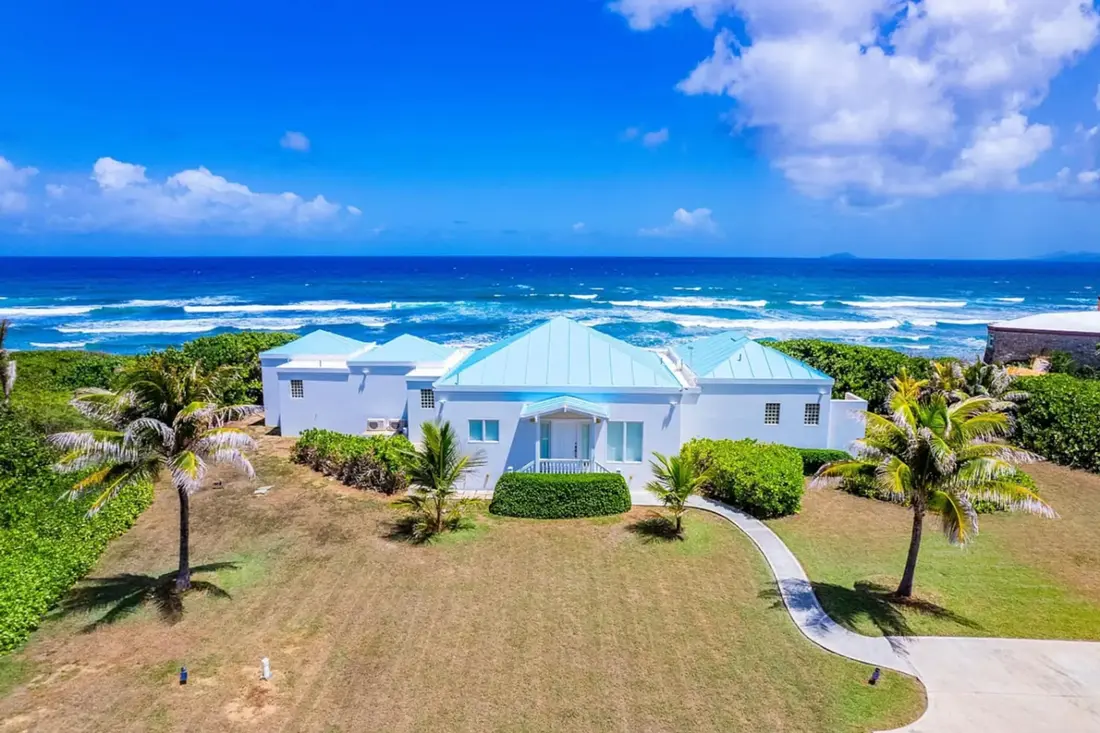
Private oceanfront on the East End with a sandy, swimmable beach, pool, outdoor kitchen and a separate guest cottage. Sleeps twelve.
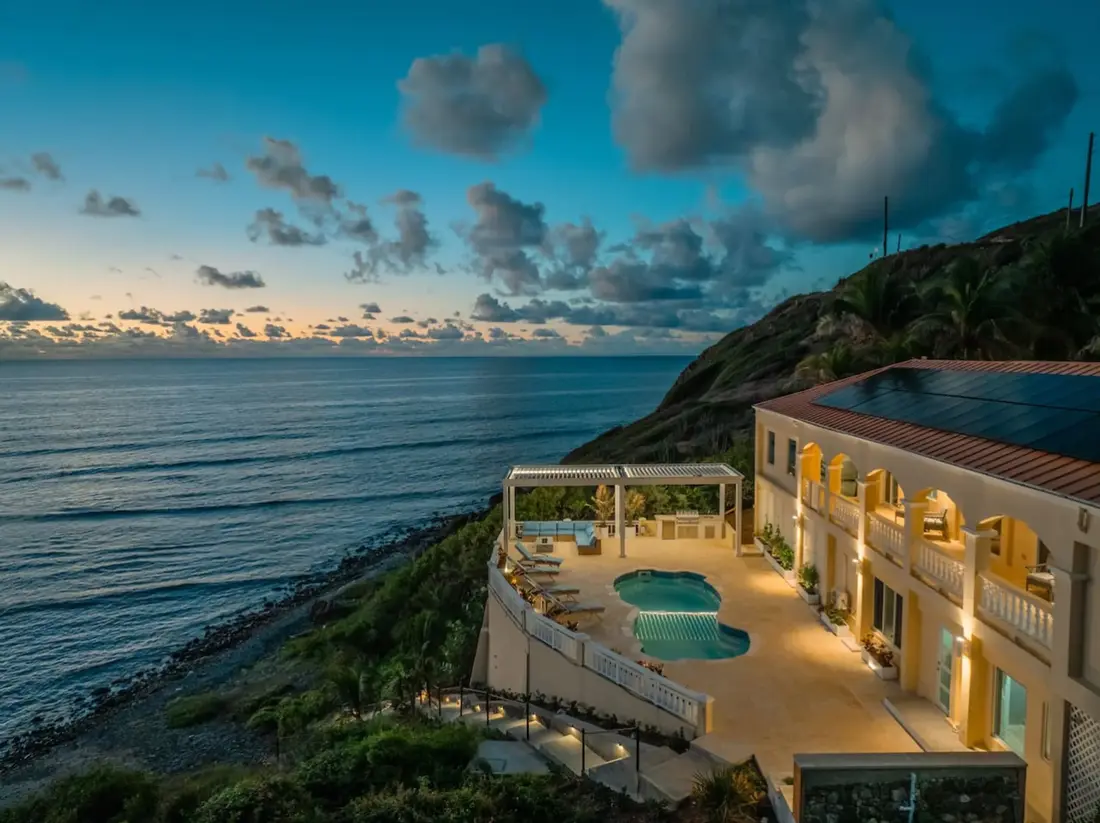 The Cerulean5 bd · 5 ba · sleeps 12 · Christiansted
More in On the Water
Sources
12 references, listed in full at the end of this guide — official park, refuge, tourism-board and business sources, checked August 2026.