Fort Christiansvaern
The yellow-brick Danish fort finished by 1740 that still anchors Christiansted's harbor. What to see inside, and the story it tells.
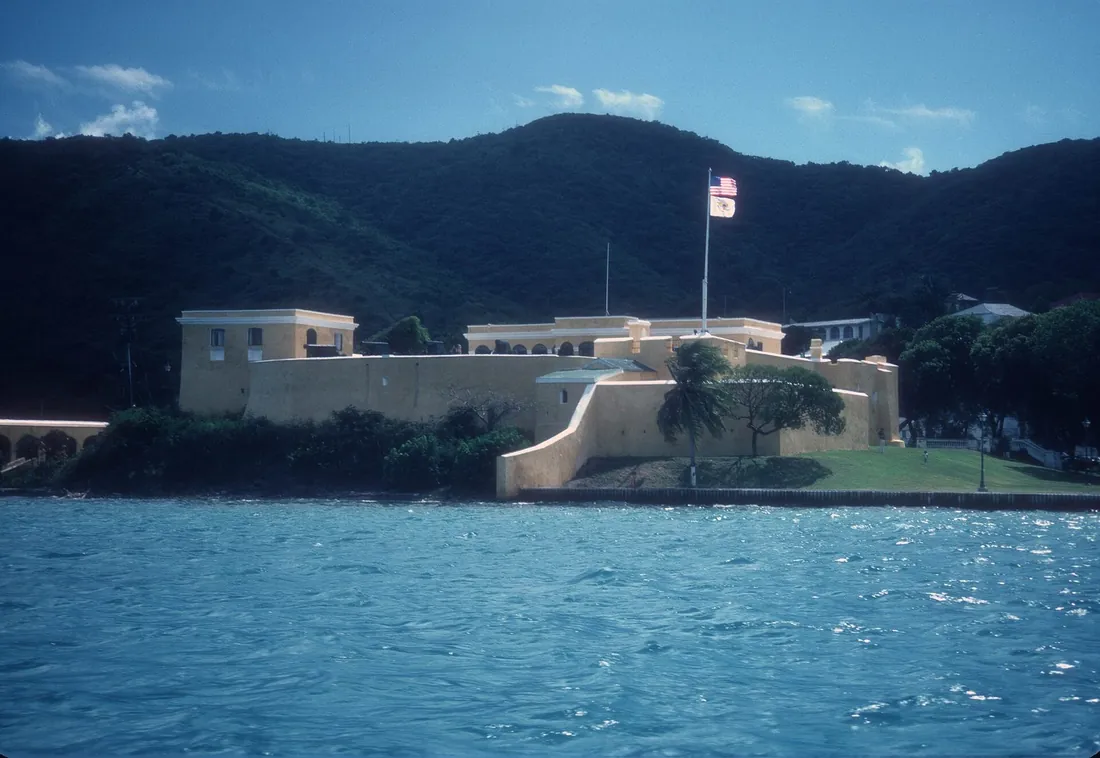
Fort Christiansvaern is the yellow harbor fort that has stood over Christiansted since the middle of the 18th century, and the National Park Service calls it one of the best-preserved colonial forts in the Caribbean. The Danes raised it from brick shipped over as ballast, set it at the edge of the harbor to guard a sugar port, and kept a garrison in it for the better part of two hundred years. This page is the fort itself at close range: how it was built and why, what the soldiers did inside these walls, the rooms a visitor walks through today, the part the fort played in a slave colony told, and the practical business of getting in. For the four other Danish buildings that share the same waterfront, see our Christiansted National Historic Site guide.
What Fort Christiansvaern is
The fort anchors the Danish waterfront at the east end of downtown Christiansted, and it is the one building on that waterfront a visitor pays to enter. The Park Service, which has run it since the middle of the last century, describes it as one of the best-preserved colonial forts in the Caribbean, and the reason is that the original fabric of the walls has come down to us largely intact. Where most Caribbean forts are either ruins or heavily rebuilt, this one still reads as the working military post it was, room for room.
It belongs to a larger unit. Christiansted National Historic Site protects five Danish structures on a few acres of harbor front, and the fort is only the first of them; the Steeple Building, the Scale House, the Custom House and the old company warehouse all stand within a short walk, each one covered in our historic site guide. The town that grew up behind the fort has its own Christiansted guide, and the wider building tradition of the quarter is laid out in the Danish architecture walk. This page stays inside the fort's own gate.
The French fort and the Danish start
St. Croix passed from France to Denmark in 1733, and Denmark took formal possession of the island in January 1734, at a ceremony on the shoreline where the fort would soon rise. A French garrison had held this spur of the harbor before the Danes arrived, and its earthwork fort stood on the spot until a hurricane broke it apart in 1738. Danish crews began a permanent masonry replacement that same year.
The building went up in stages. Its main works were defensible by about 1740, and masons carried the walls to a finished fort by 1749. Denmark returned to it a century later, rebuilding and extending the outer defenses between 1835 and 1841; that later fort is the one you walk today. In its first years the post also sheltered the colony's earliest governors, before the town had a Government House to put them in. The name honors the king on the throne when the town was founded: Christiansvaern means Christian's defense, for Christian VI of Denmark, whose name the town of Christiansted carries as well.
Yellow brick from Denmark
The color is the first thing anyone notices and the most Danish thing about the place. The walls are a soft ochre yellow, built mostly of hard brick that reached the island as ballast. A ship crossing from Denmark rode steadier with weight in an otherwise empty hold, so it sailed loaded with brick, unloaded that brick at Christiansted, and refilled the same hold with barrels of sugar for the run home. The brick paid its own way twice over, and it went into fort walls, arches, town houses and warehouses across the colony; lime-wash kept the yellow bright over the generations until it became the mark of Danish building in the islands.
Behind the brick face the walls are rubble masonry and coral stone, cut thick to hold the day's heat out and to stand up to weather. The pastel yellow is the color the Park Service maintains, and it shows deepest in the low sun right after the fort opens, which is the light to catch it in. How the same materials shaped the whole town is the subject of the Danish architecture walk; here the fort is simply the largest and oldest lesson in yellow ballast brick anywhere on St. Croix.
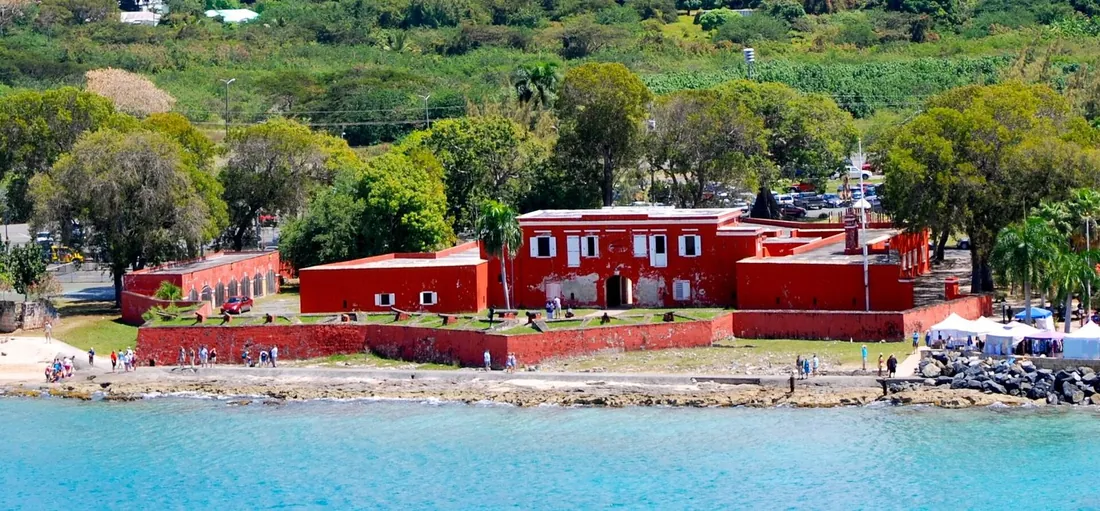
The plan of the fort
Seen from above, Fort Christiansvaern is a compact four-cornered citadel built around a central parade court, with a projecting point at each corner so the guns could sweep the walls between them. The rooms line the inside of the ramparts and open onto the court, and a run of arched openings along the upper level gives the harbor views the fort is photographed for. On the seaward side the wall carries the gun platform, the battery aimed out across the anchorage the fort was there to command. The whole footprint is modest, one tight enclosure rather than a sprawling star fortress, which is all the site ever needed; the sea closed one flank and the town closed the others, so the fort had only to sit astride the wharf.
Just inside the main gate is the ravelin, a wedge of walled ground the Danes shaped to break an attack into two streams before it could reach the doors. The small red sentry box beside the green gate doors stands here, and it is the single most photographed object in the fort. The 1830s rebuilding added two more yards to the layout: a walled stable yard on the east side and a walled prison yard on the west, both still legible in the plan. Nothing about any of it was drawn to survive a European siege. The fort answered smaller, nearer threats, and its whole shape is organized around watching the harbor rather than holding off a fleet.
What the fort was built to do
The garrison had three standing jobs, and only one of them was the kind of soldiering the walls suggest. First, it guarded the harbor and its shipping from the raiders, privateersmen and smugglers who worked these waters, and the battery on the sea wall was the argument that kept them off. Second, it backed the customs service: a fort commanding the anchorage meant no captain could land a cargo or clear the port without the crown collecting its duty, and the tax on sugar and imported goods was the colony's revenue. Third, and least often written on the old plans, the fort was the armed backstop of a slave society, the force kept in reserve against any revolt among the island's enslaved majority, who did nearly all its labor.
In practice the first two jobs were daily and the third was the one that shaped the place. The cannon here were never fired in a real fight against a foreign enemy; no hostile fleet ever tested them. What the fort did instead was routine and local, the work of a customs post and a garrison in a plantation colony, and the harder half of that work gets its own section below.
The British years
Twice the fort changed hands without a shot, which suits its record. Britain and Denmark landed on opposite sides of the wars that ran through Europe in these decades, and a British fleet came for the Danish islands during them. The first time, at the end of March 1801, the Danes signed articles of capitulation and the British took the colony bloodlessly; they handed it back the following spring, in 1802. The second time was longer. A British squadron seized St. Thomas on December 22, 1807 and St. Croix three days after, on Christmas Day, again without resistance, and that occupation held until Britain returned the islands to Denmark on November 20, 1815. Through those years the flag over Fort Christiansvaern was British, the sugar trade the fort protected ran under British rules, and the garrison's guns stayed quiet through the change of owners just as they did through everything else. It is one more piece of the same fact: the fort's strength was its position, and it almost never had to be used. The men who manned it spent their careers watching a harbor, not fighting for one.
Garrison life
Life inside the walls divided sharply by rank, and the restored rooms are arranged to show it. The officers had the best of the fort. Their day room, furnished now with pieces from the Danish period, was where they handled the post's paperwork, wrote letters, played checkers to pass the hours, and handed down discipline to the men. Around it sat the commandant's quarters and storage, the officers' bedrooms, and the rooms of the fort's clerical and police business.
The enlisted soldiers lived plainer lives a few doors away, in barracks rooms with none of the officers' comfort, and the gap between the two is one of the clearest things the fort still teaches. Below them again were the prisoners, held in the cells; the Park Service is blunt that daily conditions fell away in that order, officers first, then soldiers, then the people locked up. A kitchen fed the post, latrines served it, and a magazine held the powder well back from any hearth. The commandant, the senior officer in charge, kept the best quarters of all, and the daily round of muster, guard duty, drill and paperwork filled a life that was far more clerical than heroic. It was a small working community with a hard purpose, and it ran on that order for close to two centuries.
The rooms as you see them today
The fort is a self-guided visit. You take the rooms in whatever order you like, with a brochure from the entrance booth, and rangers lead walks for groups or on request. Start with the officers' day room, the one fully furnished space, dressed with original Danish furniture to show how the post's officers lived and worked. Several of the smaller rooms opening off it now hold the park's own research library and archives, so a door here and there is closed to visitors, but the main circuit stays open.
From the officers' side the route drops to the harder rooms. The detention cells are small, thick-walled and deliberately grim, the most direct thing in the fort. The magazine, where the garrison kept its gunpowder behind heavy walls, and the latrines survive on the circuit too, the ordinary plumbing of a fort that people forget to picture. A military exhibit fills part of the interior, with an arsenal display and cases on the fort's history, and a set of original cannon and cannonballs is laid out where the guns were once served. Read at a steady pace, the rooms carry the whole shape of the place in a single loop, comfort at the top, work in the middle, punishment at the bottom.
The gun deck and the harbor
The upper level is the reason most visitors climb. The gun platform runs along the seaward wall, still set with cannon pointed out over the water, and from up here the anchorage the fort was built to watch opens out in front of you, the red roofs of the town and the green ridge rising behind. Look down into the ravelin from the wall and the red sentry box and green doors sit right below; look out and you have the same sightline the gunners had, the whole harbor mouth in one view.
This is also the best place to grasp why the fort sits where it does. Everything the port did, weighing sugar, taxing it, storing it, loading it aboard ship, happened on the wharf and in the buildings just west of the walls, and the guns up here covered all of it. The harbor boardwalk begins a few steps from the fort's gate and runs west along the water; our boardwalk guide picks up from there, and the restaurant guide has lunch for when you come down. The fort is also the starting line for the island's Emancipation Day walk each July 3, which leaves here before dawn and crosses St. Croix to Fort Frederik; that day is covered in our Emancipation Day guide.
The fort and slavery
A fort built to defend a sugar colony was also built to keep that colony's people in bondage, and Fort Christiansvaern does not hide it. The Park Service names the garrison's third duty: the troops quartered here were the force held ready to put down any rising by the enslaved. The cells inside the walls were part of the machinery of that control, and on the grounds a bare rectangle set into the paving marks the spot of the old whipping post, where the enslaved were flogged in public. The Park Service put that marker there on purpose, and it earns a pause.
One prisoner held in the fort has a footnote in American history. Rachel Faucette, the mother of Alexander Hamilton, was locked in these cells for several months in 1750 during a marriage dispute, years before her son was born; our Hamilton page follows that thread. The fort's role is the same story the whole waterfront tells, from the auction yard at the company warehouse to the estates inland, and the wider account is in the historic site guide and at Estate Whim. The emancipation that ended it all in 1848 was won at the island's other fort, told in the Fort Frederik guide. Fort Christiansvaern did play one part in that ending: General Buddhoe, the man who led the 1848 rising, was held in these cells for roughly six months before Denmark deported him.
After the soldiers
The fort outlived its military purpose and simply kept working. From 1878 the building served as Christiansted's police station and its courthouse, and that long run as a civic building is a large part of why it stands so complete: a fort in daily use gets repaired, not torn down or left to rot. When the United States took over the Danish West Indies in 1917, the old fort changed flags but not function, still housing government offices for years afterward.
In the 20th century it became the centerpiece of a new national park unit. Congress created the historic site in 1952, and the Park Service restored the fort to how it looked during the garrison years of the 1830s and 1840s, the period the rooms are furnished to now. For the whole run of colonial owners that led up to all this, from Spain and France through the Knights of Malta to Denmark, see the seven flags of St. Croix.
Storms and preservation
Two centuries of hurricanes have crossed the fort, and the Park Service treats it as a standing preservation job rather than a finished monument. Hurricane Hugo passed straight over the island in 1989 and Maria followed in 2017, and storm repairs are a recurring part of the fort's modern life. The most recent major campaign began on May 5, 2025, when the National Park Service, together with its Historic Preservation Training Center, started phased work on the fort. Crews reworked the ravelin to bring it closer to how it looked in 1816, and rebuilt the fort's upper firing deck, which had been letting rainwater seep down into the rooms beneath it, with the work due to wrap by the middle of that August.
Through all of it the fort kept its doors open, routing visitors around the active repairs, which is the usual pattern here: expect to find some corner under work on almost any visit, and expect the fort to be open anyway. Between the storms and the constant upkeep, what survives is remarkable precisely because the walls have been kept in service, not abandoned as a ruin.
Visiting Fort Christiansvaern
The fort is open every day of the year, 8:30 to 4:30, and shuts only for Thanksgiving and Christmas Day; those hours are current as of the last check in August 2026, and island timetables shift, so confirm yours before you go. Admission is ten dollars for anyone aged sixteen and over, and a single ticket is good for three days running, which lets you come back for the ramparts another day at no extra cost. Nobody under sixteen pays. The federal interagency passes cover the fort too: the America the Beautiful annual pass and the Senior, Access and Military passes all admit their holder, and the Park Service waives the fee entirely on a short list of dates each year, Presidents Day and Memorial Day among them, along with the July 3-to-5 window, the agency's own anniversary on August 25, and Veterans Day. You pay by card at the entrance booth or ahead of time through Recreation.gov; the fort address is 2100 Church Street.
Give the interior an hour if you want to read the panels and take the rooms one at a time; about forty minutes covers the highlights. The visit is self-guided, and rangers run walks for groups or by request, so ask at the booth what is scheduled that day. One ticket admits you to the fort only; the four other buildings of the wider complex, and the way an America the Beautiful pass pays off if you are touring several national parks on the trip, are covered in the historic site guide. The fort's own lot is capped at two hours and the Park Service tows after 4:30 in the afternoon, so for a longer town day use the metered municipal lot over on Strand Street instead and walk the last block. Driving on St. Croix is on the left; our getting around page has the parking rundown and the airport run.
Fort facts
| Item | Detail at last check |
|---|---|
| Location | 2100 Church Street, east end of downtown Christiansted |
| Built | French earthwork on the site until 1738; Danish fort begun 1738, defensible by about 1740, finished 1749 |
| Enlarged | Outer defenses rebuilt and extended 1835 to 1841 (the fort standing today) |
| Material | Yellow ballast brick from Denmark over rubble masonry and coral stone |
| Name | Christiansvaern, "Christian's defense," for King Christian VI |
| Original job | Harbor and shipping defense, customs enforcement, and control of the enslaved population |
| Later use | Christiansted police station and courthouse from 1878 |
| Managed by | National Park Service; part of Christiansted National Historic Site since 1952 |
| Hours | Open daily 8:30 to 4:30; closed Thanksgiving and Christmas Day |
| Admission | $10, visitors 16 or older; good three days; under 16 free; federal passes honored |
| Time needed | About an hour inside; roughly 40 minutes for the highlights |
The rooms at a glance
| Space | What it was | What you see now |
|---|---|---|
| Officers' day room | The officers' office and lounge, and where they disciplined the men | The one fully furnished room, with original Danish pieces |
| Commandant and officers' quarters | Living and storage rooms for the fort's leadership | Several now hold the park's research library and archives |
| Barracks | The enlisted soldiers' plain quarters | Bare rooms that mark the divide in rank |
| Detention cells | Where prisoners were held | Small, thick-walled cells, the fort's grimmest space |
| Powder magazine | The gunpowder store, walled off from any fire | On the self-guided circuit |
| Kitchen and latrines | Fed and served the garrison | Kept as working spaces of the post |
| Gun deck and battery | The fort's firepower over the harbor | Original cannon and cannonballs; the best harbor view in town |
| Ravelin | A wedge to split an attack at the gate | The red guard box and green doors; reworked toward its 1816 look |
| Whipping-post marker | Where enslaved people were publicly punished | A marked patch on the grounds |
Questions guests ask
What does it cost, and how long does a visit take?
Admission is ten dollars for anyone sixteen or older, and children get in free; the ticket then works for three days, so you can split the fort across two mornings at no added cost. The federal park passes, America the Beautiful among them, admit the holder. Plan on an hour if you read the panels and walk every room, and about forty minutes if you head straight for the ramparts and the furnished rooms. Early is better twice over: the light on the brick is richest just after the 8:30 opening, and the rooms are quiet before the day fills up.
Is the fort the same thing as Christiansted National Historic Site?
The fort is the centerpiece of the site, not the whole of it. The site takes in five Danish buildings on the waterfront; the fort is the one with a gate fee and daily indoor hours, while the Steeple Building, the Scale House, the Custom House and the company warehouse are free to see from the outside. If your time is short, the fort is the piece to make sure of, but the walk between all five is what makes the history join up. Our historic site guide covers the other four in full.
Is the fort good for kids?
Yes, and it tends to be a hit. The open court, the cannon on the upper deck, the cells and the climb to the harbor view give children plenty to do, and under-sixteens get in free. The fort also deals with slavery head-on, including the whipping-post marker and the detention cells, and the panels do not soften it; families we host usually treat that as a reason to bring older kids and to talk it through before or after. A younger child will get about an hour out of the visit before interest runs down.
Why is the fort yellow?
The brick came from Denmark. Ships bound for the colony carried yellow brick as ballast on the way out, then swapped it for sugar on the way home, so the brick that steadied the crossing ended up in the walls. Builders used it across the town, and generations of lime-wash renewals kept it that soft yellow, until the color became the mark of Danish construction in the islands. The Park Service holds the fort to that historic shade, and it reads richest in early-morning sun, which is the argument for an 8:30 arrival.
What does the fort say about slavery?
It says it. The Park Service states that one of the garrison's core duties was to hold down the island's enslaved majority, and the interpretation carries that through: the detention cells, the outdoor marker at the old whipping post, and panels that tie the fort to the plantation economy it protected. None of it is softened. Standing in the cells or at the marker is a direct encounter with what the fort enforced, and it belongs in any visit. The wider system, the auction yard at the warehouse and the estates inland, runs across our history guides.
Fort Christiansvaern or Fort Frederik, which should we see?
Both, if the trip allows, since each holds a different half of the island's history. This fort is the bigger and more complete one to walk, and its subject is how the Danes ran the sugar port: guns, customs, garrison, harbor. The west-coast fort at Frederiksted is quieter and plainer, and its subject is the end of it all, the 1848 emancipation proclaimed at its gate, told in the Fort Frederik guide. Forced to choose one, go by what draws you, the colonial machine here or the freedom story there. The two sit about an hour apart by road.
Staying near the fort
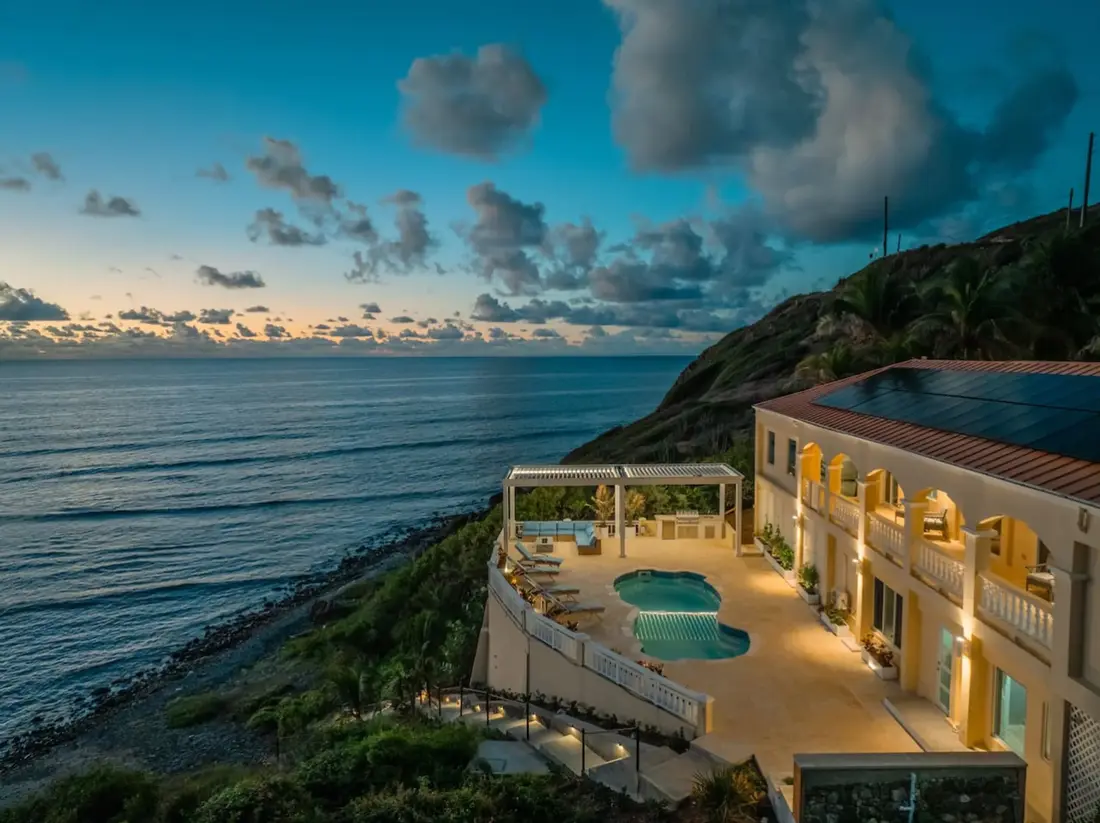
Fort Christiansvaern sits at the east end of downtown Christiansted, and most of our homes are a short drive from it. Shoy's Beach House is the closest of the twelve, about five minutes east, and The Cerulean with the wider East End collection puts the fort fifteen to twenty minutes away, an easy stop on any town morning before lunch on the water. The fort takes about an hour, which leaves the rest of the day for the beach back at the house. Driving here is on the left; our getting around page has the parking, and the full villa list is there when you are ready to pick a base.
Sources
Written from official and first-party sources, checked August 2026. Hours, prices and event dates change — confirm before you go.
In this guide
Stay nearby
On The Shoys beach: six bedrooms, six baths, pool and hot tub, room for twelve, and the beach through the back garden.
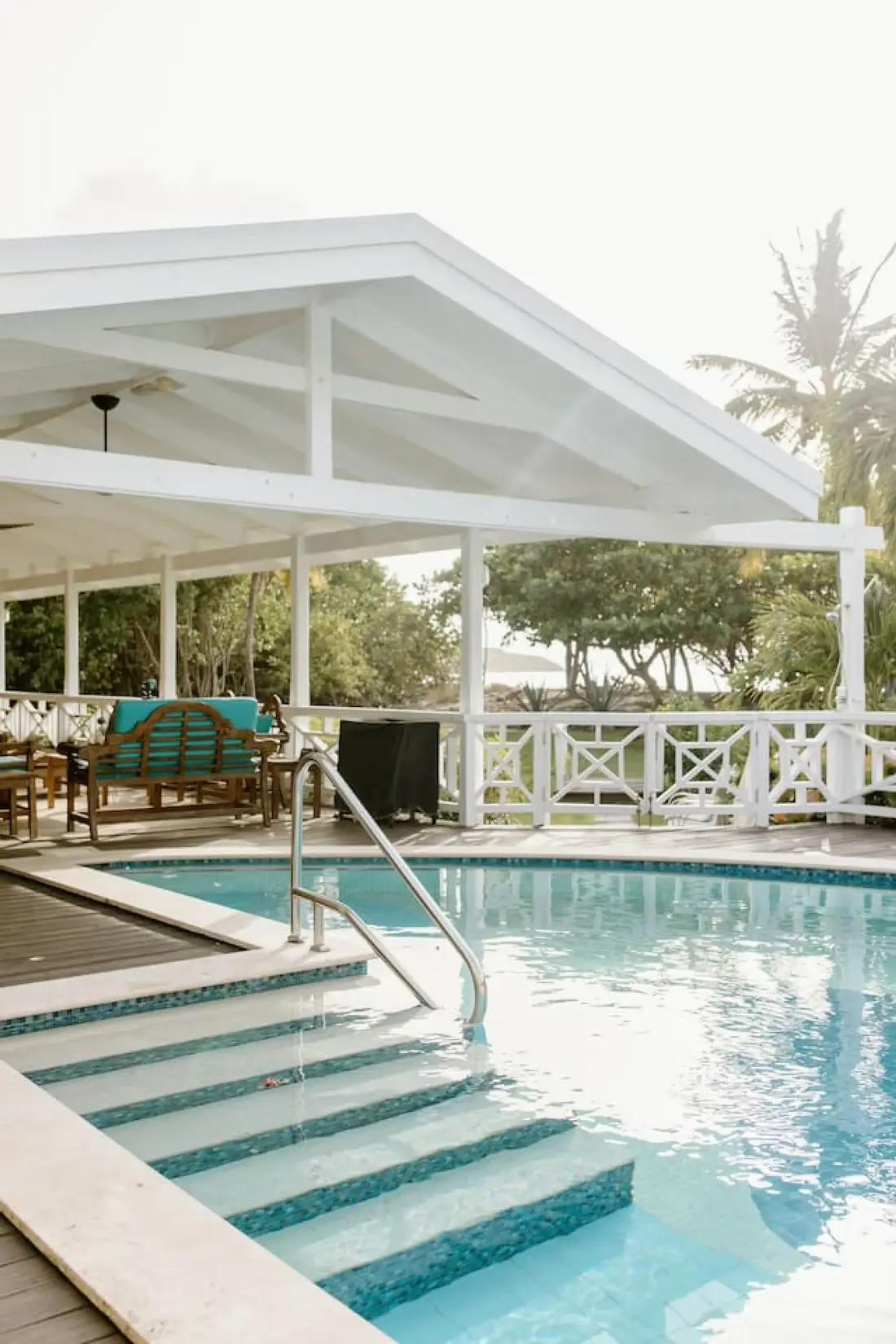 Shoy's Beach House6 bd · 6 ba · sleeps 12 · Christiansted
More in History & Culture
Sources
8 references, listed in full at the end of this guide — official park, refuge, tourism-board and business sources, checked August 2026.