The 1878 Fireburn & Queen Mary
Thirty years after emancipation, four women led a labor revolt that burned Frederiksted — and reshaped the island's story of freedom.
The Fireburn was the labor revolt that swept St. Croix's western district in October 1878, three decades after emancipation freed the island's enslaved majority. Historians rank it as the largest labor uprising in Danish colonial history: over a few days, laborers set fire to more than half of Frederiksted and some fifty estates, four women became its lasting faces, and the shock finally broke the contract system that had bound freed Crucians to the plantations since 1849. This page is the full record. It covers what the revolt was, the law that caused it, how the first of October unfolded hour by hour, who the Queens were and what the archive actually supports about each of them, the trials and executions that followed, the reforms it forced, and how the memory reaches from a Copenhagen statue back to the streets you can walk in Frederiksted today.
What the Fireburn was
On October 1, 1878, plantation workers gathered in Frederiksted, the west-coast town Crucians call Freedom City, and by nightfall the west end was on fire. The revolt takes its name from what the crowd did: they burned the estates and much of the town. What began as a demand for better pay on the one day the law let workers change employers turned into an armed rising that the Danish colony could not put down for the better part of a week, and only then with soldiers, borrowed weapons and warships standing offshore.
The scale is what sets it apart. Slavery on St. Croix had ended in 1848, when thousands of enslaved people forced Governor-General Peter von Scholten to proclaim their freedom at Fort Frederik, a day the territory keeps as Emancipation Day. The hour-by-hour account of that July morning fills a separate page, the Fort Frederik guide. What follows here is the second act, and the harder one to hold in the mind: freedom had been won a generation earlier, yet the people who won it were still tied to the same estates, for wages they could not live on, under a law that treated their labor as the planters' property in all but name. When that law met its breaking point, the answer was the largest act of collective resistance the Danish West Indies ever saw. For a visitor, the Fireburn explains the look of Frederiksted itself, the reforms that followed, and why the four women who led it are honored across the Virgin Islands and, now, in Denmark.

The contract system after freedom
To understand October 1878 you have to start with January 1849. Emancipation had ended ownership of people, but it had not given the freed population land, capital or the right to sell their labor freely. Within months the colonial administration passed a Labor Act, the Arbejdsregulativet, that rebuilt the plantation workforce under a new name. Its terms were narrow and deliberate. A laborer contracted to a single estate for a full year at a time. Wages were fixed by the colony rather than bargained, and set low. A worker's cabin and the garden plot that fed the family came attached to that same contract, so walking off an estate meant losing home and food at once.
The cruelest clause was the calendar. A worker could leave one estate for another on exactly one day in the year, the first of October, which islanders came to call Contract Day. The rest of the year, movement was effectively forbidden. To leave St. Croix altogether for higher wages elsewhere in the Caribbean, a laborer needed a passport the administration charged for and a health certificate it could withhold, a system built to keep the plantations supplied with cheap hands. Meanwhile the old obligations the estates had carried under slavery, medical care and the upkeep of the aged and disabled, were quietly dropped. The result was a bound, low-paid workforce with almost no leverage, which scholars describe as debt peonage: legally free, practically trapped.
For thirty years the pressure built without release. Wages did not rise while the price of everything else did. In the autumn of 1878 workers again pressed for higher pay and easier movement, and again the administration refused, tightening the travel rules instead. A generation that had been promised freedom in 1848 had spent its whole working life discovering the limits of it. Contract Day 1878 fell on a population that had run out of patience.
Contract Day, October 1, 1878
The first of October drew crowds into Frederiksted every year, part labor market and part holiday, as workers came to town to settle the coming year's contracts. In 1878 the mood was tense before anything happened. The spark, as the record has it, was an act of police violence. A rural laborer named Henry Trotman was beaten by police and carried to the hospital, and a rumor moved through the crowd that he had died of the mistreatment in custody. Whether he had in fact died mattered less than that people believed it, on a day when thousands who already had every reason for anger were packed into a small grid of streets.
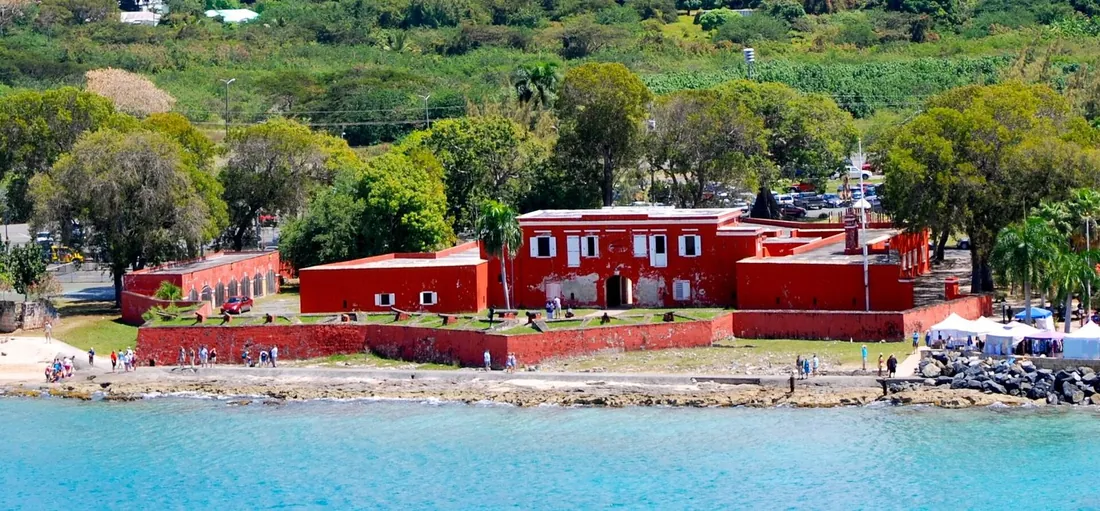
The crowd turned. People threw stones, the small garrison answered with gunfire, and the confrontation escalated past any point of recall within hours. Accounts describe police and soldiers pulling back to Fort Frederik, the dark-red fort that anchors the north end of the Frederiksted seafront, and barring themselves inside. The crowd surged against it. Unlike 1848, when the fort's commander had opened the gate to a proclamation of freedom, the garrison in 1878 held the walls and would not come out. The story of the fort across both risings is told in the Fort Frederik guide; on this day it did what it had originally been built to do, and held.
Unable to take the fort, the crowd turned on everything around it. By evening the town was burning.
The fires
Through the night of October 1 and the days that followed, the rising spread out of Frederiksted and across the western estates. Workers set fire to the town's shops and warehouses, looted stores, and moved from plantation to plantation putting the great houses, the cane fields and the sugar works to the torch. The targets were not random. These were the estates that held the contracts, and burning the cane and the mills struck at the machinery of the system directly.
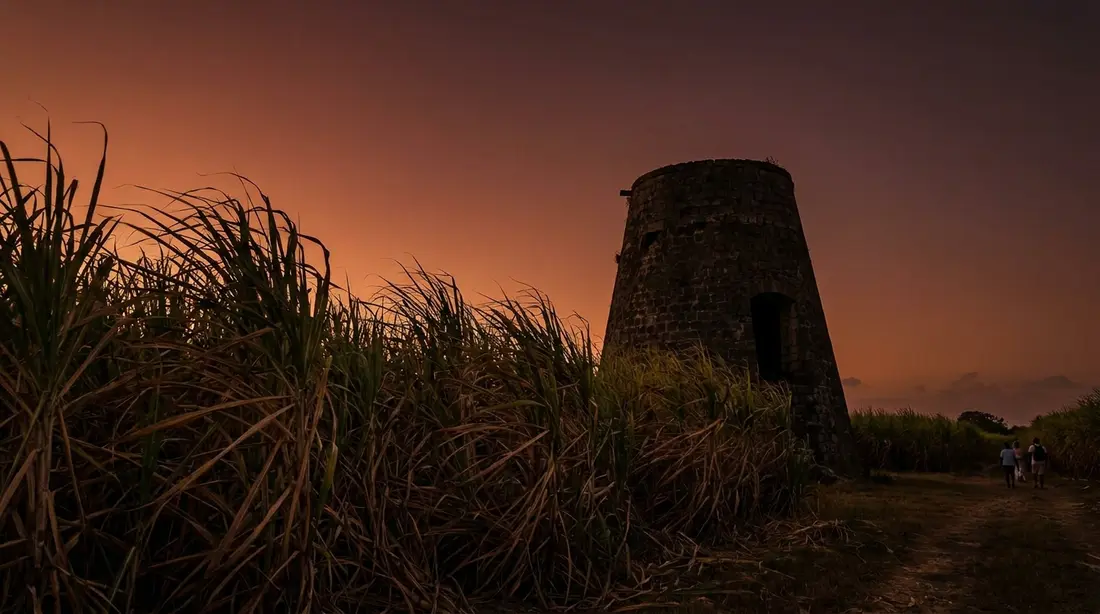
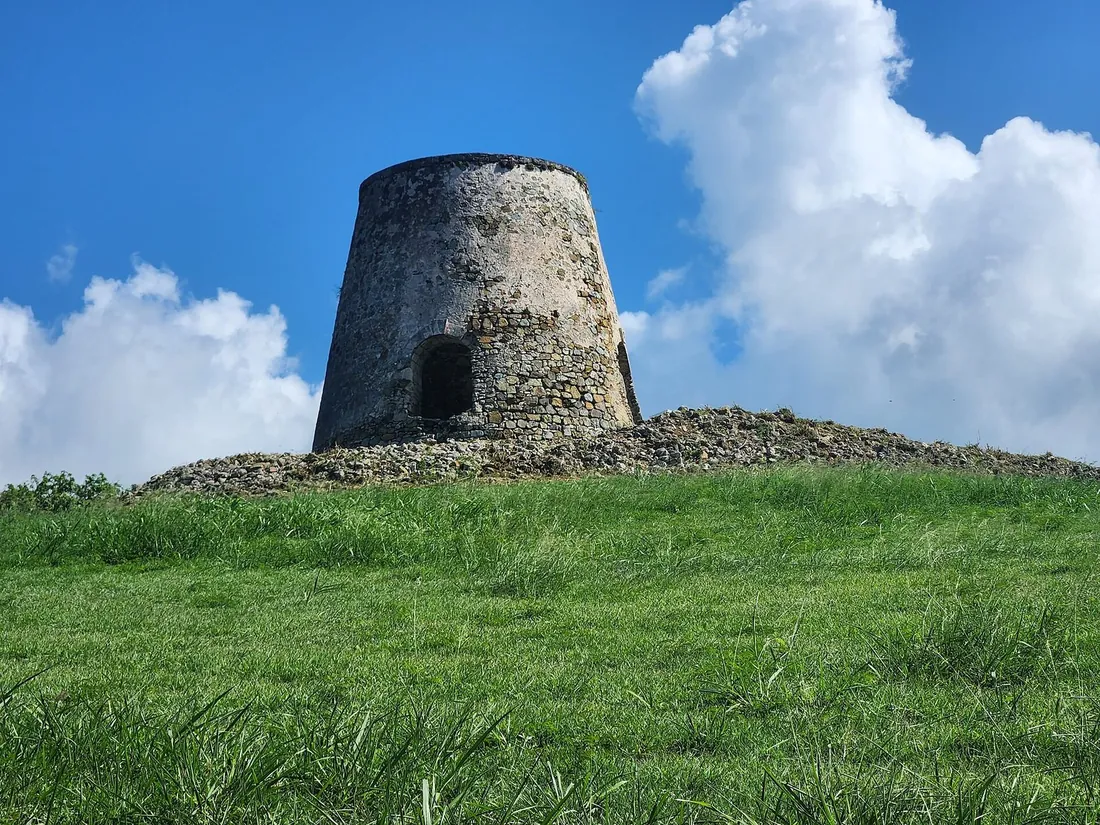
The damage was enormous for so small an island. By the accounts that survive, more than half of the town of Frederiksted burned, and roughly fifty estates were destroyed across the west and central districts, sugar mills and standing crops among them. One tally puts the burned ground at some 879 acres, with losses running to hundreds of thousands of dollars in the money of the day. The rebuilt Victorian face of Frederiksted, the fretwork balconies over the older Danish stone, dates from the reconstruction that this fire made necessary; the Frederiksted guide reads that architecture street by street. Many of the ruined sugar works were never rebuilt at all, and some of the stone towers standing in west-end pastures today, decoded in the sugar mill ruins guide, went cold in these days and stayed that way.
Contemporary observers, most of them writing from the planters' side, recorded the fires as chaos. Later Crucian and scholarly readings recover the pattern underneath: a coordinated strike against the estates and the law they enforced, carried out by people with no other instrument of protest available to them.
How Denmark put it down
The colony's response fell to Governor Janus August Garde, who commanded a garrison far too small for a rising this size. Warships of three foreign powers, British, French and American, arrived off the coast within days, drawn by the smoke and the presence of their nationals' property; by most accounts Garde declined a foreign landing but accepted arms, borrowing weapons from a British vessel to equip his troops. On October 5 he issued an ultimatum ordering all laborers back to the plantations under threat of being treated as rebels, and the garrison, reinforced and rearmed, retook the district over the following days.
The suppression was bloody. Estimates of the dead vary and the colonial records are incomplete, but an academic accounting puts the death toll around a hundred laborers, most of them shot as the soldiers regained control, against two soldiers and one plantation owner killed on the authorities' side. Reports also describe workers dying in a fire or explosion at a burning rum store during the disorder. In the immediate aftermath twelve men were condemned and put to death. The speed of those first executions, carried out before the formal trials had run their course, tells you how frightened the colony had been. The legal reckoning came next, and it reached the four women the island now remembers.
The Queens
The rising organized itself with titles borrowed from the military and the pageantry of the estate: the leaders were called captains, colonels and generals, and four women were named queens. The queens' role was partly ceremonial, leading the crowds and the rituals, and partly tactical, rallying workers and directing the action. In the folk memory of the Virgin Islands they became the enduring symbols of the whole revolt, and their names are taught to Crucian children as heroines. What the written archive supports about each is thinner than the legend, because the surviving documents are mostly the records of the colonial courts that tried them. Both the memory and the record deserve to be set down.
Mary Thomas, Queen Mary
Mary Thomas, remembered as Queen Mary, is the most famous of the four and has become the face of the Fireburn. She was born around 1848 in Antigua and came to St. Croix as a young woman in the 1860s to work the cane; by 1878 she was living at the Sprat Hall estate north of Frederiksted. She had three children and never married. In the rising she called herself a captain and took a leading part, and the workers named her among the queens. The colonial court convicted her of arson and looting and sentenced her to death, a sentence the Danish king commuted to life. The record the courts kept also notes earlier convictions against her for theft and for mistreating her children, details that sit inside a colonial legal archive built to discredit her and that later generations weigh accordingly. She was transferred to a women's prison in Copenhagen in 1882, returned to St. Croix in 1887, and died in 1905. The Queen Mary Highway on the island carries her name.
Queen Agnes and Queen Mathilda
Axeline Elizabeth Salomon, known as Queen Agnes, lived at the Bethlehem estate and is credited with rallying workers through the central and southern parts of the island during the rising. Mathilda McBean, remembered as Queen Mathilda, was the youngest of the leaders, reported to have been around twenty-one, and took a prominent part in the crowds and their ritual functions. Together with Mary Thomas these two make up the "three queens" of the oldest tradition, the trio honored in Virgin Islands song and, on St. Thomas, at the Three Queens Fountain. Both were among those convicted and sentenced to death, and both had their sentences commuted and served time in Denmark before returning home.
Susanna Abrahamsen, Bottom Belly
The fourth queen is a later addition to the public story, recovered from the Danish archives rather than carried in song. Susanna Abrahamsen, known by the nickname Bottom Belly and sometimes styled Queen Susanna, lived at the Prosperity estate and was arrested, convicted and transported to Denmark with the others. Her leading role was drawn back into the record largely through the research of the Crucian historian Wayne James, working in Danish colonial documents in the 2000s, which is why older tellings name three queens and newer ones name four. Her recovery is a reminder that the archive of the Fireburn is still being read, and that the count of its leaders has grown as scholars return to the sources.
The "Queen Mary" song
The Fireburn survived first in music. The "Queen Mary" folk song is one of the best-known pieces in the quelbe tradition, the scratch-band folk music of the Virgin Islands covered in our mocko jumbies and quelbe guide. Its author is unknown, it is sung in Virgin Islands Creole, and most Crucians learn it as children, which is how the memory of 1878 passed down through generations that never saw it written in a schoolbook. The verses are sung in Queen Mary's own voice: asked where she means to go and burn, she answers by naming the estates and calling for the match and the oil to do it. Sung to a bright quelbe rhythm, the words carry a matter-of-fact defiance that has kept the song an anthem of labor and of Crucian women's strength for well over a century. Out of respect for the tradition and for copyright, this page describes the song rather than printing its lines; hearing a scratch band play it live on the waterfront is the way it is meant to be met.
The trials and the reforms
The courts worked through the winter that followed. By the accounts historians rely on, around forty people were convicted for their part in the rising, the three best-known queens among them, and all were sentenced to death. The Danish king then pardoned the capital sentences, converting them to life imprisonment or detention at the crown's mercy. Seven of the convicted, including four women, were shipped to Denmark to serve their terms, held at the Christianshavn women's prison in Copenhagen from 1882 to 1887 before being returned to St. Croix. That an ocean crossing and a European prison were the penalty for a St. Croix labor revolt is one of the sharpest illustrations of how the colony was governed.
The reform came quickly, which tells you the rising had made its point. On October 24, 1879, the administration repealed the 1849 Labor Act. Freed at last from the annual contract and the single Contract Day, laborers could now seek work where they chose and leave the island to sell their labor elsewhere. The gains beyond that were modest. Wages rose only a little, the new contracts still favored the estates, and the deeper poverty of the plantation economy did not lift. But the legal cage that had defined life since emancipation was gone, and the door to buying land and to organized labor had opened. The struggle continued into the next century, most famously under the labor leader and editor D. Hamilton Jackson, whose own day the territory now keeps. The Fireburn is the hinge in that longer story: 1848 ended ownership of people, and 1878 broke the system that had replaced it.
The rebuilt town and the burned estates
The clearest thing the Fireburn left behind is Frederiksted itself. The fire gutted the old town, and the reconstruction gave it the layered look it still wears: Victorian wooden upper stories, gingerbread trim and balconies raised over the Danish stone ground floors the fire had spared. Walk Strand Street and King Street with that in mind and the 1878 line is visible in the buildings, cut stone below and later woodwork above; the Frederiksted guide and the Danish architecture walk both read the streetscape in detail.
The estates the crowd burned are scattered across the western and central plain, and several are now places a visitor can stand. Estate St. George, torched in the revolt, is today the St. George Village Botanical Garden, where the plantation-village ruins carry the gardens. Estate Whim, the restored plantation and museum, lets you see the working world the Fireburn rose against, laid out in the Estate Whim guide. The estates tied to the queens are on the same map: Sprat Hall, where Mary Thomas lived, north of town; Bethlehem in the central plain; Prosperity out toward the west. Read together with the sugar mill ruins, the plantation landscape becomes the physical text of the whole story, from the sugar economy through emancipation to the fire that ended the contract system.
I Am Queen Mary and the long memory
In 2018 the Fireburn returned to Denmark in bronze-colored form. The sculpture "I Am Queen Mary," a collaboration between the Virgin Islands artist La Vaughn Belle and the Danish-Trinidadian artist Jeannette Ehlers, was unveiled outside the Vestindisk Pakhus, the old Danish West India Warehouse on the Copenhagen waterfront where colonial goods once landed. Standing about seven meters, roughly twenty-three feet, it shows Queen Mary seated on a throne, barefoot, in a head wrap, a torch in one hand and a cane-cutting bill in the other, the two tools of the 1878 rising. The figure's body was built as a digital composite of both artists, scanned and merged, and the throne echoes the well-known 1967 photograph of Black Panther co-founder Huey P. Newton in a wicker chair. Its plinth holds about a ton and a half of coral stone brought from St. Croix, the same stone that enslaved and bound laborers once quarried and cut for the colony's buildings. It was widely described as the first public monument to a Black woman in Denmark, and it forced a national conversation about the country's colonial past. A winter storm damaged the sculpture on December 27, 2020, and at last report only the plinth stood while the artists worked to fund a permanent bronze.
At home the memory runs deeper and older. The Three Queens Fountain on St. Thomas honors Mary, Agnes and Mathilda; the Queen Mary Highway crosses St. Croix; and the Fireburn is taught in Virgin Islands schools, where students re-enact the rising in Frederiksted around its anniversary each October. Crucian historians, Wayne James among them, have kept returning to the Danish archives to recover names and details, and the revolt has moved into books, plays and a screenplay. For Crucians the Fireburn is a point of pride: proof that the island's freedom, at both its turning points, was taken by the people who most needed it rather than handed down.
A Fireburn history circuit
The revolt is legible on the ground for a visitor willing to spend a west-end morning on it. A respectful circuit runs like this:
- Fort Frederik — the fort the crowd besieged and could not take in 1878, and the same walls where freedom was proclaimed in 1848. Its museum sets both risings in one place, and the ground below the walls is where each began.
- Frederiksted's waterfront and streets — the Victorian town is the rebuild from the fire; Strand and King Streets show the 1878 line in their own facades.
- St. George Village Botanical Garden — the ruins of Estate St. George, burned in the revolt, now grown through with gardens.
- Estate Whim Museum — the restored plantation that shows the labor world the Fireburn rose against, from great house to windmill.
- Maroon Ridge — the northwest cliffs where earlier generations who escaped the estates held out, the longer backdrop of Crucian resistance.
The wider colonial arc that frames all of it, from the island's changes of flag to the 1917 sale to the United States, is traced in the seven flags guide, the Christiansted National Historic Site guide and the Transfer Day guide. Treat the Fireburn sites the way you would any memorial ground: read the panels, keep the cameras respectful, and give the estates their weight.
Timeline of the Fireburn
Dates and figures below are as the sources establish them; where accounts differ, the range is noted rather than a single false number.
| Date | Event |
|---|---|
| Jul 3, 1848 | Emancipation proclaimed at Fort Frederik; slavery ends in the Danish West Indies |
| Jan 1849 | Labor Act ties the freed population to year-long estate contracts at fixed, low wages |
| Every Oct 1 | Contract Day: the one day a year a laborer may change estates |
| Autumn 1878 | Demands for higher wages and easier movement refused; travel rules tightened |
| Oct 1, 1878 | Laborer Henry Trotman beaten; rumor of his death sparks the rising; the crowd besieges Fort Frederik and the fires begin |
| Oct 1-4, 1878 | More than half of Frederiksted and some fifty estates burned across the west end |
| Oct 4, 1878 | British, French and American warships arrive offshore; the garrison borrows arms from a British ship |
| Oct 5, 1878 | Governor Garde orders laborers back to the estates; suppression retakes the district; twelve men executed |
| Oct 24, 1879 | The 1849 Labor Act repealed; workers may seek work freely and leave the island |
| 1882-1887 | Four convicted women, the queens among them, held at the Christianshavn women's prison in Copenhagen, then returned |
| 1905 | Mary Thomas, Queen Mary, dies on St. Croix |
| 2018 | The "I Am Queen Mary" sculpture unveiled in Copenhagen |
Questions guests ask
What was the Fireburn, in one paragraph?
It was a labor revolt on St. Croix that began on October 1, 1878, thirty years after slavery ended, when plantation workers rose against a contract system that kept them bound to the estates for low, fixed wages. Sparked by the beating of a laborer and a rumor of his death, the crowd besieged Fort Frederik, could not take it, and set fire to Frederiksted and dozens of estates over several days. Danish troops suppressed it with about a hundred laborers killed. Four women led it and are remembered as the Queens, and within a year the hated labor law was repealed. It is considered the largest labor uprising in Danish colonial history.
Why is it called the Fireburn?
Because fire was the weapon. Unable to storm the fort where the police and soldiers had barricaded themselves, the crowd burned the town's shops and warehouses and then moved through the countryside burning the great houses, cane fields and sugar works of the estates that held their contracts. More than half of Frederiksted and roughly fifty plantations were destroyed. The name in Virgin Islands usage is simply the Fireburn, and it points straight at how the revolt was fought and at the system the fires were meant to strike.
Who were the four Queens?
They were the women the rising named as its leaders. Mary Thomas, Queen Mary, from the Sprat Hall estate, is the most famous. Axeline Elizabeth Salomon, Queen Agnes, of Bethlehem, rallied workers through the center and south of the island. Mathilda McBean, Queen Mathilda, was the youngest. Susanna Abrahamsen, called Bottom Belly, of the Prosperity estate, was recovered as a fourth queen through later research in the Danish archives, which is why older accounts name three and newer ones four. All were convicted, had death sentences commuted, and served time in Denmark before returning to St. Croix.
Was Queen Mary a real person, and how much do we know?
She was real. Mary Thomas was born around 1848 in Antigua, came to St. Croix in the 1860s to work the cane, lived at Sprat Hall by 1878, had three children, and died on the island in 1905. Her leading role, her death sentence commuted to life, her transfer to a Copenhagen prison in 1882 and her return in 1887 are all in the record. Much of the rest, and much of the fuller Queen Mary of the folk song, comes from tradition and from a colonial court archive that was hostile to her. The documented spine is solid; the details around it are read with that caution.
What can I actually see on St. Croix connected to the Fireburn?
Quite a lot. Fort Frederik in Frederiksted is the fort the crowd besieged, now a museum covering both 1848 and 1878. The Victorian streetscape of Frederiksted is the rebuild from the fire. Estate St. George, burned in the revolt, is now the St. George Village Botanical Garden, and Estate Whim shows the plantation world the rising rose against. The estates where the queens lived, Sprat Hall, Bethlehem and Prosperity, are on the same west-central map. A morning links them into a clear history circuit.
How is the Fireburn different from the 1848 emancipation?
They are two separate events, thirty years apart, at the same fort. In 1848 enslaved people forced the proclamation of their freedom, ending slavery; that is Emancipation Day, July 3. In 1878 free but bound laborers rose against the contract system that had replaced slavery, and forced the repeal of the labor law. The first ended ownership of people; the second broke the system that kept them tied to the estates afterward. Both were won by the workers themselves, which is the thread Crucians draw between them.
Where is the Queen Mary statue?
In Copenhagen. "I Am Queen Mary," by La Vaughn Belle and Jeannette Ehlers, was unveiled in 2018 outside the former Danish West India Warehouse on the harbor, and was widely called the first public monument to a Black woman in Denmark. A winter storm damaged it in December 2020, and the artists have been raising funds for a permanent bronze. On St. Thomas, the Three Queens Fountain honors Mary, Agnes and Mathilda, and on St. Croix the Queen Mary Highway carries her name.
Making it a history day from your villa
The Fireburn ground sits at the west end, so the town closest to it is Frederiksted. Our west-coast home, Sunset Sea-Clusion, puts the fort, the rebuilt streets and Estate St. George within a few minutes, easy to fold into a slow morning before the beach and the sunset the coast is known for. Guests staying on the other side of the island, at The Cerulean or another home in the East End collection, reach Frederiksted in about an hour and usually give the history circuit a full day, pairing it with the emancipation sites and the rainforest roads behind town. If the Fireburn and the freedom story are central to your visit, say so when you reserve and we will lay the sites out across your dates; every home is on our villas page.
Sources
Written from official and first-party sources, checked August 2026. Hours, prices and event dates change — confirm before you go.
In this guide
Stay nearby
On The Shoys beach: six bedrooms, six baths, pool and hot tub, room for twelve, and the beach through the back garden.
 Shoy's Beach House6 bd · 6 ba · sleeps 12 · Christiansted
More in History & Culture
Sources
9 references, listed in full at the end of this guide — official park, refuge, tourism-board and business sources, checked August 2026.