Christiansted
The Danish colonial capital turned harbor town: forts, arcades, boardwalk bars, and most of the island's day-sail fleet in one walkable grid.
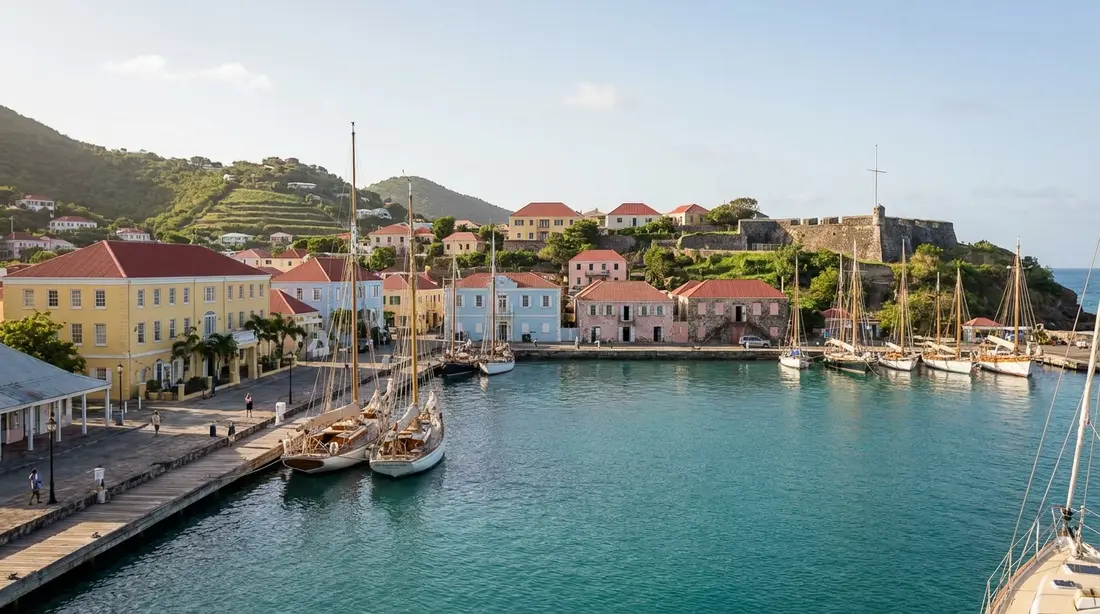
Christiansted was founded in 1734 to govern Denmark's West Indian colony, and the town the Danes laid out is still standing: a yellow-brick fort on the harbor, five colonial buildings run by the National Park Service, pastel stone blocks with red roofs, and arcaded sidewalks shading a street grid that runs straight down to the water. It is also the island's working harbor town, with the dive shops, the Buck Island boats, the seaplane base and most of St. Croix's good dinners inside a few walkable blocks. This page is the reference: the history, the buildings, the streets, the businesses verified operating as of August 2026, and the logistics.
The town
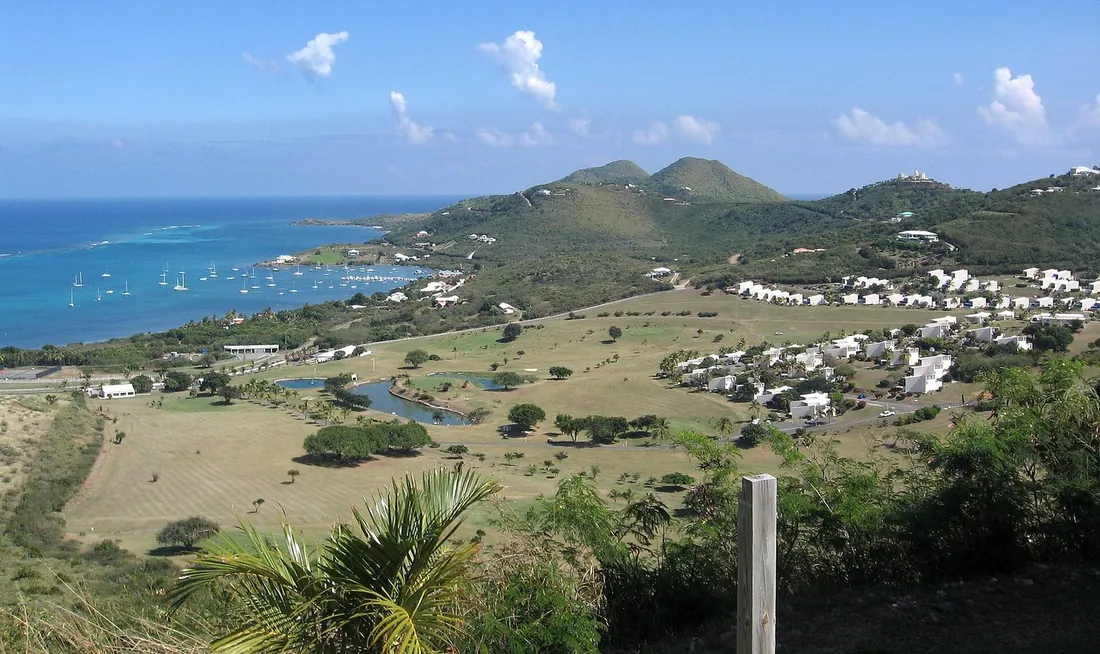
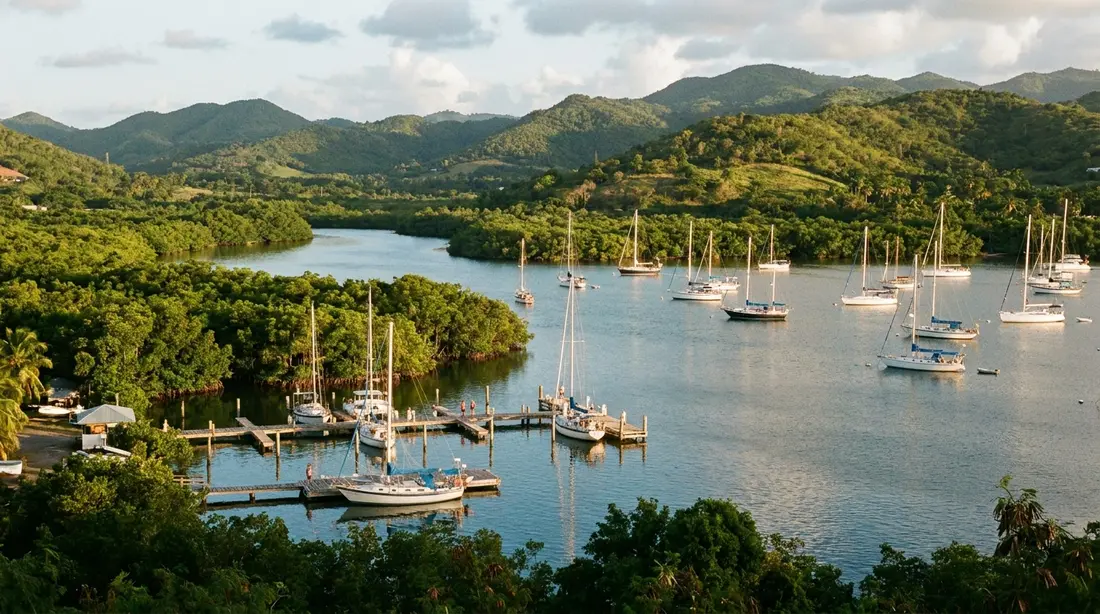
Christiansted occupies a piece of St. Croix's northeast shore where a reef line, plus the small green island of Protestant Cay a few hundred yards out from the wharf, shelters the harbor. The old town itself is a tight grid only a few blocks deep. Four long streets run parallel to the water, Strand, King, Company and Queen, tied together by short cross streets, King Cross, Queen Cross, Church, Hospital. The waterfront is bookended by Fort Christiansvaern to the east and the seaplane terminal to the west, with the boardwalk tracing the harbor from one to the other. East of the fort, a few minutes on foot, is Gallows Bay, the marina-and-errands district where the St. Thomas ferry docks.
The town proper is small. The 2020 census counted 1,866 residents in the town subdistrict, and everything a visitor wants sits inside a ten-minute walking radius. The wider Christiansted district, the island's northeast quarter, is where most of our villas are, which is why our guests know this town better than any other part of the island. It is the larger of St. Croix's two towns, the other being Frederiksted on the west coast, and the two have split the island's roles for nearly three centuries: Christiansted got the capital, the fort and the trade; Frederiksted got the deep-water pier, and today the cruise ships.
How Christiansted began
France sold St. Croix to Denmark in 1733; the price was 750,000 livres. The handover became official on January 8, 1734, at a ceremony held beside the future fort site, and within the year Frederik Moth had laid out a new town on the harbor, naming it for King Christian VI. Through the height of the sugar era Christiansted governed the Danish West Indies, holding that role until Denmark shifted its colonial seat to Charlotte Amalie on St. Thomas in 1871. The United States bought the territory in 1917 for $25 million in gold.
Historians count Christiansted among the handful of African-Danish towns to be found anywhere. The plans, the street names and the building code were Danish; the labor and craftsmanship that raised the buildings came from enslaved Africans. The result looks like nowhere else in the Caribbean: cut coral stone and ballast brick, lime-washed pastels, red roofs, and the covered sidewalks that went by the Danish term galleries. The town's economy was sugar, and the waterfront was built as a machine for exporting it: weigh the hogsheads, tax them, store them, ship them, and defend the whole operation with the fort. The machine's buildings survive in working order of function, which is what the national historic site preserves.
Christiansted National Historic Site
The National Park Service protects five Danish structures on roughly six acres of waterfront at the east end of town. Together they are Christiansted National Historic Site, and you can walk the whole complex as a loop in under an hour. Our historic site guide covers the five buildings in depth and the fort has its own page; the reference table below is the short version, with construction dates as published by the Park Service.
| Structure | Built | Original use |
|---|---|---|
| Fort Christiansvaern | Main works standing by 1740, completed by 1749; additions 1835 to 1841 | Defended the port, enforced customs collection |
| Steeple Building | Completed 1753; tower added 1794 to 1796 | St. Croix's first Lutheran church; later warehouse, bakery, hospital, school |
| Danish West India & Guinea Company Warehouse | Completed 1749 | The trading company's depot; storerooms, offices, and the yard where enslaved people were auctioned |
| Scale House | Original 1740; present building 1856 | Weighed and inspected exports to set the customs duty |
| Danish Customs House | Part of the first floor from 1751; completed 1841 | Collected import and export taxes |
The fort is the piece you go inside. Its yellow ballast brick reads deepest in morning light, and the rooms hold the quarters of the garrison, the powder magazine and the dungeon cells. The interpretive panels are direct about what the fort existed to do: it defended a sugar port and enforced the slavery that made the sugar. The ramparts give the best view in town, harbor in front, red roofs and green hills behind. The other four buildings work as an exterior walk; interior access varies with staffing and preservation work at any given time, so count anything open as a bonus.
Fort hours and fees
As published by the National Park Service at last check in August 2026: Fort Christiansvaern opens every day from 8:30 in the morning until 4:30 in the afternoon, with Thanksgiving Day and Christmas Day the only closures. Admission is $10 for visitors 16 and older and the ticket covers three days, so a return visit later in the week costs nothing. Children under 16 enter free. The America the Beautiful interagency passes, senior, access, military and volunteer passes are all honored, and the Park Service posts a handful of fee-free days each year, including Presidents Day, the July 3 to 5 holiday span, the NPS birthday on August 25 and Veterans Day. Hours at the site's welcome center and bookstore are shorter than the fort's own: Monday through Wednesday only, from 9 until 4, at last check. The fort's own parking lot allows two hours and must be clear by 4:30 p.m.; the Park Service tows.
The street grid and the Danish names
The streets still carry their Danish colonial names, usually posted in both languages. King Street was Kongens Gade, Queen Street was Dronningens Gade, Strand Street was Strandgade. Company Street is the interesting one: historians read it as named for the Danish West India & Guinea Company, the chartered trading company that financed Denmark's Caribbean colonies and ran the town's early economy. Addresses follow the old Danish quarter system rather than modern block numbering, which is how a shop comes to be numbered 2101 Company Street on a street only a few blocks long.
The signature of the grid is the arcades. On King and Company Streets especially, stone arches carry the upper floors of the old buildings out over the sidewalk, so the walkway runs through a continuous shaded gallery. The practical effect is real: by mid-morning the sun here is strong, yet under the arcades you can walk most of downtown at midday while spending less than a block at a time in direct light. Block to block the arches vary, brick on one, cut coral stone on the next, because each owner built his own section to satisfy the town's rule, with no single design behind any of it. Hurricane shutters, thick masonry and 18th-century doorways remain in daily service. For a building-by-building walking route through the architecture, see the Danish architecture walk.
Government House and the Hamilton block
No building in town outranks Government House on King Street, and it is still easy to walk past without recognizing what it is. Its central wing dates to 1747, built as a merchant's residence; the Danish crown acquired it in 1771 for the governor-general, and an 1830 project joined it with the adjacent 1797 building into the long facade you see today. The building remained in government service after the capital's 1871 move to Charlotte Amalie, and official territorial functions still take place here. Getting inside depends on that day's official schedule. When the gates stand open, the courtyard and the ceremonial staircase are worth the look; when they are closed, the arcaded base and the long balustraded front are the finest single stretch of Danish architecture on the street.
One block over, Company Street holds the town's most famous former resident. Alexander Hamilton arrived in Christiansted as a boy of roughly eleven, sometime after 1765, living at or close to 34 Company Street, where Rachel, his mother, ran a small shop. After she died he clerked for Beekman & Cruger, an export firm a short walk from the wharf, learning currencies, cargo and credit in the harbor trade. In 1772, local sponsors raised the money to send him to North America for schooling. There is no museum; the town itself is the exhibit, and the fort, scale house, warehouse and wharf he knew are all still there in working relation to one another.
The boardwalk and the waterfront
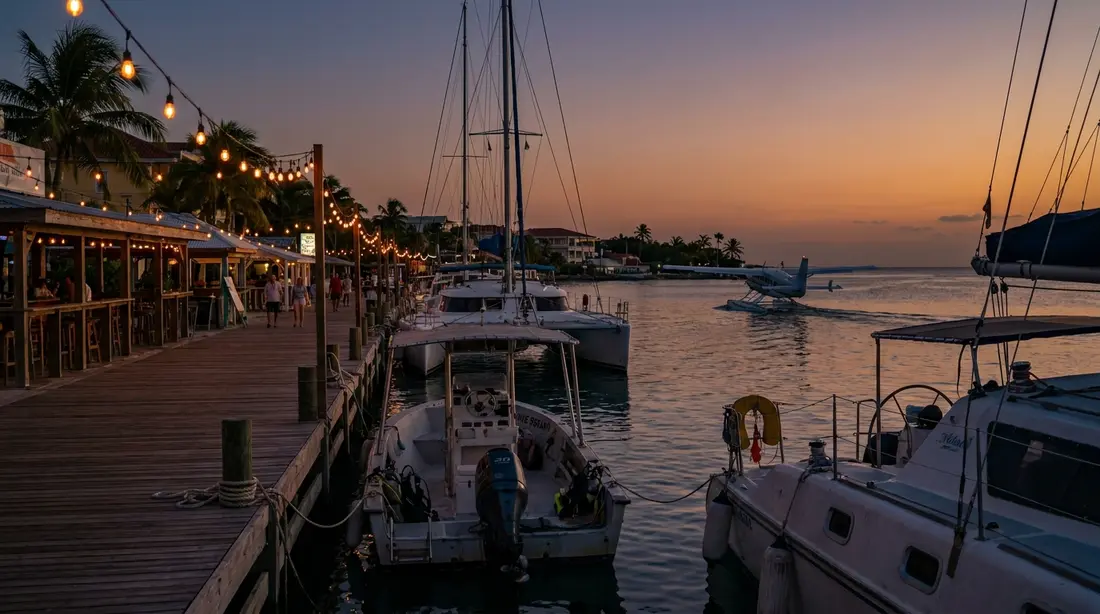
The boardwalk follows the harbor through the center of town, running from near the fort to the seaplane terminal, and it works as the town's dock street: dive boats, day-sail catamarans, harbor bars and the seaplane landing beside it all. Our boardwalk guide is the full directory. In brief, the Buck Island fleet ties up here, Big Beard's, Caribbean Sea Adventures and Jolly Roger, alongside Blue Salt Divers at 1000 King Street, the shop that carries on Dive Experience, the island's oldest dive operation, founded in 1983 by Michelle Pugh. Rum Runners and Shupe's put dinner and burgers a few feet off the water, The Mill pours Sion Farm Distillery's Mutiny Island Vodka at its boardwalk bar, and in recent winters the World Ocean School's schooner Denis Sullivan has moored in the harbor roughly November through March, selling public late-afternoon sails; check dates if a tall ship matters to you.
Evenings are the boardwalk's best hours. The Buck Island boats come home around five, the sunset sails cast off, and the rails fill. On a handful of Friday nights a year the whole downtown joins in for Jump Up, covered under events below.
Shops and galleries
Shopping in Christiansted runs small and maker-owned; there is no duty-free mall, and in most shops the person handing you the bag is the owner. Jewelry leads, and it centers on one design. The St. Croix hook bracelet was created in the mid-1960s by Sonya Hough, and Sonya Ltd., her shop at 2101 Company Street, has turned out the original design for more than sixty years now. Islanders wear the hook as a code: opening turned toward the heart means taken, turned away means available. Two other benches carry the tradition forward. On Strand Street, Crucian Gold is the Bishop family's studio, translating island history into gold, silver and bronze. ib designs on Company Street has spent more than two decades on clean, symbolic pieces such as its infinity band. All three were operating at last check in August 2026.
Beyond the jewelers: Twin City Coffee House & Gallery at 1 Company Street shows local art with prices on it beside the espresso machine, small galleries and gift shops rotate seasonally under the arcades, and Undercover Books in Gallows Bay is the island's bookshop, with coffee and pastries beside the shelves and readings through the year. Apothecary Hall on Company Street is a different kind of stop: a Danish colonial pharmacy established in 1820 that served the town for over 140 years, preserved by the St. Croix Landmarks Society and opened as a museum in 1987. By the Society's account it is the Western Hemisphere's only Danish pharmacy museum still occupying its original building. Days and hours are limited; check before counting on it. Our Apothecary Hall page has the detail.
Eating and drinking
Christiansted holds most of the island's serious dinner tables, all within a few blocks. The table-by-table rundown, with what each room does and when to reserve, is in the Christiansted restaurants guide; the categories below are the reference, verified operating as of August 2026.
- Fine dining: Savant, on Hospital Street, opened in 1998 and remains downtown's special-occasion room, with a Mexican-Thai-Caribbean fusion menu; reserve ahead, several days out in season. At 17 Church Street, Galangal plates upscale French-Asian cooking behind a serious cocktail program and a deep wine list.
- On the water: Rum Runners, where Queen Cross Street meets the boardwalk, has served steaks and seafood over the harbor long enough to count as an institution. Shupe's on the Boardwalk grinds its burgers fresh and adds wings and truffle-parmesan fries.
- Casual and daytime: Frescos Kitchen & Pub House, at 5007 Starboard Street a couple of blocks back from the water, does scratch-made breakfast and lunch. Toast Diner is the small side-street diner. Twin City Coffee House starts pouring at 6:30 on weekday mornings at last check, winds down by early afternoon, and takes Sunday off.
- Drinks: The Mill on the boardwalk pours Mutiny Island Vodka, the world's first breadfruit vodka, distilled mid-island at Sion Farm.
Two closures worth knowing, because older guidebooks still list them: Harvey's, the beloved Crucian lunch room, is gone for good, and Zion Modern Kitchen has switched to hosting private events exclusively. Our listings cover operating businesses, and we re-check them.
Protestant Cay
Protestant Cay is the little island sitting mid-harbor, and it is the town's swim. The far side has a real sand beach with calm, shallow water and a view back at Christiansted's red roofs that exists from nowhere else. The name is usually traced to the island's French period, when the story holds that non-Catholics, barred from consecrated ground, were buried on the cay; treat that as tradition rather than settled record. A small ferry has historically shuttled from the boardwalk across the couple hundred yards of harbor in about two minutes, $5 round trip for day visitors at last check.
The current caution: the cay is effectively a one-business island, and that business has had a rough stretch. Hotel on the Cay, the small hotel that operates the ferry, its beach bar and its watersports desk, drew a closure order in January 2025 when Legionella bacteria showed up in its water systems; after remediation the health department cleared it to reopen, and service since then has been intermittent. Before you plan an afternoon around the cay, check that week whether the ferry is operating, or simply glance across from the boardwalk, which shows you at once whether the shuttle is making crossings. If it is not, The Shoys beach is ten minutes east by car, covered below.
The harbor
Christiansted Harbor is the island's transport hub for everything smaller than a jet, and three operations matter to visitors.
- The seaplane. Seaborne's DHC-6 Twin Otter floatplane connects Christiansted Harbor with the Charlotte Amalie waterfront on St. Thomas, a harbor-to-harbor hop of roughly 25 minutes. Its terminal occupies the boardwalk's west end. In 2026 the route has run with a single aircraft, so schedules are thinner than in past years and worth confirming close to your dates; a fleet expansion announced in late 2025 had not visibly materialized at last check. Watching the plane flare onto the harbor is a legitimate town pastime.
- The ferry. The QE IV departs Gallows Bay, the harbor district a short walk east of the fort, for Charlotte Amalie, a crossing of about 2 hours 10 minutes. Fares at last check were near $70 each direction and $120 for the round trip, and the recent schedule skipped Tuesdays. Confirm during the week you travel; ferry timetables shift.
- The Buck Island fleet. Buck Island Reef National Monument, established in 1961 and expanded in 2001 to 19,015 mostly underwater acres, can be visited only aboard one of the five boats holding Park Service concession contracts, or under a private-vessel permit. Most of the fleet sails from the Christiansted boardwalk, and a crossing takes anywhere from 40 minutes to an hour and a half by boat; two operators leave from Green Cay Marina east of town. See Turtle Beach on Buck Island.
Fishing charters also work out of the harbor, Captain Cook Charters, Hook and Sun, Caribbean Sea Adventures' sportfishing boats and St. Croix Deep Blue among them at last check, with Lang Bank's offshore grounds beginning only a few miles past the east tip. East of Gallows Bay, Altona Lagoon is a public park on a coastal lagoon; it has been noted as a second bioluminescent bay on the island, though the organized night tours run at Salt River, and Altona is a daytime walk for most visitors.
Beaches near town
Christiansted itself has the cay swim and nothing more on the town waterfront, but the beaches start ten minutes east. The Shoys is the closest true beach: quiet, calm, and entered via the guard gate at Estate Shoys next to The Buccaneer, with a small reef at its east end. Beyond it the East End runs through Chenay Bay, Cramer's Park and the hike-in bays below Point Udall. The full list, with conditions and access for each, is in beaches near Christiansted, and the wider region in the East End guide.
Events through the year
Jump Up is the town's own event: a free street festival staged on roughly four Friday evenings annually; recent editions have fallen close to February, May, July and November, running from around 6 in the evening until 10. The historic core closes to cars, vendors and bands fill the blocks, and the mocko jumbies, the Virgin Islands' stilt dancers, come through the crowd around 8. Dates are announced a few weeks out on the island calendars. The Jump Up guide covers the night in full, and mocko jumbies and quelbe covers the culture on the stilts.
One correction worth stating, because visitors get it wrong every year: the Crucian Christmas Festival's village and its children's and adults' parades happen in Frederiksted, on the other end of the island, in the season running late December into early January. Christiansted sees festival-season events, but the parades are a Frederiksted occasion. Two other dates touch the town. The Fort-to-Fort Freedom Walk each July 3, Emancipation Day, sets out from Fort Christiansvaern around 4 a.m. and retraces roughly 15.5 miles to Fort Frederik. And Taste of St. Croix, the island's chefs-and-restaurants tasting event, ran its 26th edition on June 11, 2026 at Divi Carina Bay; its venue and date move, so check ahead. The whole island calendar, month by month, is in a year of events.
Getting there and parking
Every route into town ends the same way: park once at the edge of the grid and walk. Downtown's core streets are one-way, they back up around midday, and nothing in the old town is more than ten minutes on foot from anything else. Rates and hours below are as of last check against the island's published parking guidance.
| Where | Cost | Hours | Notes |
|---|---|---|---|
| Government lot, Strand Street by King Cross | $1 an hour, capped at $5 a day | Daily from 7:30 a.m. until 6 p.m. | Central, and the best full-day option |
| Fort Christiansvaern lot (NPS) | No charge for fort visitors | Two-hour limit; clear the lot by 4:30 p.m. | Towing enforced |
| Lot across from the seaplane terminal | Free | Unposted; taken early | At the boardwalk's west end |
| Street parking | Free wherever legal | Gone by mid-morning | Check posted signs on the one-way blocks |
For evenings, the government lot shuts at 6 p.m., which leaves street parking, or asking your restaurant where the regulars put their cars; dinner crowds sort it out every night. Drive times from town, at normal traffic: our East End villas 15 to 20 minutes, Salt River 20 to 25, Cane Bay 25 to 30. Uber and Lyft do not operate on St. Croix, traffic keeps left even though the cars are ordinary American left-hand-drive models, and taxis can be arranged for a night out so nobody drives home after dinner. The wider subject, rental cars, taxi rates, the airport run, is on our getting around page.
Practical notes
- Walking the town. The core is flat, compact and walkable, and the arcades keep most of the main shopping streets in shade. Sidewalks are 18th-century in places; watch the steps up and down at the gallery arches.
- After dark. The busy blocks, the boardwalk, the restaurant streets, the fort end of downtown, stay lively into the evening. Use ordinary town sense: keep to the lit and peopled streets at night, and do not leave anything visible in a parked car, here or at any beach lot on the island.
- Heat. Mid-morning through mid-afternoon is strong sun. Water, a hat, and the shaded side of the street are the whole trick; the arcades exist because the Danes learned the same lesson.
- Hours run island-style. Many shops close by late afternoon and some keep no Sunday hours; the fine-dining rooms are small enough that reservations matter in season.
- Money and phones. U.S. dollars, U.S. phone networks, area code 340, no passport needed for U.S. citizens. Cards work nearly everywhere; carry some cash for festival vendors and small shops.
- Cruise days. Ships dock at Frederiksted, so Christiansted never gets the pier crowds directly, though taxi tours bring passengers through on ship days.
Questions guests ask
How old is Christiansted?
The town dates to 1734, the year after France sold St. Croix to Denmark and the year the transfer was formalized in a ceremony beside the fort site. Frederik Moth laid out the grid and named the town for King Christian VI. That makes it nearly three centuries old, and unusually intact for its age: the fort, the customs buildings, Government House and whole blocks of arcaded streets survive from the Danish era, which is why the waterfront core is run by the National Park Service as a national historic site.
What does it cost to visit the fort?
Ten dollars for visitors 16 and older, as published by the Park Service in August 2026, and the ticket is good for three days, so a return visit costs nothing extra. Kids under 16 get in free with an adult, and the federal interagency passes, senior, access, military and annual, are all accepted. Each year the Park Service also posts several fee-free days. Fort hours run 8:30 to 4:30 every day, with Thanksgiving and Christmas the exceptions. Budget about an hour for the rooms, the ramparts and the view.
Do cruise ships dock in Christiansted?
No. St. Croix's cruise pier is in Frederiksted, on the island's west end, about 45 minutes away by road. Christiansted's harbor handles the seaplane, the St. Thomas ferry, the Buck Island fleet, dive boats and charters, and it has no berth for cruise ships. On ship days some passengers reach Christiansted by taxi tour, but the town's rhythm is set by its own visitors and residents, which is part of why it keeps its working-harbor feel year-round.
Is there a beach in Christiansted?
The town's swim is Protestant Cay, the small island in the harbor, reached by a two-minute ferry from the boardwalk, $5 round trip at last check. The cay's beach is sandy and calm with the best view of town there is. Its services hang on the cay's single small hotel, which shut for a stretch in early 2025 and has operated off and on since, so confirm the ferry before planning on it. The nearest beach by car is The Shoys, about ten minutes east through the Estate Shoys gate.
Is Christiansted safe for visitors?
The town core is small, busy and heavily walked, and guests visit daily without incident. Use the same sense you would in any small town: at night, keep to the lit and busy blocks around the boardwalk and the restaurant streets, and skip deserted side streets. The most common problem on St. Croix is property crime of opportunity, so leave nothing visible in a parked car, in town or at trailheads and beach lots anywhere on the island. Ask your villa manager about current conditions; that is what we are for.
Can you day-trip to St. Thomas from Christiansted?
Yes, two ways, both starting in town. The Seaborne seaplane flies from the west end of the boardwalk to the Charlotte Amalie waterfront in about 25 minutes; one aircraft has covered the route in 2026, so check the schedule close to your dates. The QE IV ferry runs from Gallows Bay in about 2 hours 10 minutes; expect roughly $70 each direction or $120 round-trip at last check, and note the recent schedule includes no Tuesday sailings. Cape Air and Fly The Whale also connect the islands airport-to-airport.
What is Jump Up and when is the next one?
Jump Up is Christiansted's free evening street festival, typically held on four Fridays annually, recently around February, May, July and November, from roughly 6 p.m. to 10. Downtown closes to cars, vendors and bands fill the streets, shops stay open late, and the mocko jumbie stilt dancers make their pass at about 8. The island's event calendars announce dates a few weeks ahead, so look once your travel window is set. If one falls inside your stay, go; details are in our Jump Up guide linked above.
Staying near Christiansted
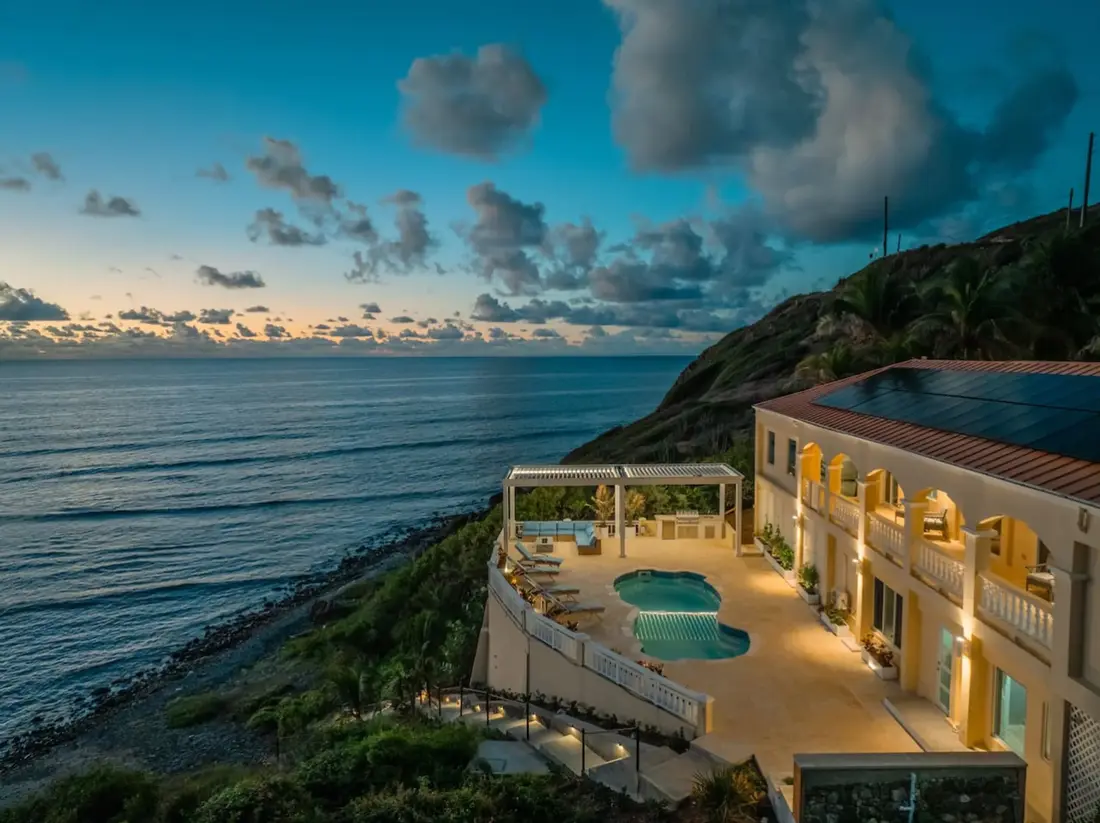
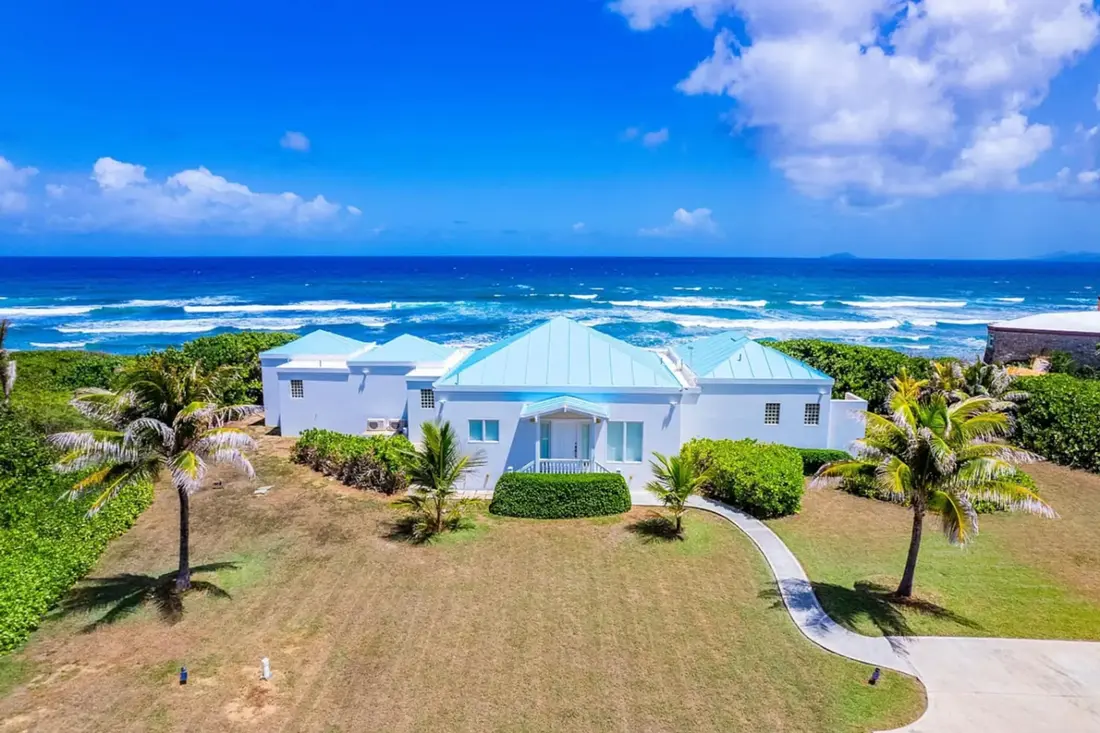
The Christiansted side of the island holds most of our twelve homes, which means town is the errand run, the dinner reservation and the boat departure rather than a day trip. Shoy's Beach House opens onto the sand at The Shoys, minutes east of downtown, and Sunset Oasis, a beachfront condo, sits an easy drive from town. Out past Green Cay, The Cerulean and the remaining homes in the East End collection keep the balance most guests want: quiet water at the house, and Christiansted's restaurants, shops and boats 15 to 20 minutes away. See all villas.
Sources
Written from official and first-party sources, checked August 2026. Hours, prices and event dates change — confirm before you go.
In this guide
Stay nearby
On The Shoys beach: six bedrooms, six baths, pool and hot tub, room for twelve, and the beach through the back garden.
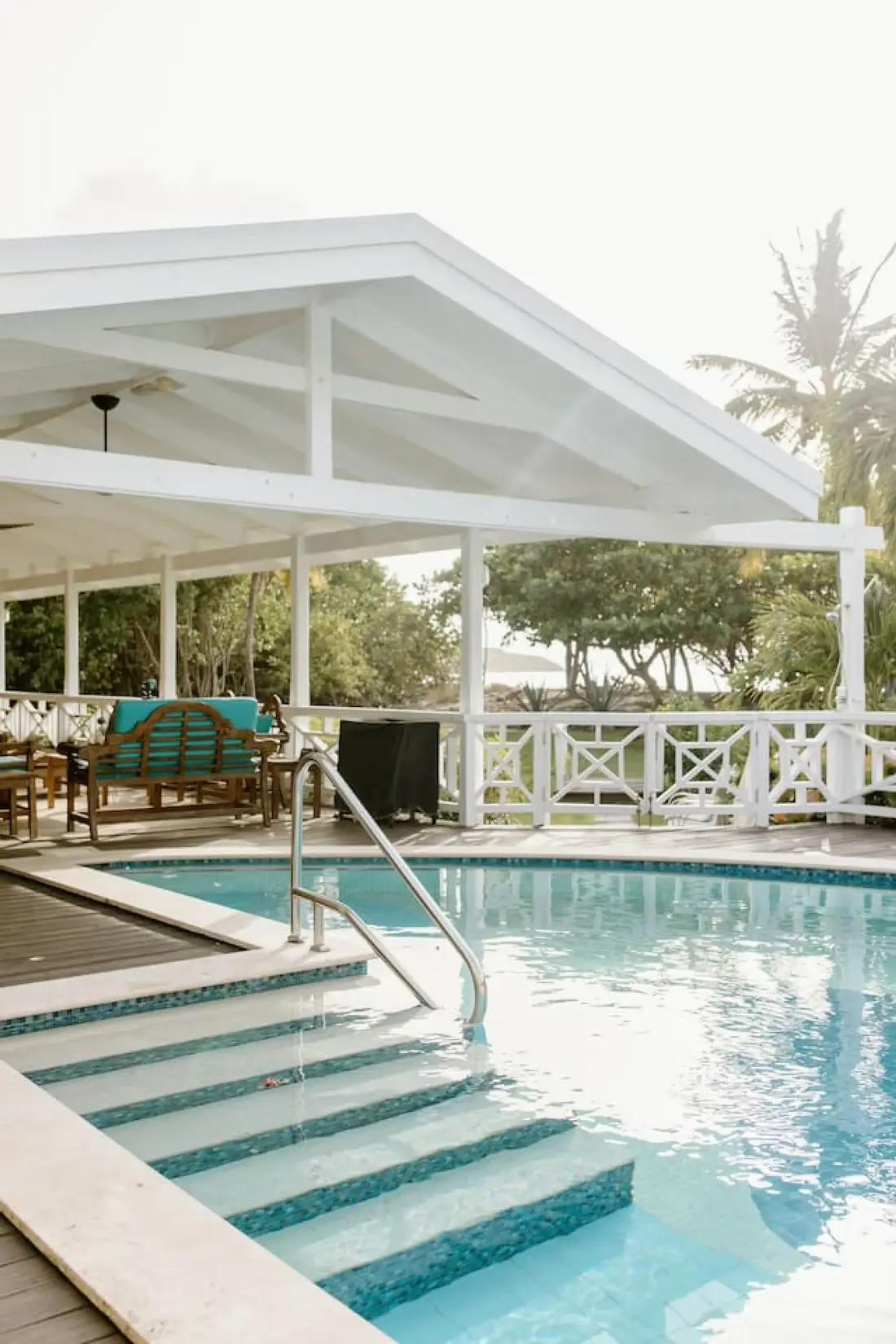 Shoy's Beach House6 bd · 6 ba · sleeps 12 · Christiansted
More in Towns & Areas
Sources
11 references, listed in full at the end of this guide — official park, refuge, tourism-board and business sources, checked August 2026.