The Sunset Beaches
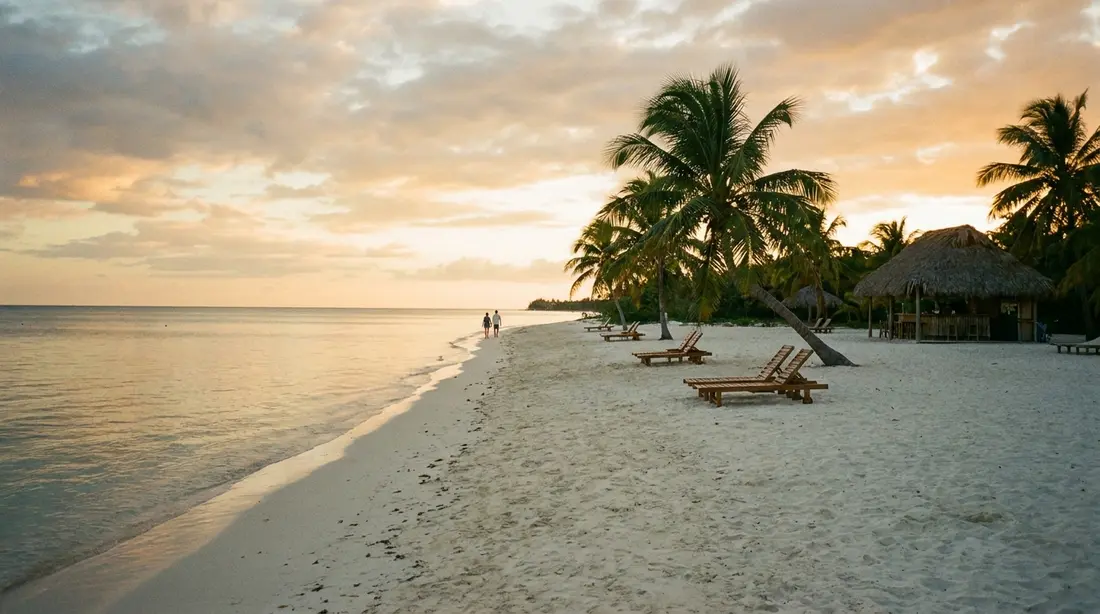
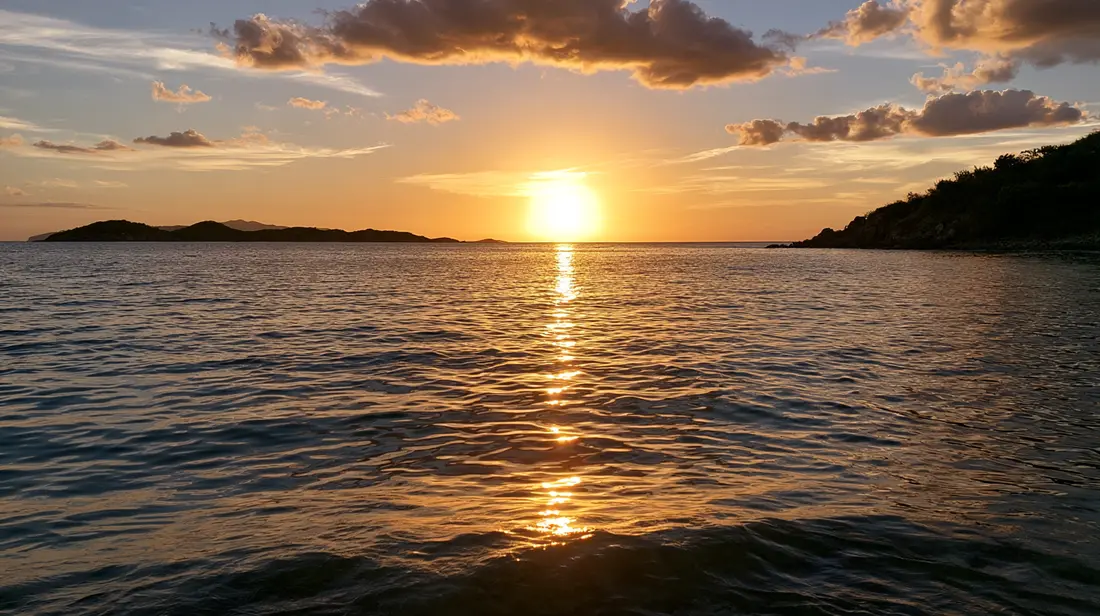
The west coast faces the setting sun over flat water. Rainbow, Frederiksted and Dorsch are the beaches to be on when it drops.
Only one side of St. Croix watches the sun reach the sea. The island stretches long from east to west, so its western shore holds the entire evening show, over water the trade winds have already flattened. This page is the reference for that half hour: where the sun lands on the horizon in December versus June, what time it goes down month by month, how quickly dark follows, what each west-end vantage is like at that hour, and what the east side of the island gets instead. Plan one west-end evening into any week here; most guests plan two.
Why the west coast gets the sun
The reason is shape. St. Croix measures about 22 miles east to west and only 7 north to south, so the north shore looks at the Atlantic, the south shore looks at the Caribbean, and a single coastline, the short western edge from La Grange down past Frederiksted toward Sandy Point, has open sea lying to its west. Every sunset-over-water view on the island belongs to that few miles of shore.
Geography then does the west end a second favor. The trades blow out of the east nearly year-round, which makes the western shore the sheltered, leeward side. The water off Frederiksted and Rainbow Beach usually lies close to flat by late afternoon, which means a clean, low sea horizon, long reflections, and a comfortable final swim while the light goes amber. The east half of the island keeps its own prize: Point Udall is the easternmost point of the United States, and daybreak reaches it before anywhere else in the country. The pattern for a week is simple. Mornings belong to the East End sunrise; a couple of evenings belong to the west.
One planning note follows from all of this: most of our homes sit around Christiansted and the East End, so a west-end sunset is an outing rather than a stroll. The drive runs roughly 40 minutes from Christiansted and up to an hour from the far East End. Build the evening around it, an afternoon at the beaches near Frederiksted, then dinner where you stand when the light drops.
Where on the horizon the sun goes down
The sun does set in a different place in December than in June, and on a coast with a pier, a lighthouse and a curve of beach bars, that difference decides your framing. Compass bearings make it concrete: due west is 270 degrees. At the equinoxes, around March 20 and September 22, the sun sets almost exactly due west for every observer on Earth, so in those weeks the drop lines up straight out from the Frederiksted waterfront.
Away from the equinoxes, the setting point slides along the horizon with the season. At St. Croix's latitude, about 17.7 degrees north, the swing spans roughly 25 degrees to either side of due west. Around the December solstice the sun goes down in the west-southwest, near a bearing of about 245 degrees; around the June solstice it goes down in the west-northwest, near 295. That is a full 50-degree arc across the year, and it moves fastest through spring and fall, then loiters near each extreme for weeks around the solstices.
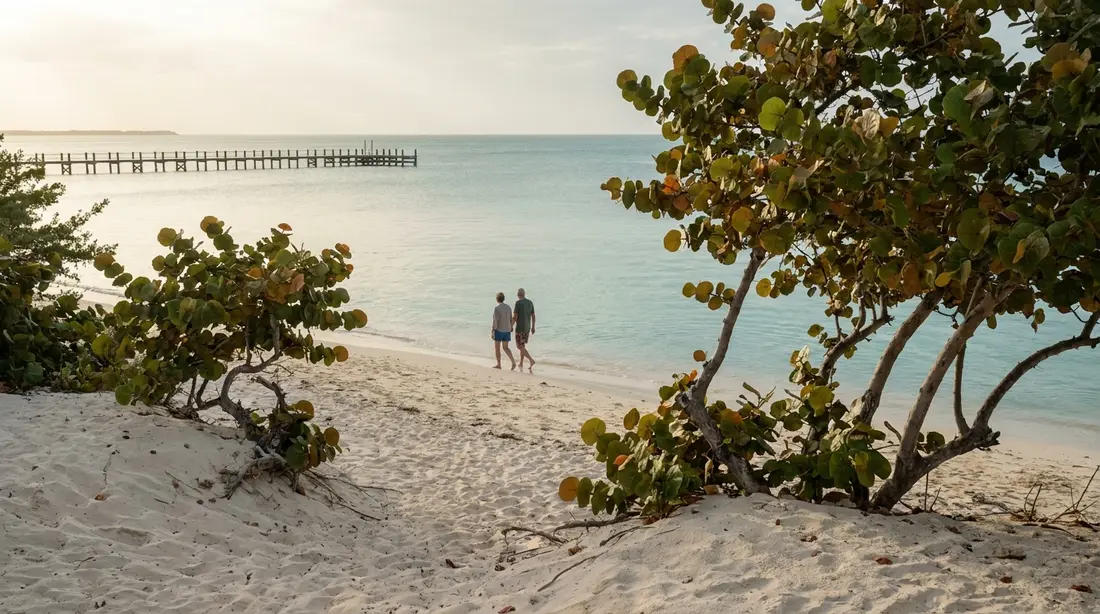
Spot by spot, the arc matters like this. Frederiksted's pier reaches west from the middle of the waterfront, so in winter, seen from the town beach north of it, the sun comes down on the far side of the pilings and turns the whole structure into a black cutout, which is the postcard everyone chases. In summer the set point migrates north of the pier line, and the beaches up the Rainbow stretch face it most squarely. Ham's Bluff, on the island's northwest corner, looks northwest by nature, so its season is the summer half of the year, when the west-northwest set lands in front of it. None of this changes where you can enjoy the evening; all of it changes where the color concentrates and what stands in silhouette.
The sunset clock
St. Croix stays on Atlantic Standard Time in every month, with no daylight-saving change, so the sunset hour drifts gently instead of jumping. U.S. Naval Observatory calculations for the west end put the year's earliest sets in late November, at about 5:42 p.m., and the latest in the first week of July, at about 6:59 p.m. The whole year fits inside a 77-minute band: never before about 5:40, never after about 7.
The second number is the one visitors misjudge. Civil twilight, the usable light after the sun goes below the horizon, lasts only 21 to 24 minutes here in every season, because at tropical latitudes the sun descends steeply rather than sliding along the horizon. Travelers from higher latitudes expect a long, slow dusk; St. Croix switches the lights off. Roughly 25 minutes after the drop it is dark enough for headlights.
That fast dusk creates the 30-minute planning window this page keeps returning to. Arrive 30 to 45 minutes before the listed time and you see the full build, the last swim, the color climbing the clouds. Arrive at the listed minute and you catch only the drop. Stay 20 minutes after and you get the sky's second act, then find your car while you can still see it. Tables at the west-end bars fill through the final hour; on winter evenings that means being seated by 4:45. Any weather app gives the exact minute for your dates, and the weather guide covers the cloud seasons.
Frederiksted pier and the waterfront
The town itself is the most social place on St. Croix to watch the day end. Frederiksted faces due west along its whole length, and the final hour plays out on three parallel stages: the sand of Frederiksted Beach, the seawall promenade behind it, and the pier reaching toward the sinking sun. Locals fish from the pier and the wall at that hour; the pier is open for walking whenever a cruise-ship security zone does not close part of it, and it costs nothing.
The supporting cast sits within a two-minute walk. The Fred's bar and pool terrace pour through the drop, Louie & Nacho's serves tacos and cold drinks beside it, and Fort Frederik, where emancipation was proclaimed in 1848, stands over the north end of the beach and goes copper in the last light. Dinner afterward is a short stroll, and the Frederiksted restaurants guide maps the choices. At last check a free concert series ran on the waterfront on third Fridays from roughly October through May, timed to the sunset hour; ask locally for current dates.
Practicalities: parking is on the waterfront streets and around the fort, and the strip near the pier keeps some evening life and light after dark, so the walk back to the car is easy; the usual travel sense about leaving nothing visible in the vehicle applies. A ship at the pier changes the crowd completely, so check the cruise schedule if you want the seawall thinly settled. While you wait for the hour, look down: this beach is the island's known ground for sea glass.
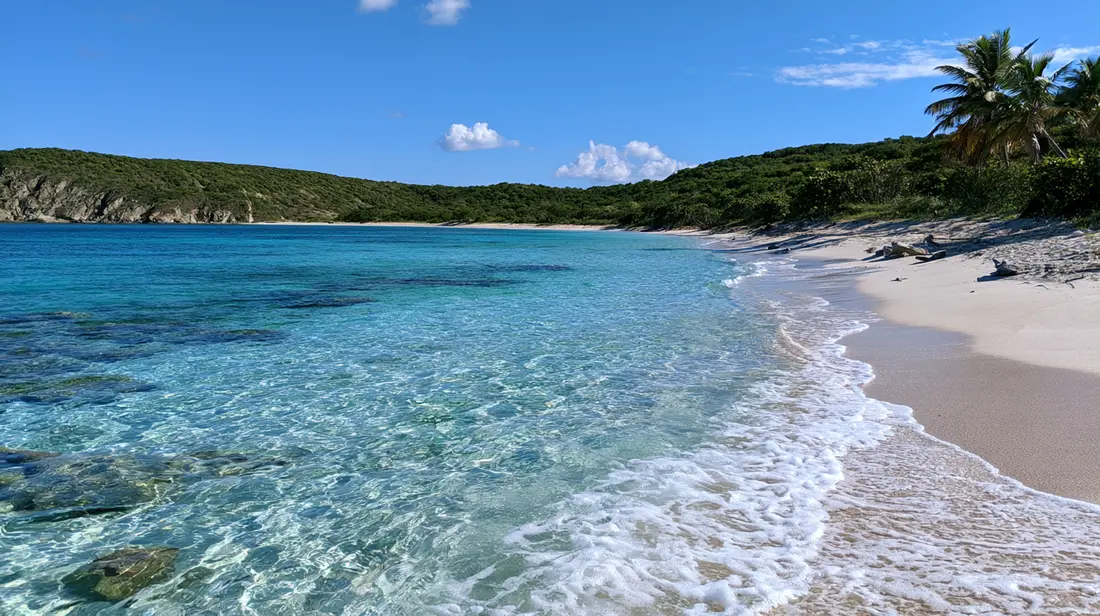
Rainbow Beach at the end of the day
Rainbow Beach, a few minutes north of town, is the serviced version of the same show. Rhythms has run its beach bar on this sand for roughly three decades, West End Water Sports rents the chairs and the toys, and the tables sit close enough to the water that the sun appears to come down at the end of your own row. Late afternoon is the beach's best mood: the jet skis go quiet, the swimmers drift in to stand chest-deep facing west, and orders shift from lunch to sundowners. On live-music nights the sound carries the transition from day to dark.
Parking is a free lot plus roadside space, and the turnover works in your favor at this hour, since the beach-day crowd leaves as the sunset crowd arrives. After dark the lot thins with the bar, so plan to walk out while Rhythms is still lively rather than last. The one timing caution is the same as the town's: a cruise day fills this sand by mid-morning, and the sunset tables go early.
Dorsch Beach, the quiet option
Dorsch Beach runs south from Frederiksted past Sand Castle on the Beach, and it is the low-volume seat for the same sky. Palms and sea grapes back the sand and hold real shade for the waiting hour, the bottom is sand for a final swim, and on many weekday evenings the beach holds more trees than people. The Beach Side Cafe's oceanfront terrace serves dinner nightly at last check, with Saturday-evening live music, so the classic Dorsch evening is a towel on the sand until the drop and a table on the terrace for the afterglow. Parking is informal, along the shore road; arrive with daylight left so you can pick your spot, and keep the car's interior empty of temptations here too, since this stretch is darker than the town strip once night settles.
Sandy Point closes before the show
The island's grandest western sand is off the sunset menu, and it is worth saying. Sandy Point National Wildlife Refuge admits visitors only on Saturdays and Sundays from September through March, 10 a.m. to 4 p.m., and shuts entirely from the first of April through the end of August so nesting leatherbacks have the beach to themselves. Because the year's earliest sunset is about 5:42 p.m., the gate closes at least an hour and a half before the sun goes down on every single day the refuge is open. Treat Sandy Point as a daytime pilgrimage and give the evening to Dorsch, the town, or Rainbow.
Ham's Bluff for a sunset with altitude
Every other spot on this page is at sea level. Ham's Bluff is the exception: the 1915 Danish light tower stands on the island's northwest shoulder with the sea roughly 360 feet below, reached by an uphill forest walk of about half an hour. Its sightline faces northwest, which makes it a summer-season sunset perch, the months when the sun comes down in the west-northwest in front of the bluff; in midwinter the set point sits far to the south of its view. The caution that matters is the descent. The trail is unlit, rooty and closed in by trees, and dusk here lasts barely twenty minutes, so either start down the moment the disc goes, with a headlamp in your pocket, or take the bluff at golden hour and be on the sand at Rainbow for the drop itself. Many guests do the walk in the morning instead and keep evenings at sea level.
The east-deck evening
Guests staying on the East End often ask what their side of the island gets at that hour, and the answer is a different show rather than none. The sun itself disappears behind the island's spine, but the eastern sky performs opposite it: as the west goes orange, the east horizon over Buck Island turns rose and violet in a band photographers call the Belt of Venus, and on clear evenings the color hangs there for a quarter hour. Decks that face Buck Island, including those at The Cerulean and The Buck Island Overlook, look straight into that counter-glow with the island's silhouette in the middle of it.
The east deck also owns the moon. A full moon rises around the time the sun sets, and it rises in the east, which means that once a month the east side of St. Croix gets a moonrise over open water at exactly the hour the west side is watching the sun go. A moon path on the sea from your own railing, drink in hand and no drive home, is a fair trade for the disc itself. The sunset sails guide covers the boat version of both evenings, including the monthly full-moon sail on Lyric Sails' 63-foot catamaran Jolly Mon out of Frederiksted.
The green flash
The west end is a legitimate green-flash coast, so here is what the thing actually is. As the sun sits on the horizon, the atmosphere bends its light, and it bends short wavelengths more strongly than long ones, so the colors separate vertically by a tiny amount: a red image of the sun lowest, a green-blue image highest. The blue is scattered out of the beam by the air itself, which leaves green as the topmost visible sliver. A green rim of this kind exists at the top edge of every clear-horizon sunset, but it is far too thin for the naked eye. What turns the rim into a visible flash is a mirage: when a layer of warm or cool air magnifies that last sliver, the green swells into a spot you can see, usually for a second or two at the instant the final piece of sun disappears.
The conditions are exactly what Frederiksted offers on a good evening: a hard, uninterrupted sea horizon, clear air, and calm water. The technique is restraint. Staring at the disc on its way down bleaches your color vision and can hurt your eyes, so watch the beach, the pelicans, anything else, and give the sun your full attention only when a sliver thinner than a fingernail remains. Then the odds: most evenings produce nothing, because the mirage layer either is not there or is not shaped right, and a week of perfect horizons can pass without one. Nobody should drive west for the flash. Drive west for the sunset and treat any green as the island tipping you.
Photographing the drop
Tropical dusk moves fast, so it rewards a little preparation. Notes from the beaches on this page:
- Wipe the lens first. An afternoon of salt air leaves a film that turns every light source into smear. A clean shirt corner fixes more sunset photos than any setting.
- On a phone, expose for the sky. Tap the brightest part of the frame and drag the exposure down until the color saturates; the sand and people go dark, which is the picture you want. Modern HDR modes handle the bright-disc-dark-beach split well, and a burst at the final sliver catches the exact frame of the drop. Move your feet instead of using digital zoom.
- On a camera, protect the highlights. Meter on the sky beside the sun and pull back about a stop; blown orange recovers badly. A daylight white-balance setting keeps the warmth that auto white balance tries to correct away. A small aperture turns the last point of sun into a star.
- Give the frame a foreground. The pier's pilings and its evening fishermen at Frederiksted, the chair line and moored boats at Rainbow, palm trunks and sea-grape leaves at Dorsch, the lighthouse rail at Ham's Bluff. A bare horizon makes a postcard; a silhouette makes a photograph.
- Stay for the second peak. The best color of many evenings arrives 10 to 20 minutes after the sun has gone, when the light from below the horizon catches the undersides of the clouds. Most of the beach leaves at the drop, which means the strongest sky often plays to an empty shore. This is also the moment for a phone's night mode, braced on a rail or a cooler lid.
Picnics, drinks, and the rules of the sand
An evening picnic is the cheapest great dinner on St. Croix, and the rules around it are friendlier than most visitors expect, with a few firm edges.
- The beach itself is public. The territory's open-shorelines law keeps the shoreline, out to 50 feet inland or the natural vegetation line, open to everyone, so no bar or hotel controls the sand in front of it. Buy a drink because you want one, never as admission.
- Drinks are generally allowed. The U.S. Virgin Islands has no blanket ban on drinking in public the way most mainland towns do, and a sundowner on the sand is an ordinary local pleasure. Public-intoxication and drunk-driving laws still apply in full, and the drive back east is long, dark and on the left, so settle the driver question before the cooler opens. See the driving guide.
- Skip glass. National-park beaches in the territory prohibit glass containers outright, individual beaches post their own rules, and broken glass on sand where everyone walks barefoot needs no statute to be a bad idea. Cans, boxes and refillable bottles do the job.
- Assume no fires. Rules vary by site and permits are not a casual matter; plan a picnic, never a bonfire, unless you have confirmed otherwise with the managing agency.
- Leave with everything. Pack-out here is absolute, down to caps and citrus peels. From March through July, leatherbacks and other sea turtles nest on several island beaches, so keep white flashlights off the sand at night and give any marked nest a wide berth.
- Respect posted hours. Territorial park beaches such as Cramer's post their own hours, and the federal refuge at Sandy Point locks at 4 p.m.; the beaches in this guide's spot list have no gate.
Planning around the moon
The lunar calendar quietly sorts your evenings. On full-moon nights the show is double: sun down in the west, moon up in the east within the same hour, which is the East End deck's night to shine and the night Lyric Sails runs its monthly moonlight trip. The nights near the new moon flip the logic. With no moon in the evening sky, the west-end beaches go properly dark 40 minutes after sunset and the stars come out over the sea, and the same darkness is when the glow at Salt River reads brightest, which makes a west-end sunset followed by a bio bay paddle the island's best one-two evening. Check any moon-phase app when you sort your week; the operators' own calendars mark the dim-glow nights around the full moon.
Sunset times through the year
Mid-month sunset and end of civil twilight for the west end, from U.S. Naval Observatory data for 2026; the minute shifts by only a day or two of drift year to year.
| Month | Sunset (mid-month) | Dark by | Evening note |
|---|---|---|---|
| January | 6:05 p.m. | 6:28 p.m. | Set point well south of west; pier silhouettes from the town beach |
| February | 6:21 p.m. | 6:43 p.m. | Clear, breezy evenings in the Christmas-winds season |
| March | 6:29 p.m. | 6:51 p.m. | Sets almost due west near the equinox, straight out from the waterfront |
| April | 6:36 p.m. | 6:58 p.m. | Sandy Point closes for the season; Dorsch and town carry the coast |
| May | 6:45 p.m. | 7:08 p.m. | Set point moving north; Rainbow faces it head-on |
| June | 6:56 p.m. | 7:20 p.m. | Ham's Bluff season begins; west-northwest sets |
| July | 6:58 p.m. | 7:22 p.m. | Year's latest sets, about 6:59 in the first week |
| August | 6:46 p.m. | 7:08 p.m. | Warm water, thin crowds, long golden hour |
| September | 6:22 p.m. | 6:43 p.m. | Due-west sets return near the equinox; greenest hills behind you |
| October | 5:57 p.m. | 6:19 p.m. | Dinner-hour sunsets; waterfront concerts resume at last check |
| November | 5:43 p.m. | 6:06 p.m. | Earliest sets of the year, about 5:42 late in the month |
| December | 5:47 p.m. | 6:11 p.m. | Be seated by 4:45; full dark before 6:30 |
The west-end sunset planner
| Spot | Drive from Christiansted | Parking | Dinner pairing |
|---|---|---|---|
| Frederiksted Beach and pier | About 40 minutes | Waterfront streets, lit near the strip | The Fred, Louie & Nacho's, town restaurants |
| Rainbow Beach | About 45 minutes | Free lot plus roadside | Rhythms, on the sand |
| Dorsch Beach | About 45 minutes | Roadside along the shore road | Beach Side Cafe terrace |
| Ham's Bluff (summer half) | About 50 minutes plus a 30-minute walk | Trailhead at the road's end; rough final stretch | Descend, then eat in Frederiksted |
| East End deck | None | Your own driveway | Whatever the villa kitchen is making |
Questions guests ask
What time should we get to the beach?
Work back from the table above: 30 to 45 minutes before the listed sunset for a towel spot and the full build of color, a full hour early for a bar table in the busy season or on any cruise-ship day. The other half of the answer is the ending. Dark arrives 21 to 24 minutes after the sun goes in every month of the year, so if you mean to swim, swim before the drop, and if you mean to stay for the afterglow, know that you will walk to the car in real dusk.
Which beach has the best sunset?
The sky is identical from all of them, so the choice is about what surrounds you. Rainbow puts a bar, music and rental chairs at your back. Frederiksted adds the pier, the fort and a town's worth of dinner options within a block. Dorsch trades all of that for shade trees and space. First-timers usually do the town for the scene; second evenings tend to drift to Dorsch. If the group cannot agree, the three sit within ten minutes of each other, so scouting all of them before the light commits you costs nothing.
Can we watch the sunset at Sandy Point?
No. The refuge operates on weekend daytime hours in its open season, September through March, and the 4 p.m. closing lands well before the earliest sunset of the year, which is about 5:42 in late November. The gate is locked entirely from April through August for leatherback nesting. Visit at midday on an open weekend for the two miles of empty sand, and take the evening at Dorsch or the town beach, which face the same water.
Is the green flash real or a bar story?
Real, documented optics: refraction sorts the low sun's light by color, scattering removes the blue, and a mirage layer occasionally magnifies the leftover green into a visible spot for a second or two at the instant the sun disappears. It needs a knife-clean sea horizon and stable air, and most evenings do not produce one, which is exactly why the sighting carries bragging rights. Save your eyes until only a sliver remains, then watch that last point without blinking.
Can we bring drinks onto the sand?
Generally yes. The territory has no general prohibition on drinking in public the way most mainland jurisdictions do, and a beach sundowner is an established local custom, at last check and with local sense applied: no glass containers, nothing left behind, and a sober driver for the long dark drive east. National-park sites ban glass outright, and any posted rule at a specific beach outranks this paragraph. The bars at Rainbow and the Frederiksted strip solve the question entirely if you would rather arrive empty-handed.
Do the east-side villas get any of the show?
They get their own version. The disc itself drops behind the island, out of view, but east-facing decks watch the counter-glow color the sky over Buck Island, and once a month they get the full moon rising out of the sea at roughly the hour of sunset, which many guests rate above the sunset itself. Staying east and driving west once or twice for the classic drop is the arrangement that works; commuting across the island every evening is the mistake.
What is the drive back east like after dark?
Forty minutes to an hour of unlit two-lane road, driven on the left. It is entirely manageable, thousands of residents do it daily, but treat the first night drive with respect: take the Melvin Evans Highway rather than the back roads, watch for pedestrians and the occasional unlit cyclist near the towns, and expect the odd pothole. If nobody wants the job, a taxi evening to Frederiksted is a legitimate plan; arrange the return pickup in advance, since cabs do not cruise for fares after dark.
Sunset from our villas
One of our homes was named for this page's subject. Sunset Sea-Clusion sits on a hillside on the island's west side, minutes from Rainbow Beach, with a west-facing terrace, a private pool and outdoor speakers pointed at the evening: the drop happens in front of the house, no drive required, and solar power with a backup generator keeps the villa comfortable after dark. On the other coast, The Cerulean and our East End homes own the counter-glow, the Buck Island moonrise and the first light of the next morning. Tell us which end of the day matters most to your group and we will point you at the right coastline; browse all villas to compare.
Sources
Written from official and first-party sources, checked August 2026. Hours, prices and event dates change — confirm before you go.
In this guide
Stay nearby
Private oceanfront on the East End with a sandy, swimmable beach, pool, outdoor kitchen and a separate guest cottage. Sleeps twelve.
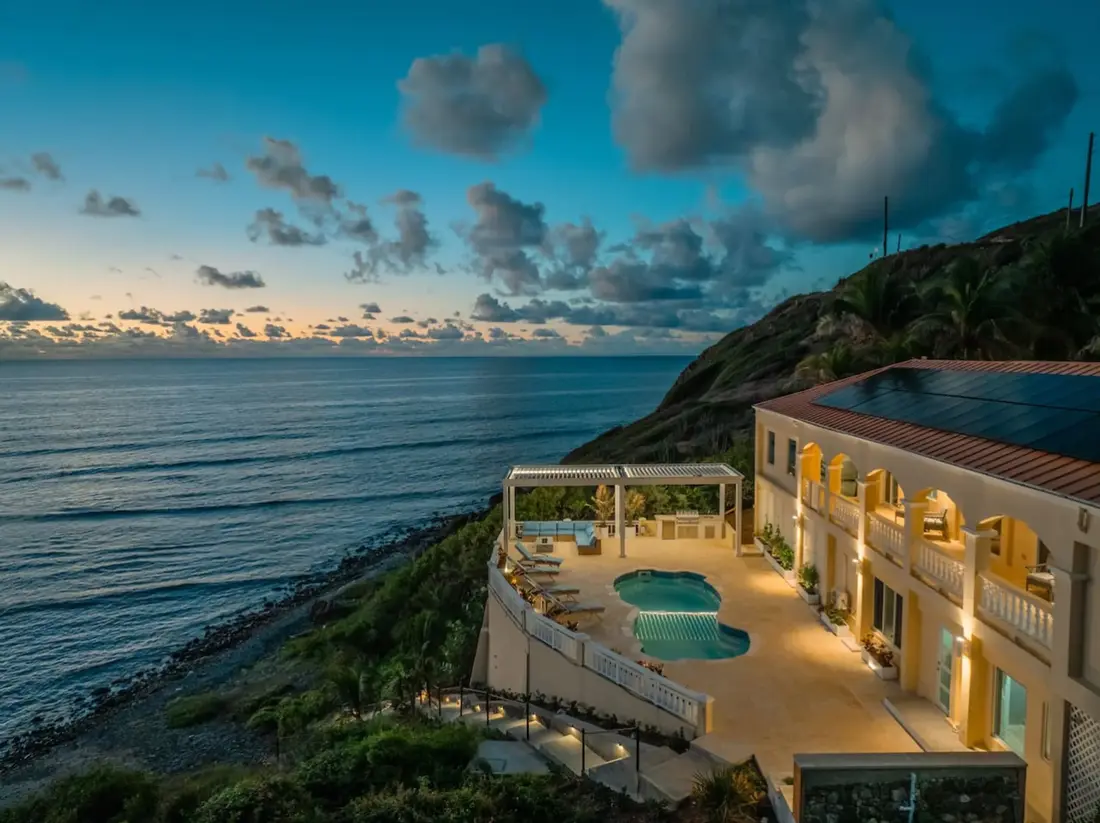 The Cerulean5 bd · 5 ba · sleeps 12 · Christiansted
Sources
9 references, listed in full at the end of this guide — official park, refuge, tourism-board and business sources, checked August 2026.