Why the Bay Glows
St. Croix has two bioluminescent bays — Salt River and Altona Lagoon. The organisms behind the glow, and the odds of seeing it.
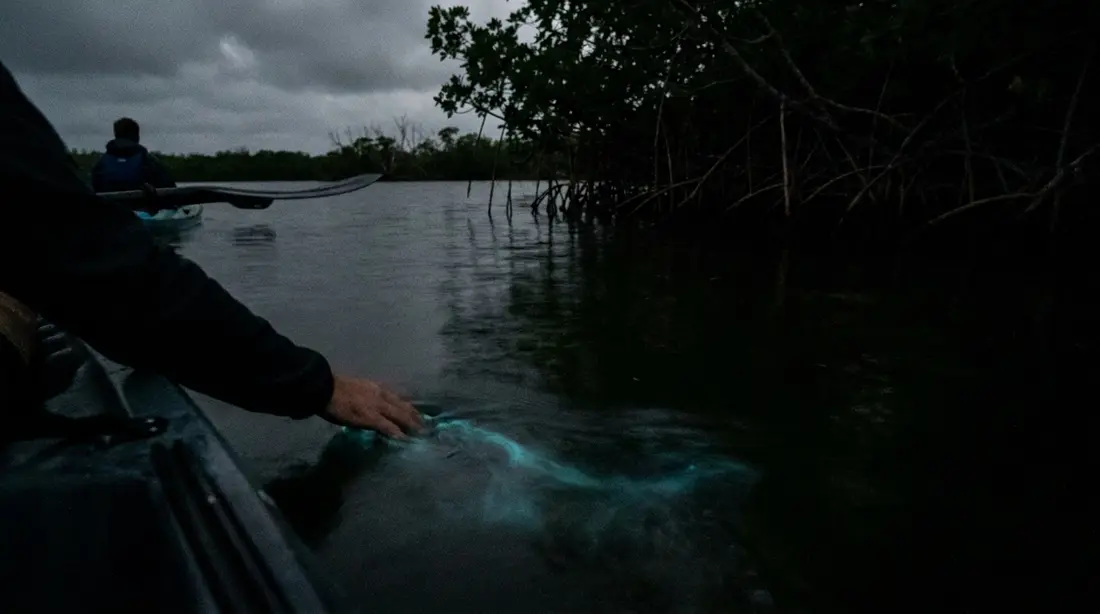
St. Croix has two bioluminescent bays. Salt River Bay, on the north shore, is one of the few places on earth where the water lights up on every night of the year; Altona Lagoon, at the eastern edge of Christiansted, holds the same kind of light far less reliably. The glow is a real chemical reaction running inside single-celled plankton, set off whenever the water moves, so a paddle blade, a darting fish, or a hand trailed overboard flares blue-green for a moment. This page is the science of that light and a plain comparison of the two bays. For how to actually get out on the water and see it, our bio-bay kayak tours guide carries the operators, the prices, and the moon calendar.
What a bioluminescent bay is
Plenty of seawater can flash faint light on a dark night. A true bioluminescent bay is a much rarer thing: a nearly enclosed lagoon where light-producing plankton live packed together in permanent, dense concentration, so the water performs on any dark night rather than only during a passing bloom that arrives and fades. Concentration is the whole trick. The same organisms drifting thin across the open sea produce a glow no eye would catch; corralled by the tens of thousands into a small, sheltered basin, they turn every disturbance into a visible spark. Only a handful of bays on the planet hold that dense a resident population, and fewer still hold it well enough to glow the year round. Salt River is one of them. Understanding why means starting with the animal, or rather the not-quite-animal, that makes the light.
The organism that makes the light
The light-maker at Salt River is a dinoflagellate named Pyrodinium bahamense, a single-celled plankton so small that one cell is invisible to you and a spark is thousands firing together. Dinoflagellates sit in an odd corner of biology. This one is armored, its cell wrapped in interlocking plates of cellulose, and it photosynthesizes, feeding on sunlight by day the way a plant does, then drifting in the water column and flashing by night. The species comes in two named varieties: the Atlantic and Caribbean form, variety bahamense, which is the one glowing at Salt River and across Puerto Rico, and an Indo-Pacific form, variety compressum. It is the plankton responsible for most of the region's celebrated glowing lagoons, and a research team from the Scripps Institution of Oceanography confirmed that it is what lights Salt River, with the bay's brightness rising and falling in step with how many of the cells are present; that fieldwork is summarized on our tours guide. What follows is what happens inside one of those cells.
How one cell makes light
Each cell carries its own light kit, and the parts are known in detail. Scattered through the cell sit roughly 400 tiny light organs called scintillons, each about half a micrometer across, formed as little balloon-like pouches budding off into the cell's central vacuole. Inside a scintillon are two ingredients kept apart until needed: the fuel, a molecule called luciferin, which is a reduced tetrapyrrole and a close chemical relative of chlorophyll, held in check by a dedicated luciferin-binding protein; and the enzyme that burns it, luciferase, a large protein built from three repeating units. The switch that fires the whole thing is mechanical. When moving water shears or squeezes the cell, an electrical pulse, an action potential, sweeps across the vacuole's membrane and opens voltage-gated channels. Protons flood out of the acidic vacuole into the scintillon, and the pH drops from about 8 to about 6. That sudden acidity does two things at once: it wakes the luciferase and it makes the binding protein release its grip on the luciferin. The freed fuel meets oxygen, the enzyme drives the reaction through a short-lived peroxide state, and the energy comes out as a photon of light near 470 nanometers, in the blue-green band. Each burst is over in roughly a tenth of a second, and one cell can release on the order of a billion photons in that sliver of time, the whole sequence triggered and delivered within a few thousandths of a second, faster than your eye can follow.
Why the cells make light at all
A plankton spending energy on light needs a reason, and the leading one is defense, often called the burglar-alarm hypothesis. A tiny grazer that bumps a cell sets off the flash; the flash startles the grazer, and, more usefully, it advertises the grazer's position to the larger predators hunting it. The cell cannot escape, so it calls attention to its attacker. Two things follow from this that matter to a visitor. First, the light is a response to being touched, which is why the water only performs where something moves it. Second, the whole system runs on an internal clock. The cells rebuild their scintillons fresh every night and dismantle them again in the early morning, so the flashing machinery is loaded after dark and largely absent by day. The cells in fact make light in two modes: the bright, brief flash you trigger by disturbing the water, and a much fainter glow they give off on their own late in the night phase, too dim to notice from a boat but real and measurable in a lab. That daily rhythm is the reason a daytime paddle through the very same lagoon shows nothing unusual on the water, a contrast our daytime kayaking guide takes as its whole subject.
Why the light gathers in a bay
The organism alone is not enough; the shape of the water decides whether you ever see it. A glowing bay needs a basin that traps its plankton instead of flushing them out to sea. The winning recipe is a lagoon almost closed off from the ocean, joined to it by a narrow mouth, shallow and warm, with weak tides and slow water exchange. Fresh water and nutrients run in off the land; the narrow neck lets little escape; and the cells multiply and stay, building the density that makes a spark visible. Salt River's inner lagoon fits that description, a small, shallow, mangrove-ringed pocket behind a reef-guarded mouth, and its layout and the drive to it are covered in our Salt River area guide. The same basin logic explains why the world's glowing bays are lagoons and river mouths rather than open beaches, and why one careless cut in the geography, a dredged channel, a widened mouth, can drain the glow out of a bay for good.
The mangrove connection
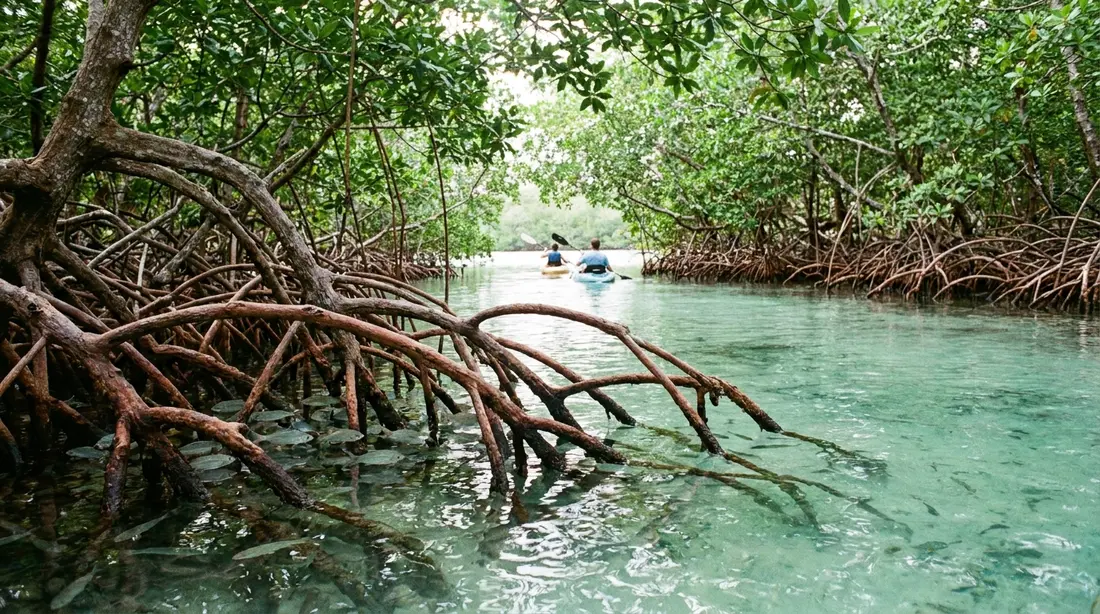
The trees ringing the lagoon are not scenery; they are the food supply. Pyrodinium bahamense cannot build its own vitamin B12, a nutrient it must get from the bacteria it lives among, and those bacteria feed on the steady rain of decaying leaves the red mangroves drop into the water. Tannins and nutrients leaching from the root zone enrich the lagoon further, and the roots themselves still the water and shade the shallows where the cells gather. Take the mangroves away and the kitchen closes: the bacteria starve, the plankton lose their vitamin source, and the light fades. This is the quiet reason Salt River still performs while glowing lagoons elsewhere have gone dim, because its mangrove forest, one of the largest left in the territory, stands inside a national park and cannot be cleared for development. The forest gets its own full treatment on our mangroves of Salt River guide, and the broader web of life it supports runs through our wildlife guide.
Other light-makers around the lagoon
The dinoflagellates are the main act, but they share the water and the shoreline with a small cast of other organisms that make their own light, and guides point them out on a good night. Comb jellies, clear jelly-like drifters about the size of a walnut, give off a green shimmer when a net or a paddle brushes past them. The Bermuda fireworm keeps a light show on a strict lunar schedule: for a few evenings after the full moon, shortly after dark, the females rise toward the surface and pour out a greenish glow that draws the males up to spawn, a piece of timing precise enough that biologists set their watches by it. And true fireflies, land insects using the same chemical trick for the same courtship purpose, blink in the trees along the banks. Between the plankton in the water, the worms rising to breed, and the beetles in the mangroves, a single dark night at the bay can hold several kinds of living light at once, each running on its own separate biological clock. The plankton are the only one of the three that answers to your paddle; the others keep their own time.
St. Croix's two bays compared
Salt River gets the fame and the tours, but it is not the island's only glowing water. Altona Lagoon, a public shoreline park a short way east of Christiansted, past Gallows Bay and near The Buccaneer, holds the same bioluminescent plankton, and when the conditions align its water can sparkle as well. The difference between the two is worth understanding before you plan around either, because it is a difference of reliability and access, not of the underlying science. Salt River holds a thick, permanent colony of the plankton, steady enough that operators call it a super glow bay; it is reached only by guided kayak from the marina, and it sits protected inside a national park. Altona's plankton come and go and shift around the lagoon, so any single evening there is a gamble, but the lagoon has a shoreline you can walk to without a boat, so it stands as the no-cost, self-guided choice for a traveler ready to gamble on a black, moonless night near town. No commercial night tours run at Altona at last check; every kayak operator works Salt River. The practical takeaway: if seeing the glow is a priority, plan on Salt River and think of Altona as a spare-night long shot. Altona's daytime setting as a Christiansted-side park comes up in our Christiansted guide.
| Salt River Bay | Altona Lagoon | |
|---|---|---|
| Where | North shore, about a 25-minute drive from Christiansted | Eastern edge of Christiansted, past Gallows Bay |
| Access | Guided kayak only, from Salt River Marina | Walk-up from the public shoreline; no boat needed |
| Reliability | Dense resident population; glows every night of the year | Intermittent; the plankton roam and thin out |
| Protection | Inside a national historical park and ecological preserve | Public lagoon and shoreline park |
| Cost to see it | Paid guided tour; see the tours guide | Free, on your own, if the night cooperates |
| Best for | Anyone who wants a near-certain sighting | A gambler near town on a moonless night |
Bioluminescence elsewhere on the island
The two named bays are not the only places the sea lights up around St. Croix. On a dark, moonless night, snorkelers and swimmers sometimes notice their own movements trailing a faint blue glow in the open shallows, a breaking wave glinting, or a boat wake sparking behind the hull. Night divers see it too, a hand wave or a fin kick lit up in the black water, which is one of the odder pleasures covered in our night diving guide. This open-water glow is real bioluminescence, but it is usually a different situation from a bio bay: a temporary scatter of light-producing plankton drifting through, dense enough for a night or a week and then gone, rather than a resident population held in place by a lagoon. Telling the two apart is the difference between a lucky night and a natural landmark, and it comes down to which organisms are involved.
True bio bay or passing bloom
Not every glow in the water is the same organism. The plankton that build a permanent bay and the plankton behind a random beach shimmer are often different species with different habits. The resident bay-builder is Pyrodinium bahamense, the armored, sunlight-eating dinoflagellate described above, which concentrates and stays put. A great deal of the world's casual, here-tonight-gone-tomorrow sea sparkle, by contrast, comes from a relative called Noctiluca scintillans, nicknamed sea sparkle, a much larger dinoflagellate, up to about two millimeters across, that has no cellulose armor, does not photosynthesize, and lives by eating other plankton. Noctiluca drifts the world's coasts and blooms in dense, short-lived patches, the source of many viral blue tears and glowing surf photographs, and it is generally non-toxic. Both make light the same basic way, but only the first kind, corralled by the right geography and fed by mangroves, produces a bay that glows on a schedule you can plan a trip around. A one-off glow on a random beach is a lovely accident; a bio bay is an ecosystem.
| Trait | Bio-bay builder (Pyrodinium bahamense) | Sea sparkle (Noctiluca scintillans) |
|---|---|---|
| Size | Microscopic, single-celled | Large for a plankton, up to about 2 mm |
| Cell wall | Armored with cellulose plates | Naked, no armor |
| Feeding | Photosynthetic; eats sunlight by day | Eats other plankton |
| Behavior | Concentrates and stays; builds resident bays | Drifts and blooms in short-lived patches |
| Toxicity | Can produce saxitoxin (see below) | Generally non-toxic |
The world's bioluminescent bays
Reliable, year-round glowing bays are scarce, and travelers who have seen St. Croix's often want to know how it ranks. There is no official global registry, and the counts you read vary, but a small, familiar roster of bays turns up again and again. Puerto Rico holds three of the best known: Mosquito Bay on the island of Vieques, which Guinness World Records recognized in 2006 as the brightest bioluminescent bay in the world; Laguna Grande at Fajardo; and La Parguera at Lajas. Beyond Puerto Rico, Jamaica's Luminous Lagoon near Falmouth and a glowing bay in Vietnam's Ha Long area are the ones most often named. St. Croix's Salt River belongs in that short company, and its distinction is durability rather than record brightness: the trait that sets it apart is that it lights up on all 365 nights, where many famous bays glow only in seasons or spells. Brightness at most bays rises and falls with the season, the rainfall, and the water temperature, so a bay that never fully goes dark is the rarer and more dependable prize for a traveler who cannot choose the month of a trip. Puerto Rico's bays, like Salt River, bar swimming and are reached by kayak, for the same conservation reasons laid out further down.
Why darkness matters
The flash of a single cell is faint and brief, and your eye needs contrast, not brightness, to catch it. Anything that lifts the background light of the water surface drowns the sparks the way a full moon or a lit city erases the fainter stars. That is the plain physics behind the first rule of seeing a bio bay: go on a dark night. Moonlight is the main culprit, so the glow reads best across the moonless half of each month and weakest near the full moon, and cloud cover, rain, and how stirred-up the water is all shift the odds at the margin. This page covers the why; the how, meaning how to read a lunar calendar and pick the darkest night inside your travel dates, belongs to the tours guide, and the seasonal weather picture is in our weather guide. The same physics has a conservation edge: artificial light from shoreline development competes with the glow exactly as the moon does, which is one more reason a bay ringed by an undeveloped national park keeps performing while a lagoon rimmed with bright docks and houses can lose its show even with the plankton still present.
Toxicity and harmful algal blooms
Here is a piece of the science the postcards leave out, stated so you can judge it. Pyrodinium bahamense is not only a light-maker; scientists track it as a harmful algal bloom species, because it can produce saxitoxin, the potent nerve poison behind paralytic shellfish poisoning and a form of pufferfish poisoning. For a long time the Atlantic and Caribbean populations had no record of making the toxin at all, and it was the Indo-Pacific variety that carried the reputation; over roughly the past two decades, though, researchers documented saxitoxin in the species in Florida waters, notably the Indian River Lagoon, and found that toxin-capable and toxin-free genetic types sit side by side within the same Atlantic populations. What this means for a visitor is narrow and worth getting right. Saxitoxin is a hazard through eating contaminated shellfish or fish that have filtered and stored it, not through paddling over the water or letting it run off your fingers, and there is no report of the glow at these bays harming the people who come to see it. The sensible line: enjoy the light, and do not gather or eat shellfish from a bioluminescent lagoon. It is a reminder that a bio bay is a living, changing bloom under scientific watch, not an inert light show.
Keeping the bays glowing
A glowing bay is a fragile machine, and the same short list of insults dims bays everywhere: pollution and nutrient overload, cloudier water from runoff and dredging, the loss of the mangroves that feed the plankton, boat traffic and development around the shore, chemicals rinsing off swimmers, and artificial light washing out the show. The cautionary tale is Puerto Rico's Mosquito Bay, the brightest of them all, which dimmed sharply in the mid-2010s and prompted an official investigation into the bay's water quality before it recovered; a multimillion-dollar effort backed by federal coastal funding has since worked to restore the mangroves and seagrass around it. Salt River's best protection is its status: the lagoon and its forest sit inside a national historical park and ecological preserve, shielded from the shoreline building that has hurt bays with no such wall. Visitors carry a share of the job too, which is why the operators ask for no sunscreen, insect repellent, perfume, or scented products on any skin that will touch the water, since those chemicals accumulate in a small, slow-flushing lagoon and damage the very cells you came to watch. Cover up against mosquitoes with long sleeves instead of spray. The full water-etiquette rundown lives on the tours guide.
Seeing it responsibly
The reason you paddle rather than swim in a bio bay is the science, not fussiness. Salt River keeps guests in the boats, both because a dark lagoon is no place for a night swim and because a resident plankton population is easy to degrade and hard to rebuild; Puerto Rico's bays ban swimming for the same reason. Where a shoreline lets you wade in on your own, as parts of Altona do, the no-chemicals rule still holds: nothing that rinses off should go in the water. Handle the wildlife lightly, take nothing, and leave the lagoon as you found it. This page is the what and the why; when you are ready for the who, when, and how much, the operators, the boats, the moon windows, and the packing list are all on our bio-bay kayak tours guide, and the whole bay it sits in, from the 1493 landing beach to the dive canyon offshore, is mapped in the Salt River area guide and the history at Salt River and 1493.
Questions guests ask
Is the glow really there every night?
At Salt River, yes, in the sense that the plankton live in the lagoon year-round and their light-making machinery loads every night. That is the rare thing about the bay and what the Scripps measurements confirmed. What changes from night to night is whether your eyes can pick the light out, and that comes down mostly to how dark the sky is, plus cloud, rain, and how much the water is moving. So the organisms are a near-constant; the sighting is a variable. Booking on a dark, moonless night stacks the odds heavily in your favor. Altona is a different story, since its plankton are not resident in the same dependable way.
How do Salt River and Altona actually differ?
Both hold the same kind of bioluminescent plankton, but they behave differently and you reach them differently. Salt River has a dense, permanent population inside a protected national park, glows on any dark night, and is seen by guided kayak from the marina. Altona, on the eastern edge of Christiansted, has the organisms too, but they drift around the lagoon and thin out, so the glow there is intermittent and unpredictable; its advantage is that you can walk to the shoreline for free without a tour. For a reliable sighting, choose Salt River. For a free gamble near town on a moonless night, Altona is worth a look.
Can we see it without paying for a tour?
Only realistically at Altona, and only with luck. Altona Lagoon has public shore access, so on a dark night you can walk down and see whether the water is performing, at no cost. The trade-off is that Altona's glow is unreliable, so many nights show little or nothing. Salt River, the dependable bay, sits inside a national park and is reached by guided kayak from the marina, so seeing it in practice means booking a trip. The booking details, operators, and prices are on our tours guide. If cost is the deciding factor, try Altona first and keep expectations loose.
Is the water dangerous to touch?
No, not from contact. The organism can produce saxitoxin, and scientists watch it as a harmful algal bloom species, but that toxin is a danger through eating shellfish or fish that have concentrated it, not through paddling on the water or trailing a hand in it, and there is no report of the glow harming visitors at these bays. The one sensible precaution is a food one: do not collect or eat shellfish from a bioluminescent lagoon. Otherwise the water is as safe to be on as any other calm bay on the island.
Why can't we wear sunscreen or bug spray?
Because the chemicals that rinse off your skin, sunscreen, insect repellent, perfume, scented lotions, wash into a small, slow-draining lagoon and build up there, and they harm the delicate plankton that make the whole show. In a bay that flushes to the sea only through a narrow mouth, whatever goes in tends to stay. That is why operators ask you to arrive with nothing scented on any skin that will meet the water, and to keep mosquitoes off with long sleeves and long trousers instead of spray. It is a small courtesy that protects the population future visitors are coming to see.
Is St. Croix's glow as bright as Puerto Rico's?
Probably not at its peak. Mosquito Bay on Vieques is recognized as the brightest bioluminescent bay in the world, and on a good night it outshines its rivals. Salt River's claim is a different one: reliability. It is among the small number of bays that glow on every night of the year, and the Scripps team found that on strong nights its output can rival the benchmark Puerto Rico bay. In plain terms, expect something subtle and remarkable, glitter trailing off anything that moves, rather than a floodlit pool. Set that expectation and a dark night at Salt River rarely disappoints.
Where to stay near the glow
Nearly all of the homes we manage sit near Christiansted, which keeps both bays within easy reach: Salt River is about half an hour up the north-shore road, and Altona is only minutes from town. Our East End villas reach Salt River Marina by the coast road through town, an easy run even after dark; the beachfront collection makes the same drive, while the west-end houses trade a longer trip to the bay for closeness to the sheltered Frederiksted diving. Because the glow turns on a dark sky, the most moon-dependent outing on the island, let us know the nights you will be here and we will point you toward the darkest windows of your stay. Browse the full roster on the villas page.
Sources
Written from official and first-party sources, checked August 2026. Hours, prices and event dates change — confirm before you go.
In this guide
Stay nearby
Private oceanfront on the East End with a sandy, swimmable beach, pool, outdoor kitchen and a separate guest cottage. Sleeps twelve.
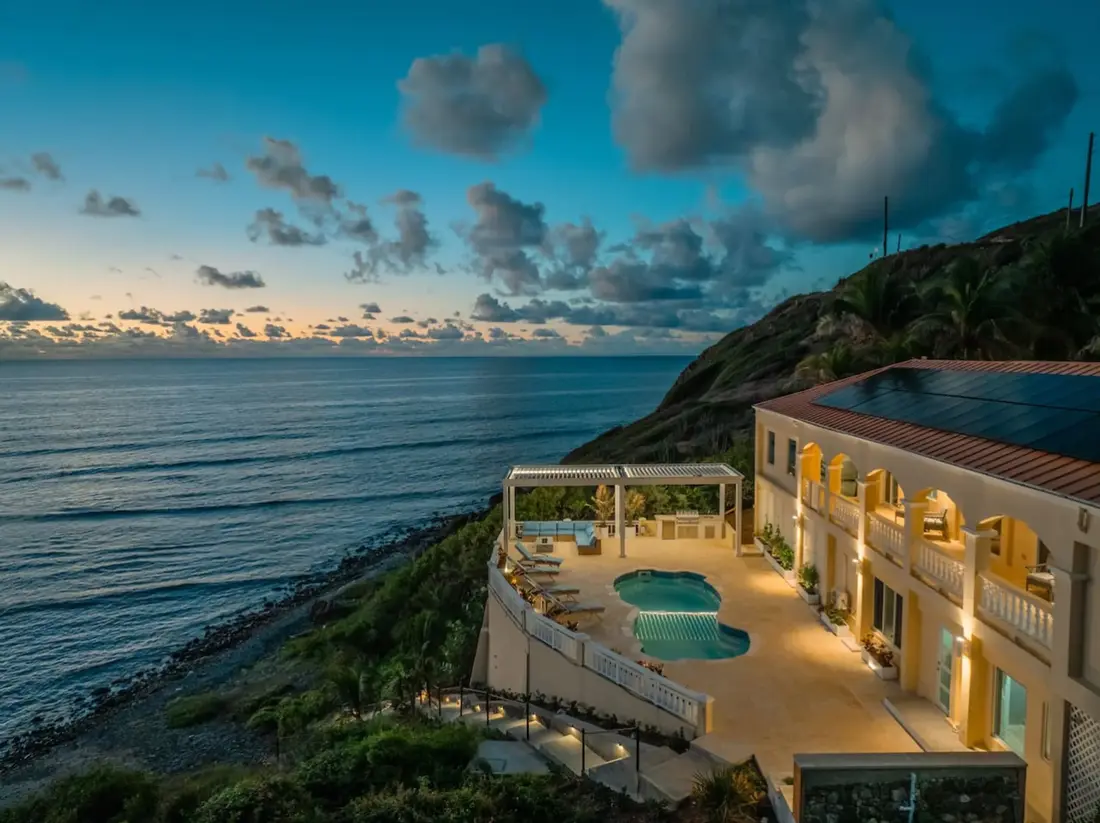 The Cerulean5 bd · 5 ba · sleeps 12 · Christiansted
More in Nature & Wildlife
Sources
12 references, listed in full at the end of this guide — official park, refuge, tourism-board and business sources, checked August 2026.