The St. Thomas Day Trip
A 25-minute seaplane or a morning ferry: how to see St. Thomas and be back for dinner in Christiansted.
St. Thomas sits forty miles north of St. Croix, close enough that three different vehicles will carry you over and home between breakfast and dinner: a seaplane that lifts off inside Christiansted Harbor, a car ferry out of Gallows Bay, and small wheeled aircraft linking the two airports up to a dozen times a day. Whether the crossing deserves one of your villa days is a fair question with a real answer, and the answer depends on which vehicle you pick, what you want from the hours ashore, and how much of the day you are willing to spend in transit. This page runs that arithmetic, compares the three routes properly, maps what actually fits into an afternoon in Charlotte Amalie, and covers the two follow-up questions everyone asks next: St. John, and the British Virgin Islands.
The day-trip math
Start with the only calculation that matters. A day trip buys you somewhere between four and seven hours on St. Thomas, bracketed by the transport on either end. The seaplane, when its schedule cooperates, gives you the most: roughly 25 minutes each way, downtown dock to downtown dock, which can leave six or seven usable hours ashore. The ferry gives you the least: about two hours and ten minutes each way on the published pattern, which compresses the visit to four and a half hours or so between docking and check-in for the return. The airport flights land in the middle once you add the ground transfers each airport demands.
Weigh those hours against what St. Thomas offers a visitor on foot or in a taxi: a walkable historic core with the territory's biggest concentration of shops, a famous beach twenty minutes over the mountain, a harbor that stays busy with cruise traffic most of the winter. That is a genuine day's worth of material. It is also material of a particular kind — town, retail, one marquee beach — and knowing that in advance is the difference between a satisfying excursion and an expensive errand.
The trip earns its day for three kinds of guests. First-timers to the territory who are curious what the busier island looks like, and who will enjoy the comparison as much as the destination. Shoppers, because Charlotte Amalie's retail rows and the federal $1,600 per-person exemption make it the region's serious shopping town, with jewelry and liquor pricing St. Croix does not try to match. And bucket-listers who want to stand on Magens Bay's mile of sand, which photographs the way the brochures promise. The trip suits a fourth group by accident: aviation people, for whom the seaplane crossing is the destination and St. Thomas is the excuse.
Skip it, without guilt, if none of those describe you. Guests deep into a beach-and-snorkel week usually find that a St. Thomas day trades a known quantity — another morning at The Shoys or a sail to Buck Island — for a busier version of things St. Croix already does quietly. Families with small children should think hard about the ferry option in particular; four-plus hours of round-trip boat time is a lot of contained toddler. And anyone whose week is short should remember the crossing spends a full day no matter how you slice it.
The three ways across
Every crossing option runs between the same two islands, and each produces a different shape of day. The seaplane is the premium pick and doubles as an attraction in its own right. The ferry is the budget pick and turns the crossing into a small sea voyage. The wheeled flights are the frequency pick, with schedule depth the other two cannot offer. All three are covered in one line each on our getting to St. Croix page and in the broader charters and getting around reference; what follows is the day-trip view of each, which is a different question from simply getting from A to B.
The seaplane
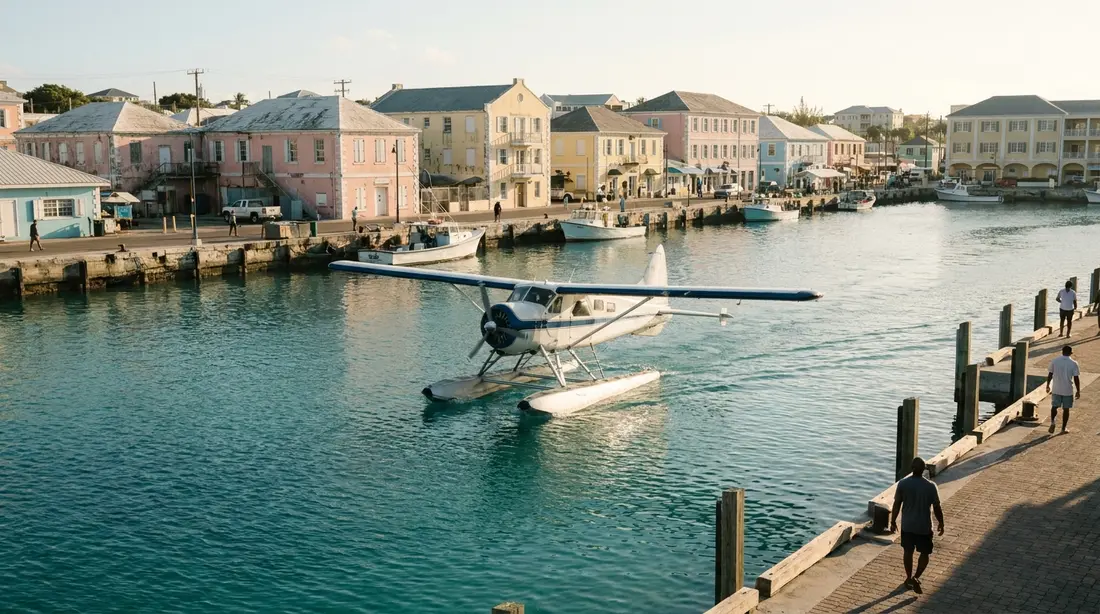
Seaborne Airlines operates a De Havilland Twin Otter on floats between the Christiansted waterfront and the harbor at Charlotte Amalie. Flight time runs about 25 minutes. The departure is the part guests talk about afterward: the aircraft taxis away from the ramp at the west end of the Christiansted boardwalk, turns into the wind, and accelerates across the harbor throwing spray until the floats break free. The route crosses forty miles of open Caribbean at low altitude, with reef lines and the odd sailboat sliding underneath, and ends with a water landing inside one of the busiest harbors in the region. People who fly it once tend to book it again on the strength of the takeoff alone.
For a day-tripper the seaplane holds a structural advantage no other option can touch: both terminals are downtown. You step off the dock in Charlotte Amalie a short walk from Emancipation Garden, the shopping rows and the taxi stands, having spent zero minutes in an airport shuttle. On the St. Croix side, the terminal sits steps from the boardwalk restaurants, so the day can end with the short stroll to dinner. Downtown-to-downtown in under half an hour is the whole pitch, and it is a strong one.
Now the caveat, which is real and worth planning around. A single Twin Otter has carried the route through 2026 while the airline, under owners who took over in mid-2025, works to enlarge its fleet — financing for additional floatplanes has been announced, and until those arrive the timetable flexes. Days of operation and departure times shift; a mechanical issue or a weather delay has no spare airframe behind it. The practical rules: check the current schedule before you assign the trip a date, book early, reconfirm the day before, and know that the airport flights exist as a same-day fallback if the morning goes sideways. Fares are published at booking rather than as a posted flat rate, so price it on your dates.
The ferry
The QE IV sails between Gallows Bay — the small harbor district a few minutes east of downtown Christiansted — and the Charlotte Amalie waterfront. The crossing takes about two hours and ten minutes, and at last check the fare was $70 each way, $120 for a round trip. The working pattern for years has been a morning departure from St. Croix around 8 a.m. and an afternoon return from St. Thomas around 3 p.m., with no sailings on Tuesdays and check-in closing shortly before the boat leaves. Schedules move around holidays and maintenance periods, so verify the week you travel rather than the month before.
That timetable defines the ferry day. Arrive Gallows Bay by about 7:30, dock in Charlotte Amalie mid-morning, and you have until early afternoon — call it four and a half hours — before the return boarding. It is enough for the downtown circuit and lunch, or for a Magens Bay run with the town squeezed to an hour, and it is not enough for both done well. Ferry day-trippers should pick one objective and enjoy it rather than sprint two.
The crossing itself splits opinion, and sea state decides which camp you join. On a settled day the upper deck is a pleasure: forty miles of blue water, flying fish, St. Thomas growing on the horizon, a breeze the whole way. When the channel is running a swell — common in winter when the Christmas Winds blow, and after any weather system — the ride gets lively, and passengers prone to motion sickness feel every minute of it. Take the seasickness precautions you know work for you, sit low and central if you are unsure, and check the marine forecast the night before with the same seriousness you would give a sail. Our weather guide explains the seasonal wind pattern behind this.
What the ferry buys in exchange: the lowest posted price of the three options by a wide margin for a couple or family, no baggage anxiety, no weight limits worth noticing, and a crossing that children old enough to enjoy a boat ride remember fondly. It also carries vehicles, though for a day trip you will not want the car — taxis cover the St. Thomas side better than an unfamiliar rental in Charlotte Amalie traffic.
The airport flights
Cape Air and Fly The Whale both connect Henry E. Rohlsen Airport on St. Croix with Cyril E. King Airport on St. Thomas, about 25 minutes wheels-up to wheels-down. Fly The Whale runs the crossing in nine-seat Cessna Grand Caravans with as many as twelve round trips a day at last check; Cape Air flies it in its familiar twin-engine Cessna 402s several times daily. Every seat on both types is a window seat, and the low-altitude view over the channel is a legitimate fringe benefit.
The catch for a day-tripper is everything around the flight. Rohlsen sits fifteen to twenty minutes from Christiansted, and Cyril E. King sits west of Charlotte Amalie, a taxi ride from both the town and the beaches — about $11 solo or $9 per person for two or more into downtown on the posted sheet at last check. Add check-in buffers on both ends and the real door-to-door time approaches the ferry's, at a fare closer to the seaplane's, with none of the harbor theater. As a pure day-trip vehicle, the wing flights are nobody's first pick.
They win in three situations. When the seaplane's thin schedule does not fit your date, the airport flights almost always do — twelve daily frequencies forgive a late start or an early return. When wind or sea state grounds the floatplane or makes the ferry unpleasant, the Caravans and 402s usually still fly. And when the St. Thomas trip is really a connection — meeting family flying into Cyril E. King, catching a fare that only departs St. Thomas — the airport-to-airport routing is the point rather than the penalty. Frequent-schedule redundancy is also why we tell seaplane bookers to relax: if the Otter cancels, the day is usually rescuable.
The three routes compared
| Route | Time in transit | Cost pattern | Shape of the day |
|---|---|---|---|
| Seaborne seaplane | ~25 min each way, dock to dock | Quoted at booking | Downtown both ends; longest hours ashore; single aircraft, so confirm the schedule and reconfirm the day before |
| QE IV ferry | ~2h 10m each way | $70 one way / $120 round trip at last check | Morning out of Gallows Bay, mid-afternoon return; about 4.5 hours ashore; no Tuesday sailings on the recent pattern |
| Fly The Whale | ~25 min in the air + airport transfers both ends | Varies by date | Up to 12 daily round trips; the schedule-depth option and the weather fallback |
| Cape Air | ~25 min in the air + airport transfers both ends | Varies by date | Several daily frequencies; same airport math as Fly The Whale |
One planning note that applies to all four rows: buy the return leg when you buy the outbound. Walk-up seats exist on good days, and betting your dinner reservation on one is how a day trip becomes an overnight.
Five to seven hours ashore
Every worthwhile St. Thomas day is built from the same three modules, and the transport you chose determines how many fit. The downtown module — the historic core on foot, the shops, lunch — takes two to three hours and starts wherever the boat or taxi drops you. The Magens Bay module — taxi over the ridge, a swim, taxi back — takes three hours done comfortably. The overlook module — the tram or a taxi up to a harbor viewpoint — takes under an hour when it is running. A seaplane day fits all three with lunch. A ferry day fits the downtown module plus one other, chosen in advance. Trying to do everything on a ferry schedule is the classic day-trip mistake, and the people making it are easy to spot at the 2:40 check-in, sunburned and sprinting.
Charlotte Amalie on foot
The capital of the territory rewards a couple of unhurried hours, and it asks for exactly none of your logistics: the core is flat, compact and walkable from the waterfront. What it is, at root, is a Danish harbor town that became one of the busiest cruise ports in the Caribbean, and both identities show. The streets nearest the water run heavy to jewelry, watches, liquor and perfume — this is duty-free retail at industrial scale, built for ship passengers with hours to spend. If shopping is your module, you are in the right town; comparison-shop between stores, know your mainland prices before you fly, and keep receipts for the exemption paperwork. If shopping is background noise, one block uphill the town gets quieter and older fast.
The historic pieces worth your walking time, roughly east to west. Fort Christian, the red Danish fort facing the harbor since the 1670s, is the oldest standing structure in the territory and reopened as a museum after a long restoration; at last check it kept weekday hours, roughly 9 to 3, with admission around $10, so a weekend day-tripper should plan on exterior photos only. Emancipation Garden beside it marks where the 1848 proclamation freeing the territory's enslaved people was read publicly on St. Thomas. Government House stands on the hill above, and from there the 99 Steps climb Government Hill — a step street laid with yellow ballast brick that arrived in the holds of Danish sailing ships, and the town's best free exercise; most visitors count more than ninety-nine. The St. Thomas Synagogue on Crystal Gade, finished in 1833 with its sand floor intact, remains among the oldest synagogue buildings in continuous use anywhere under the American flag, and welcomes respectful visitors most weekdays. Blackbeard's Castle, the hilltop tower above town, has cycled between closed and partially open in recent years; treat it as a photo backdrop unless current listings say otherwise.
Two practical notes color the whole downtown experience. First, cruise volume sets the town's temperature: on a multi-ship winter day the shopping streets are elbow to elbow by late morning, and on a no-ship day whole arcades doze. You cannot control which you get, but the ship schedules are public, and a glance the night before tells you what you are walking into. Second, the town's lunch rooms tucked into the old arcades are better than a shopping district deserves — ask for the courtyard places a block or two off the main drag rather than eating at the first waterfront table with a laminated menu.
Above the cruise dock at Havensight, an aerial tram climbs Flag Hill to an overlook complex about 700 feet over the harbor, with a bar, shops and a view that earns the ride on a clear day. Its operating days have tracked the cruise-ship calendar, which for a day-tripper means it may well be closed on a quiet day — verify hours that week before building the hour around it, or substitute any taxi driver's favorite pullout on the Magens road, which delivers a comparable postcard for the cost of the detour.
The Magens Bay run
Magens Bay is the beach the territory puts on its posters: nearly a mile of white sand closing a deep, protected bay on the island's north side, calm as a lake most days, with lifeguards, changing rooms, food and chair rentals. It is a public park run by a territorial authority, and at last check admission was $7 per person, children under 12 free. It earns the fame. It also shares the fame with every cruise passenger on the island, so its crowd level, like downtown's, moves with the ship schedule — big-ship winter middays are shoulder to shoulder, while early afternoons on light days can be quiet enough to hear the palms.
The logistics from downtown are a taxi over the mountain, about twenty minutes each way, at roughly $12 per person on the posted sheet at last check — figure $24-plus per person round trip once the return is included, since fares here price per rider rather than per cab. Drivers wait at the beach lot or return on a pickup time you agree in advance; agree it clearly, because the beach has no meter of idle taxis on a slow day. Add the admission and a chair and the famous swim costs a couple about $75 before lunch. Worth it once, with the eyes-open note that St. Croix guests are comparing it to beaches that charge nothing and share their sand with a dozen people.
Adding St. John
The follow-up question on every planning call: can the day stretch to St. John? Mechanically yes — passenger ferries cross from Red Hook on St. Thomas's east end to Cruz Bay roughly hourly on the hour through the day, about 20 minutes and about $13 for a non-resident adult one way at last check, plus a bag fee. But look at what the stack of segments does to the clock. Reaching Red Hook from Charlotte Amalie is a 30-to-45-minute taxi at roughly $15 per person; the ferry adds its 20 minutes plus the wait for the top of the hour; and everything runs in reverse before your St. Croix return, with zero slack for a missed connection. From a ferry-schedule day it simply does not fit. From a seaplane day it fits as a cameo — two or three hours in Cruz Bay or one beach on the North Shore road — for travelers who accept transit as the price.
Our advice, having watched guests try both: treat St. John as its own day trip only if the seaplane schedule that week gives you a long day, and otherwise leave it for a future USVI trip based on St. Thomas or St. John itself. The St. Croix vs St. John comparison covers what each island does best, and a rushed ninety minutes in Cruz Bay flatters neither your day nor that island.
The British Virgin Islands
One more island chain sits visibly north of St. Thomas, and it needs a different answer because it is a different country. The BVI are British territory: entering means a valid passport for every traveler, the BVI's online arrival card, customs on both ends and departure taxes — the full international kit that the USVI trip never asks of a U.S. citizen. Ferries run from the Charlotte Amalie waterfront to Road Town, Tortola, several times daily on the recent schedule, taking 45 minutes to an hour. From a St. Croix villa, that means stacking a domestic crossing and an international one, with two customs clearances each direction, into a single day — technically possible on paper and a poor idea in practice. Guests who want the BVI should give them nights of their own, or book one of the St. Thomas-departing day charters as a trip from a St. Thomas overnight. The full planning resource is our St. Croix vs BVI comparison; the one-line version is that the BVI are a boating destination that deserves better than four hours.
Timing the day
Three timing rules keep the trip pleasant regardless of route. First, take the earliest departure your option offers. The published patterns — the ferry's 8 a.m. sailing, the first morning flights — exist because the math only works from the front of the day; a late-morning start converts the trip into an afternoon errand. Second, build the return around a buffer, never around the last possible departure. For the ferry that means being at the Charlotte Amalie dock thirty minutes before boarding; for flights it means the airport taxi leaves downtown ninety minutes before wheels-up; for the seaplane it means reconfirming the return time that morning, because a one-aircraft operation reshuffles when weather intervenes. Third, aim the trip at a midweek day when you can, avoiding both the ferry's Tuesday gap and, if crowds bother you, the heaviest cruise days — the ship calendar is public and worth the glance.
Season shades the choice of vehicle more than the choice of day. Winter's trade winds make the channel sportier for the ferry and occasionally delay the floatplane; summer flattens the water and fattens the seaplane schedule's reliability, at the cost of afternoon heat downtown. There is no bad season for the trip, only a season-appropriate route.
ID, money and the shopping allowance
The crossing is domestic. St. Thomas and St. Croix are the same U.S. territory, so U.S. citizens carry the same ID they flew in with and clear no customs in either direction — the full detail lives in no passport needed. Dollars, U.S. cards and U.S. phones all work identically on both islands. The one piece of paperwork worth knowing exists is pleasant: purchases in the USVI ride home under a federal duty-free exemption of $1,600 per person, which is the legal machinery behind Charlotte Amalie's price tags on watches, stones and spirits. Keep receipts, and note that liquor quantities have their own rules worth checking if you buy seriously.
What the day costs
Published, checkable numbers only; flight fares move with dates and are quoted at booking, so they appear here as the variable they are.
| Line item | Pattern at last check |
|---|---|
| QE IV ferry, round trip | $120 per person |
| Seaplane or airport flight, round trip | Quoted at booking; price your dates |
| Airport taxi, Cyril E. King to downtown | $11 solo / $9 per person for two or more, each way |
| Taxi, downtown to Magens Bay | About $12 per person each way |
| Magens Bay admission | $7 per person; under-12s free |
| Fort Christian admission | About $10, weekday hours |
| Red Hook to Cruz Bay ferry | About $13 non-resident adult, one way, plus bag fee |
| Lunch downtown | Ordinary U.S. restaurant pricing |
A couple doing the ferry-plus-downtown version spends roughly $250 to $300 all-in. The seaplane version costs more and returns more hours; where it lands depends entirely on the fare your dates draw. Families should run the per-person taxi arithmetic before committing to the Magens run — four riders pay four fares each direction, which is the recurring surprise in USVI ground transport, explained at length in our taxis guide.
St. Croix as the base island
A quiet argument hides inside this whole page, and guests usually discover it on the ride home: the day trip runs better in this direction. Basing on St. Croix means sleeping on the larger, calmer island — the one with room around its beaches and dinner tables that seat you without a ship-day wait — and borrowing St. Thomas's energy for exactly the hours you want it. Reverse the arrangement and you commute out of the bustle to find quiet on a clock. Plenty of travelers love St. Thomas for what it is, and our side-by-side comparison gives it full credit; for a villa week, the pairing of a St. Croix base with one St. Thomas day gives you both islands at their best.
Questions guests ask
Is the St. Thomas day trip worth it?
For first-timers curious about the busier island, for serious shoppers, and for anyone set on seeing Magens Bay, yes — pick the seaplane if its schedule fits your date and the budget allows, because the extra hours ashore change the day. For guests mid-way through a happy beach-and-diving week with no itch to shop, the candid answer is that the day often gives back less than another St. Croix day would. It is a good trip. It is simply an optional one.
How long is the ferry from St. Croix to St. Thomas?
About two hours and ten minutes each way on the QE IV between Gallows Bay and the Charlotte Amalie waterfront. The recent pattern has been a roughly 8 a.m. departure from St. Croix and a mid-afternoon return sailing, with no Tuesday service, at $70 one way and $120 round trip at last check. Schedules shift around holidays and maintenance, so confirm for your travel week, arrive before check-in closes, and pack sea-sickness precautions if winter swell is running.
Can I do St. Thomas and St. John in one day from St. Croix?
Only on a long seaplane day, and even then St. John gets a cameo rather than a visit: taxi across St. Thomas to Red Hook, the hourly 20-minute ferry to Cruz Bay, two or three hours ashore, then every segment in reverse. On the ferry schedule it does not fit at all. If St. John is the island you actually care about, give it a dedicated trip or base a future vacation nearer to it.
Do I need a passport for a St. Thomas day trip?
No. Both islands are the U.S. Virgin Islands, so the crossing is domestic — carry the government-issued ID you flew in with and expect no customs in either direction. The exception is any add-on into the British Virgin Islands, which is international travel requiring a passport for every member of the party, the BVI's arrival card, and customs both ways. That is one reason the BVI work poorly as a same-day extension and deserve their own itinerary.
How reliable is the seaplane schedule?
Book it with a plan B. One Twin Otter has flown the route through 2026 while the airline adds aircraft, so the timetable varies by day of week and can reshuffle for weather or maintenance with no spare airframe behind it. In practice most flights operate as sold; the sensible habits are booking early, reconfirming the afternoon before, taking the earliest departure offered, and knowing that Fly The Whale and Cape Air fly the airport route many times daily as a fallback.
What is there to do in Charlotte Amalie for a few hours?
Walk the historic core: Fort Christian and its museum on weekdays, Emancipation Garden, the 99 Steps up Government Hill, and the 1833 synagogue with its sand floor, all within an easy flat-and-one-hill loop of the waterfront. Around that loop sits the Caribbean's densest duty-free shopping district, strongest on jewelry, watches and liquor. Add a courtyard lunch a block off the main streets, and, on days it operates, the tram to the Flag Hill overlook above the cruise dock.
Is Magens Bay doable on the ferry schedule?
Yes, if it is the day's single objective. Dock mid-morning, taxi straight over the ridge, swim and lunch at the beach, and taxi back with a comfortable margin for the afternoon check-in — that fills the roughly four and a half hours cleanly. What the ferry day cannot absorb is Magens plus a full downtown circuit; choose one, or take the seaplane and do both. Budget the per-person taxi fares both ways plus the $7 admission.
The villa at the end of the day
The best hour of a St. Thomas day is the last one, and it happens on St. Croix: the boat or floatplane comes home to Christiansted Harbor, the crowd noise stays forty miles behind, and dinner is waiting a short walk or drive away — on the boardwalk if you land downtown, or back at your own table with the groceries you laid in on day one. Our homes sit on the quiet island on purpose, from Christiansted-adjacent places that make the seaplane dock a five-minute errand to East End beachfront where the day ends in the water. Build the crossing into a week with the 7-day itinerary, or ask the team which departure suits your dates.
Sources
Written from official and first-party sources, checked August 2026. Hours, prices and event dates change — confirm before you go.
In this guide
Stay nearby
On The Shoys beach: six bedrooms, six baths, pool and hot tub, room for twelve, and the beach through the back garden.
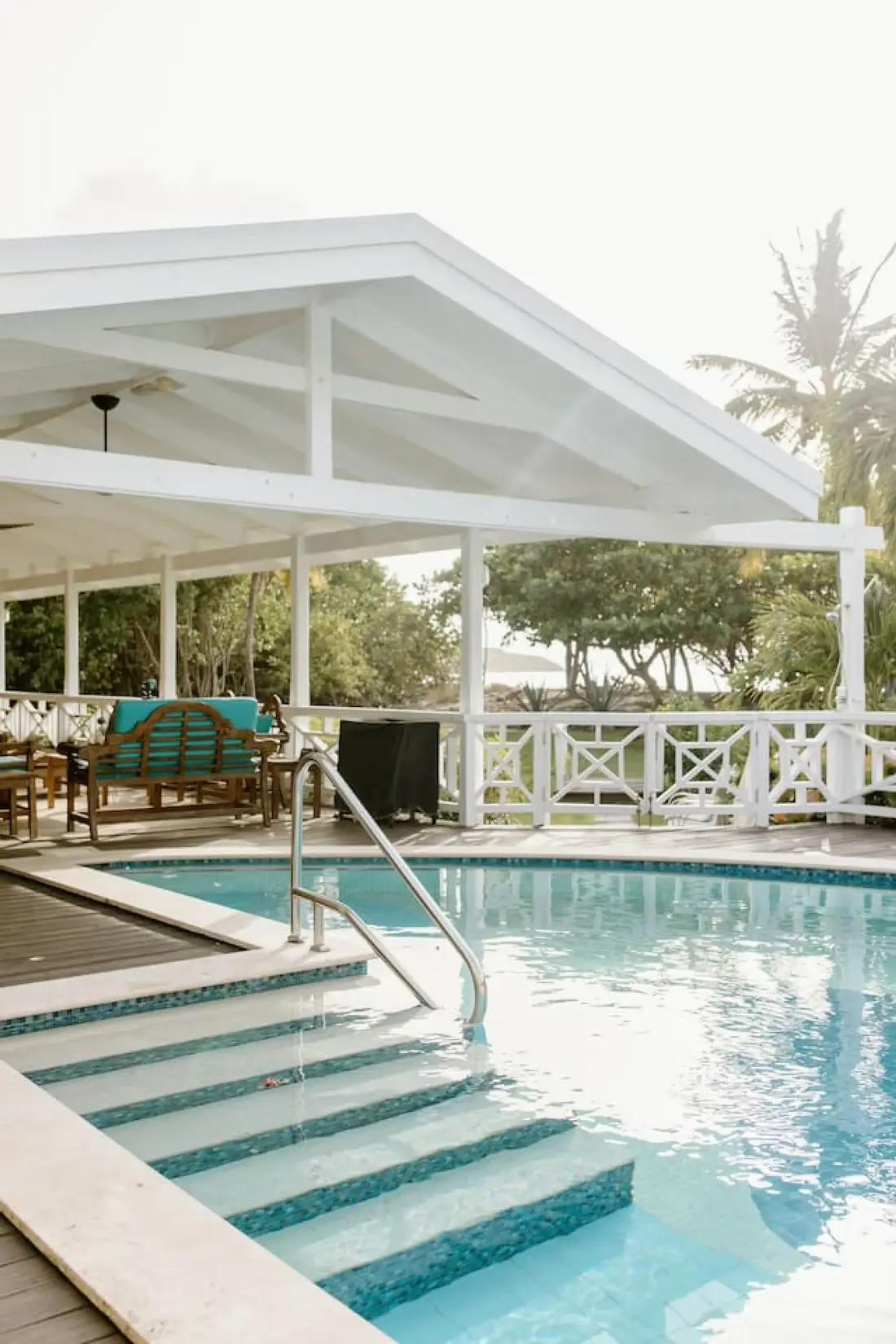 Shoy's Beach House6 bd · 6 ba · sleeps 12 · Christiansted
More in Plan Your Trip
Sources
11 references, listed in full at the end of this guide — official park, refuge, tourism-board and business sources, checked August 2026.