
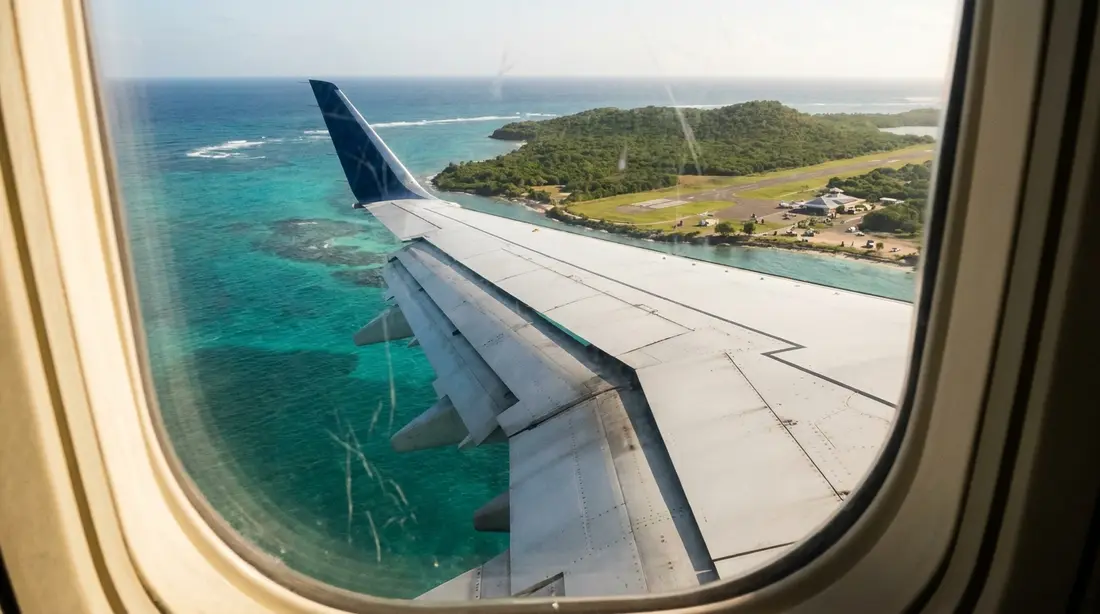
Getting to St. Croix
Nonstops from Miami, Charlotte, Atlanta, Newark and more — plus the seaplane and ferry from St. Thomas. Every route, verified.
Every airline that serves St. Croix, every schedule and every flight time is laid out in the tables on our getting here page. This page is the layer above the tables: how to choose between the two basic ways onto the island, which gateway to aim for from your part of the country, why the schedule leans so hard on Saturdays, how to build a connection that holds, and what to do when a travel day breaks. Routes here are as published in August 2026; airlines adjust constantly, so confirm before you buy.
The two ways in
Strip away the details and there are exactly two ways to reach Henry E. Rohlsen Airport (STX). You fly nonstop from one of five mainland gateways — Miami, Charlotte, Atlanta, Chicago and, from late October 2026, Newark — or you make one stop, most often in San Juan, at a mainland hub, or on St. Thomas. Everything else on this page is about choosing between those two and executing whichever one you pick.
The nonstop wins when it exists for your dates. That sounds obvious, and the qualifier is the whole game: several of the nonstops run only on Saturdays, and most of the schedule thickens in winter and thins in summer. If your travel day is a Saturday between December and April and you live within reach of a gateway, the decision makes itself. A single flight removes the misconnect risk entirely, and on an island where the onward option after a missed flight may be tomorrow, that is worth real money.
The connection wins in four situations. When you travel midweek, since only Miami — and in deep winter, Charlotte and Atlanta — offers non-Saturday service. When you travel in the low season, when the map shrinks toward Miami and the Saturday Atlanta flight. When you start far from the gateways, because a West Coast or mountain-state itinerary connects somewhere no matter what. And when the fare gap is wide enough to pay for the extra hours, which happens more often outside the winter peak.
One framing note that changes how relaxed the whole exercise can be: every mile of the trip is domestic for U.S. citizens. There is no customs stop in San Juan, no passport check at the gate, no arrival formality on the island — details in no passport needed. Visitors from other countries clear U.S. immigration at their first mainland airport or in San Juan, and from there the trip is domestic for them too.

Reading the nonstop map
Five gateways carry the mainland nonstops as of August 2026, and each plays a different role.
- Miami is the spine. American's MIA–STX service is the only route that runs every day of every month, roughly three hours in the air, with a second frequency on many dates. Whatever else the schedule does, this flight is the constant, which is why so many itineraries from elsewhere in the country are really just "get to Miami."
- Charlotte is the Southeast door. American brings the CLT nonstop back on Saturdays starting November 7 and runs it every day beginning December 17, 2026. Once it goes daily it becomes the best connecting funnel for much of the eastern half of the country, since Charlotte is an easier airport to change planes in than Miami.
- Atlanta is the Delta door. Delta flies ATL–STX on Saturdays through the fall and steps up to six days a week — every day except Monday — on December 19, 2026. If your home airport is a Delta town, this is your funnel.
- Chicago is a winter Saturday treat. American's ORD nonstop operates winter Saturdays beginning December 5 — a single weekly chance for the Midwest to skip the connection.
- Newark is the newcomer. United begins Saturday EWR–STX service October 31, 2026, published into late March — the first nonstop from the New York area in over three decades. As published, it leaves Newark at 9:03 a.m. and lands at 1:20 p.m., which is close to the ideal arrival time on this island, as covered below.
Two absences matter as much as the five presences. Fort Lauderdale disappeared from the map when Spirit Airlines shut down entirely on May 2, 2026, and no carrier has picked the route up. And there is nothing nonstop from anywhere west of Chicago, from Canada, or from Europe — every one of those trips connects. The full city-by-city routing logic lives on our fly-from pages.
Gateway math by home region
The practical question is which gateway to position to. The answer follows your region and, almost as much, your frequent-flyer allegiance.
- New York and New England: the Saturday Newark flight when it operates; otherwise a morning departure to Charlotte or Miami and the early-afternoon flight down. Detail on flying from New York and from Boston.
- Mid-Atlantic: Charlotte once it goes daily in mid-December; Miami the rest of the year. Washington-area travelers can also drive or shuttle to the Newark Saturday flight; see flying from D.C..
- The Southeast: the shortest trips in the country. Florida rides the Miami nonstop; the Carolinas, Georgia and Tennessee split between Charlotte and Atlanta by carrier loyalty.
- The Midwest: the winter Saturday O'Hare flight when it fits, Delta through Atlanta when it does not, American through Charlotte or Miami as the third path. See flying from Chicago and from Minneapolis.
- Texas and the West: one stop, full stop. American through Miami or Charlotte is usually the cleanest single-ticket build; Delta through Atlanta works identically. From the West Coast, the time zones make an eastbound red-eye plus the midday island flight the least painful shape, or break the trip with a gateway overnight.
- Canada and Europe: connect at a U.S. gateway — Miami, Charlotte and Atlanta see the most of this traffic — or route to San Juan and hop across. Non-U.S. citizens clear immigration at that first airport, so pad that connection generously.

The Saturday pattern
Look down the schedule and one day of the week keeps appearing: Charlotte returns on Saturdays, Chicago flies Saturdays, Atlanta flies Saturdays through the fall, Newark flies Saturdays. The concentration is deliberate. Caribbean leisure markets turn over on weekly rhythms — villa bookings here, like most of the region, run strongest Saturday to Saturday — so airlines concentrate their weekly widebody-of-capacity where the demand actually changes over. A once-weekly flight timed to the changeover day captures most of the market a daily flight would, at a seventh of the cost.
For a traveler this pattern has three consequences. First, if you can shape the trip as a Saturday-to-Saturday week in season, the nonstop map opens all the way up for you, and the villa calendar will thank you as well. Second, a midweek arrival in most months means a connection by definition, so plan it as one rather than hunting for a nonstop that does not exist. Third, seasonal windows have edges: the Newark flight is published from October 31 into late March, the Chicago flight is a winter product, and the daily Charlotte and near-daily Atlanta patterns begin in mid-December. A trip in early November or late April sits just outside several of these windows, so check dates against the current schedule rather than against memory.
Booking windows and fare patterns
We will not quote fares — they move daily and any number printed here would be wrong by the weekend. The patterns, though, are steady enough to plan around. Winter Saturday nonstops are small-inventory products: the Newark flight, as published, is one 126-seat 737-700 per week, and when a plane that size sells through its cheap seats there is no second flight an hour later to absorb the spill. Book those legs as soon as the villa week is confirmed. Miami, with daily service and more seats, behaves like a normal domestic route and forgives later booking.
Three habits pay for themselves. Set a fare alert on your route the day the villa is booked, so you see the price's range before you commit. Check a day either side of your target when the schedule allows it, because the Saturday concentration of demand can make adjacent days price differently. And price the one-stop build against the nonstop even when the nonstop exists — on off-peak dates the connection through Miami or San Juan sometimes undercuts it by enough to matter, and sometimes does not, which is precisely why you check rather than assume. Seasonally, the winter peak from the holidays through April carries the firmest prices; late spring and the quiet stretch from late summer into early December are where the soft fares live, in line with the crowd pattern in weather and when to visit.
A calendar note on when routes even become bookable. Airlines load schedules roughly eleven months out, but seasonal Caribbean routes are a different animal: they tend to be announced and opened for sale in late spring or summer for the following winter, which is exactly how the 2026 additions arrived — the Newark service was announced in the summer for an October start, with Chicago and the expanded Charlotte and Atlanta patterns published for December. If you are planning next winter's trip in March and the nonstop you want "does not exist," it may simply be unpublished; recheck the route when summer announcements land before settling for a connection.
One-way builds and mixed carriers
Because the entire journey is domestic, St. Croix fares mostly follow U.S. domestic pricing logic, and that opens a tool many travelers never think to use: booking each direction separately. On routes priced this way, a one-way generally costs about half the round trip rather than the punitive one-way fares international markets charge, so mixing carriers carries little penalty — down on American through Miami on your midweek start date, home on the Saturday Newark nonstop, each leg on the airline that serves that day best. Price the round trip and the two-one-ways build side by side; they will often land within dollars of each other, and the mixed build frequently wins on schedule. Two caveats keep the tactic sound: hold both directions in checkout before buying either, so a price jump on leg two does not strand a purchased leg one, and remember that two one-ways are two tickets for change-fee purposes — each direction reprices independently if plans move.
Connecting through San Juan
San Juan is the Caribbean's great sorting hall, and for St. Croix it is the connection with the most depth. Cape Air and JetBlue together operate the SJU–STX hop nonstop — around thirty crossings a week at last check, about fifty minutes gate to gate — with departures spread from early morning to early evening. Fly The Whale adds service from Isla Grande, the small in-town San Juan field, for travelers already on that side of the city. Since half the mainland flies nonstop to San Juan, this turns nearly any U.S. airport into a one-stop trip to St. Croix on days the mainland gateways offer nothing.
The craft is in the ticketing. Cape Air publishes codeshare and interline partnerships with JetBlue and American through San Juan, which means the mainland leg and the island hop can ride on a single ticket: one reservation, bags tagged through to STX, and — the part that matters — the airline owns the problem if the first flight runs late. Book it that way whenever the option appears. A two-ticket build, mainland carrier plus a separately purchased island hop, is sometimes cheaper and always riskier: a delay on ticket one is simply your problem on ticket two. If you self-connect, leave half a day between the flights and carry on your bags; if you are on one ticket, ninety minutes at San Juan is a comfortable cushion and an hour is workable.
One more San Juan virtue: frequency is resilience. Misconnect at a hub with one onward flight a day and you sleep there; misconnect at San Juan before noon and there is usually another hop to catch before dinner.
Connecting through the mainland gateways
The other one-stop shape routes you through Miami, Charlotte or Atlanta and puts the long overwater leg last. Booking engines will cheerfully sell connections here in the forty-to-fifty-minute range, and legal is a different standard from wise. Miami in particular is a big, slow airport to cross with a gate change. The working rules: take the first flight of the morning into the gateway rather than the one that "just fits," hold ninety minutes or more of connect time, keep everything on one reservation, and never book the last onward flight of the day as your plan A. When the island leg goes daily in mid-December, a missed morning bank at Charlotte can still salvage the same day; miss the once-weekly Saturday flight at Newark and the recovery is a rebooked routing through another hub, not a later departure.
From the West Coast, consider splitting the trip deliberately: fly to the gateway the evening before, sleep, and board the island flight rested. It converts a fragile 4 a.m. start into two easy days, and it is the single most effective misconnect insurance that money can buy cheaply.
St. Thomas as the back door
Forty miles north, St. Thomas draws nonstops from a longer list of mainland cities and at higher frequency than St. Croix does, which makes STT a legitimate plan B when the STX schedule refuses to fit your dates. Land there, then cross by whichever mode suits the hour: Cape Air and Fly The Whale run the wing-flight crossing to Rohlsen many times daily, about twenty-five minutes airborne; Seaborne's Twin Otter crosses harbor to harbor and sets down on the water in Christiansted, though a single airframe covers that route in 2026 and its timetable moves around; and the QE IV ferry sails Charlotte Amalie to Gallows Bay in a bit over two hours — one-way tickets run $70 and round trips $120 at last check, with no sailings on Tuesdays on the recent pattern. Book the crossing on generous margins if the inbound flight lands late in the day, since the last hops leave before evening. The crossing options are compared properly in the St. Thomas day trip guide and the charters and getting around reference; the same knowledge that powers a day trip powers an arrival.
The back door also enables a two-island trip with no backtracking: arrive St. Thomas, spend the first nights there, cross to St. Croix mid-trip and fly home nonstop from STX. Airlines price these open-jaw builds as two one-ways or a multi-city ticket, and on domestic-style routes that generally carries no penalty — check both builds and take the cheaper.
Bags southbound, inspections homebound
On the way down, a single-ticket itinerary checks bags through to STX like any domestic trip, including through San Juan on the Cape Air partnerships noted above. Only a self-connect on separate tickets forces a bag claim and re-check, which is one more argument against them. There is no agriculture restriction flying into the territory worth planning around, though produce in a suitcase is never a great traveler.
The way home is where St. Croix differs from a mainland airport, and it is mild: departing passengers pass a Customs and Border Protection document check plus a USDA screening of luggage before boarding, so two hours at the airport is the right allowance. The compensation for the extra line is the shopping math — the duty-free allowance coming home from the USVI runs $1,600 per person with up to five liters of spirits under the island-purchase rules, roughly double the standard foreign-travel figure. The departure-day mechanics, allowance fine print and the rest of the first-and-last-day playbook live in first-time visitor tips.
When the travel day breaks
Here is the risk spelled out, because a plan built on a pretty version of it fails. St. Croix is served by a handful of flights a day in winter and fewer off-season, several of them weekly. A misconnect that would cost you three hours en route to Denver can cost you a night en route to STX, and during the holiday peak — when every seat on every island flight is sold — it can cost more than one. Connections remain a perfectly good way to travel here — provided you build them the way this page describes: morning legs, single tickets, real connect times, San Juan's frequency when you have the choice, and the gateway-overnight trick from long-haul starts. Remember too where the winter weather risk actually lives: a January nor'easter at the origin airport strands more St. Croix travelers than anything tropical ever does in that season, which is one more argument for the first bank of the morning and for routing south ahead of a forecast rather than through it.
Layer on the paper defenses. Travel insurance with trip-delay and missed-connection coverage is cheap against the cost of a villa night, and for summer and fall dates it should be bought the day the trip is, for the reasons covered in the hurricane season guide. That guide also covers the storm-week routine: when a named system threatens the region, the airlines publish rebooking waivers that let you move flights without change fees, and the smart play is to use the waiver early rather than gamble on the last scheduled departure. Finally, if a delay is the airline's fault — mechanical, crew — ask the carrier to cover the overnight and rebook you through a different hub if it gets you in sooner; agents can route STX traffic through San Juan even when your original itinerary never touched it.
And tell us. A villa is a house with your name on it, so a late arrival costs you nothing here except island hours; send the new flight details and the check-in adjusts.
Private and charter arrivals
For groups, the charter math deserves one paragraph. Rohlsen's 10,002-foot runway takes any business jet nonstop from the East Coast, the FBO on the field has been run by the Bohlke family since 1959, and the island supports genuine on-demand lift — locally based jets plus turboprop charters positioned over from San Juan, a forty-nautical-mile errand. Charter pricing is quoted per trip rather than per seat, which means a full villa group sometimes finds the gap between eight winter airline tickets and one small-aircraft charter narrower than expected. The operators, aircraft and quoting process are covered in flying private to St. Croix, with the wider small-plane picture in charters and getting around.
Arriving well
The last routing decision happens before you buy: pick an itinerary that lands with daylight left. Most of the nonstops arrive early-to-mid afternoon, which is the schedule working in your favor — it leaves time to collect the rental car (reserved when the flights were, per renting a car), make the grocery stop, and take your first left-side drive to the villa in sunlight rather than on unlit rural roads. An itinerary that lands at dusk after two legs saves an hour on paper and spends it, with interest, on the ground. Drive-time context from the airport: figure under twenty minutes into Christiansted, a quarter hour to Frederiksted, and up to forty out to the East End. The full first-day sequence is in first-time visitor tips.
The gateways at a glance
Patterns as published in August 2026 — treat every row as "confirm before booking."
| Gateway | Carrier | Pattern as published, August 2026 | Airborne |
|---|---|---|---|
| Miami (MIA) | American | Every day, all year; second frequency on many dates | ~3 hr |
| Charlotte (CLT) | American | Saturdays again from Nov 7; every day starting Dec 17, 2026 | ~3¾ hr |
| Atlanta (ATL) | Delta | Saturdays through fall; six days a week (no Monday) from Dec 19, 2026 | ~4 hr |
| Chicago (ORD) | American | Winter Saturdays, first flight Dec 5, 2026 | ~4¾ hr |
| Newark (EWR) | United | Saturdays from Oct 31, 2026, published into late March | ~4½ hr |
| San Juan (SJU) | Cape Air / JetBlue | Multiple crossings daily, all year | ~50 min |
| St. Thomas (STT) | Cape Air / Fly The Whale / Seaborne / QE IV ferry | Many wing flights daily; seaplane schedule varies; ferry six days a week | ~25 min air / ~2 hr 10 min sea |
Questions guests ask
What is the fastest way to get to St. Croix?
From South Florida, American's Miami nonstop at about three hours in the air — the shortest ride from anywhere on the mainland and the only route that operates daily in every month. From other gateway cities, the seasonal nonstops beat any connection when they operate on your dates: Charlotte and Atlanta around four hours, Newark about four and a half. From everywhere else the fastest realistic trip is one stop, and the clock is decided less by the routing than by how tight and how early your connection is.
Should I connect in San Juan or at a mainland hub?
Both work, and they fail differently. San Juan gives you frequency — misconnect there in the morning and another fifty-minute hop usually leaves within hours — plus single-ticket builds through the Cape Air partnerships with JetBlue and American. The mainland hubs give you bigger aircraft and one long leg instead of two short ones, at the cost of thin onward schedules outside deep winter. Our rule of thumb: take whichever build puts you on one ticket with ninety-plus minutes of connect time and a morning first leg, and if both qualify, take the cheaper.
How much connection time is enough?
On a single ticket, ninety minutes is a comfortable floor at Miami, Charlotte, Atlanta or San Juan, and an hour is defensible when the onward schedule has depth behind it. Interrogate the recovery before the sit time: ask what the next flight to STX is if you miss yours. If the answer is "tomorrow" or "next Saturday," either lengthen the connection, move it earlier in the day, or route through San Juan where the answer is usually "this afternoon." On two separate tickets, no connection shorter than half a day deserves the name.
Can I fly into St. Thomas and reach St. Croix the same day?
Usually, if the inbound lands by mid-afternoon. The wing flights on Cape Air and Fly The Whale cross in about twenty-five minutes and run throughout the day, the seaplane crosses harbor to harbor when its schedule aligns, and the ferry sails once daily on its six-day pattern. The catch is the evening: the last crossings depart before dinner time, so a mainland flight that reaches St. Thomas at 6 p.m. means a night there. Check the day's last crossing before you book the inbound, and hold a refundable St. Thomas room if the timing is tight.
When are flights to St. Croix cheapest?
The soft window in most years runs from late spring through early December, excluding holiday weeks — the same months the island itself is quietest. Winter Saturdays are the firmest fares on the calendar because that is where demand concentrates and where several routes offer exactly one flight a week. We deliberately quote no dollar figures, since fares reprice constantly; the reliable habits are a fare alert set the day the villa books, an early purchase for any once-weekly winter nonstop, and a comparison against the San Juan one-stop before committing.
What happens if I miss my connection to the island?
On one ticket, the airline rebooks you on its next available routing at no charge and, when the cause was theirs rather than weather, generally covers the overnight — ask, and ask specifically about routings through San Juan, which agents sometimes overlook. On separate tickets you are buying a new fare at walk-up prices, which is why this page keeps warning against them. Either way, message us with the new arrival details; the house holds, and late check-ins are routine here.
Do my bags check through to St. Croix?
Yes, whenever the whole trip rides on one reservation — including itineraries that change planes in San Juan on the published Cape Air partnerships, where the bag is tagged STX at your home airport and next appears at Rohlsen. The exceptions are self-connects on two tickets, which require claiming and re-checking, and the ferry-or-seaplane arrival via St. Thomas, where the airline portion ends at STT and the crossing is on you. Going home, checked luggage passes the agriculture screening at STX before the flight, so arrive with the two-hour margin.
The villa week your flights are built around
Notice how often Saturday appeared on this page — the same day villa weeks naturally turn over. A Saturday-to-Saturday stay lines your dates up with every seasonal nonstop on the map, which is the single easiest way to make the whole trip simpler and often cheaper. Browse the homes, from Christiansted-adjacent places a short drive off the airport road to East End beachfront worth the extra half hour, and send us your routing once it is booked — flight number, arrival time, party size. We line up the check-in, point you to the right grocery stop for your route, and answer the connection questions this page could not, because we make these same flights ourselves. Start with a note to the team or the book direct explainer.
Sources
Written from official and first-party sources, checked August 2026. Hours, prices and event dates change — confirm before you go.
In this guide
Stay nearby
On The Shoys beach: six bedrooms, six baths, pool and hot tub, room for twelve, and the beach through the back garden.
 Shoy's Beach House6 bd · 6 ba · sleeps 12 · Christiansted
More in Plan Your Trip
Sources
10 references, listed in full at the end of this guide — official park, refuge, tourism-board and business sources, checked August 2026.