Mocko Jumbies & Quelbe
Stilt dancers watching over the carnival and the scratch-band sound of the Virgin Islands: the living culture you'll actually see and hear.
Two traditions carry the sound and the sight of a Crucian celebration. The mocko jumbie is the masked dancer who works a crowd from stilts that lift him well above every head. Quelbe is the scratch-band folk music the Virgin Islands wrote into law in 2003 as its official sound. One arrived as a West African masquerade carried across the Atlantic by enslaved people; the other took shape on the island itself, where African rhythm met European melody on the sugar estates. Both outlived slavery, both are worked today by living performers and the academies that train the next set, and both are things a visitor can actually see and hear. This page is the reference to each: the origins, the makings, the people who kept them, and where you meet them on St. Croix now.
Two living traditions, met on their own terms
Before the history, a word on posture, because it shapes how a visitor should approach both. The mocko jumbie and the scratch band are not attractions built for cameras. They come out of the plantation and the century after it, they carried spiritual and civic weight long before they carried a tourist's attention, and the people who perform them now are culture-bearers keeping a family and community inheritance alive. Guests are welcome to watch, to photograph the public performances, and to buy the music. The welcome runs warmer for those who treat the dancers and players as artists at work rather than props: give the stilt-walkers room, applaud the bands, ask what a squash is, and read a solemn moment for what it is. A note on spelling while we are here. Scholars and Trinidadians usually write moko jumbie; the Virgin Islands commonly write mocko jumbie, an English-shaped rendering of the same word, and this page uses the island's spelling except in the proper names of specific troupes.
The Moko: an African stilt masquerade
The figure is far older than any Caribbean record of it. Across a wide band of West and Central Africa, masked dancers performed on stilts in roles that were sacred as often as festive, some of them held inside secret societies: they stood in for spirits at funerals and festivals, opened ceremonies, and appeared wherever a community needed a presence larger than a person. The name points back to that world. Moko is generally read as a West or Central African word tied to a healer or a guardian, and some accounts trace it instead to the name of a deity; the scholarship does not fully settle the question, and the fair summary is that the word carries the sense of a protective, watching figure. Height was the whole idea. A dancer raised two or three times a man's stature could look out over a gathering and see what moved toward it, and people read that vantage as protection, a guardian who noticed danger first and stood between it and the crowd.
The crossing, and the jumbie
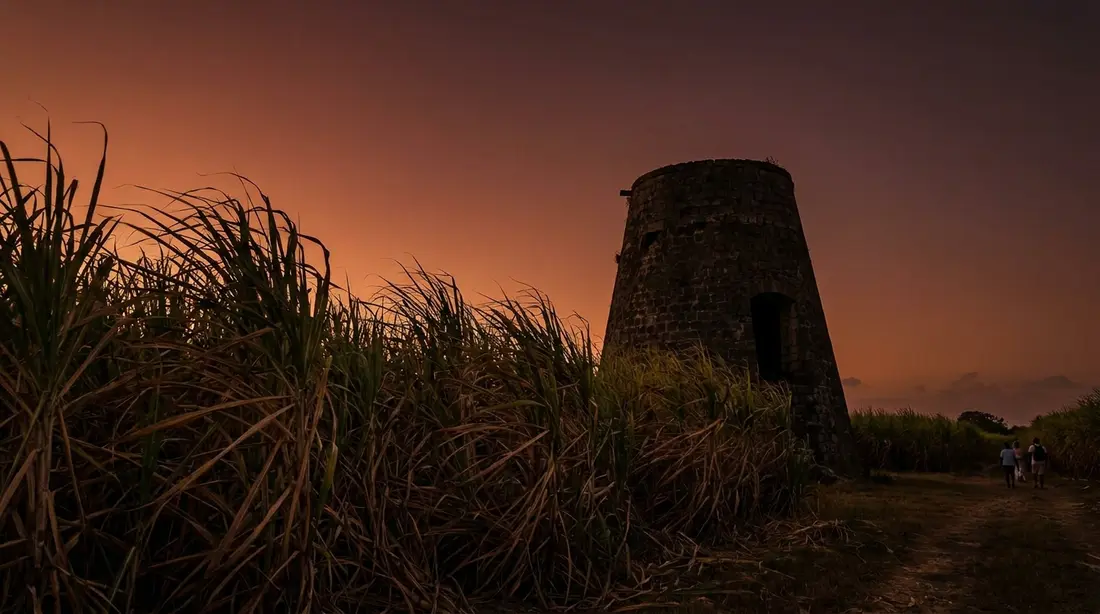
The masquerade came into the Caribbean the way its people did, in the slave trade that stocked the sugar islands, and it put down roots across the region during the era of bondage. The earliest written sighting in these islands is precise: a masked mocko jumbie moving through the streets of St. Thomas with a knot of musicians at Christmas in 1791. The second half of the name is Caribbean. Jumbie is the regional word for a spirit or a ghost, used from island to island and generally traced to Kongo roots, part of the same family that gives English the word zombi. Joined together, Moko and jumbie named a tall spirit who both guarded and judged, a figure that blessed a gathering, warded off harm, and could shame bad conduct in front of the whole village. In the older street practice one or two jumbies moved with a small band of musicians, issuing blessings as they passed, rather than performing in the big costumed troupes that fill a modern parade. That moral role, the jumbie as a watcher a community answered to, is part of why St. Croix treats the tradition as an inheritance rather than a show, and the figure has been part of Virgin Islands life for more than two hundred years.

The costume and the stilts
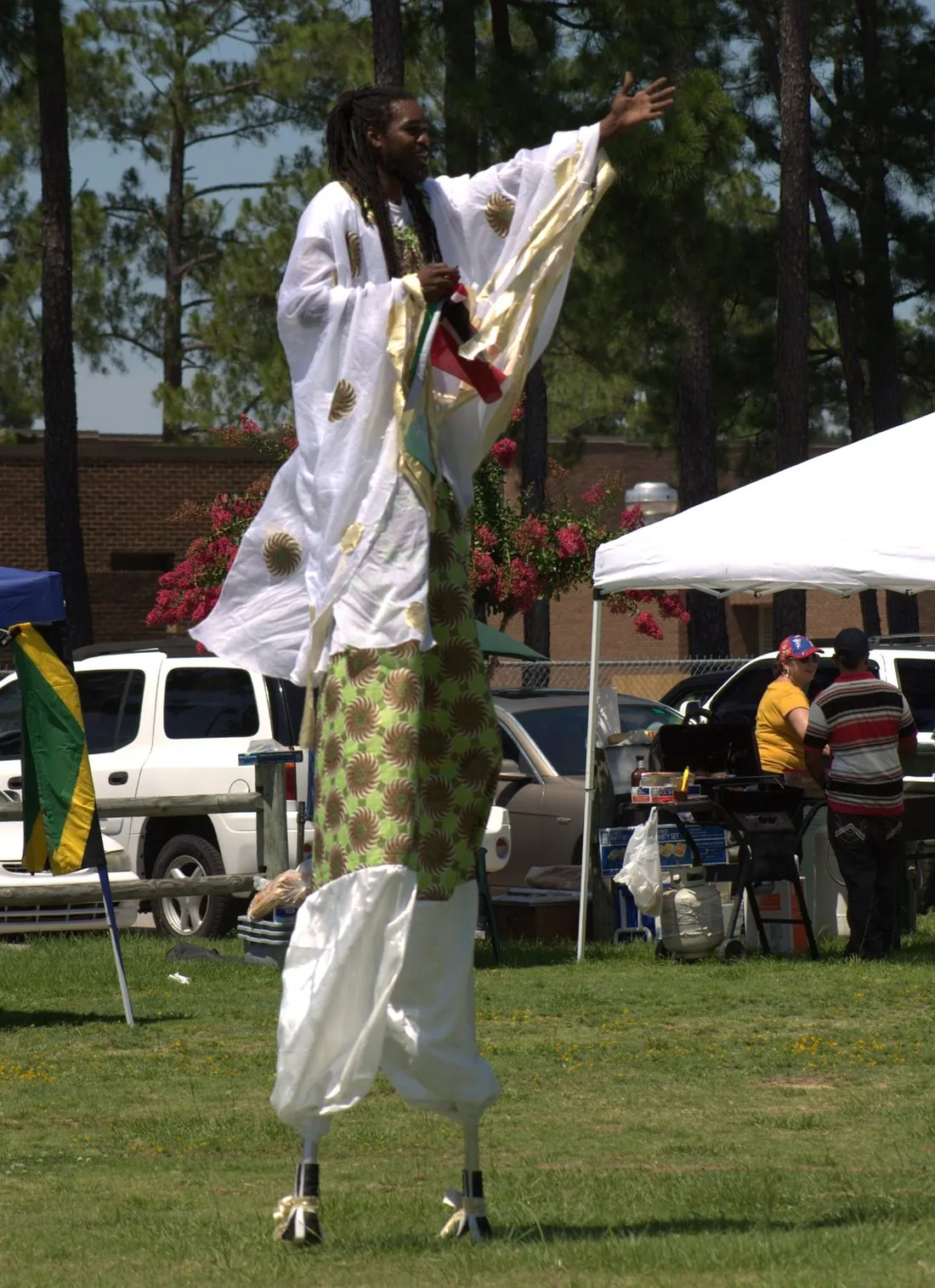
The look is deliberate and total. A mocko jumbie is covered from the feet to the crown, in trousers, long sleeves, gloves, a mask or paint, and a hat, so that only the eyes show. The old explanation is that a spirit should not be recognizable: cover the dancer completely and the person disappears into the figure. On St. Croix the tallest costumes put the dancer well overhead, with sources describing stilts that stand the performer somewhere from ten to twenty feet off the ground, though plenty of dancers, and nearly all beginners, perform far lower. The stilts strap to the legs and are worn without a safety line; a fall is a real fall. That is why the skill takes training rather than nerve alone.
A dancer learns to mount from a wall or a partner's shoulder, to balance and pivot, to dip and recover, and to dance rather than merely walk for the length of a parade route in tropical heat, all while the costume narrows the view and the crowd presses close. Beginners start low and short, on stilts a child can manage, and work up over years; the troupes you see on the route hold every level at once, from first-year kids to veterans who have marched for decades. Modern stilts are lighter and better built than the rough poles of the old days, but the physical demand has not changed. The best make it look weightless, which is the surest sign of how hard it is.
Ali Paul and the modern silhouette
The figure a visitor sees today owes its shape to a handful of St. Thomas dancers who carried it through the twentieth century. An earlier master, John "Magnus" Farrell, performed from the 1940s into the 1960s in the older style, a tall cone hat and bare feet on the stilts. The turn to the modern look came with Alvin Paul, known across the islands as Alli or Ali Paul, who began as a boy around 1960 and founded Alli Paul's Original Moko Jumbies on St. Thomas that decade, later forming a St. Croix troupe as well. His changes stuck. He put the dancers in long trousers and shoes that hid the stilts and the feet, giving the figure the clean, towering line it now has, and he varied the hats. He also opened the tradition to women, bringing his own sister, Ann, in as the first female mocko jumbie, and moving the dancers into hotels, parties and cultural shows alongside the parades. His Original Moko Jumbies performed from the 1960s until 2019, a run of roughly sixty years, and the dancers he trained seeded much of what followed.
Willard John and the Guardians of Culture
If Ali Paul fixed the look, Willard John built the school that keeps it stocked. John learned the stilts from his cousin John McCleverty, in a teaching line that runs back through the older St. Thomas dancer Hugo Moolenaar, and made his own debut in the St. Thomas carnival parade in 1975. He moved to St. Croix in 1979 and found no active mocko jumbies on the island. Through the 1980s he taught stilt-dancing in schools and community programs, and in 1993 he founded the Guardians of Culture Moko Jumbies, a youth academy run out of a public elementary school that teaches boys and girls both the skill and the history behind it. Roughly four hundred young Crucians have come through it over the years, and those students, and their students in turn, are much of who you see on the route now. John also made a film, Mokolution, tracing the figure's path from Africa through the Caribbean, and in 2024 he was named a Taproot Fellow by the Alliance for California Traditional Arts for his work teaching the tradition. The academy is the reason the island's stilt-dancing did not thin out with its first generation of masters.
The record attempts and the next generation
The tradition now has a younger cohort with an international profile. Yisrael Petersen, who came up as a boy through Ali Paul's Original Moko Jumbies and went on to perform abroad, is among the St. Croix-rooted dancers carrying it forward, and he is the name most often attached to the territory's Guinness ambitions: he has pursued a record attempt for continuous stilt-walking measured in hours. Treat that as a goal rather than a settled fact. No U.S. Virgin Islands entry for mocko-jumbie stilt-walking sits in the record books at last check, and the widely reported mass-stiltwalk records, such as a gathering of several hundred dancers in 2017, were set in Trinidad rather than here. What is not in doubt is the pipeline. Between Ali Paul's troupe, the Guardians of Culture academy and the school programs, St. Croix has a steady supply of trained dancers, from first-year children on short stilts to veterans who have worked the parades for a lifetime.
Quelbe: the territory's official music
Quelbe is the folk music of the Virgin Islands, and since 2003 it has held that title by statute. On December 16, 2003, the Legislature of the Virgin Islands passed Bill No. 25-0056, carried by Senators Shawn-Michael Malone, Lorraine Berry and Emmett Hansen II with several co-sponsors, and made quelbe the territory's official traditional music, with a clause putting it into the public-school curriculum. The law even wrote down what quelbe is: a folk music with roots in Africa and Europe that the statute calls, in its own words, "a fusion of bamboula rhythms and chants, cariso songs and melodies." Naming can confuse a visitor, because the same music answers to three names by island. Crucians call it quelbe; on St. Thomas it is more often scratch band music; in the British Virgin Islands it is fungi music. They are one tradition. Stanley Jacobs, the St. Croix flutist who spent decades pushing the music from the margins to the statute books, has recalled that people once told him he should not be singing quelbe, that it carried a stigma; the 2003 law was part of turning that around.
The scratch band and its instruments
What makes a scratch band is its instrument set, and the older the band, the more of it began as things found rather than bought. The rhythm comes off the squash, a dried gourd ridged along its length and dragged with a wire or a comb for a dry, scraping pulse, the sound that gives the music its scratch. Over it rings the steel, a heavy metal triangle keeping time. A flute, traditionally a transverse cane flute a player often made himself, carries the melody. A banjo or a banjo-ukulele and a guitar hold the chords; in lean years the banjo was built from a sardine can. And the bottom end came from the road: the pipe, a length of car tailpipe blown like a bass horn, its low honk likened to a braying donkey, which is where its blunt island nickname, the "ass pipe," comes from. Modern bands often add an upright or electric bass, congas, a saxophone and a keyboard, but the squash and the steel are the engine that keeps a group a scratch band and not something else.
| Instrument | What it is | Its job in the band |
|---|---|---|
| Squash | A dried gourd ridged and scraped with a wire or comb | The scraping rhythm that gives the music its name |
| Steel | A large metal triangle | Keeps the time above the squash |
| Flute | Traditionally a transverse cane flute, often homemade | Carries the melody |
| Banjo or banjo-ukulele | Sometimes built from a sardine can in lean years | Rhythm and chords |
| Guitar | Standard six-string | Chords and backing |
| Pipe (the "ass pipe") | A length of car tailpipe blown like a horn | The bass line |
| Modern additions | Upright or electric bass, congas, saxophone, keyboard | Fill out contemporary bands |
The roots of the sound
Quelbe is a creole music in the exact sense: several traditions folded into one over generations on the estates. The African foundation is the part the 2003 statute names outright, the bamboula, the drum-and-chant dance of the enslaved, and the cariso, the topical call-and-response song often led by women, whose habit of commenting on daily life quelbe inherited whole. Onto that base came European dance music brought by the planters and the garrisons: the quadrille above all, along with jigs and the local merengue. The fife-and-drum of the Danish and British military bands added another layer, their march tunes absorbed and re-timed to the islands' own feel. The mix is why quelbe is, first and last, dance music, and why a single number can sound at once like a march, a reel and something entirely Caribbean.
The quadrille connection
Between the stilts and the scratch band sits the quadrille, and it is worth knowing because it ties the two together and turns up wherever they do. The quadrille is a formal figure-dance, couples moving through set patterns called out by a leader, that the island took from the European ballrooms of the Danish era and made its own, danced to a scratch band rather than a parlor piano. It never fully died out on St. Croix the way it did in many places. School and community troupes still learn the figures and perform them in their whites at cultural events, and the same bands that play a festival stage play for the dancers. When you see quadrille on Emancipation Day or at a school showcase, you are watching the dance half of the quelbe tradition, the reason so much of the old repertoire is built as dance music in the first place. It is also the clearest sign that these traditions are still functional rather than merely preserved: people dance the quadrille because it is theirs.
Lyrics as the island's newspaper
For most of its history quelbe was also how the island talked about itself. Long before broadcast reached the Virgin Islands, the songs told stories, cracked jokes and moved gossip through a crowd, reporting on who had done what to whom, the scandal of the season and the failings of the powerful, in words that ran from sly to blunt and turned openly risque around Christmas. That gave the music a double job. It entertained, and it held people to account: a person who behaved badly might hear about it in a scratch band's next song, in front of everyone. The commentary habit runs straight back to the cariso, and it is why old-timers describe quelbe as the island's newspaper set to a squash and a flute. A visitor who catches the words along with the tune is hearing a running record of Crucian life, one verse at a time.
The culture-bearers
A handful of names carry the music's modern history. James "Jamesie" Brewster, born on St. Croix in 1929 and working until his death in 2014, was the scratch-band figure known across the islands as the King of Scratch; he led Jamesie and the All Stars and became the subject of the 2006 documentary Jamesie, King of Scratch, by the filmmaker Andrea E. Leland, which carried the music and its archive well beyond the territory. Stanley and the Ten Sleepless Knights, the St. Croix band the flutist Stanley Jacobs co-founded around 1970, worked the island's parties, its quadrille dances and its carnival parades for well over fifty years. Jacobs plays a transverse cane flute he makes himself alongside a metal flute, a flute-making craft he learned from Stanford Simmonds of the Simmonds Brothers Band; he cut the album Quelbe! Music of the U.S. Virgin Islands for Smithsonian Folkways, and in 2022 received a National Heritage Fellowship from the National Endowment for the Arts, the highest honor the United States gives a folk or traditional artist. His band also runs a nonprofit that teaches quelbe and quadrille to island children and funds music scholarships. Blinky and the Roadmasters is another of St. Croix's long-running scratch bands, and between the working groups and the school programs the music still has a full bench of active players and young ones coming up behind them.
How the two traditions live today
The stilt-dancer and the scratch band travel together, and a visitor meets them in the same handful of settings. The fullest is festival season: the Crucian Christmas Festival, St. Croix's Christmas-season carnival from late December into early January, when mocko jumbies lead the parades through Frederiksted and the bands play the festival village and the food fair. Jump Up, Christiansted's quarterly street party, is the most reliable off-season chance: stilt dancers work the crowd downtown while scratch bands and steel pan play the route. Emancipation Day on July 3 brings both to the Frederiksted waterfront, where quadrille sets are danced to quelbe as part of the day's cultural program. February's AgriFest agricultural fair runs thick with the music, as does Transfer Day on March 31. On cruise-ship days mocko jumbies often greet arrivals at the Frederiksted pier, and several hotels book stilt dancers and scratch bands for weekly cultural nights. The island's full slate sits in a year of events. Quadrille is the hinge between the two: the band plays, the dancers step the figures, and the jumbies move at the edges. One caution worth setting: neither is a nightly attraction. Both are tied to events and the festival calendar rather than a standing show, so seeing them takes a little timing.
Keeping both alive
Both traditions are deliberately taught rather than left to survive on their own, because both nearly thinned to nothing within living memory and both depend on knowledge that lives in people, not books. The danger was not abstract: across the region the stilt masquerade had faded so far that mid-century observers in Trinidad called it all but gone, and when Willard John reached St. Croix in 1979 there were no working dancers left on the island to learn from. The 2003 quelbe law put the music into the public-school curriculum and gave the Department of Education a music division to carry it. Willard John's Guardians of Culture academy has trained roughly four hundred stilt-dancers since 1993, and Ali Paul's troupe seeded a generation before that. The Ten Sleepless Knights' nonprofit teaches quelbe and quadrille to children and funds scholarships, and film and recording have done the rest: Stanley Jacobs's Smithsonian Folkways album, Willard John's Mokolution, and the Jamesie documentary and its archive, later released online at no cost, all fix the tradition in a form the next generation can study. Add the festival committees, the church-hall quadrille groups and the family lines that hand the stilts and the flute down at home, and the picture is of a culture that decided, out loud, not to lose these two things. The Crucian food guide covers the table that goes with them, and the Frederiksted guide and Christiansted guide cover the two towns where you meet them.
The two traditions at a glance
| Tradition | What it is | Where you see it |
|---|---|---|
| Mocko jumbie | A masked dancer on stilts; an African guardian-spirit masquerade more than two centuries old on the island | Crucian Christmas Festival parades, Jump Up, Emancipation Day, the Frederiksted pier on ship days, hotel cultural nights |
| Quelbe (scratch band) | The territory's official folk music, played on squash, steel, flute, banjo, guitar and tailpipe bass | The festival village and food fair, Jump Up, Emancipation Day, AgriFest, cultural nights |
| Quadrille | The Danish-era figure-dance still danced to quelbe | Emancipation Day, cultural festivals and school showcases |
Questions guests ask
What is a mocko jumbie?
A mocko jumbie is a costumed dancer who performs on stilts, covered from head to toe with only the eyes showing. The tradition is a West African stilt masquerade, brought to the Caribbean by enslaved people and part of Virgin Islands life for more than two hundred years. The name joins Moko, an African word tied to a healer or guardian spirit, with jumbie, the Caribbean word for a spirit, so the figure reads as a tall guardian who watches over a gathering. On St. Croix you see them at parades, street parties and cultural events, ranging from first-year children on low stilts to veterans working high above the crowd.
Why do the dancers cover their whole bodies?
Because a spirit is not supposed to be recognizable. The full covering, trousers, sleeves, gloves, mask or paint, and a hat, with only the eyes left open, lets the dancer disappear into the figure, in keeping with the tradition's origins as a spirit masquerade. It has a practical side too: the costume is part of the spectacle, and hiding the stilts under long trousers, an innovation credited to the St. Thomas master Ali Paul, gives the mocko jumbie its clean, towering line. When you meet one, give it room and let it work; the stilts are strapped on without a safety line, and the dancer needs the space.
What is quelbe, and what makes a scratch band?
Quelbe is the Virgin Islands' traditional folk music, and the group that performs it is called a scratch band. The core instruments are the squash, a scraped gourd that gives the music its scratchy pulse; the steel, a metal triangle; a flute for the melody; a banjo and guitar for the chords; and a bass made from a car tailpipe, the "ass pipe." Older bands built much of that from what was around, down to banjos made from sardine cans. The songs matter as much as the playing: quelbe lyrics comment on island life, often with humor and a sharp edge. Modern bands add bass, congas and horns, but the squash and steel keep it a scratch band.
Is quelbe really the official music of the Virgin Islands?
Yes. On December 16, 2003, the Legislature passed a bill making quelbe the territory's official traditional music and directing the public schools to teach it. The law describes quelbe as a folk music rooted in Africa and Europe, built from bamboula rhythms and cariso songs. The designation was a turning point for a music that had long been looked down on; the flutist Stanley Jacobs, who campaigned for it, has said people used to tell him not to sing quelbe at all. Since the law, the music has a place in the school curriculum and a firmer claim on the island's cultural identity.
Where can I see mocko jumbies and hear quelbe?
Both turn up together across the island's calendar. The Crucian Christmas Festival from late December into early January is the fullest, with jumbies leading the Frederiksted parades and bands on the village stages. Jump Up, Christiansted's quarterly street party, is the easiest to catch on a short trip. Emancipation Day on July 3 brings both to Frederiksted, and February's AgriFest is full of the music. Mocko jumbies also greet cruise ships at the Frederiksted pier, and some hotels host weekly cultural nights. Check a year of events once your dates are set.
How should a visitor be respectful?
Treat the performers as artists, not photo props. Watch, applaud and photograph the public performances freely, but give the stilt-dancers a wide lane, keep small children back from the stilts, and do not grab at a costume for a picture. At a solemn occasion such as the Emancipation Day ceremonies, take your cue from the crowd about when to go quiet. Buying the music and tipping the players is welcome, and it goes straight to the people keeping the tradition alive. If you want to learn more on the spot, ask; most players and dancers are glad to explain what a squash is or how the stilts are strapped on.
Can I take the music home?
Yes. Stanley and the Ten Sleepless Knights recorded an album, Quelbe! Music of the U.S. Virgin Islands, for Smithsonian Folkways, which is the most widely available recording of the real thing. The documentary Jamesie, King of Scratch introduces the late scratch-band master James Brewster and the tradition around him, and unedited footage from that project has been released online at no cost. Between the two you can hear and see quelbe as it is actually played, which is the next best thing to catching a scratch band on a festival stage in person.
A culture day from our villas
These two traditions reward planning a stay around the calendar. Time a trip to festival season, a Jump Up or Emancipation Day, and you can build a day around the parades and the bands; even off-season, a hotel cultural night or a scratch-band set is easy to add to a beach week. For the Frederiksted events, the festival parades, Emancipation Day, the cruise-pier greetings, our west-end home, Sunset Sea-Clusion, puts you within walking distance. For Jump Up and the Christiansted side, The Cerulean and the other homes in our East End collection are a short drive in. Tell us if the culture is the reason for the trip when you reserve, and we will build the days around it. Every home is on our villas page.
Sources
Written from official and first-party sources, checked August 2026. Hours, prices and event dates change — confirm before you go.
In this guide
Stay nearby
On The Shoys beach: six bedrooms, six baths, pool and hot tub, room for twelve, and the beach through the back garden.
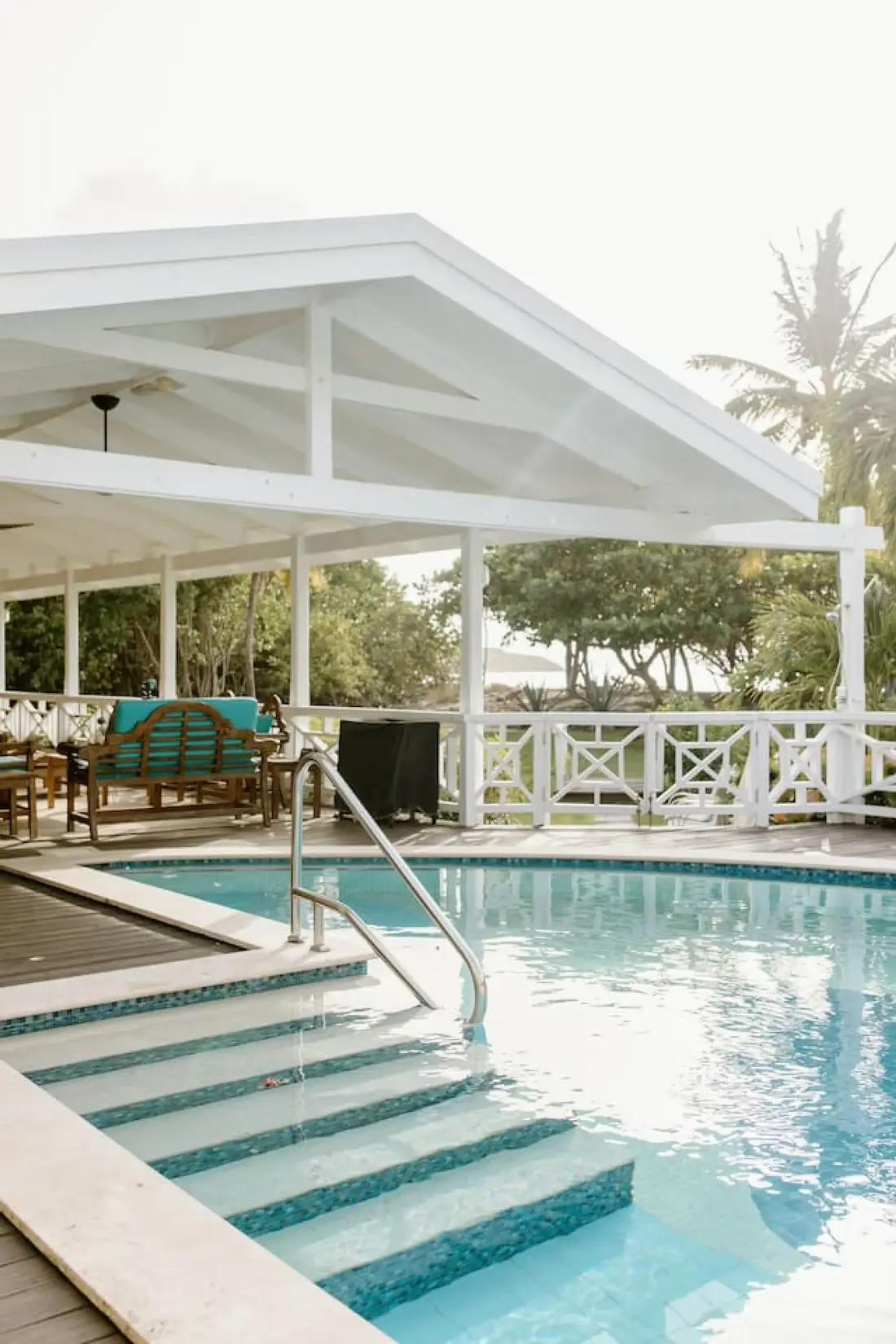 Shoy's Beach House6 bd · 6 ba · sleeps 12 · Christiansted
More in History & Culture
Sources
12 references, listed in full at the end of this guide — official park, refuge, tourism-board and business sources, checked August 2026.