Our guides already catalog where to snorkel on St. Croix. This post covers the part the lists leave out: how to read the water before you get in, where and how to enter at the spots people actually snorkel, what lives over which kind of bottom, the gear and sunscreen rules that apply here, and how to arrange a week so your best snorkeling lands on the best water.
A list of spots answers one question: where. It does not answer the questions that decide how the morning actually goes. Is today a north shore day or a west side day? Why did the family that entered at the boat ramp have a lovely swim while the couple fifty yards down the beach limped out with urchin spines in their feet? Why did you see three turtles over the seagrass and none over the coral? None of that is luck. All of it is learnable, and most of it can be learned before you ever put a mask on.
So treat this as the skills course that sits on top of the spot list. For the spots themselves, coast by coast, start with our shore snorkeling guide and the individual beach guides it links. What follows is how to use them well.
The wind decides where you snorkel
One fact organizes every snorkeling decision on St. Croix: the trade winds blow from the east nearly all year. The island lies roughly east to west, about 22 miles long, so the wind gives every coast a fixed character. The East End takes the weather first and is the roughest on an average day. The north shore runs crosswise to the trades and picks up chop as the wind builds, plus swell from distant Atlantic storms in winter. The west coast lies in the lee of the whole landmass, sheltered from the trades, and its water is the flattest you will find, day after day.
That is why the west end beaches around Frederiksted feel like a pool on days when the East End bays are white-capped, and why the same spot can be glass on Tuesday and a washing machine on Friday. The spot did not change. The wind did.
The practical rule: the harder the wind is blowing, the farther west you snorkel. On a light-wind day, everything is open, including the East End. On a moderate day, the north shore still works in the morning. On a windy day, go west and snorkel the lee, or make it a Frederiksted Pier day, where the water stays calm in almost anything. You do not need a forecast app to apply this, although one helps. You need to notice which way the palms are leaning and how hard.
Swell is the second variable, and it runs on a different calendar than wind. In winter, storms far out in the North Atlantic push long-period swell down onto the north shore even on windless days. That is when Cane Bay can look deceptively smooth from the road and still be surging over the shallow reef. Summer and early fall usually bring the flattest, clearest water of the year on every coast. Hurricane season runs June 1 to November 30, most active in August and September; the ocean between disturbances in those months is often superb, and you simply watch the forecast like everyone else on the island.
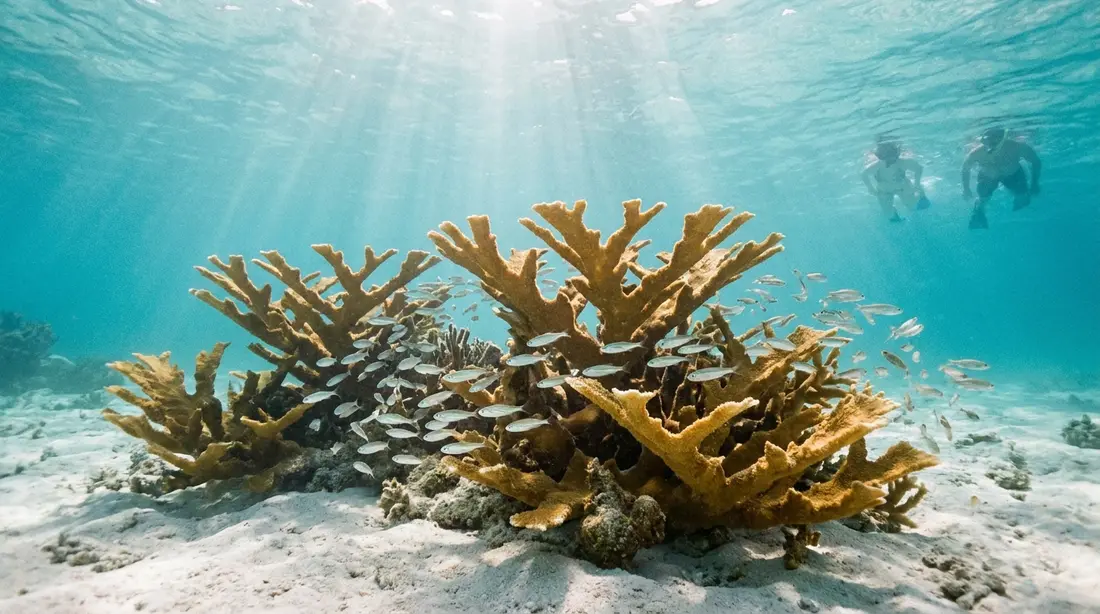
Why mornings win
Nearly every good snorkel on St. Croix happens before lunch, and there are three separate reasons.
First, wind. The trades are usually lightest around dawn and build through the day, often peaking mid-afternoon. A north shore that is snorkelable at 8 a.m. can be choppy by 1 p.m. The sea does not care about your brunch reservation.
Second, visibility. Chop stirs sand into the water column, so the same reef reads clearer on calm morning water. Rain matters too: heavy overnight rain sends runoff out of the guts and can leave a milky band along shore, especially near town. After a big rain, give the water a morning to clean up, or pick a spot away from the drainage.
Third, light. Color underwater depends on sunlight getting down to the reef. Very early, the sun is too low and the reef reads gray-blue. By mid-morning the angle is good and the water is usually still calm, which makes roughly 9 to 11 a.m. the sweet spot most days: settled water plus real color. Photographers chase exactly that window.
The morning rule shapes the whole vacation day, and it shapes it well. Snorkel early, eat a long lunch, spend the afternoon on a calm west side beach or by the villa pool, and nobody feels shortchanged.
A five-minute condition check from the sand
Before any snorkel, stand on the beach for five minutes and actually look. This one habit prevents most bad days in the water.
- Whitecaps. Scattered whitecaps offshore mean wind chop. A few are fine for confident swimmers. A field of them means pick another coast.
- Sets. Watch the shoreline through several waves. Swell arrives in groups with quiet gaps between them. If the biggest sets are breaking over the entry or surging up the sand, the entry will be harder than it looks right now.
- Water color. Brown or milky water near shore means runoff or stirred sand, and visibility will disappoint. Clean blue over the reef is what you want.
- Other people. Snorkelers already out, moving easily, are the best condition report there is. An empty ocean on a nice day at a popular spot is worth a second thought.
- Movement. Pick a buoy or a swimmer and watch for a minute. Steady drift in one direction means current. Note which way it runs before you get in, and plan to start your swim against it so the ride home is free.
Add one phone check: the Frederiksted cruise schedule, if the pier is your plan, because the pier is off limits to swimmers when a ship is berthed. And when in doubt anywhere, ask a dive shop. The shops at Cane Bay and in Frederiksted look at this water every day, and a two-minute conversation beats an hour of guessing.
Entries and exits, spot by spot
Most snorkeling injuries on this island are foot injuries, and nearly all of them happen in the first and last ten feet of the swim. Every popular spot has a right way in.
Cane Bay. Enter at the sandy channel in front of the boat ramp. That lane of clean sand is the door; the areas either side of it hold coral heads and sea urchins in shallow water, which is exactly where people put their feet down. Walk in until the water is mid-thigh, put your fins on in chest-deep water, and swim out over the sand until the reef rises to meet you. Reverse the process on the way in: swim to the sand lane, fins off in chest-deep water, walk out. Our Cane Bay guide covers the beach itself.
Frederiksted Pier. Enter from the town beach beside the pier and swim to the pilings; the bottom is sand and the water is usually flat, which makes this the easiest entry on the island. The rules are the only complication: no swimming around the pier while a cruise ship is in port, so check the schedule first. Nep2une Scuba, the dive shop steps from the pier that longtime visitors will remember as N2theBlue, is the place to ask about conditions and rules on the day. The pier guide has the fuller picture.
The sheltered eastern bays. The Shoys and Chenay Bay have plain sand walk-in entries with no tricks, which is one reason we point beginners and families there first. Wade in, float, done.
Jack's and Isaac's Bays. The hike-in bays near Point Udall have patches of rock and rubble at the waterline, so wear reef shoes for the entry and pick your lane from the beach before you commit. Go only on calm days; the Jack's and Isaac's guide explains the trail and what to carry.
Two habits apply everywhere. Never enter or exit over living coral, for the reef's sake and for yours. And shuffle your feet on any sandy bottom rather than stomping, which gives a resting stingray time to move along; it is the standard courtesy everywhere rays live.
What lives over which bottom
The most useful snorkeling skill after swimming is knowing what kind of bottom you are looking at, because the bottom decides the cast of characters. People come back from a seagrass bed disappointed that the coral was thin, when the seagrass was the whole point: that is the turtle pasture. Read the bottom and you know what to look for.
| Habitat | Where you find it | What to look for |
|---|---|---|
| Fringing reef | Cane Bay inner reef, the eastern bays, Buck Island's lagoon | Parrotfish, blue tang, sergeant majors, trumpetfish, moray eels in crevices, hawksbill turtles working the sponges |
| Wall edge | Cane Bay, about 100 yards out | Schooling triggerfish, barracuda holding still in the blue, the occasional reef shark cruising the lip, open-water surprises |
| Seagrass beds | Chenay Bay, The Shoys, patches all along the sheltered bays | Green turtles grazing, southern stingrays, conch trails, flounder if you look closely |
| Sand channels | Between reef patches everywhere | Stingrays resting under a dusting of sand, garden eels, jacks passing through |
| Pier pilings | Frederiksted Pier | Seahorses, frogfish, octopus, squid, juvenile trunkfish, sponges and soft corals on the structure itself; tarpon after dark |
The turtle logic is worth spelling out, because turtles are what most visitors want most. Green turtles are grazers; NOAA describes their diet as mainly seagrasses and algae, which is why you find them over the grass beds in the calm eastern bays, heads down, surfacing every few minutes to breathe. Hawksbills eat reef sponges almost exclusively, so you find them on the coral itself, nosing into crevices. If you want turtles, in other words, do not circle the prettiest coral head all morning. Swim the border where reef meets grass and check both sides.
Rays follow similar logic. Southern stingrays feed over sand and seagrass, and what you usually see is the outline: a diamond shadow under a thin blanket of sand, or two eyes and a tail. Spotted eagle rays are the flyers, passing along the reef edge in open water, and a sighting is a good day anywhere on the island.
The pier deserves its own note because it breaks the pattern. A pier is an artificial reef built vertically, and the pilings concentrate small, strange, slow life that open reef scatters: seahorses wrapped around sponges, frogfish doing their impression of a lump, octopus in the shadows. It rewards a completely different pace. Pick a piling, stop swimming, and stare at it for two full minutes. The piling will start producing animals you were swimming past.
The wall, for snorkelers
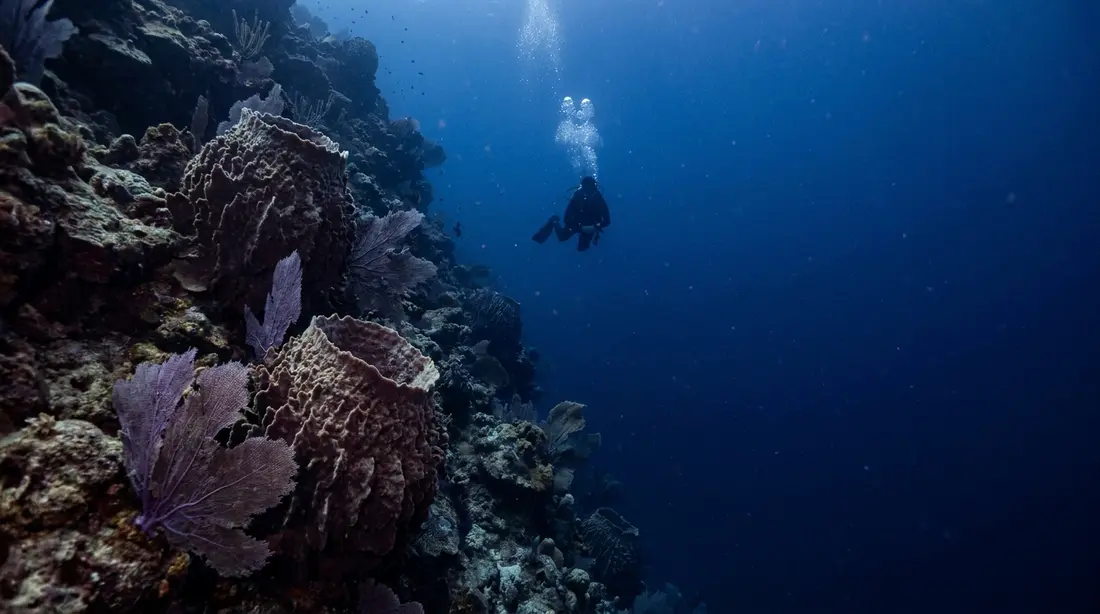
St. Croix's north shore is famous in diving circles for its wall, and Cane Bay is the one place a strong swimmer can visit it with just a mask and fins. From the beach, the bottom runs out over sand and reef to a lip roughly 100 yards offshore, and past that lip the bottom simply leaves: the drop begins around 40 feet down and falls away toward depths measured in thousands of feet.
From the surface, the experience is a color line. The mottled browns and golds of the reef end at a band of deep, structureless blue, and hanging over that edge is dramatic even though you are doing nothing but hanging at the surface. Schools stack up along the lip, barracuda hold in the current, and divers' bubbles come up past you like champagne.
Be sober about who this swim is for. It is 100 yards out and 100 yards back, in water that can carry current and surface chop, over a bottom too deep to stand on. That is a real swim, for confident ocean swimmers only, ideally with fins, a floatation aid, and a partner. Everyone else has two good options: enjoy the inner reef, which holds most of the fish in a fraction of the distance, or see the wall properly with one of the Cane Bay dive shops across the road, from a boat, with a guide.
Buck Island, the guided day
Everything else in this post is do-it-yourself. Buck Island is the opposite, by design, and it is better for it.
Buck Island Reef National Monument sits about 1.5 miles off the northeast coast: a 176-acre island inside 19,015 protected acres of sea, a no-take reserve ever since 1961, when President Kennedy set it aside. You cannot drive there and you cannot anchor your own rented kayak there; access is by permitted boat only, which in practice means booking a trip with one of the concessionaires the NPS authorizes, departing from the Christiansted boardwalk and the East End, or holding a private-vessel permit. Our boat tour guide compares the operators; crossings take anywhere from 40 to 90 minutes, depending on which boat you choose.
The centerpiece is the underwater trail in the east lagoon, a marked snorkel route through elkhorn coral gardens and one of only three underwater trails in the United States. You swim it in a small group with the crew, reading the markers, over fish that have never been hunted and act like it. Half-day trips pair the trail with time on Turtle Beach at the island's west end; full-day trips add lunch and a longer beach stay.
Here is why the guided format matters for this post's purposes: Buck Island is where the conditions problem is handled for you. The crew picks the day's route for the wind, watches the group in the water, carries flotation for nervous swimmers, and calls it off when the weather says so. If someone in your party is an anxious snorkeler, put Buck Island early in the week. A morning inside a calm, guided lagoon builds exactly the confidence the shore spots ask for. Book it for early in the trip anyway, so a windy day can push it later without pushing it off the calendar.
Gear that earns its place in the bag
Snorkeling gear is a short list, and quality matters in inverse order to price.
The mask is everything. A leaking mask ruins a snorkel faster than rain, jellyfish, or a cranky toddler. Fit test: hold the mask to your face without the strap, breathe in gently through your nose, and let go. A mask that fits stays put on suction alone. Do this in a shop before the trip if you can; a mid-range mask that fits your face beats an expensive one that fits someone else's. Defog it with the shop's drops or a dab of baby shampoo, rinsed, every single time.
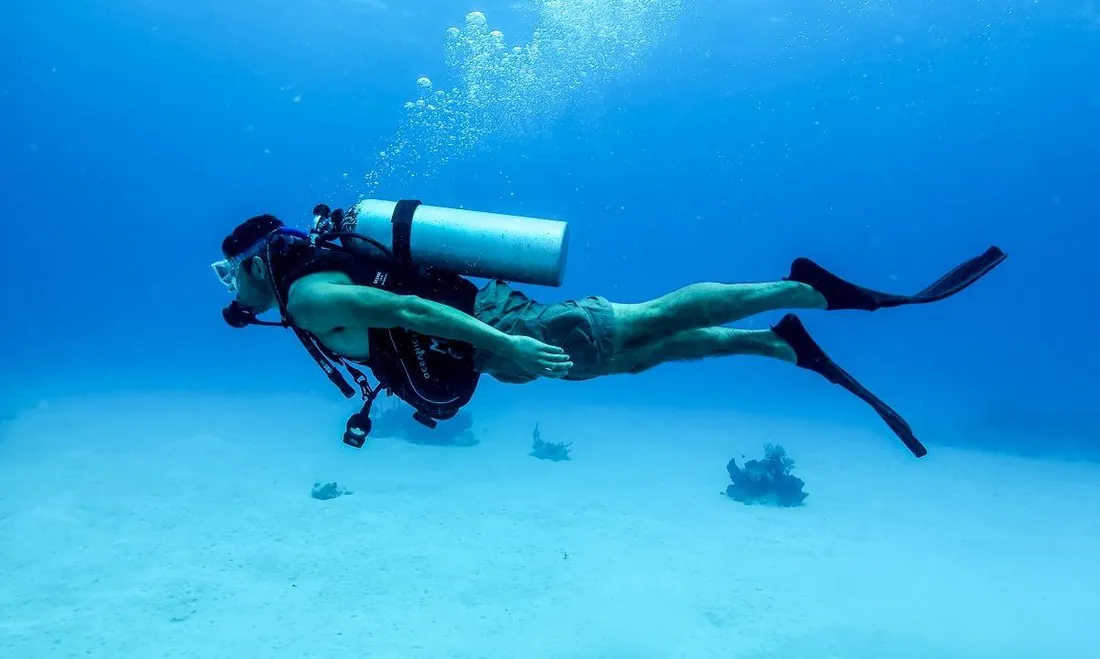
Fins, for any real swim. For a slow drift over seagrass at Chenay Bay you can skip them. For Cane Bay, the pier's outer pilings, or anywhere current might show up, fins are the difference between swimming and struggling. Open-heel fins with neoprene socks double as foot protection on rough entries.
A flotation aid, with zero shame. An inflatable snorkel vest lets you adjust buoyancy with one breath, rest without treading water, and stay out twice as long. The strongest swimmer in your group will borrow it by day three. Pool noodles work fine in the calm bays.
A rash guard. A long-sleeve rash guard blocks most of the sun on the body part that actually burns while snorkeling, your back, and cuts your sunscreen use accordingly. The water is warm year-round; almost nobody needs a wetsuit for snorkeling here.
Reef shoes. For the hike-in bays and any rocky entry. Cheap, light, and the reason your week does not include tweezers.
If you would rather not fly with any of it, rentals are easy: the dive shops at Cane Bay and Frederiksted rent snorkel sets, West End Water Sports rents gear right on the sand at Rainbow Beach, and every Buck Island operator includes gear in the trip.
Gear you can skip
The snorkel aisle is full of solutions to problems St. Croix does not have.
Full-face masks look reassuring and work acceptably for calm-water floaters, but they are hard to clear if they flood, awkward to equalize if you duck-dive, and useless the moment conditions pick up. A standard mask and snorkel is the better tool everywhere on this island, and it packs flatter.
Gloves solve a problem you should not have, because nothing on the reef is yours to touch. Dive knives, the same. Camera poles longer than your arm mostly produce footage of a pole. And a cheap action camera changes more snorkels than it improves: chasing the shot is the main reason people kick coral, crowd turtles, and miss the animal that was hovering behind them the whole time. Bring the camera, take your pictures, then put it away for the second half of the swim. The second half is usually better.
One purchase that beats all of the above: a bright surface float or dry-bag buoy on a short leash. It makes you visible to boat traffic, gives you something to rest on, and carries the car key. Fishermen and freedivers here use them for a reason.
The sunscreen law
The U.S. Virgin Islands regulates sunscreen, and visitors are expected to comply, so this deserves its own section.
The territory banned sunscreens containing three specific chemicals: oxybenzone, octinoxate, and octocrylene, often called the toxic three O's. The law was signed in July 2019 and its final phase, covering sale, distribution, and possession, took effect March 30, 2020. The reasoning is the science connecting those ingredients to coral damage and bleaching; they wash off swimmers directly onto the reefs the territory depends on. The USVI was among the first places in the world to go this far, and the reefs in this post are exactly what the law exists to protect.
Compliance is simple. Use mineral sunscreen, meaning the active ingredients on the back of the tube are zinc oxide or titanium dioxide and nothing from the banned list. Read the front of the bottle skeptically and the back of it carefully: plenty of products labeled reef-friendly still contain octocrylene, which is the one people miss. Island stores stock compliant sunscreen everywhere, so buying it after you land is the zero-effort option.
Better still, need less of it. A rash guard and a hat cover more skin more reliably than any lotion, never wash off, and never need reapplying. Cover up, then use mineral sunscreen on what is left: face, neck, backs of the legs. The backs of the knees and calves are the classic first-day snorkeling burn; they face the sun the entire time you float.
How to behave around the animals
The rules of conduct on a reef are not etiquette for its own sake. Each one traces to how the animals and the coral actually work.
Coral is the one to internalize. It is an animal, a colony of them, and the living tissue is the thin outer layer, exactly the part a hand or a fin tip hits. A casual touch can kill patches of a colony that took decades to grow, and some corals return the favor; fire coral stings like its name. So the discipline is body position: float horizontal, keep your fins up behind you, and never stand on anything that is not clearly sand. If you need to rest or fix a mask, that is what your float is for, or swim to sand first.
Turtles breathe air. Every turtle you watch is on a clock, and it will need to come up. The classic mistake is a snorkeler hovering directly overhead for the photo, which blocks the runway to the surface. Stay to the side, keep a few body lengths of distance, and let the turtle set the pace; a turtle that keeps grazing while you watch is a turtle you are watching correctly. Chasing any animal ends the encounter every time. Stillness extends it.
Rays want warning, which is what the sand shuffle at entry is for. Give a resting ray its space and it will usually let you watch it for as long as you like.
And take nothing. Buck Island is a no-take reserve down to the smallest shell, and shells and coral are protected around the island generally. The souvenir is the photograph.
Safety, in plain terms
St. Croix snorkeling is about as forgiving as ocean swimming gets, and a few habits keep it that way.
Snorkel with someone. The water here is rarely fierce; the reason for a partner is that the ocean's small problems, cramp, a broken fin strap, a swallowed wave, are trivial with company and tiring alone. If you do go out solo at a busy beach, stay inside the area other swimmers are using and tell someone on shore your plan.
Know the current drill. Currents here are mostly gentle longshore drifts, and the five-minute beach check will have shown you the direction. If you ever find yourself working harder than expected to get home, do not swim straight against it. Swim across it, toward shore at an angle, and let it spend itself. Fins and a float turn this from a scare into an anecdote.
Respect boat traffic. Snorkelers are hard to see from a console. Stay over the reef and out of channels, keep your bright float with you, and be extra alert near the Christiansted boardwalk and anywhere boats moor. At the pier, the rule is absolute: stay out of the water when a cruise ship is in port.
Mind the small hazards. Urchins live in exactly the rocky shallows people wade through; enter over sand. Fire coral and fireworms punish touching, which you were not going to do anyway. Jellyfish appear occasionally; a rash guard handles most of what they offer.
Know your fuel gauge. Cold is rarely the limit here, but sun, dehydration, and yesterday's rum punch all are. Snorkel before you drink, not after, and get out one round before you are tired, because the exit swim is the one that counts.
Snorkeling by season
There is no bad season to snorkel St. Croix; the water is swimmable every day of the year. The character of the days shifts, and the plan should shift with it.
Mid-December to mid-March. Peak season, and the season of the Christmas Winds, the brisk trades that make winter the breeziest stretch of the year. Winter also sends occasional north swell onto Cane Bay and the north shore. The playbook: snorkel early, keep plans flexible, and let the west side be your reliable friend. The pier and the sheltered eastern bays produce good snorkeling nearly every winter day.
April and May. The winds ease, the crowds thin, and the north shore comes back into its calm rotation. Excellent conditions with less competition for them.
June through August. Typically flat, warm, and clear, with a drier lull in early summer. The best months for the East End spots and for stringing together several different snorkels in one week.
September through November. Statistically the most active stretch of hurricane season, and also the island's quietest and greenest. Between weather systems the ocean is often the flattest of the year. Book with flexible cancellation, watch the forecast, and enjoy having the reef largely to yourself.
Whatever the month, rain is the wildcard that people forget: a heavy squall can cloud nearshore water for a day. If the morning after a downpour looks milky, swap the reef morning for a town morning and snorkel the next day instead.
Building the snorkel week
A week gives you room to do this properly, which mostly means putting the flexible things early and matching each day's spot to each day's water. Here is a template built on everything above; bend it to your group and the forecast.
| Day | Plan | Why this order |
|---|---|---|
| 1 | Easy shakeout swim at The Shoys or Chenay Bay; book the Buck Island boat | Test everyone's gear and comfort in sheltered water; boats fill, and early booking leaves reschedule room |
| 2 or 3 | Buck Island: underwater trail plus Turtle Beach | The guided day builds skills and confidence for the rest of the week |
| 3 or 4 | Cane Bay, morning | Spend a calm morning on the island's signature shore snorkel; strong swimmers visit the wall lip |
| 4 | West side float day at Rainbow Beach or Dorsch | Rest day that still gets everyone in the water; gear rentals on the sand |
| 5 | Frederiksted Pier, morning, no ship in port | A completely different habitat; slow snorkeling over the pilings |
| 6 | Jack's and Isaac's Bays, calm day only | The adventurous one: hike in, reef shoes, carry water, have it to yourselves |
| 7 | Repeat the group's favorite | By now you will know it, and second visits at a known spot are always better |
Two scheduling notes make this run smoothly. First, treat every snorkel as a morning event and plan afternoons around beaches, food, and shade; the wind will enforce this anyway. Second, hold the plan loosely. The order above assumes average conditions, and the whole skill this post teaches is swapping days without regret. A windy Tuesday does not cancel Cane Bay; it moves Cane Bay to Thursday and moves the pier up.
You will want a rental car for all of it. The island has never had Uber or Lyft, you drive on the left side of the road in standard left-hand-drive cars, and no snorkeling spot on the island is much more than 40 minutes from any other, which is exactly what makes the swap-the-day strategy work.
Questions guests ask
Is St. Croix good for first-time snorkelers?
Yes,. The sheltered eastern bays offer calm, shallow water over seagrass where beginners can float in comfort and still see turtles and rays, which is a better first snorkel than most islands can offer. The guided Buck Island trip adds a crew, flotation, and a protected lagoon. The skills ladder is real here: bays first, then the pier, then Cane Bay's inner reef, then, for strong swimmers only, the wall lip. A family can spread that progression across one week.
Do I have to take a tour to snorkel Buck Island?
In practice, yes. Buck Island Reef National Monument is reachable only by boat, and visitor access runs through the concessionaires authorized by the National Park Service, most departing from the Christiansted boardwalk, or through a private-vessel permit arranged with the park. There is no swim-from-shore option and no freelance drop-off. The upside is that the tour is the experience: the crew guides the marked underwater trail, and the trips pair it with beach time on the island.
When is the water calmest?
Summer and early fall are typically the flattest and clearest stretches, and mornings beat afternoons in every month because the trade winds build during the day. Winter brings the Christmas Winds, which blow from about mid-December until mid-March, plus occasional north swell on the north shore, so winter snorkeling leans on early starts, the west coast, and the sheltered eastern bays. There is no month where you cannot snorkel; there are only days when you should snorkel somewhere else.
Can you snorkel Frederiksted Pier any day?
No. Swimming around the pier is prohibited whenever a cruise ship is berthed, so the pier snorkel is a check-the-schedule activity. Ship-free days are common outside peak cruise season and the schedule is public, so planning around it is easy. On the day, the dive shops in Frederiksted can confirm conditions and rules; conditions themselves are rarely the problem, since the west coast water at the pier is the calmest on the island.
Will we see sharks?
Almost certainly not while snorkeling, and that disappoints more visitors than it relieves. Divers along the Cane Bay wall report the occasional reef shark cruising the drop-off, and reef sharks are a normal, healthy part of a Caribbean reef. In the shallow water where snorkelers spend their time, sightings are rare. The animals you will actually need to manage are sea urchins at rocky entries and the sun on the back of your legs.
What sunscreen is legal in the USVI?
Mineral sunscreen whose active ingredients are zinc oxide or titanium dioxide. The territory bans sunscreens containing oxybenzone, octinoxate, or octocrylene; the ban has been fully in effect since March 30, 2020. Check the active-ingredients panel rather than trusting a reef-friendly label, because octocrylene still appears in products marketed as reef-safe. Compliant sunscreen is sold all over the island, and a long-sleeve rash guard reduces how much of it you need in the first place.
Do we need to bring our own gear?
No. Every Buck Island operator includes snorkel gear in the trip, the dive shops at Cane Bay and in Frederiksted rent good sets, and West End Water Sports rents gear on the sand at Rainbow Beach. That said, a mask that fits your own face is the one item worth packing, because fit is personal and a leaky rental mask is the most common thing standing between a visitor and a great snorkel. Masks pack flat; bring yours and rent the rest.
Where to stay for a snorkeling week
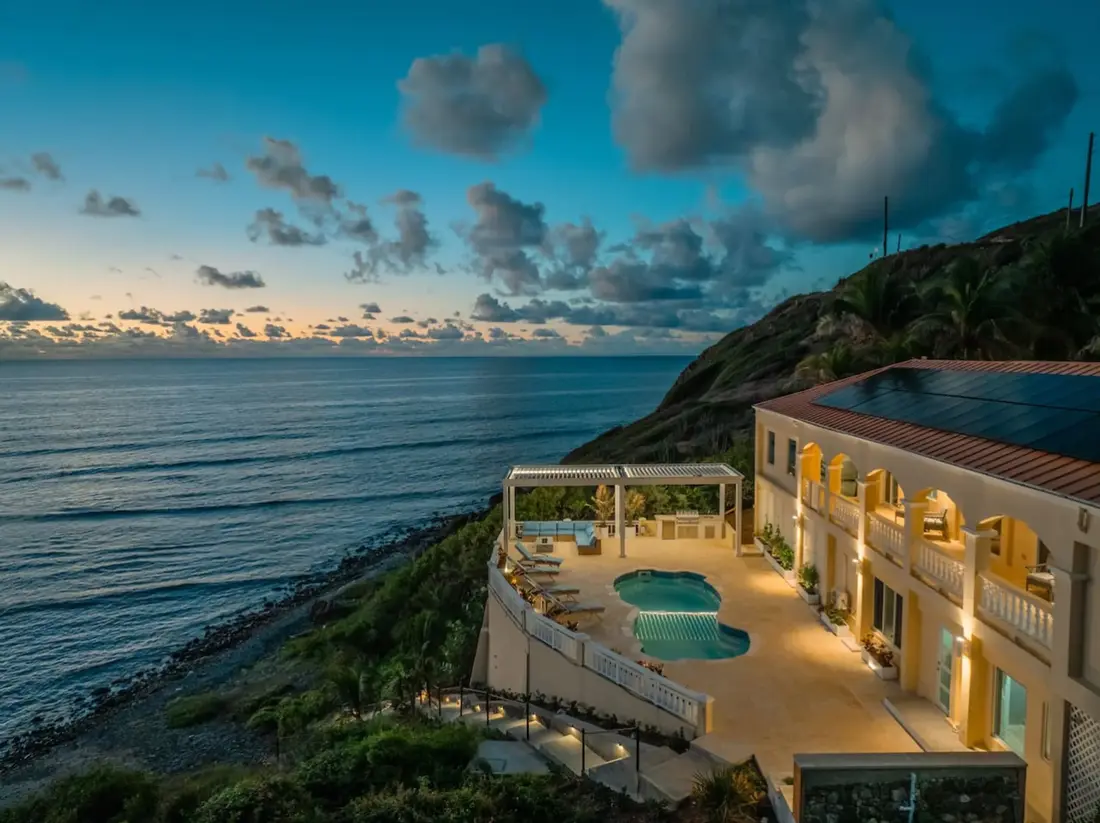
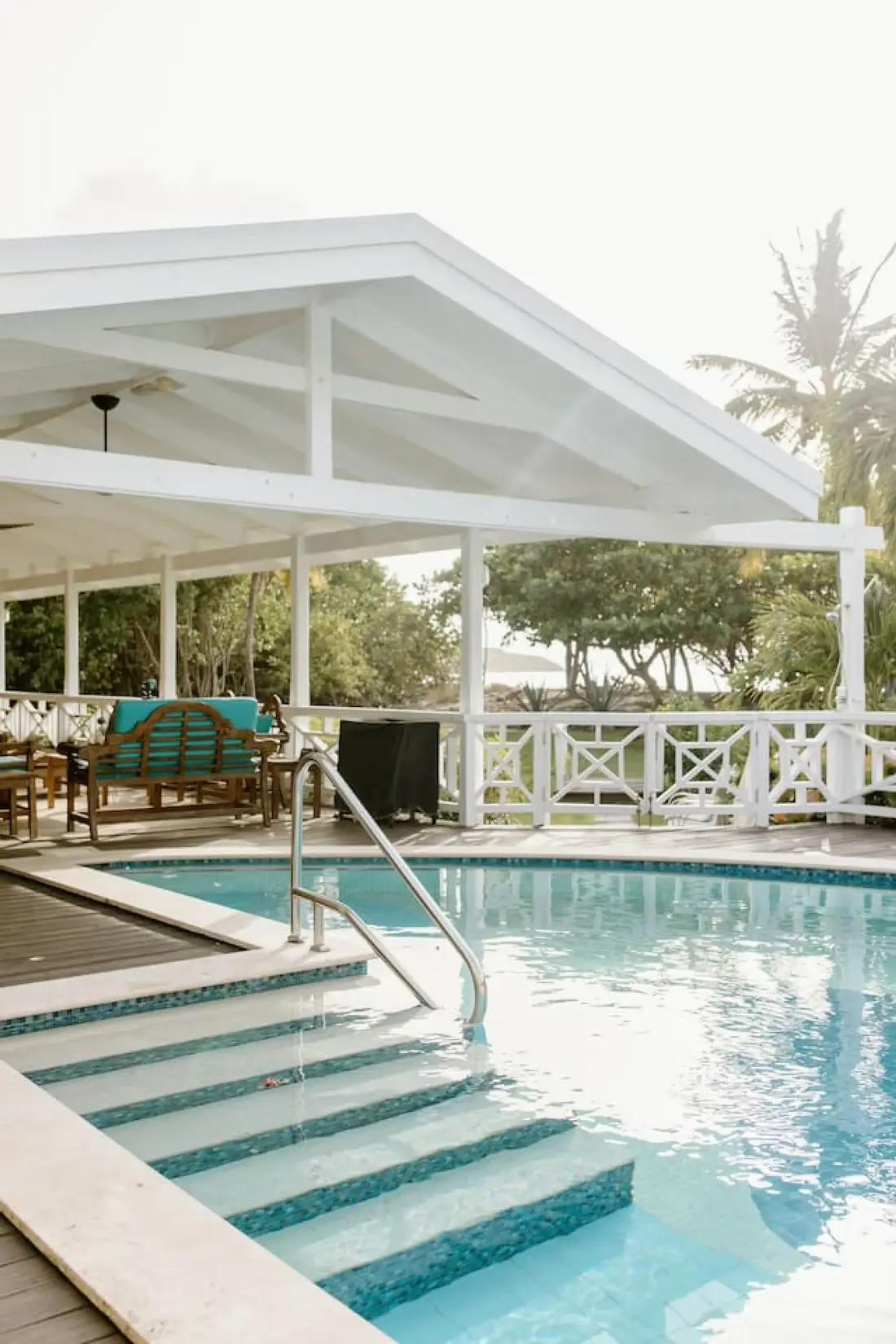
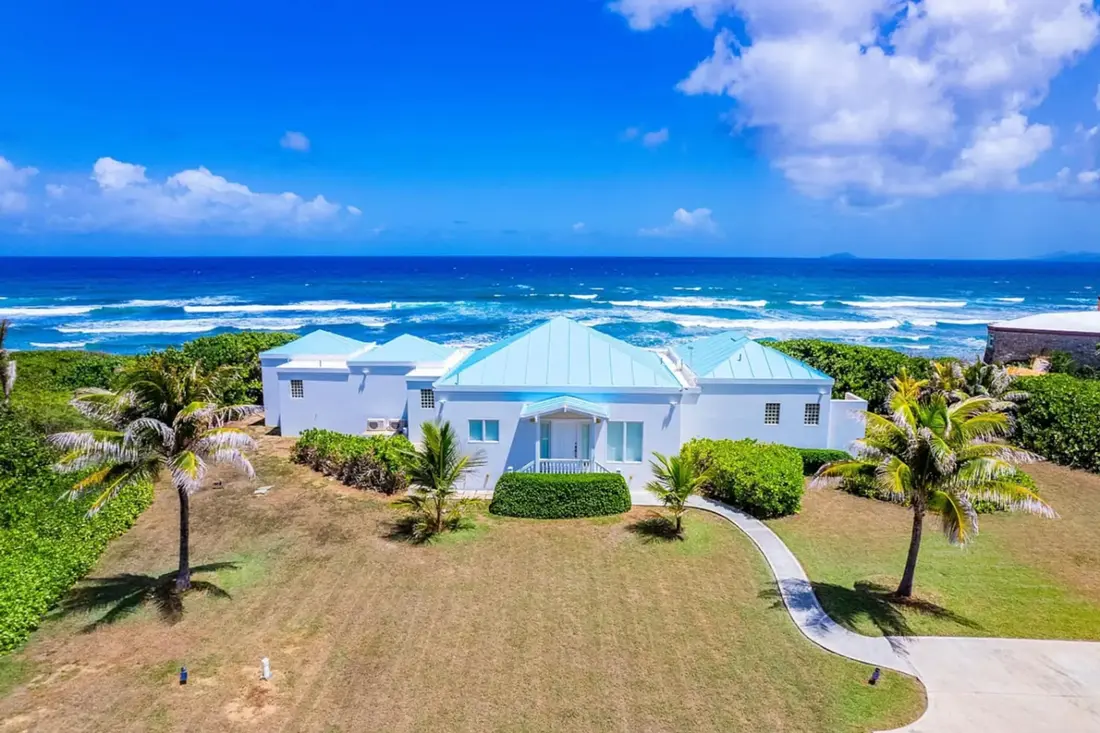
Where you sleep decides which snorkel is your easy default. Shoy's Beach House opens straight onto The Shoys itself, which puts the island's best beginner water at the bottom of the garden. On the East End, The Cerulean has a private beach and faces Buck Island across the water, and The Buck Island Overlook keeps the monument in view from the terrace, a daily reminder to book the boat. The rest of our beachfront homes and East End villas put the sheltered bays, the Christiansted boardwalk departures, and the north shore all within an easy morning drive. Every home we manage works as a base for the week in this post; the difference is which reef you can reach before breakfast.
Sources
Written from official and first-party sources, checked August 2026. Hours, prices and event dates change — confirm before you go.