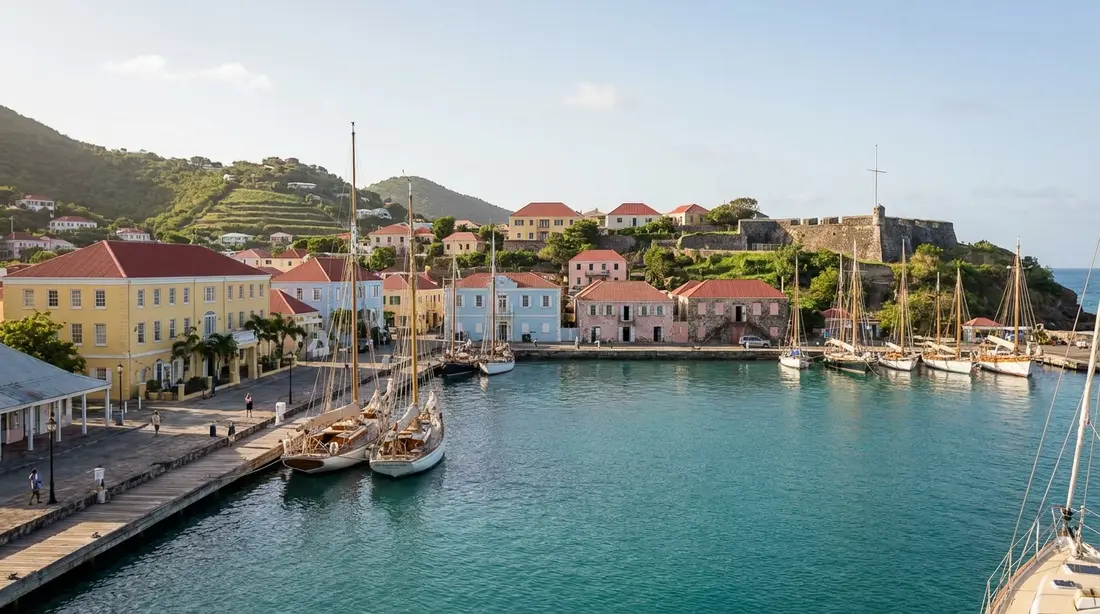
Christiansted is St. Croix's harbor town, and the best way to learn it is on foot. Park once, walk the boardwalk before the heat, take the fort at opening, follow the arcaded streets through the old Danish quarter, swim off the cay in the afternoon, and stay through dinner. This post walks that whole day in order, with the practical details, parking, hours, and fees, exactly where they come up.
Most write-ups of Christiansted are lists: five things to see, seven places to eat. Useful, and we keep those lists current in our Christiansted guide and the pages linked from it. But a list does not tell you how the town actually fits together, which matters here more than in most places, because Christiansted is small enough to cover entirely on foot and dense enough that the order you do things in changes the day. The fort opens at 8:30 and the light on the ramparts is best early. The arcades give you shade at noon, when you need it. The swim is a two-minute ferry ride you can take at two in the afternoon. The boardwalk is at its best from golden hour on. Walk the town in the right order and everything lines up.
So this is the day as we would actually spend it, hour by hour, morning through the drive home. Every place named here was operating at last check in August 2026, and every hour and price carries a date or a hedge, because both change on an island. Where a subject has its own reference page on this site, we link it and move on; this post is the connecting thread, the walk itself.
One orientation note before the day starts. Christiansted sits on the island's northeast coast, on a harbor protected by a reef line and by Protestant Cay, the small green island a few hundred yards off the wharf. The old town is a compact grid a few blocks deep: Strand, King, Company, and Queen Streets, stitched together by short cross streets with names like King Cross, Queen Cross, and Church. The fort anchors the east end of the waterfront, the seaplane base sits at the west end, and the boardwalk runs between them. That is the whole stage.
The shape of the day
Here is the skeleton, built around the hours that are fixed. Everything else in this post hangs off it.
| Time | Where you are | Why then |
|---|---|---|
| 7:00 am | Boardwalk loop, then coffee | Coolest hour; the harbor is glass; the coffee house opens at 6:30 weekdays at last check |
| 8:30 am | Fort Christiansvaern | Opening time; low sun on the yellow brick; the rooms are empty |
| 10:00 am | The historic waterfront, then the arcaded streets | Shade under the galleries as the heat builds |
| 12:30 pm | Lunch | Harbor view or side-street shade; your call |
| 2:00 pm | Protestant Cay, or the shops | The ferry crossing takes about two minutes |
| 4:30 pm | Back at the car if you parked at the fort | The NPS lot must be empty by 4:30; towing is enforced |
| 5:30 pm | Boardwalk, drink in hand | Golden hour; the Buck Island boats come home |
| 7:00 pm | Dinner | Reserve the fine-dining rooms; walk in on the waterfront |
You do not need to do all of it. Guests staying two weeks tend to do this day in pieces, a morning here, a dinner there. But the full version works as a single day, and first-timers usually remember it as the day St. Croix came into focus.
Getting into town and parking
Driving here is on the left, and downtown Christiansted adds a second wrinkle: the core streets are one-way, and they can back up around midday. The local habit, and our standing advice, is to treat the car as a way to reach the edge of town, then park once and walk everything. Nothing in the old quarter is more than about ten minutes on foot from anything else.
There are three parking answers that matter, all verified against the island's own published guidance, with rates as of last check.
| Lot | Cost at last check | Hours at last check | Notes |
|---|---|---|---|
| Government lot, Strand Street near King Cross | $1 per hour, $5 daily cap | 7:30 am to 6:00 pm daily | The full-day answer; central to everything |
| Fort Christiansvaern lot (NPS) | Free with fort visit | 8:30 am to 3:30 pm, two-hour limit | Towing enforced; the lot must be clear by 4:30 pm |
| Small lot across from the seaplane terminal, west end | Free | Unposted; arrive early | Handy for the west end of the boardwalk |
| Street parking | Free where legal | Fills by mid-morning | Parallel spots; read the signs on the one-way blocks |
If the day includes an evening in town, the government lot's 6:00 pm close means street parking or asking your restaurant where regulars leave the car. Dinner crowds manage it every night; it just takes one extra loop of the block. For the wider subject of cars, taxis, and getting around the island, our getting around page covers it; the short version is that there is no Uber or Lyft on St. Croix, so the car you drove in on is your ride home.
The boardwalk before eight
Start at the water. The Christiansted boardwalk runs along the harbor through the middle of town, and at seven in the morning it belongs to walkers, fishermen, and staff hosing down decks. The trade wind has not come up yet, the harbor is usually flat, and Protestant Cay sits a few hundred yards out with the sun on it. Walk the full length once, fort to seaplane base and back, and you will have seen the town's whole waterfront before most visitors are awake.
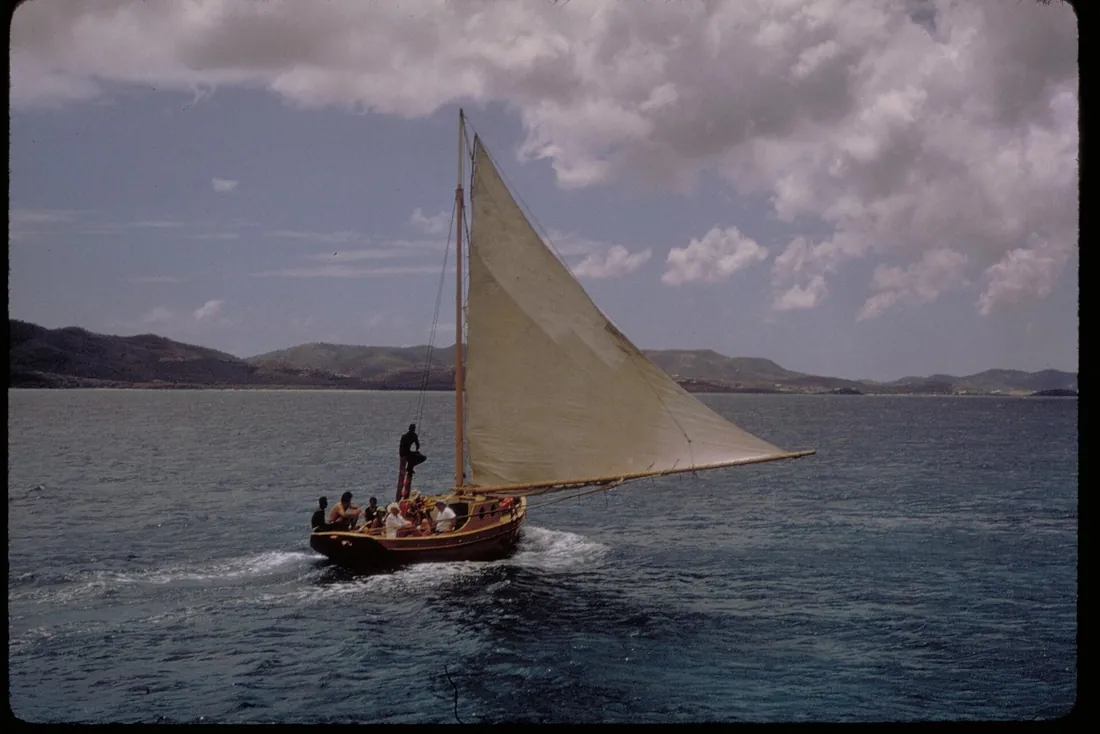
This is also when you understand what the boardwalk is: a working dock street. The catamarans tied along it, Big Beard's boats, Caribbean Sea Adventures' fleet, the Jolly Roger, will load snorkelers for Buck Island by mid-morning. The dive shop at the east end, Blue Salt Divers at 1000 King Street, carries on the island's oldest dive operation. In winter you may see a tall ship anchored out; the World Ocean School's schooner has wintered in the harbor in recent seasons and sold afternoon public sails. All of that traffic starts here, which is why our boardwalk guide is mostly a directory of boats. At this hour, though, it is simply the best walk in town.
Coffee is a block inland. Twin City Coffee House and Gallery, at 1 Company Street, opens at 6:30 on weekdays at last check, closes by early afternoon, and stays closed Sunday. It is a coffee house in an old arcaded building with local art on the walls and a courtyard in back, and the breakfast sandwiches are the real thing. Carry the cup back to the waterfront railing if you want the view with it. Toast Diner, a small side-street diner, is the other early option when it is open; both are covered with the rest of the town's tables in our Christiansted restaurants guide, linked at lunch below.
Fort Christiansvaern at opening
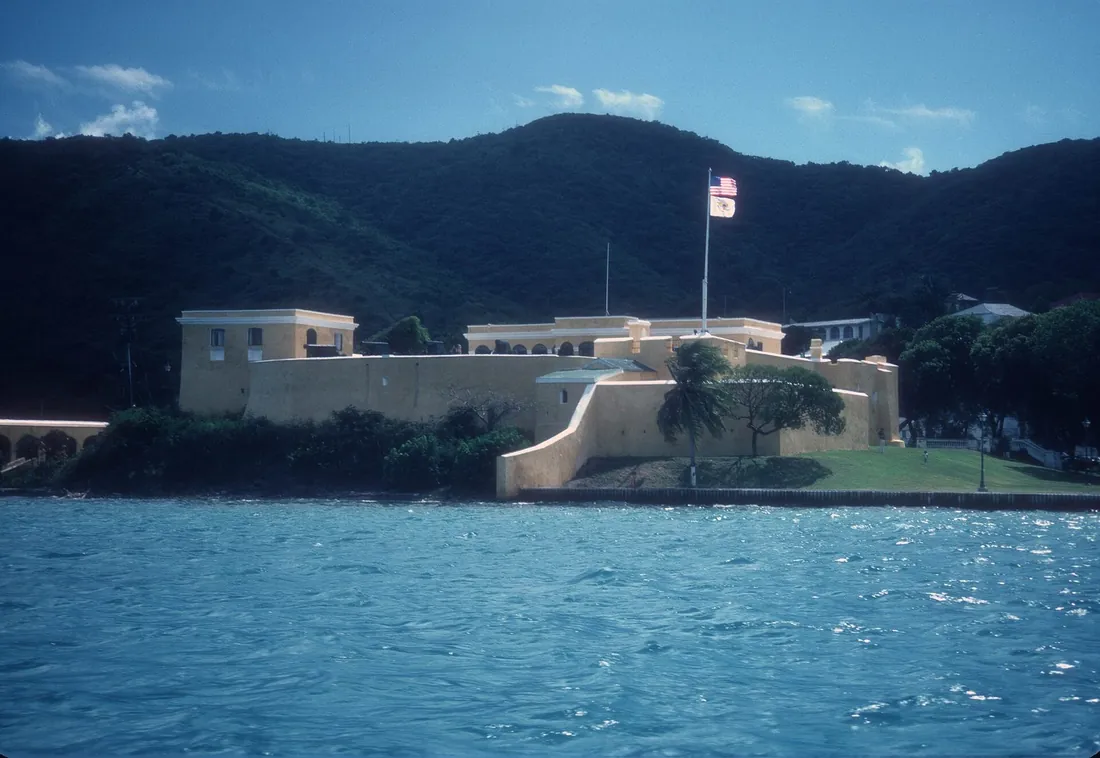
The fort opens at 8:30 am daily, closed only Thanksgiving and Christmas, and 8:30 is the time to go. The building is yellow Danish brick, completed by 1740, and in low morning light the color is at its deepest. You will likely have the ramparts to yourself for the first half hour.
Admission, as published by the National Park Service in August 2026, is $10 for adults 16 and older and covers three days, which matters if you want to come back with the family later in the week; children under 16 enter free with an adult, and the federal America the Beautiful passes are honored. The Park Service also posts a handful of free-entrance days across the year.
Give it a full hour. The rooms hold the garrison's quarters, the powder magazine, and the dungeons, and the interpretive panels are direct about what this fort was for: it defended a sugar port, and it enforced the slavery that made the sugar. Christiansted's history does not read comfortably, and the Park Service does not sand it down. Then climb to the ramparts, where the cannon still point across the harbor mouth, and look at the town behind you: red roofs, church towers, the green hills beyond. It is the best single view in Christiansted, and it costs ten dollars.
Two logistics notes. The fort's own lot allows two hours and the Park Service tows; if you are settling in for a long town day, use the government lot instead and walk over. And the site's welcome center and bookstore keep shorter hours than the fort, Monday through Wednesday 9 to 4 at last check, so plan any bookstore stop early in the week. The fort's full story has its own page in our Fort Christiansvaern guide.
The customs waterfront
Step out of the fort and you are standing in the middle of Christiansted National Historic Site, which protects five Danish buildings on this one stretch of waterfront. The other four sit within a couple hundred yards of the fort's gate, and even from the outside they explain the town better than any plaque.
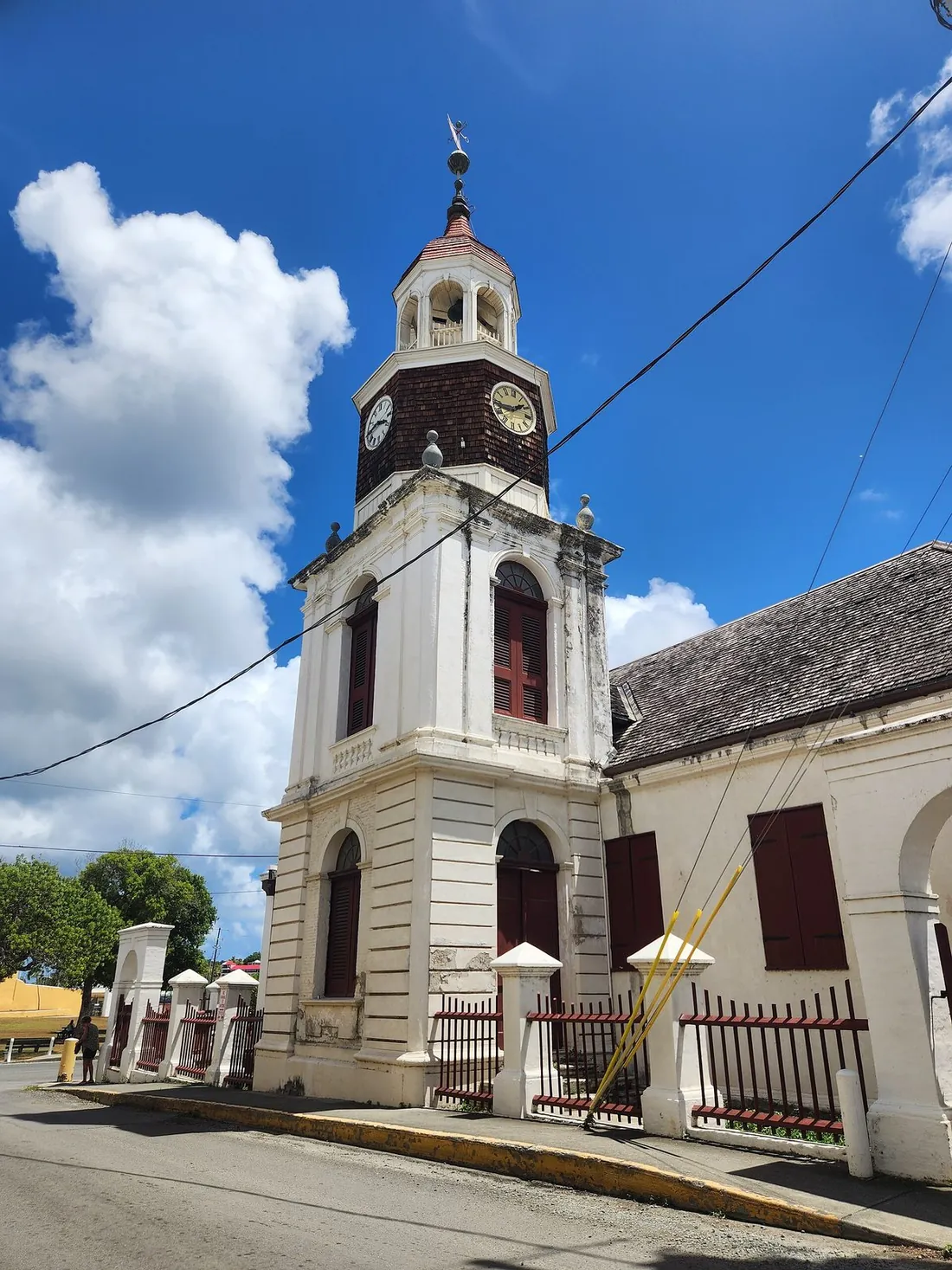
Walk them as a loop. The Scale House faces the wharf because everything the island produced crossed its scales; a hogshead of sugar was weighed here before it was taxed and shipped. The Danish Customs House next door collected the tax. The Danish West India & Guinea Company Warehouse, a block inland, was the trading company's depot, and its yard was a place where enslaved people were bought and sold; stand in front of it long enough to let that register. The Steeple Building, white with its wedding-cake tower, was the town's first Lutheran church and is the most photographed building in Christiansted after the fort itself.
The point of the loop is the system it reveals. Denmark bought St. Croix from France in 1733, took formal possession in a ceremony beside this fort in January 1734, and Frederik Moth laid out the town that same year as the capital of the Danish West Indies. What the Danes built at the water's edge was a machine for exporting sugar: weigh, tax, store, ship, defend. The five buildings are the machine, still standing in order. Opening hours for the interiors vary and some are closed for preservation work at any given time, so treat the loop as an outdoor walk and count anything open as a bonus. The full site, building by building, is in our Christiansted National Historic Site guide.

The arcaded streets
Now turn inland, because the town above the waterfront is the part most day visitors miss. Christiansted is described by historians as one of the world's few African-Danish towns: laid out to Danish plans, built by enslaved African craftsmen, and the result looks like nowhere else. Pastel stone buildings, red roofs, and, the signature, arcaded sidewalks that the Danes called galleries, stone arches carrying the upper floors out over the walkway.
King Street and Company Street carry the best continuous runs of arcade, and by ten in the morning you will understand why they were built. The sun here is serious by mid-morning, and the galleries put the whole shopping and business district in permanent shade. You can cross most of downtown at noon without standing in direct sun for more than a block. Eighteenth-century climate engineering, still working.
Walk slowly and look up as much as ahead. The arches change from block to block, brick here, cut coral stone there, because each owner built his own section to the town's rule rather than to a single design. Hurricane shutters hang beside doorways that have been in use since the 1700s. Street numbers follow the old Danish quarter system, which is why addresses like 2101 Company Street exist. A few buildings carry restoration plaques with their original construction dates; collecting those dates block by block is a good game to give kids. If you want the full architectural walk with the details named building by building, that is its own page: the Danish architecture walk. And Apothecary Hall, the preserved 1820 pharmacy on Company Street, is a worthwhile ten minutes when it is open; check current days before counting on it.
Government House and the Hamilton block
Two stops on this grid deserve their own paragraphs. The first is Government House on King Street, the grandest building in town and easy to walk past without realizing what it is. The central wing went up in 1747 as a merchant's private house; the Danish crown bought it as the governor's residence in 1771, absorbed the planter's residence next door to the west in 1828, and added the long eastern porch in the 1830s. When Denmark moved its colonial capital to Charlotte Amalie in 1871, the building stayed in government use, and it still hosts official functions for the territory today. Interior access depends on what is scheduled that day; when the gates are open, the courtyard and staircase are worth the look, and when they are not, the facade with its arcaded base is the finest single piece of Danish architecture on the street.
The second stop is a block over on Company Street, and it is about a teenager. Alexander Hamilton came to Christiansted around age eleven, after 1765, and lived at or near 34 Company Street, where his mother Rachel kept a small shop. Orphaned a few years later, he clerked for the export firm Beekman & Cruger, learning currencies, cargoes, and credit in a countinghouse a short walk from the wharf you stood on this morning. In 1772 local sponsors sent him to North America for an education, and the rest is the ten-dollar bill. There is no grand museum here, and that is rather the point: the town itself is the exhibit. The harbor he watched, the streets he walked, and the trade he learned are all still visibly one system, fort to scale house to warehouse to wharf.
The seaplane landing
Somewhere in your town day, probably more than once, you will hear a low twin-engine drone and see a small aircraft drop toward the harbor, flare, and land on the water in a long white plume. This is the Seaborne seaplane, and watching it land is a legitimate Christiansted activity; people on the boardwalk stop mid-sentence for it every time.
The practical facts, as of August 2026: Seaborne flies a DHC-6 Twin Otter floatplane between Christiansted Harbor and the Charlotte Amalie waterfront on St. Thomas, harbor to harbor in roughly 25 minutes. The airline has been operating the route with a single aircraft this year, so schedules are thinner than they once were and worth confirming close to your dates; an expansion of the fleet was announced in late 2025 but had not visibly materialized at last check. The terminal sits at the west end of the waterfront, which is why that end of town has the free parking lot mentioned earlier.
The seaplane is also half of the answer to a question guests ask constantly: can you day-trip to St. Thomas? Yes, two ways. The seaplane is the fast, scenic, more expensive way. The QE IV ferry is the steady way, sailing from Gallows Bay, the harbor district a few minutes' walk east beyond the fort, to Charlotte Amalie in about two hours and ten minutes, around $70 one way and $120 round trip at last check, with no sailings on Tuesdays on the recent schedule. Verify the week you travel; ferry schedules here move. Gallows Bay itself is worth knowing anyway: it is the town's marina-and-errands quarter, home to Undercover Books, the island's bookshop, which keeps coffee and pastries beside the shelves and hosts readings through the year.
Lunch in town
By half past twelve you have earned a long lunch, and Christiansted's lunch decision comes down to a simple pattern: water or shade. The town's full table-by-table rundown lives in our restaurants guide, so what follows is the pattern, with the names current as of August 2026.
The water option is the boardwalk. Shupe's grinds its burgers fresh and serves them with the harbor a few feet away; Rum Runners, at Queen Cross Street where it meets the waterfront, has been doing steaks and seafood over the water long enough to count as an institution. Both take walk-ins at lunch most days. You pay for the real estate with a busier room, and on a hot day the breeze off the harbor is worth it.
The shade option is a block or two inland, under the arcades and awnings. Frescos Kitchen & Pub House on Starboard Street cooks homemade breakfast and lunch a couple of blocks off the water and is where you will hear more local accents than visitor ones. Toast Diner does diner food in a small funky room. Twin City, if you are back there before it closes in the early afternoon, does salads and sandwiches that outclass its price point.
Two cautions that keep guests from walking to a dead door. Harvey's, the beloved Crucian lunch institution that older guidebooks still list, closed permanently. Zion Modern Kitchen no longer opens for regular service; it books private events only. Both closures are current as of August 2026. When a name you read somewhere is missing from our lists, that is usually why: we list what is open, and we re-verify.
The ferry to Protestant Cay
The town's swim is 200 yards offshore. Protestant Cay, the small island in the middle of the harbor, has a proper sand beach on its far side, calm water, and a view back at the town's red roofs that you cannot get any other way. A little ferry shuttles across from the boardwalk in about two minutes, historically running continuously through the day, with a round trip for non-hotel guests at $5 at last check.
The current state of play, because guests will find the news stories if they search: the small hotel on the cay, Hotel on the Cay, was ordered closed in January 2025 after Legionella bacteria were found in its water systems, and it was cleared by the health department to resume operations about a week later after remediation and clean tests. It has operated since, but the episode is a reminder that the cay is a one-business island: the ferry, the beach bar, and the watersports desk all run at the hotel's pleasure and schedule. Before you build an afternoon around it, have your villa manager confirm the ferry is running that week, or simply look across from the boardwalk, where you can see the shuttle making its crossings.
If the cay is not running, or you want a fuller beach afternoon, the nearest proper beach is The Shoys, about three miles east of town past the Buccaneer resort, a calm, quiet crescent reached through the Estate Shoys guard gate; give your name, say you are going to the beach, and drive through. Our Shoys beach guide has the details. Between the cay and The Shoys, a Christiansted day never needs to go swimless.
Shops and the people who make things
Christiansted's shopping is small-scale and maker-driven, which is exactly its appeal; there is no duty-free mall here, and most afternoons you will be handed your purchase by the person whose name is over the door. The jewelry story leads. St. Croix has a signature piece, the hook bracelet, designed in the mid-1960s by Sonya Hough, whose shop, Sonya Ltd. at 2101 Company Street, still makes the original more than sixty years on. Islanders read the hook like a signal: opening toward your heart means taken, away means available. Watch wrists at the next bar you sit at and you will see the code in use.
Sonya's is the start, and the walk fills in the rest. Crucian Gold on Strand Street is the Bishop family's studio, working island history into gold, silver, and bronze, including their own knot-based takes on Crucian tradition. ib designs on Company Street has spent over two decades on clean, symbolic pieces like the infinity band. Around the jewelers, small galleries and gift shops rotate with the seasons under the arcades, and the gallery room at Twin City shows local work with prices on it. The line-up shifts year to year, so treat any specific gallery listing, including ours, as a snapshot; the jewelers named here were all operating at last check in August 2026.
Buying from these benches does something a souvenir cannot: a hook bracelet made on Company Street is a St. Croix object in a way nothing imported can be, and the makers know their regulars by name. A surprising number of our repeat guests measure their history with the island in bracelets acquired one trip at a time.
The provisioning run
A villa vacation runs on groceries, and Christiansted is one end of the island's provisioning axis, so it makes sense to fold the shopping into the town day rather than burn a separate morning on it. The full store-by-store breakdown is in our groceries and provisioning guide; here is how it looks from town.
Closest to downtown, Pueblo's Golden Rock store sits at the edge of Christiansted and covers the basics, with a second Pueblo at Villa La Reine mid-island; the chain is a USVI fixture known for produce and sharp liquor and beer prices. The specialty stop is Seaside Market and Deli at Estate Mt. Welcome on the way out of town toward the east, the island's one gourmet market: real bakery, made-to-order sandwiches, wine and cheese, fresh fish and meat, and party platters, which is why it has become the default first-night stop for villa guests arriving on the east side.
For the big shop, drive ten minutes further to the mid-island cluster: Plaza Extra East, which the territory's consumer-affairs department has measured as the cheapest full market basket on St. Croix, with Cost-U-Less next door doing warehouse-club bulk with no membership fee, and The Market STX nearby for a modern stateside-style aisle experience. The efficient pattern for an east-side stay is one big mid-island shop early in the week, then top-ups at Pueblo or Seaside on any town day like this one. Ice cream and anything frozen ride home fine on a 15-minute East End drive; on a longer summer drive, bring a cooler bag.
Evenings on the boardwalk
Come back to the waterfront around 5:30, because the boardwalk saves its best hour for last. The sun drops behind the west end of town, the harbor goes gold, and the day's traffic runs in reverse: the Buck Island catamarans come home with sunburned snorkelers, the fishing charters back into their slips, and the sunset sails cast off as everyone else ties up. Get a drink at any rail along the walk and watch the parade. This is the hour the old post on our previous website called the boardwalk's transformation, and it remains the single most reliable piece of theater in town.
A few nights a year, the town turns the volume all the way up. Jump Up is Christiansted's street festival, held typically four times a year, in recent years landing in or near February, May, July, and November, on a Friday evening from roughly 6 to 10 pm. The grid you walked this morning closes to cars from the boardwalk up to Company Street, vendors and bands fill the blocks, and around 8 pm the mocko jumbies come through, the Virgin Islands' towering stilt dancers, an African tradition carried here in the colonial era and kept gloriously alive. Dates move around, so check the island's event calendar for the next one rather than assuming; if your trip overlaps a Jump Up, reshuffle whatever else you had planned that night. It is the town at its fullest, families everywhere, and it costs nothing.
On ordinary nights, the after-dinner scene is mellow: a walk along the water, live music somewhere most weekends, the fort floodlit at the east end. Christiansted is not a late-night town, and by eleven the streets are quiet.
Dinner and the drive home
Dinner splits the same way lunch did, with one added rule: the fine-dining rooms are small, so reserve. Savant has been the downtown special-occasion room since 1998, cooking a fusion of Mexican, Thai, and Caribbean that sounds unlikely and has outlasted every skeptic; book it days ahead in season. Galangal, at 17 Church Street, does upscale French-Asian plates with serious cocktails and a long wine list. On the casual side, the waterfront keeps serving: Rum Runners over the harbor lights is the classic first-night dinner, and Shupe's will feed a family without ceremony. All of them, with details, are in the restaurants guide.
Then the drive home, which deserves one practical paragraph. It is dark, you are driving on the left, and St. Croix's roads outside town are lightly lit, with the occasional unbothered cow or iguana. None of this is difficult; it just wants a sober driver and modest speed. Eastbound, guests at our East End villas are 15 to 20 minutes from table to driveway on Route 82 or the South Shore Road. Westbound, the run out Centerline Road is longer, flat, and straightforward. Guests routinely rank the night drive home from Christiansted, windows down, sea air, bats in the headlights, among the trip's small pleasures, once the driver has a day of left-side practice behind them.
Questions guests ask
How much time does Christiansted need?
One full day, morning to dinner, covers everything in this post at an unhurried pace. But the town rewards repetition more than length: most guests end up back three or four times across a week, a boat departure one morning, a provisioning run another, two dinners. If you only have a single afternoon, do the fort, the arcades, and golden hour on the boardwalk, in that order, and save the rest for the return trip you will probably book.
Do you need a car for a Christiansted day?
To reach town, yes, unless you arrange a taxi each way; St. Croix has no Uber or Lyft, and our villas sit 15 to 40 minutes out depending on the property. Once you arrive, the car's job is done: park at the government lot on Strand Street, a dollar an hour with a five-dollar daily cap at last check, and do everything else on foot. The whole old town fits inside a ten-minute walking radius; the getting-around page linked earlier covers rental cars, taxis, and left-side driving in full.
Can you swim in Christiansted itself?
Yes, via the two-minute ferry to Protestant Cay in the middle of the harbor, which has a real sand beach with calm water and the best view of town there is. The ferry ran about every ten minutes through the day at last check, $5 round trip for non-hotel guests, but the cay's services depend on its one small hotel, which closed briefly in early 2025, so confirm it is running before you plan on it. The backup is The Shoys, a quiet crescent beach about three miles east of town.
Where do the Buck Island boats leave from?
Mostly from the Christiansted boardwalk, steps from the fort, with a couple of operators sailing from Green Cay Marina east of town. Buck Island Reef National Monument is reachable only with one of five Park Service concessionaires or a private-boat permit, and the crossing runs 40 to 90 minutes depending on the boat. Half-day and full-day trips both exist; book a day or two ahead in season, and build your town day around the departure, since the boats leave mid-morning.
When is Jump Up?
Typically four Friday evenings a year, roughly quarterly, with recent editions falling in or near February, May, July, and November, from about 6 to 10 pm through downtown and along the boardwalk. The mocko jumbie stilt dancers usually come through around 8. Exact dates are announced on the island's event calendars a few weeks out, so check once your travel dates are set. If one lands during your stay, go; it is the best free night St. Croix offers.
Is the fort worth it with kids?
Yes, and it is one of the island's cheaper family outings: children under 16 enter free with an adult, and the adult ticket is $10 for a three-day pass as published in August 2026. Kids get ramparts, cannon, dungeons, and a powder magazine; parents get the view and the history. An hour covers it before attention flags. Mornings are cooler and emptier. Note the two-hour limit in the fort's own parking lot, which the Park Service enforces with a tow truck.
Christiansted or Frederiksted, which town should we prioritize?
Do both; they are different instruments. Christiansted is the bigger, busier harbor town, with the fort, the arcades, most of the fine dining, and the Buck Island boats. Frederiksted, on the west coast, is smaller and quieter, with its own emancipation history, the cruise pier, sea-glass beaches, and the island's sunset side. A practical split: Christiansted for a full day and your dinners out, Frederiksted for a sunset afternoon. Our Frederiksted guide makes the case for the west end.
Where to stay while you do all of this
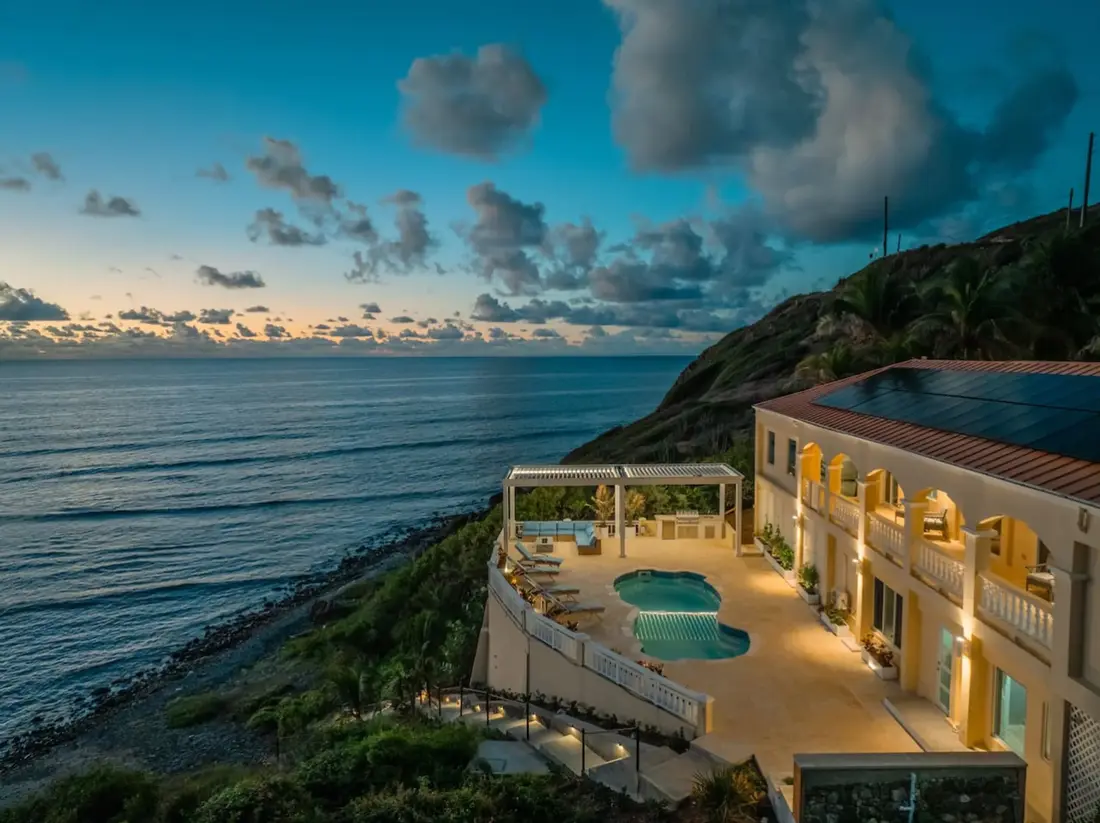
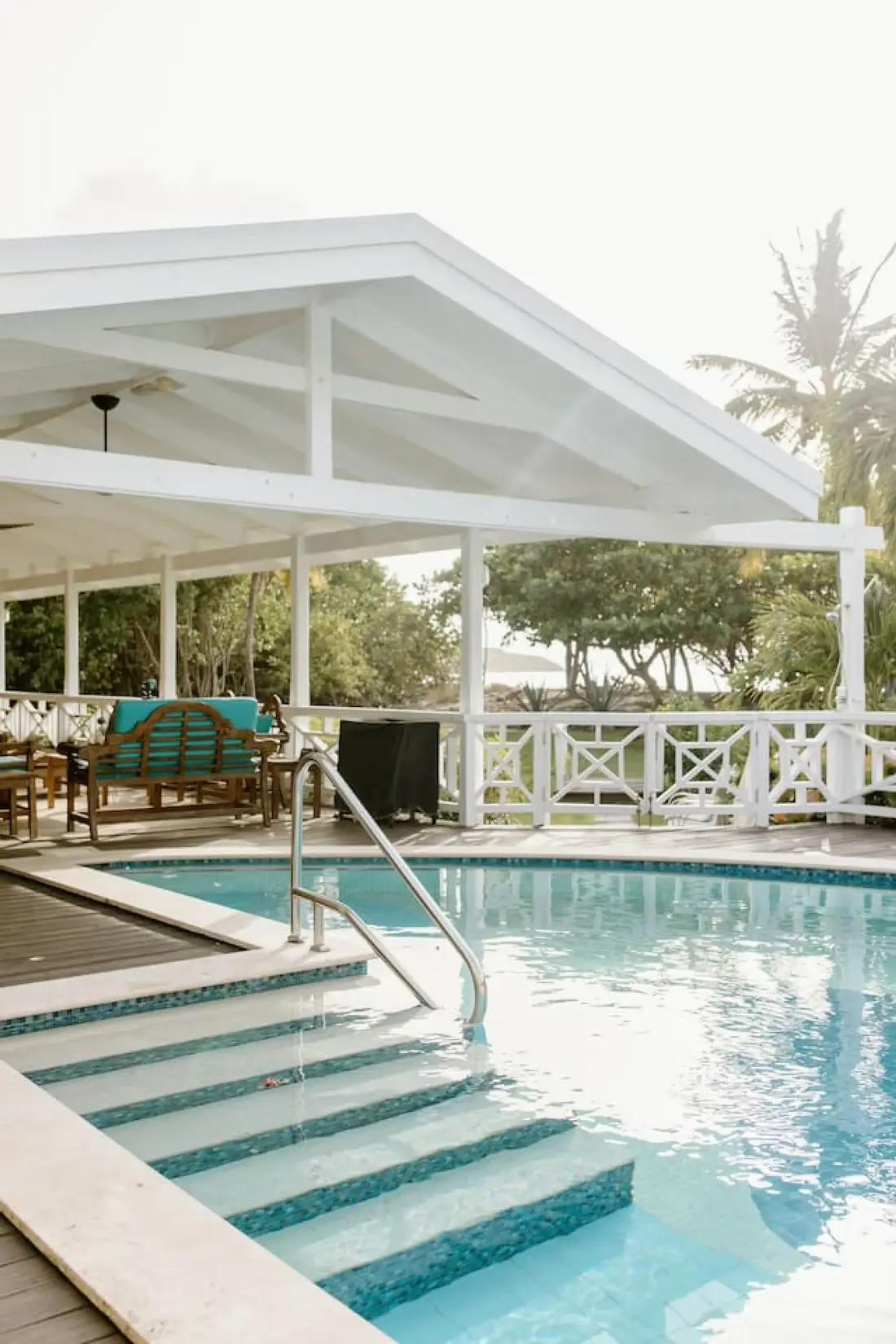
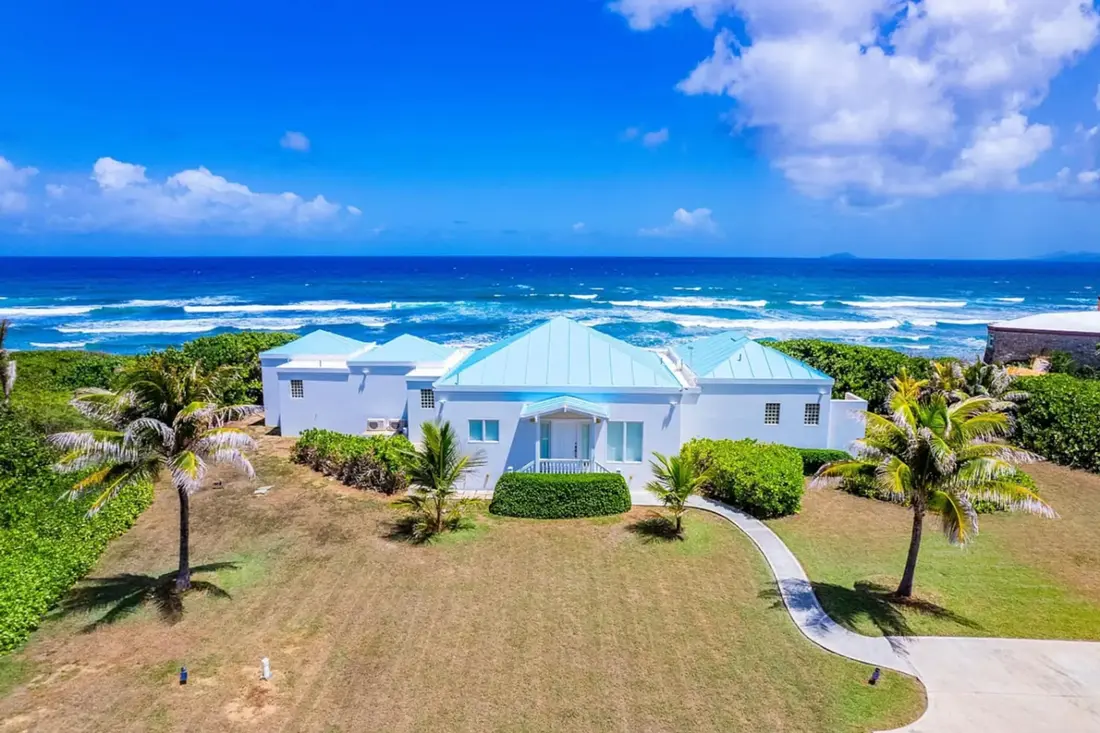
Most of our twelve homes sit around Christiansted or minutes beyond it, which means this whole day starts and ends close to your own pool. Shoy's Beach House puts you on the sand at The Shoys, five minutes east of the boardwalk. Sunset Oasis is a beachfront condo an easy hop from town. Out on the East End, The Cerulean faces Buck Island from its own private beach, about 20 minutes from dinner in town, and the rest of the East End collection keeps the same balance: quiet water at home, Christiansted's restaurants and boats within an easy drive. Every home is booked direct and locally managed, and if you want a hand matching a villa to the way you plan to use the town, ask; it is the part of the job we like best.
Sources
Written from official and first-party sources, checked August 2026. Hours, prices and event dates change — confirm before you go.