Plenty of visitors leave St. Croix wondering what it would take to stay. This post answers that at the resident level: what groceries and electricity actually cost, how cisterns and hurricane season work, what healthcare and schools look like, what transplants miss after a year, and how to test the life for a month before you commit to it.
If you have ever imagined trading traffic, long winters, and packed schedules for warm weather, sea views, and a slower pace, you have probably wondered what everyday life on St. Croix actually feels like. The short answer is that it is both practical and rewarding. The long answer is this post. Life here comes with history, daily access to the water, and a grounded rhythm that most mainland towns lost decades ago. It also comes with a power bill that will make you flinch, a water supply that falls on your own roof, and a season every year when you check your shutters and your generator fuel.
We rent villas to visitors, and a steady share of our guests are quietly interviewing the island while they swim. Some are thinking about retirement. Some can work from anywhere and are testing whether anywhere could be here. This post is written for them, and it is written straight, because the people who stay longest are the ones who arrived with accurate expectations. For the visitor-level reference, see our St. Croix page; what follows is the resident version.
The island, briefly
Of the U.S. Virgin Islands, St. Croix is the largest: 84 square miles, roughly 22 miles long and 7 wide, population 41,004 at the 2020 census. It is American soil. Residents use U.S. dollars, U.S. mail, U.S. phone networks on area code 340, and a U.S. driver's license gets you on and off the island with no passport. There are two towns, Christiansted on the northeast coast and Frederiksted on the west, with most services strung along the roads between them. The west end is wet and green, with a rainforest soaking up more than 50 inches of rain annually. The east end is dry cactus country running out to Point Udall, the most easterly ground in the United States. You drive on the left here, in ordinary American cars with the wheel on the left side, and after the first week you stop thinking about it.
Those are the brochure facts. The resident facts are different in kind: where the cheap eggs are, which day the barge comes in, what the fuel surcharge on the power bill did this quarter, and who to call when the cistern runs low in April. That is the material of this post.
What it costs, in one view
Everything sold on St. Croix arrived in a shipping container, and the freight is baked into every shelf price. That single fact drives most of the cost-of-living story. Some numbers can be pinned down; the rest move around enough that anyone quoting exact figures is guessing. Here is what we can state with sources, as of mid-2026.
| Item | Figure at last check | Notes |
|---|---|---|
| Residential electricity | Roughly 39 to 43 cents per kilowatt-hour all-in | WAPA rates; roughly triple what most mainland households pay |
| Windstorm insurance | Commonly quoted at 1.35 to 2 percent of replacement cost per year | Deductibles often 2 to 5 percent of insured value; lenders require it |
| Cistern minimum (new construction) | 10 gallons per square foot of roof, one story | 15 gallons for two or more stories; V.I. Code Title 29 |
| Good Hope Country Day School tuition | $13,850 per year, as published for 2024 | The island's largest independent PK-12 school |
| Ferry to St. Thomas | $70 one way, $120 round trip | QE IV from Gallows Bay, about 2 hours 10 minutes |
Groceries resist a clean number. Residents on the relocation forums commonly put the premium at a third to half over mainland prices, with wide swings by store and by item. Rent and home prices moved sharply after 2020 and depend heavily on location, condition, and whether the place comes with a view. Treat any single cost-of-living index for St. Croix with suspicion; the plain answer is that a careful household spends noticeably more here than in most mainland towns, and a careless one spends dramatically more.
Groceries and the barge
Grocery shopping on St. Croix is a skill you build. The main players are Plaza Extra, with a store on each end of the island, Pueblo with two locations, and Cost U Less, the warehouse-style store next to Plaza Extra East where bulk buyers save real money. Residents cross-shop without embarrassment. The same half gallon of organic milk has been spotted at three different prices at three stores in the same week, and people here can tell you which store wins on produce, which on liquor, and which on paper goods.
Two habits mark the long-term resident. First, you learn the rhythm of the supply chain. Stock arrives by barge, so a store can be flush with something on Tuesday and out of it for two weeks starting Thursday. When you see the thing you like, you buy two. Second, you loosen your grip on brand loyalty. The island will teach you that a specific brand of a specific cracker is a preference you can live without.
The counterweight is what grows and swims here. Saturday farm stands, the fish trucks, seasonal mangoes that mainland supermarkets have never met, and the whole Crucian kitchen: pate from a roadside window, johnny cakes, kallaloo, fresh wahoo and mahi. Residents who eat with the island rather than against it spend less and eat better. The annual AgriFest fair in February exists because agriculture here is a living thing, and the vendors you meet there sell year-round.
Mail-order fills the gaps. USPS treats the U.S. Virgin Islands as domestic, so Priority Mail is the workhorse of island life, and the post office box is a social institution. Many mainland retailers, though, either decline to ship here or price the USVI like a foreign country at checkout, so residents keep a mental list of who ships sanely. Next-day delivery is a mainland memory. Two weeks is normal. You adjust, and then one day you notice you no longer miss the churn of boxes.

The power bill
Ask any resident for the biggest recurring shock of island life and most will hand you a WAPA bill. The Virgin Islands Water and Power Authority charges residential rates that worked out to roughly 39 to 43 cents per kilowatt-hour at last check, once the fuel-adjustment component is included; the territory's Public Services Commission trimmed the rate in 2025 and has held the fuel surcharge flat into 2026. For comparison, most mainland households pay somewhere in the teens. Running mainland habits through that meter, with central air conditioning set to 71 and a dryer running daily, produces bills that new arrivals photograph and send home in disbelief.
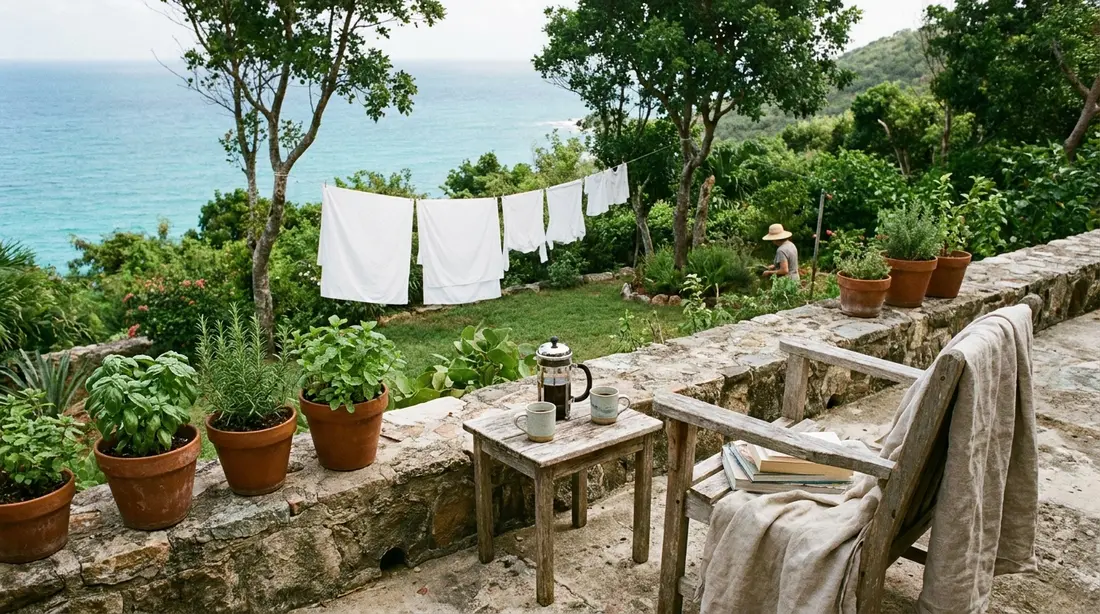
So residents run different habits. Houses here are built to breathe: cross-ventilation, ceiling fans, louvered windows aimed at the trade winds. Air conditioning becomes a bedroom-at-night tool rather than a whole-house default. Laundry dries on a line in a climate designed for it. Solar panels with battery storage went from novelty to normal in the years after the 2017 storms, and the math on them here is better than almost anywhere under the U.S. flag.
Then there are the outages. The grid on St. Croix goes down more often than any mainland grid you have lived on; sometimes for minutes, occasionally for longer, and now and then island-wide while WAPA hunts the fault. Long-term residents treat this as weather. The freezer stays reasonably full but never precious, the phone stays charged, and a generator or battery bank covers the essentials. Many households have shifted their internet to Starlink or a fixed-wireless provider precisely so that a grid problem does not also take out the workday. None of this is disqualifying. All of it is real, and the people who thrive here are the ones who budget for the bill and shrug at the blinks.
Water falls on your roof
Here is the adjustment nobody on the mainland sees coming: on St. Croix, most homes catch their own water. Virgin Islands law has required it since 1964. Under Title 29 of the V.I. Code, new dwellings without a connection to the public water system must be built with a rainwater catchment and cistern, sized at a minimum of 10 gallons of storage per square foot of roof for a single-story house and 15 gallons for two or more stories. The cistern is usually poured into the foundation, which means a Crucian house is, structurally, a tank with rooms on top. The EPA notes that the overwhelming majority of Virgin Islands households rely on roof catchment for at least part of their supply.
Living on a cistern rewires small habits. Rain stops being scenery and becomes income; residents check the gauge after a squall the way farmers do. Showers get shorter. Dishwashers run full. In a dry March you watch the level, and if the sky does not cooperate, you call a water truck and buy a delivery, which every long-term resident has done and nobody considers a crisis. Drinking is its own decision: cistern water can be treated and filtered to drink, and EPA guidance covers how, while many households simply run a filter tap or buy drinking water and use the cistern for everything else.
Visitors staying in our villas never think about any of this, because we manage it behind the scenes. Residents think about it in a low-grade, background way, roughly the amount of attention a mainland homeowner gives a furnace. It is one more system you own. It is also, once you settle into it, oddly satisfying: your household runs on rain you caught yourself.

Housing and windstorm insurance
The housing stock on St. Croix runs from historic town houses in Christiansted to concrete hillside homes with Buck Island views to condos on the water. Long-term rentals exist at every level, but the good ones move fast and many change hands through word of mouth before they are ever listed, which is one more argument for spending time on island before you commit. Buying is a normal U.S. transaction with title insurance and recorded deeds; the U.S. legal framework is one of the quiet advantages this territory holds over most of the Caribbean.
The line item that surprises buyers is windstorm insurance. This is hurricane country, and the insurance market prices it that way. Industry guides for USVI buyers commonly quote annual windstorm premiums in the range of 1.35 to 2 percent of a home's replacement cost, with deductibles running 2 to 5 percent of the insured value, and the market has been hard for years: high premiums, few carriers, little negotiating room. Territorial law does not mandate the coverage, but any lender will, so a financed purchase carries it in practice. Concrete construction, hurricane shutters, and impact glass can trim the premium and are worth every penny for their own sake.
Budget for this without flinching and the rest of the ownership picture makes sense. Plenty of residents own here happily. They simply own with their eyes open, in houses built for the weather that will eventually come, insured on the assumption that it will.
Taxes, briefly and carefully
The U.S. Virgin Islands runs a mirror tax system. The federal Internal Revenue Code applies here with "Virgin Islands" substituted for "United States," and bona fide residents file their returns with the territory's Bureau of Internal Revenue instead of the IRS, at the same rates on the same forms. There is no separate territorial income tax stacked on top, so the overall burden resembles living in a state with no state income tax. The territory also operates economic development programs that grant significant tax benefits to qualifying businesses that set up here and hire locally.
That is as far as a rental company's blog should go. Residency rules, the bona fide resident tests, and the development programs all have real teeth and real paperwork, and the mistakes are expensive. If taxes are part of your reason for considering the move, spend money on a professional who works USVI cases before you spend money on anything else.

Island time is a real adjustment
Every newcomer arrives believing they are relaxed enough for island time. The island then administers the test. The errand that takes twenty minutes on the mainland takes a morning here. The government office wants a document you did not bring, and the person ahead of you in line is catching up with the clerk, unhurried, because they went to school together. The contractor says Tuesday and means a Tuesday. Registering a car or transferring a driver's license is a same-week project, done in person, with cash or exact paperwork, and it goes fine if you bring patience and goes badly if you bring a mainland schedule.
Errands cluster, which helps. The island is set up around a few service hubs rather than endless retail corridors, with Sunny Isle mid-island covering banking, pharmacy, and general shopping in one stop. Residents learn the hubs quickly and settle into a predictable weekly rhythm. Routines here are more intentional and less convenient, and after a few months most people decide that trade runs in their favor.
There is also a courtesy layer that functions as law. You say good morning before you say anything else, in the shop, in the office, on the trail. Drivers stop mid-road to let someone out of a driveway and tap the horn as a greeting rather than a complaint; see driving on the left for the visitor version of this. Transplants who learn the manners get folded into the island with startling speed. Transplants who stay brisk and transactional stay strangers, and the island, politely, lets them.
Hurricane season is a routine, and it never fully leaves your head
The Atlantic hurricane season occupies the calendar from June 1 until November 30, and the statistical peak of activity lands in August and September. For a visitor that is a footnote on trip insurance; see our hurricane season guide for that version. For a resident it is a season of the year with its own chores, the way New England has a firewood season.
The rhythm looks like this. In late May you top up what the household would need for a couple of weeks of self-sufficiency: water, shelf food, batteries, propane, fuel for the generator, cash in small bills. You confirm the shutters all still close, because one frozen bolt in June is a problem and the same bolt in a warning cone is an emergency. Through the summer you watch the tropical outlook the way mainlanders watch a weekend forecast, with practiced calm. Most seasons, nothing comes near, and the supplies rotate into the pantry in December.
Residents who lived through 2017, when two Category 5 storms crossed the territory within two weeks, do not romanticize any of this, and neither will we. What they will tell you is that preparation works, that the community response afterward was the island at its best, and that houses and infrastructure rebuilt since are stronger than what stood before. Storm readiness here is a lifestyle line item: a generator, a plan, a season of mild vigilance every year. People fold it in the way coastal Floridians and Gulf Texans do, and life between June and November remains, on the overwhelming majority of days, ordinary warm island life. September through November is also the greenest, quietest stretch of the year, which residents consider a fair exchange.
A 41,000-person small town
St. Croix functions as a small town wearing an island's geography. You will see your dentist at the beach, your banker at the farm stand, and your plumber's cousin at the DMV, where she may quietly move your paperwork along because you coached her nephew's team. Word travels at speeds that outrun the internet. If you are used to the anonymity of a city, the first months feel exposed; every errand is a social event and your business is community property. Then it flips, and the same web that watched you is holding you up: someone you barely know drives your kid home, checks your roof after a squall, or delivers soup when word gets around that you are sick.
The community calendar is the social spine. The Crucian Christmas Festival stretches from the end of December into the first days of January, closing with the children's and adults' parades through Frederiksted. AgriFest fills Estate Lower Love with food and livestock over three days in mid-February. Mardi Croix brings a beach parade to Cane Bay, Jump Up turns downtown Christiansted into an evening street party several times a year, and mocko jumbies on stilts preside over all of it. Residents do not attend these as spectators; they staff booths, march, cook, and judge.
For transplants, the fastest route in is to volunteer. The St. Croix Environmental Association, the St. Croix Hiking Association, the animal shelter, the turtle-nesting patrols at Sandy Point in season: all run on volunteers and all absorb newcomers gratefully. Six months of showing up will root you deeper here than six years of keeping to yourself. The island is small, everyone does know everyone, and whether that sounds like a warning or a promise tells you a lot about how you will do here.
Healthcare requires a plan
This is the section to read twice, because it is the one that most often decides the question for retirees. St. Croix has a hospital, the Governor Juan F. Luis Hospital and Medical Center outside Christiansted, with an emergency room and core services, plus primary-care physicians, dentists, physical therapy, and a network of clinics that handle the routine business of staying healthy. Day-to-day medicine here works.
Specialty care is where the planning starts. For advanced cardiology, oncology, complex surgery, and most subspecialties, residents fly, typically to Puerto Rico or the mainland, and island health insurance plans are structured around that reality. Families here treat the possibility of a medical flight the way mainland families treat a deductible: a known cost you arrange in advance. Many carry medevac or air-ambulance coverage, which is inexpensive relative to what it insures. If you or a family member manages a serious chronic condition, talk to your specialists about it before you commit to the move, and build the travel into your plan rather than discovering it in a hard week.
The trend line, for once, points up. After years of post-2017 operations in temporary and hardened facilities, the territory signed the contract in March 2026 to demolish and rebuild the Juan F. Luis hospital, a project estimated in the hundreds of millions with construction expected to run about five years. Residents are watching it with the wary optimism the territory applies to all large projects. In the meantime the practical mindset applies: know where routine care lives, know which services involve a referral or a flight, and give anything medical more lead time than you would at home.
Schools, for families doing the math
Families have three lanes. The public system, run by the Virgin Islands Department of Education, operates elementary through high schools across the island; like small public systems everywhere, individual schools vary, and local parents are the best source on which ones are strong right now. The private lane is anchored by Good Hope Country Day School in Kingshill, an independent college-preparatory school serving prekindergarten through 12th grade, formed in 2013 by the merger of two long-running island schools; published tuition was $13,850 for 2024, modest by mainland private-school standards. Smaller options include AZ Academy, St. Croix Montessori, and a handful of faith-based and specialty schools on the education department's non-public roster. Homeschooling is legal, registered through the territory, and more common here than the mainland average.
For higher education, the University of the Virgin Islands maintains its Albert A. Sheen campus on St. Croix, which also gives the island a steady stream of lectures, athletics, and community programs. The plain calculus for parents: class sizes tend to be small, kids grow up swimming and sailing and knowing every adult in their orbit, and the trade is a shorter menu of electives, club sports, and academic tracks than a big suburban district offers. Families who stay tend to value the first list more than they miss the second.
Getting on and off the island
An island address is only as workable as its airport, and this is where St. Croix quietly outperforms its size. Henry E. Rohlsen Airport has nonstop mainland service on American from Miami year-round and Charlotte seasonally moving to daily in winter, Delta from Atlanta stepping up to near-daily in winter, a winter Saturday Chicago flight, and, new for late 2026, United from Newark, the first New York-area nonstop in more than 30 years. San Juan connections on Cape Air and others fill the gaps, and the schedule thickens every winter. See getting here and the flight guide for the current map.
For residents this is the difference between island living and disconnected living. Mainland family, business trips, medical appointments, a wedding on a Saturday: all of it is a same-day flight, and for many transplants that fact is what made the move thinkable at all. Remote workers in particular should note the eastern time zone alignment in winter (the territory stays on Atlantic time year-round, one hour ahead of eastern standard, even with eastern daylight) and the improving bandwidth picture on the ground.
Inter-island travel is its own small pleasure. Cape Air and Fly The Whale hop to St. Thomas in about 25 minutes, the Seaborne seaplane lifts out of Christiansted Harbor itself, and the QE IV ferry makes the crossing from Gallows Bay in about two hours ten minutes for $70 one way at last check. Residents use these for errands, court dates, concerts, and the occasional St. John beach day; see the day-trip guide for how it works.
What transplants miss, and what they never miss
Ask people who have lived here five years and the miss list is consistent. They miss retail depth: the specific store with the specific thing, same-day delivery, a mall's worth of choice. They miss the casual availability of specialists, from cardiologists to appliance repair techs for obscure brands. They miss cheap electricity every single month. Some miss anonymity, the mainland luxury of running an errand without a conversation. Many miss people most of all; being a flight away from aging parents and growing grandchildren is the heaviest recurring cost of the move, and the one worth the most thought before you make it.
The never-miss list is shorter and heavier. Winter. Commutes. Traffic that means traffic, rather than three cars behind a man selling coconuts. The scheduling arms race of mainland life, where every hour is spoken for two weeks out. The strange mainland condition of living forty minutes from open water and seeing it twice a year. On St. Croix the sea is present in an ordinary week the way a park is present in a city neighborhood: the after-work swim, the Sunday beach, the boat day that costs a tank of gas. Nobody moves back for the weather.
The pattern in who stays is not subtle. People who arrive expecting a permanent vacation leave within two years, usually annoyed at the DMV. People who arrive expecting a small American town with Danish architecture, a barge schedule, and a reef off the porch tend to still be here a decade later, and they are the ones saying good morning to you at the farm stand.
The resident's year
One way to feel the shape of life here is to walk the calendar the way a resident does.
| When | What island life is doing |
|---|---|
| January | Festival parades in Frederiksted close the Crucian Christmas Festival; Christmas Winds keep everything breezy; peak visitor season |
| February | AgriFest at Estate Lower Love; Mardi Croix beach parade at Cane Bay; the driest, coolest stretch begins |
| March and April | Driest months; cistern-watching weather; visitor season winds down after Easter |
| May | First green-up rains; hurricane supplies topped up before June 1 |
| June and July | Season officially open but typically quiet; mangoes; Emancipation Day on July 3 |
| August and September | The active storm window; forecast-watching as a background habit |
| October and November | Greenest, quietest months; locals get the beaches back |
| December | Christmas Winds return; Festival season opens; the island fills again |
Annual events shift dates year to year, so residents live by the official calendars, and you should check them for any given year. The larger point is the shape: a year measured in winds, rains, festivals, and one season of vigilance, rather than in quarters and semesters.
Try a month before you commit
Here is the advice we give every guest who asks about moving, and we give it knowing it sounds self-serving from a villa company: do not buy anything until you have lived here for at least a month, and do it in more than one season if you can. A vacation cannot answer the questions that matter. A month can. A month is long enough to cook from island groceries instead of eating out, to sit through a power blink and see how you take it, to make the Sunny Isle run on a Saturday with everyone else, to feel a week of September heat or a week of Christmas Winds, and to find out where the island's rhythm chafes against yours.
A villa is the right instrument for the test precisely because it is a house. You get the kitchen, the laundry, the cistern-fed plumbing, the trade-wind ventilation, the drive to town, the whole domestic mechanism of Crucian life, with someone else responsible when a system hiccups. Rent a car for the duration, since that is what residency requires anyway; our car guide covers the companies. Spend the month doing errands, going to whatever is on the community calendar, and talking to every transplant who will hold still. Ask them what they wish they had known. They will tell you at length, and most of it will match this post.
Work the test seriously and you will leave with one of two valuable answers. Either the island fit, and you can start the housing search already knowing which end of the island is yours, or it chafed, and a month of villa rent bought you out of a six-figure mistake. We have watched guests reach both answers, and both left grateful. Booking a longer stay directly with us also costs less than the platforms; see book direct for how that works.
Questions guests ask
Do Virgin Islands residents pay federal income tax?
The territory mirrors the federal tax code. Bona fide USVI residents file with the territory's Bureau of Internal Revenue instead of the IRS, at the same rates and on the same forms, with no extra territorial income tax stacked on top; the overall effect resembles a no-income-tax state. The residency rules have real teeth, so anyone planning a move with taxes in mind should hire a professional who handles USVI cases before doing anything else.
How much does electricity cost on St. Croix?
At last check, WAPA residential rates worked out to roughly 39 to 43 cents per kilowatt-hour once the fuel-adjustment component is included, which is roughly triple what most mainland households pay. Residents manage it with trade-wind ventilation, fans over air conditioning, line drying, and increasingly with solar panels and batteries, which pay back faster here than almost anywhere in the country.
Can you drink cistern water?
Most St. Croix homes catch rainwater on the roof and store it in a cistern, as territorial law has required for new construction since 1964. Cistern water can be filtered and disinfected to drinking standard, and EPA guidance for Virgin Islands cisterns covers how; in practice many households run a filter tap or buy drinking water and use the cistern for everything else. Villas handle all of this behind the scenes, so guests never think about it.
Does St. Croix have Uber or Lyft?
No rideshare operates on St. Croix. Residents drive their own cars, and visitors rent one; taxis and the VITRAN bus system cover the rest. Driving happens on the left side here, in normal American cars, which sounds harder than it is. For a month-long trial stay, plan on a rental car for the full stretch, since daily life here assumes one. See getting around.
Do you need a passport to move to St. Croix?
No. Because the island is U.S. territory, the move for U.S. citizens is legally about as complicated as moving to another state: no passport, no visa, no immigration process, same currency, same postal service. You will transfer your driver's license and register your car with the territory after you arrive, both in-person errands that reward patience.
What is the hospital situation on St. Croix?
The Governor Juan F. Luis Hospital and Medical Center handles emergency and core care, and the island has primary-care doctors, dentists, and clinics for routine medicine. Advanced specialty care generally means a flight to Puerto Rico or the mainland, and many residents carry air-ambulance coverage. A full rebuild of the hospital was contracted in March 2026, with construction expected to take about five years.
How do mail and packages work?
USPS treats the U.S. Virgin Islands as domestic, so regular mail and Priority Mail work the way they do on the mainland, and the post office box is a fixture of island life. Many online retailers ship here without fuss; many others decline or charge international rates, so residents learn which is which. Deliveries take longer than mainland habits expect, and islanders plan accordingly.
Where to stay while you decide
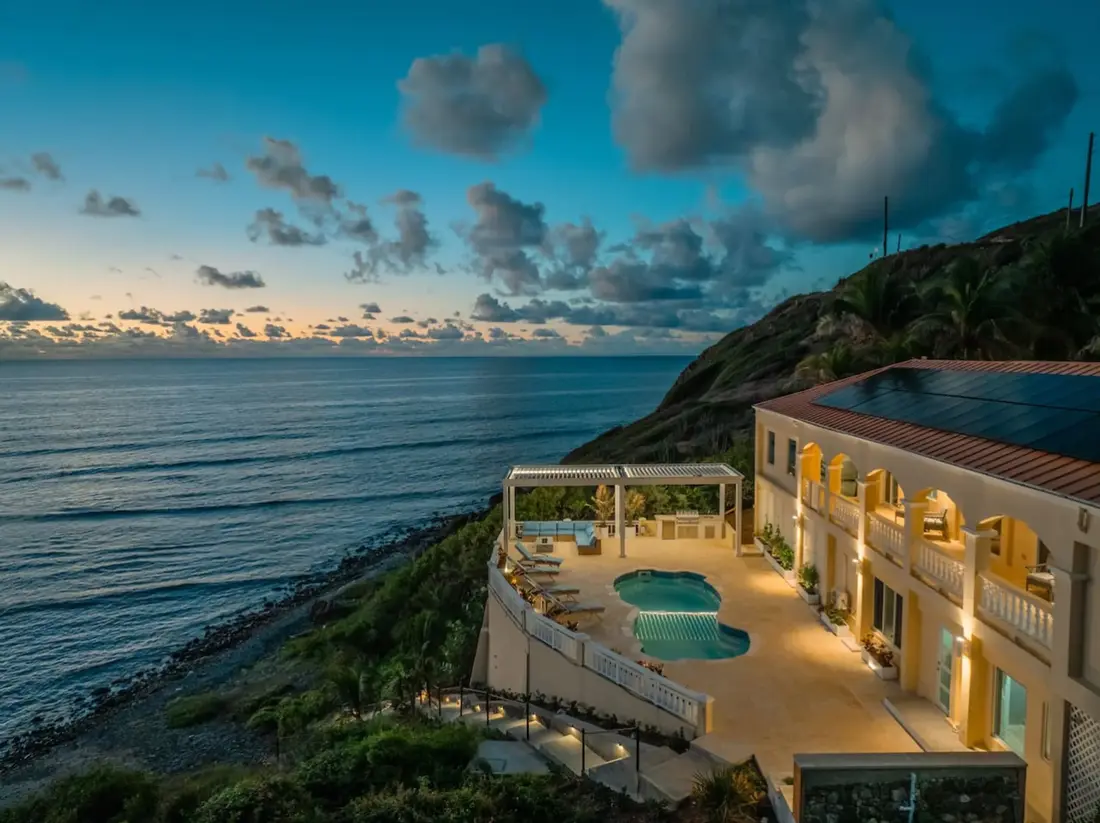
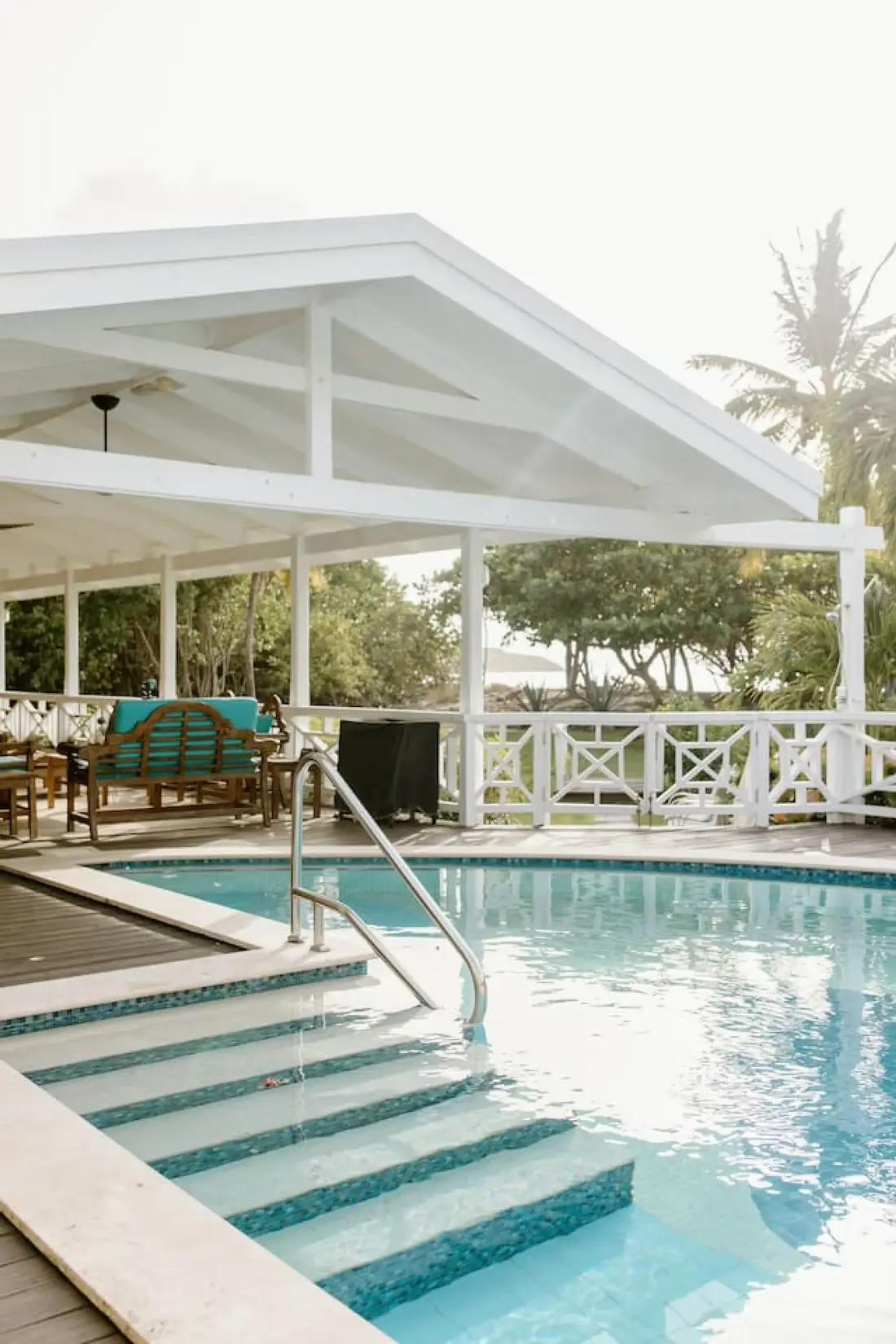
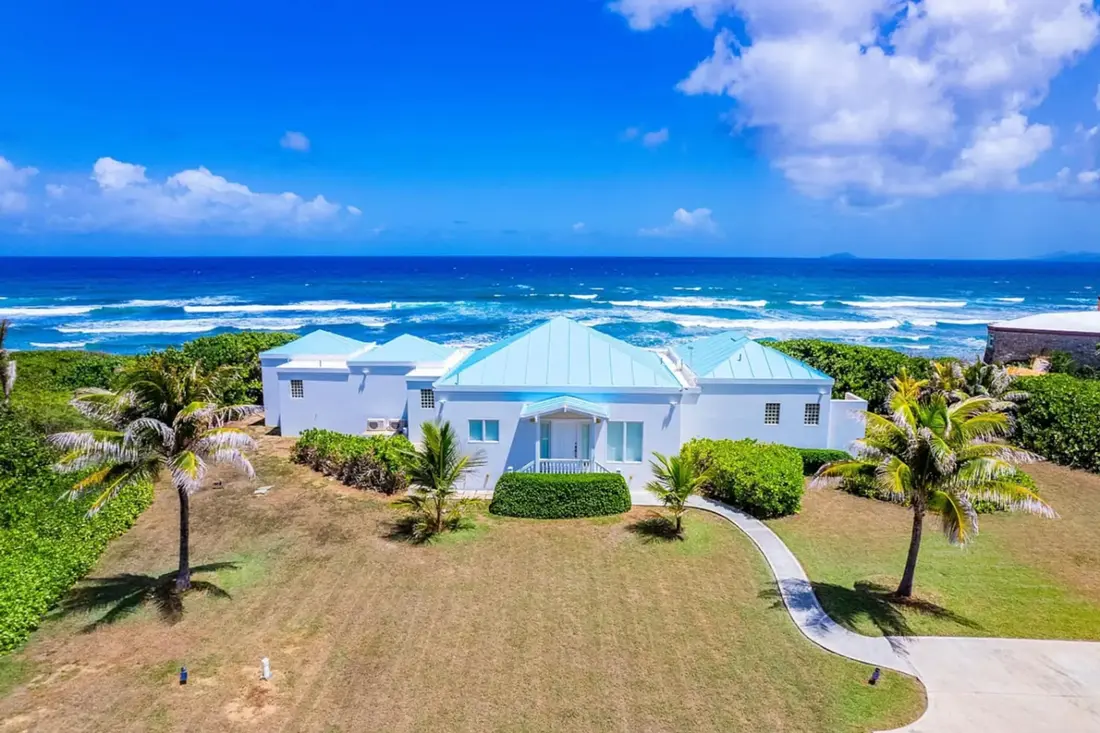
If you are ready to run the one-month test, or even a two-week rehearsal, stay in the kind of home you are imagining for yourself. Our villas and condos cover the island's main answers to the where-would-I-live question: the East End, where The Cerulean sits above its own beach facing Buck Island, and our East End collection shows what that dry, quiet side of the island feels like; the Christiansted side, where Shoy's Beach House puts a household of five bedrooms directly on The Shoys beach; and the west end, where Sunset Sea-Clusion faces the Frederiksted sunsets that close every island day. Smaller households testing condo life can look at Caribbean Blue Hideaway. Every home is locally managed by people who live here, which means your questions about WAPA bills, cisterns, and contractors get answered from experience. Come cook, drive, shop, and say good morning for a month. The island will tell you the rest.
Sources
Written from official and first-party sources, checked August 2026. Hours, prices and event dates change — confirm before you go.